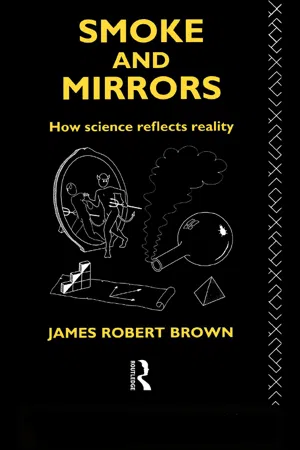
Realism is an enlightening story, a tale which enriches our experience and makes it more intelligible. Yet this wonderful picture of humanity's best efforts at knowledge has been badly bruised by numerous critics. James Robert Brown in Smoke and Mirrors fights back against figures such as Richard Rorty, Bruno Latour, Michael Ruse and Hilary Putnam who have attacked realist accounts of science.
But this volume is not wholly devoted to combating Rorty and others who blow smoke in our eyes; the second half is concerned with arguing that there are some amazing ways in which science mirrors the world. The role of abstraction, abstract objects and a priori ways of getting at reality are all explored in showing how science reflects reality.
Smoke and Mirrors is a defence of science and knowledge in general as well as a defence of a particular way of understanding science. It is of interest to all those who wish or need to know how science works.
- 216 pages
- English
- ePUB (mobile friendly)
- Available on iOS & Android
eBook - ePub
About this book
Information
Part I
INTRODUCTION
The first chapter is a defence of realism. It employs a kind of ‘realism is the best explanation of the success of science’ argument, but it is quite different from other versions in that the explanation is narrative—a style of explanation often used in biology and in history. The conclusion of the argument—full-blooded scientific and metaphysical realism—is strong, though the argument for it is not. (Of course, it would be better to have a strong argument for a weak conclusion, but why not take a chance?) Normally, ‘success of science’ arguments model the explanation on deductive or inductive forms. Critics then ask embarrassing questions about novel predictions and the like, knowing full well there are no answers to be had. Instead, I see realism as an enlightening story, a tale which enriches our experience and makes it more intelligible. But it is not just another tall tale; I’m not embracing anti-realism at some metalevel. Instead, just as biological and historical accounts of past events explain by telling a story in which the explained events are embedded, realism provides a general framework for understanding how things work. For that reason, it is quite believable and should be thought true.
1
EXPLAINING THE SUCCESS
OF SCIENCE
Richard Rorty’s Philosophy and the Mirror of Nature (1979) has done much to undermine a particular view of scientific knowledge and intellectual progress. More recently, he has pooh-poohed the very idea of ‘explaining the success of science’, and with it he has dismissed one of the stronger arguments for scientific realism. (The argument runs: our theories are successful and truth is the best explanation for this success; therefore, our theories are probably true.) ‘[W]e do not itch,’ says Rorty, ‘for an explanation of the success of recent Western science any more than for the success of recent Western polities’ (1987, 41). Written just before the collapse of the Berlin Wall, the dissolution of the Warsaw Pact, the breakup of the Soviet Union and the crushing of Iraq in the Gulf War, it is hard to imagine a less plausible sentiment.
Not only are we at present swamped with (usually silly and smug) analyses of ‘why the West won’, but if events should turn sour (as they often seem in danger of doing) we will be awash with explanations of the ‘failure’ of Western policies. And our concern is quite fitting. Knowing why particular political strategies worked (or failed) is of obvious vital interest. The same can be said for science. I’m happy to join Rorty in lumping science and politics together, but let’s try to explain the successes (or failures) of both, rather than turn our backs on them.
Karl Popper has a completely different motivation, but he too has steadfastly held that the success of science is not to be explained—it’s a miracle. ‘[N]o theory of knowledge’, he says, ‘should attempt to explain why we are successful in our attempts to explain things’ (1972, 23). And even though ‘science has been miraculously successful,’ as he puts it, ‘[t]his strange fact cannot be explained’ (ibid., 204). Consistency with his other views requires him, no doubt, to disavow any presupposition that a scientific theory is likely to be true. Yet explanations of the success of science often make that very assumption: a theory’s success is explained by assuming that the theory is true. Hence Popper’s quandary. But throwing up our hands in despair or embracing miracles seem neither the heroic nor the reasonable thing to do. I have nothing heroic to offer by way of accounting for the success of science either, but I shall try a moderately reasonable stab at it.
Before proceeding further, something should be said about the term ‘success’. There are several ways in which science is an overachiever. Its technological accomplishments are undeniable: it is very handy for building bridges and curing diseases. It is also a glorious entertainer: many of us would rather curl up in bed with a good piece of popular physics than with any novel. And science has also been a great success at extracting tax dollars from us all. (I do not say that cynically; I would gladly pay more.)
By calling science successful I do not mean that everything that is called science is successful, only that many current theories are. And by calling these theories successful I chiefly mean that:
- they are able to organize and unify a great variety of known phenomena;
- this ability to systematize the empirical data is more extensive now than it was for previous theories; and
- a statistically significant number of novel predictions pan out, i.e. our theories get more predictions right than mere guessing would allow.
This, I think, is roughly what is involved in the normal use of the phrase ‘the success of science’, and I simply follow tradition here. At any rate these are the senses of success that I shall be dealing with. Even though they are common ingredients, they are not, however, always clearly distinguished by writers on this topic.
MIRACLES, DARWIN AND ‘THE TRUTH’
The thing to be explained is the success of science, and the way realists often explain this fact is by claiming that theories are true, or at least approximately true, and that any conclusion deduced from true premisses must itself be true. So the assumption that theories are (approximately) true explains the success of those theories. Realism, as Hilary Putnam (1975a) puts it, is the only explanation which does not make the success of science a miracle. J.J.C.Smart states the case this way:
If the phenomenalist about theoretical entities is correct, we must believe in a cosmic coincidence. That is, if this is so, statements about electrons, etc., are of only instrumental value: they simply enable us to predict phenomena on the level of galvanometers and cloud chambers. They do nothing to remove the surprising character of these phenomena…. Is it not odd that the phenomena of the world should be such as to make a purely instrumental theory true? On the other hand, if we interpret a theory in a realist way, then we have no need for such a cosmic coincidence: it is not surprising that galvanometers and cloud chambers behave in the sort of way they do, for if there really are electrons, etc., this is just what we should expect. A lot of surprising facts no longer seem surprising.
(1968, 39)
We can reconstruct the argument in this passage in a way that makes it seem quite reasonable and convincing.
- Conclusion O (an observation statement) can be deduced from theory T.
- O is seen to be the case.
- If T is true then the argument for O is sound and so O had to be true.
- If T is false then the argument for O is merely valid and the probability of the arbitrary consequence O being true is very small (i.e. it would be a miracle if O were true).
- Therefore the argument for O is probably sound.
- Therefore T is probably true. (That is, even T’s theoretical statements are probably true.)
This argument uses the realist’s explanation of the success of science to draw ontological morals. Let us contrast it with a rival ‘Darwinian’ view of the anti-realist Bas van Fraassen, perhaps the most influential of recent anti-realists, who gives such an account of the success of science in The Scientific Image.1 The explanation goes something like this: just as there are a great many species struggling for existence, so too have a great many theories been proposed. But just as species which are not adapted to their environment become extinct, so too are theories which do not make true observational predictions dropped. The belief that our theories might be true, or even approximately true, is therefore an illusion. It is similar to the illusion that Darwin undermined, that species are evolving toward some goal. van Fraassen writes:
I can best make the point by contrasting two accounts of the mouse who runs from its enemy, the cat. St. Augustine …provided an intensional explanation: the mouse perceives that the cat is its enemy, hence the mouse runs. What is postulated here is the ‘adequacy’ of the mouse’s thought to the order of nature: the relation of enmity is correctly reflected in his mind.
But the Darwinist says: Do not ask why the mouse runs from its enemy. Species which did not cope with their natural enemies no longer exist. That is why there are only ones who do.
But the Darwinist says: Do not ask why the mouse runs from its enemy. Species which did not cope with their natural enemies no longer exist. That is why there are only ones who do.
And so, he continues:
In just the same way, I claim that the success of current scientific theories is no miracle. It is not even surprising to the scientific (Darwinist) mind. For any scientific theory is born into a life of fierce competition, a jungle red in tooth and claw. Only the successful theories survive—the ones which in fact latched on to actual regularities in nature.
(1980, 39f)
‘Truth’ plays no role at all in the success of science for the Darwinian anti-realist. Yet for the realist it is the central explanatory factor. So here we have two main contenders, but could either of these explanations of the success of science be right?
THE DARWINIAN ANSWER
I characterized the success of science as having three ingredients. Van Fraassen’s Darwinian explanation seems to account for two of these features, but not the third. He has an apparently adequate answer to the questions why theories get so much right and why newer theories get more right than the ones we have tossed out. The simple answer is that we have tossed out any theory which did not organize, unify and generally get a lot right; and we have tossed out theories which have done less well, comparatively, than others.
However, the third question is still unanswered. Why do our theories make correct predictions more often than one could expect on the basis of mere chance? Here the Darwinian analogy breaks down since most species could not survive a radical change of environment, the analogue of a novel prediction.
There is also a more general problem with van Fraassen’s Darwinian approach. It is a problem which stems from the empiricism of anti-realists. An implicit assumption is that rational choice and success go hand in hand. On this assumption it is not surprising that science is successful in the senses (1) and (2) given on page 4, since we choose theories, says the empiricist, on that very basis. This, I think, is not so. Success, as characterized by a van Fraassen-type anti-realist, is a totally empirical notion. But in reality theories are rationally evaluated on the basis of several other considerations besides empirical factors. I do not wish to argue here for any in particular, but let us suppose that conceptual, metaphysical and aesthetic concerns play a role in actual theory choice, (van Fraassen calls these ‘pragmatics’ and allows that they play a role.) Consequently, it is not a trivial analytic truth that the rational thing to believe is also the most successful (as success was characterized above). Anyone who is not an extreme empiricist must concede that it is quite possible that the most rationally acceptable theory is not the most successful theory.
So even the Darwinian answers to (1) and (2) which above I tentatively conceded to be adequate are, in fact, not adequate after all. And (3), of course, remains entirely unexplained. The Darwinian account, linked to an empiricist methodology, yields a plausible account of two of the three aspects of success, but unlinked from this untenable methodology it accounts for nothing.
REALISM AND REFERENCE
A belief common to scientific realists is that the succession of theories is getting closer to the truth. This belief may well be true (I hope it is), but it is often tied to a doctrine that says that the central terms of one theory refer to the same things as the central terms of its successor and predecessor theories. Moreover, the intuitive idea of getting-closer-to-the-truth will itself need fleshing out in the form of an explicit doctrine of verisimilitude. Unfortunately, there are terrible problems with both of these. Beliefs about the constancy of reference run afoul of the history of science, and the concept of verisimilitude is plagued with technical problems. Even a cursory glance at the past suggests that there is no royal road to the truth such as that implied by the convergence picture, and every explication of verisimilitude so far proposed has been a crashing failure. Let’s look at things now in some detail. In the most quoted version of the realist’s explanation of the success of science, Putnam writes:
The positive argument for realism is that it is the only philosophy that doesn’t make the success of science a miracle. That terms in mature theories typically refer (this formulation is due to Richard Boyd), that the theories accepted in a mature science are typically approximately true, that the same term can refer to the same thing even when it occurs in different theories—these statements are viewed by the scientific realist not as necessary truths but as part of the only scientific explanation of the success of science, and hence as part of any adequate scientific description of science and its relations to its objects.
(1975a, 73)
In the next section I shall examine the idea that mature theories are ‘typically approximately true’ by looking at Newton-Smith’s views, since they are much more developed than Putnam’s. This section will be devoted solely to examining the claim that ‘terms in mature theories typically refer’. Let us begin by looking at a very simple theory:
Alasdair loves Hegel.
For the sake of the argument, let us suppose that it is quite a successful theory (there were reports of his buying several works by Hegel, waxing eloquent about Hegel’s logic, hanging a picture of Hegel on his office wall etc.) and that all the terms in this simple theory refer. But is the fact that all the terms refer sufficient to explain why the theory is successful? The simplest consideration completely undermines this supposition. The following theory, we may suppose, is very unsu...
Table of contents
- COVER PAGE
- TITLE PAGE
- COPYRIGHT PAGE
- DEDICATION
- PREFACE
- ACKNOWLEDGEMENTS
- PART I: INTRODUCTION
- PART II: SMOKE
- PART III: MIRRORS
- AFTERWORD
- NOTES
- BIBLIOGRAPHY
Trusted by 375,005 students
Access to over 1.5 million titles for a fair monthly price.
Study more efficiently using our study tools.
Frequently asked questions
Yes, you can cancel anytime from the Subscription tab in your account settings on the Perlego website. Your subscription will stay active until the end of your current billing period. Learn how to cancel your subscription
No, books cannot be downloaded as external files, such as PDFs, for use outside of Perlego. However, you can download books within the Perlego app for offline reading on mobile or tablet. Learn how to download books offline
Perlego offers two plans: Essential and Complete
- Essential is ideal for learners and professionals who enjoy exploring a wide range of subjects. Access the Essential Library with 800,000+ trusted titles and best-sellers across business, personal growth, and the humanities. Includes unlimited reading time and Standard Read Aloud voice.
- Complete: Perfect for advanced learners and researchers needing full, unrestricted access. Unlock 1.5M+ books across hundreds of subjects, including academic and specialized titles. The Complete Plan also includes advanced features like Premium Read Aloud and Research Assistant.
We are an online textbook subscription service, where you can get access to an entire online library for less than the price of a single book per month. With over 1.5 million books across 990+ topics, we’ve got you covered! Learn about our mission
Look out for the read-aloud symbol on your next book to see if you can listen to it. The read-aloud tool reads text aloud for you, highlighting the text as it is being read. You can pause it, speed it up and slow it down. Learn more about Read Aloud
Yes! You can use the Perlego app on both iOS and Android devices to read anytime, anywhere — even offline. Perfect for commutes or when you’re on the go.
Please note we cannot support devices running on iOS 13 and Android 7 or earlier. Learn more about using the app
Please note we cannot support devices running on iOS 13 and Android 7 or earlier. Learn more about using the app
Yes, you can access Smoke and Mirrors by James Robert Brown in PDF and/or ePUB format, as well as other popular books in Philosophy & Epistemology in Philosophy. We have over 1.5 million books available in our catalogue for you to explore.