- 152 pages
- English
- ePUB (mobile friendly)
- Available on iOS & Android
eBook - ePub
Responsive Environments
About this book
Clearly demonstrates the specific characteristics that make for comprehensible, friendly and controllable places; 'Responsive Environments' - as opposed to the alienating environments often imposed today. By means of sketches and diagrams, it shows how they may be designed in to places or buildings.
This is a practical book about architecture and urban design. It is most concerned with the areas of design which most frequently go wrong and impresses the idea that ideals alone are not enough. Ideals must be linked through appropriate design ideas to the fabric of the built environemnt itself. This book is a practical attempt to show how this can be done.
Information
Chapter 1:
Permeability
Introduction
Only places which are accessible to people can offer them choice. The extent to which an environment allows people a choice of access through it, from place to place, is therefore a key measure of its responsiveness. We have called this quality permeability.
Permeability: public and private
If everywhere were accessible to everybody, physically or visually, there would be no privacy. But one of our basic sources of choice stems from our ability to live both public and private roles. For this capacity to flourish, both public places and private ones are necessary.

Of course, public and private places cannot work independently. They are complementary, and people need access across the interface between them. Indeed, this interplay between public and private gives people another major source of richness and choice.
Public and private spaces, and the interfaces between them, each have different implications for permeability.
Permeability and public space.
The permeability of any system of public space depends on the number of alternative routes it offers from one point to another. But these alternatives must be visible, otherwise only people who already know the area can take advantage of them. So visual permeability is also important.
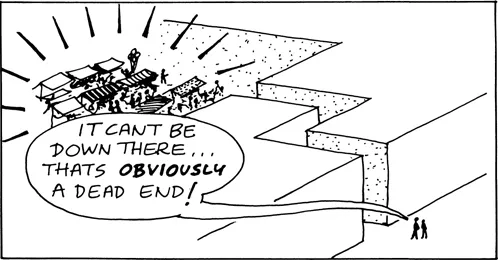
Both physical and visual permeability depend on how the network of public space divides the environment into blocks: areas of land entirely surrounded by public routes. These can vary radically in size and shape, as illustrated below:
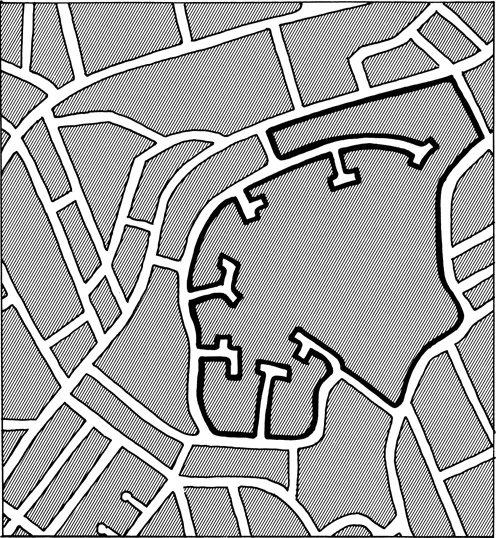
The advantages of small blocks
A place with small blocks gives more choice of routes than one with large blocks. In the example below, the large-block layout offers only three alternative routes, without backtracking, between A and B. The version with small blocks has nine alternatives, with a slightly shorter length of public route.
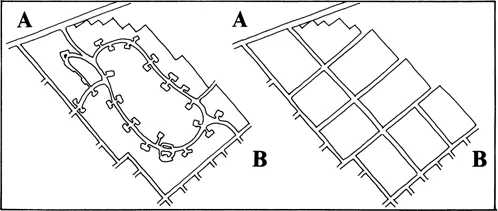
Smaller blocks, therefore, give more physical permeability for a given investment in public space. They also increase visual permeability, improving people’s awareness of the choice available: the smaller the block, the easier it is to see from one junction to the next in all directions.
The decline of public permeability
Three current design trends work against permeable public space:
- increasing scale of development.
- use of hierarchical layouts.
- pedestrian/vehicle segregation.
Scale of development
Unnecessarily monolithic developments, which could function equally well if divided into smaller elements, produce excessively large blocks.
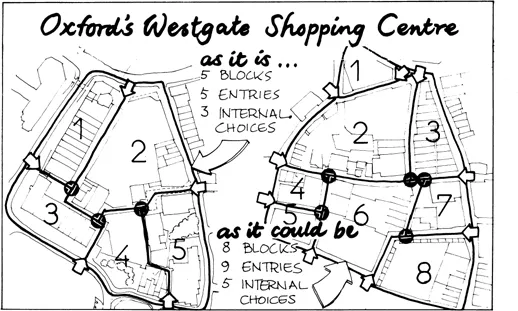
Hierarchical layouts
Hierarchical layouts reduce permeability: in the example below there is only one way from A to D, and you have to go along B and C: never A-D directly, or ADCABCD, but always ABCD. Hierarchical layouts generate a world of culs-de-sac, dead ends and little choice of routes.
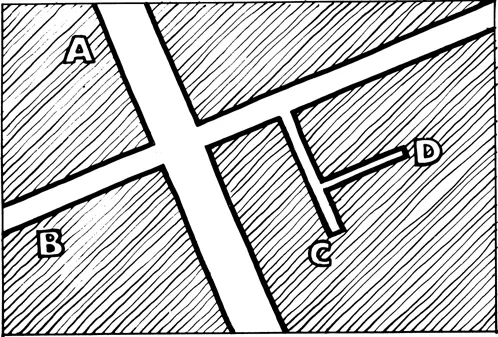
This is not to say that culs-de-sac are always negative: they support responsiveness if they offer a choice which would otherwise be missing. But they must be added to a permeable layout, not substituted for it.
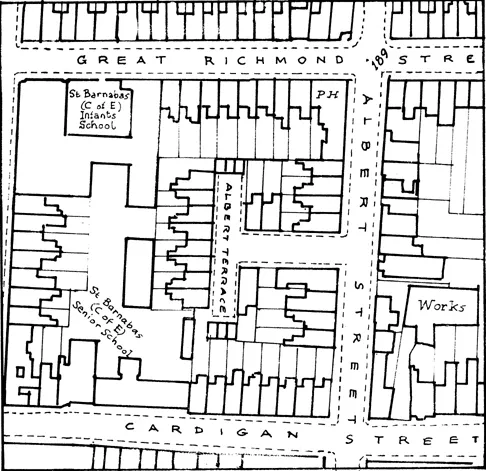
Segregation
Permeability is effectively reduced by segregating the users of public space into different categories, such as vehicle users and pedestrians, and confining each to a separate system of routes. When this happens, the only way to give both categories a level of permeability equivalent to a de- segregated system is through an expensive duplication of routes.
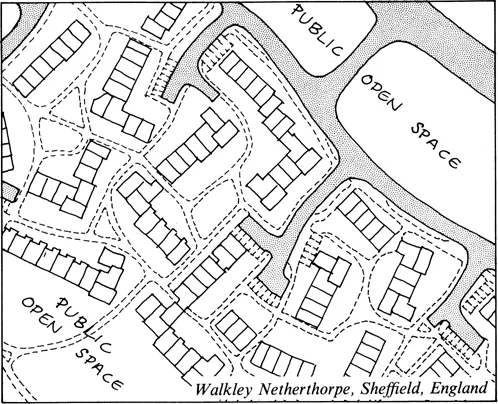
Avoid built-in segregation.
Chapter 4 will show other ways of helping motorists and pedestrians to live together. And in any case, it is never necessary to build segregation irrevocably into a layout early in design. If we initially make a high level of permeability for everyone, then segregation can be achieved later, if necessary, by detailed design or management. This gives future users control over how they want to use the place, because they can de-segregate if circumstances change.
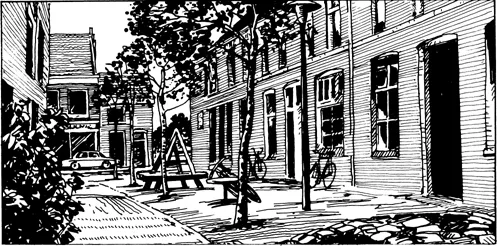
Permeability and the public/private interface
Since physical access to private space is necessarily limited, permeability across the public/private interface is largely a visual concern. This has different implications for public and private space.
The interface: visual permeability
Visual permeability between public and private space can also enrich the public domain. If wrongly used, however, it can confuse the vital distinction between public and private altogether.
This is because not all the activities in private space are equally private: there is a gradation, for example, from entrance hall to lavatory. To maintain the public/private distinction, the most private activities must be kept from visual contact with public space.
The interface: physical permeability
Physical permeability between public and private space occurs at entrances to bu...
Table of contents
- Cover
- Halftitle
- Title
- Copyright
- Contents
- Acknowledgements
- I. Introduction
- 1. Permeability
- 2. Variety
- 3. Legibility
- 4. Robustness
- 5. Visual appropriateness
- 6. Richness
- 7. Personalisation
- 8. Putting it all together
- Notes
- Suggestions for further reading
- Bibliography
- Illustration credits
- Index
- Books of related interest
Trusted by 375,005 students
Access to over 1.5 million titles for a fair monthly price.
Study more efficiently using our study tools.
Frequently asked questions
Yes, you can cancel anytime from the Subscription tab in your account settings on the Perlego website. Your subscription will stay active until the end of your current billing period. Learn how to cancel your subscription
No, books cannot be downloaded as external files, such as PDFs, for use outside of Perlego. However, you can download books within the Perlego app for offline reading on mobile or tablet. Learn how to download books offline
Perlego offers two plans: Essential and Complete
- Essential is ideal for learners and professionals who enjoy exploring a wide range of subjects. Access the Essential Library with 800,000+ trusted titles and best-sellers across business, personal growth, and the humanities. Includes unlimited reading time and Standard Read Aloud voice.
- Complete: Perfect for advanced learners and researchers needing full, unrestricted access. Unlock 1.5M+ books across hundreds of subjects, including academic and specialized titles. The Complete Plan also includes advanced features like Premium Read Aloud and Research Assistant.
We are an online textbook subscription service, where you can get access to an entire online library for less than the price of a single book per month. With over 1.5 million books across 990+ topics, we’ve got you covered! Learn about our mission
Look out for the read-aloud symbol on your next book to see if you can listen to it. The read-aloud tool reads text aloud for you, highlighting the text as it is being read. You can pause it, speed it up and slow it down. Learn more about Read Aloud
Yes! You can use the Perlego app on both iOS and Android devices to read anytime, anywhere — even offline. Perfect for commutes or when you’re on the go.
Please note we cannot support devices running on iOS 13 and Android 7 or earlier. Learn more about using the app
Please note we cannot support devices running on iOS 13 and Android 7 or earlier. Learn more about using the app
Yes, you can access Responsive Environments by Sue McGlynn,Graham Smith,Alan Alcock,Paul Murrain, Ian Bentley in PDF and/or ePUB format, as well as other popular books in Architecture & Architecture General. We have over 1.5 million books available in our catalogue for you to explore.