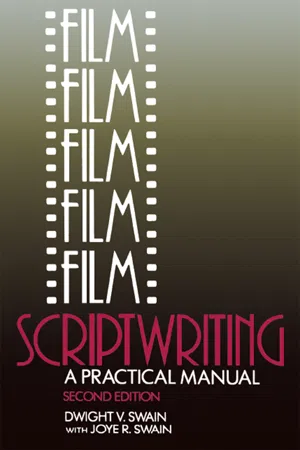
This second edition of the widely acclaimed Film Scriptwriting is a truly practical manual for the working writer. It provides all the clear, step-by-step guidance you need to script both fact and feature film and video - from getting and developing ideas to the writing of master scene or shooting script.
Featured in this new edition are annotated excerpts from some of today's most successful films, selected to point up principles and techniques discussed. Interviews with working film specialists reveal the things professional directors, producers, story editor, and analysts look for in appraising the scripts that come across their desks.
- 432 pages
- English
- ePUB (mobile friendly)
- Available on iOS & Android
eBook - ePub
About this book
Information
CHAPTER 1
Film and You
One of the nicest things about film scriptwriting is that it offers not just a living, but a way of life which allows you to make full use of your potential.
In addition, if you’re cut out for it, it can prove a tremendous lot of fun.
Next question: What do you need to become a film scriptwriter?
Seven things:
1. The kind of rhinoceros hide and iron backbone that won’t take “no” for an answer.
2. The ability to become excited about any subject on ten minutes’ notice—or no notice at all.
3. Resilience on a level that enables you to take the worst punch in the teeth or knife in the back where your ego is concerned and still come up affable and smiling.
4. Conscience of a brand that keeps you dedicated to making the best of a bad job, even when your every atom churns with resentment/disappointment.
5. An understanding of how to make the most of your creative talent.
6. A decision as to the area in which you wish to work.
7. A knowledge of the scriptwriter’s ground rules and technical devices.
Does this mean that if you have these attributes, success is automatically assured you?
Oh, come, now! Becoming a film scriptwriter is one thing; becoming a successful film scriptwriter, a rather different matter.
You see, in this life there’s an element known as competition. Certain things loom as desirable—things like high pay, congenial work, ego satisfaction. In consequence, more people want them than can get them.
Result: survival of the fittest … an unhappy state, for many, in view of the fact that “fittest” may, upon occasion, mean anything from pure genius to possession of an uncle with an inside track. But that’s the way of the world, as they say, and the ability to face it and fight it is part of the stubbornness and resilience on which we focused in points 1 and 3 above.
On the other hand, breaks alone can carry you only so far, especially where scriptwriting is concerned. How much success you achieve in the long haul will depend pretty much on your own ability as a writer … your ability, plus the seven points listed above, that is.
So, what about those points? Let’s consider them one at a time.
1. The kind of rhinoceros hide and iron backbone that won’t take “no” for an answer.
If your father is a major movie star, a top director, a seven-figure investor in a film company or a company that buys films, it’s quite possible your desire to become a scriptwriter will win a reasonably warm reception. Agents will agree to read your efforts. Producers will chat with you over drinks. A director may even go so far as to take you under his wing; hire you for some minor job so you can observe the process and problems of film making at first hand.
You understand, they still won’t buy your scripts or hire you as a writer; not unless said scripts are in and of themselves of top quality, fully up to the level of the competition. Film production is far too expensive a proposition for it to be otherwise. But, you will have a built-in “in”—a breach of sorts in the towering walls which otherwise seem to surround the motion picture market.
Most of us, for better or worse, have no such entrée. In consequence, we have no choice but to storm the barricades on our own.
There are easier tasks, believe me. For one thing, scripts submitted by mail ordinarily come back unopened. (I’ll explain why in Chapter 16.)
So, you have to shoot angles, start on a different level. Maybe that means doing films on your own, in Super 8 or whatever, in hopes someone will recognize your talent. Or taking film courses in schools that bring in people from the industry to lecture. Or scraping acquaintances with studio personnel, on the theory that sooner or later you’ll meet someone with the authority to buy scripts. Or taking jobs as page boy or typist or sweeper, in order to scrape up such acquaintances.
I wish I could pretend that any or all of these approaches held your answer. Unfortunately, they don’t. Scriptwriting is a rough field to crack, and for every writer working, there are a dozen struggling to survive with part-time jobs outside the field.
What it comes down to is that if you learn the ropes, and if you persevere, and if you have the writing skill, then maybe—just “maybe,” mind you—you’ll eventually make the grade.
This doesn’t discourage you? Good! Because if you can be discouraged, you’re better off not to start. Only if the writing of film scripts enthralls you to the point that you can’t be stopped do you have any business in this field.
2. The ability to become excited about any subject on ten minutes’ notice—or no notice at all.
A friend of mine, half of a husband/wife team long prominent in the ranks of TV and film writers, once told me, “One thing I know. In this business, can you do it in a hurry counts for a lot more than can you do it good.” Then he added, “You can’t imagine how many jobs we’ve cinched because we could leave a conference, bounce ideas off each other for five minutes in the reception room, and then walk back in with a fresh angle.”
My own experience in the fact-film field echoes that in spades. I have, on numerous occasions, discovered on entering a meeting that someone had billed me as being wild to do a script on quail-hunting, or the acidizing of oil wells, or promotion of a backwoods women’s college. Once, even, my phone rang and when I answered I found I was talking to a psychiatrist who wanted a film scripted from a citation in a medical text. On another occasion, a feature producer thrust an abstract painting at me and was shocked when my interpretation of it as a springboard to a film didn’t match his.
The point? You’d better be fast on your feet, Jack, and this is no field for negative thinkers.
3. Resilience on a level that enables you to take the worst punch in the teeth or knife in the back where your ego is concerned and still come up affable and smiling.
This is the morning after a week in which you’ve worked your heart out to build a really spectacular angle for the bright new producer of a science fiction film. He listens while you try to sell it … then informs you he isn’t interested in “hack work” or “linear thinking” and exercises his right to cut you off the job.
The technical consultant on an industrial relations film accuses you of being a “racist bastard” because you’ve differentiated two characters in your script by labeling one a Serbian, the other an Italian.
The star of a feature finds your very presence so distasteful that she demands the director bar you from the set. Her stand-in tips you off that the real issue is that Star thinks you’ve given a bit player better lines than hers in a 30-second exchange.
Yes, you do need resilience!
4. Conscience of a brand that keeps you dedicated to making the best of a bad job, even while your every atom churns with resentment/disappointment.
The film is on deer hunting. A conservation man insists that you include a shot of a knife ripping open a doe shot out of season … hands lifting out a dead fawn’s blood-dripping fetus. You point out it’s going to make half the viewers sick, but you get nowhere.
A film on mental retardation for a national agency. A petty bureaucrat, afraid of repercussions, wants to carve the guts out of it for fear of offending one state’s medical association.
A feature with a hideously weak director. The male lead continually bollixes plot lines. When you protest, the actor retorts, “George S. Kaufman never made me memorize my sides. Why should you?”
In each of these instances, you have a decision to make. Since you’re not in charge, you can’t control the situation. So, will you slack off and say, “The hell with it,” or will you go on sweating, trying to make the film as good as you can, within the limits of your predicament?
If your answer is, “The hell with it”—please quit before you start. This business has enough eight-balls already. Which is not to say you may not withdraw or demand that your name be taken from the credits, upon occasion. The man I’m objecting to is the one who stays on the job but quits trying.
5. An understanding of how to make the most of your creative powers.
It goes without saying that a film scriptwriter must above all be creative. Creativity is one of the major—if not the major—tools in his craft-kit.
Some people, obviously, are more creative than others.
It’s also a fact, however, that most of us can become infinitely more creative than we are, if we learn how to make the most of our abilities.
The creative person, you see, is one somehow conditioned to make multiple responses to single stimuli. That is, he tends to have a variety of reactions to whatever he perceives. Most often, he’s not even conscious that he does this. But—spontaneously, habitually—it’s become an integral part of his overall pattern of behavior to operate in this manner.
Thus, consider a candlestick. The non-creative among us see it for what it is and nothing more—as some sort of holder with a socket for a candle.
The creative person, on the other hand, looks beyond this obvious function to see the candlestick’s further potentials, based on its size, shape, material, components, relationship to the room and its furnishings, and so on. So if I ask him to devise ten ways to murder someone with a candlestick, odds are that sooner or later he’ll come up with something fresh and original, simply because he’s formed the habit of envisioning more than one possibility per situation.
You, in turn, can through practice train yourself to apply this same principle to every phase of your writing. If a character seems trite and obvious, make a list of half a dozen ways you might increase his individuality via unique goals, background, attitudes, appearance, mannerisms, speech, or what have you. Look at Tootsie, with the hero in drag, or the characterization of Sherlock Holmes as a boy in Young Sherlock Holmes. Continental Divide features an outdoor heroine who dominates woods and mountains, while the man, at home on city streets, is unable to take care of himself in the wilds. Ruthless People sees Bette Middler, a kidnap victim, terrorizing her captors. Does a dialogue passage sound dull? Try different lines—a dozen of them! Let the little old lady carry a switchblade in her reticule, or the preacher’s wife sleep around. How about a monster of a man who faints at the sight of blood? The bathing beauty who’s scared of water? The tycoon who can’t read? (Pardon me—better skip that last one; Somerset Maugham built a classic short story around it!)
Similarly, your film’s key statement may be dull or it may be spritely (or provocative, or profound, or what have you). Your own taste and judgment will be the deciding factor. Given “What about Susie Schnick-elfritz’s party?” as a central question, you may come up with answers ranging from “Seven close friends attended” to “Any birthday can be a disaster, if Susie bakes the cake!”
But remember, it takes practice to change habit patterns. Get in the swing of creative thinking before crucial need for it arises. To that end, look for faces in clouds. Compare people with animals as to manners or appearance. Devise outrageously appropriate replies to propriety’s questions—even if you don’t have the nerve to voice them. Leave a movie two-thirds through the picture, set up five possible endings of your own, and then go back for the next performance and see if the scriptwriter resolved the situation as cleverly.
Do keep the fitness of things in mind, however. That is, be sure your characters—whether people, products, or principles—stay in character. Don’t throw your picture out of kilter with shock for shock’s sake. You’ll still have plenty of room to move around, once you learn to devise a variety of fresh handlings—via lists—for every mundane circumstance.
6. A decision as to the area in which you wish to work.
Film production today is a fantastically big field—and all of it needs competent scriptwriters. But you’re the one who has to decide which road you want to take.
Thus, there are art films, business films, documentary films, educational films, entertainment films, experimental films, government films, industrial films, medical films, promotional films, religious films, sales films, scientific films, slide films, travel films, and a host of others. Each area offers strengths and weaknesses, advantages and opportunities and headaches.
You need to find out about these various specialties: the demands they make, the rewards they offer. Here, we can strike little more than a glancing blow at an issue that warrants all sorts of study.
Where you’re concerned, the important thing is not to fall prey to snap judgments, slap-dash decisions. Above all, recognize that Hollywood represents only the tip of the film world’s iceberg. Othe...
Table of contents
- Cover Page
- Title Page
- Copyright Page
- Contents
- Preface to the Second Edition
- Foreword
- Chapter 1: Film and You
- Part One: The Fact Film
- Part Two: The Feature Film
- Part Three: Tricks of the Trade
- Appendix A: The Storyboard
- B: Judging Screen Time
- C: For Further Reading
- D: Terms You’ll Use
- E: Writers’ Guild of America
- F: Writers’ Guild of Great Britain
- Index
Trusted by 375,005 students
Access to over 1.5 million titles for a fair monthly price.
Study more efficiently using our study tools.
Frequently asked questions
Yes, you can cancel anytime from the Subscription tab in your account settings on the Perlego website. Your subscription will stay active until the end of your current billing period. Learn how to cancel your subscription
No, books cannot be downloaded as external files, such as PDFs, for use outside of Perlego. However, you can download books within the Perlego app for offline reading on mobile or tablet. Learn how to download books offline
We are an online textbook subscription service, where you can get access to an entire online library for less than the price of a single book per month. With over 1.5 million books across 990+ topics, we’ve got you covered! Learn about our mission
Look out for the read-aloud symbol on your next book to see if you can listen to it. The read-aloud tool reads text aloud for you, highlighting the text as it is being read. You can pause it, speed it up and slow it down. Learn more about Read Aloud
Yes! You can use the Perlego app on both iOS and Android devices to read anytime, anywhere — even offline. Perfect for commutes or when you’re on the go.
Please note we cannot support devices running on iOS 13 and Android 7 or earlier. Learn more about using the app
Please note we cannot support devices running on iOS 13 and Android 7 or earlier. Learn more about using the app
Yes, you can access Film Scriptwriting by Dwight V Swain,Joye R Swain in PDF and/or ePUB format, as well as other popular books in Media & Performing Arts & Film & Video. We have over 1.5 million books available in our catalogue for you to explore.