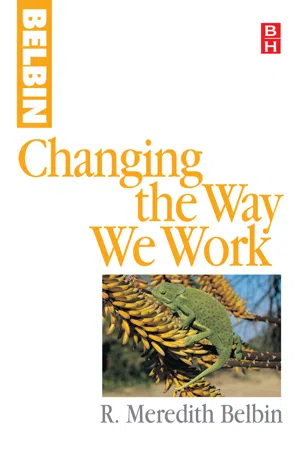
- 160 pages
- English
- ePUB (mobile friendly)
- Available on iOS & Android
eBook - ePub
Changing the Way We Work
About this book
How many problems at work arise from the way in which jobs are set up? Either people don't have a clear understanding of their duties and responsibilities, spending time and energy disentangling them from those of their co-workers or they are hemmed in by job specifications that allow no room for movement and initiative.
An alternative system is needed, where jobs can grow and develop: where communication about the work can flow up as easily as down. Dr Belbin describes a radical approach incorporating colour-coding and information technology derived from experiments now being undertaken in three countries. Workset is a new means of delivering greater efficiency in a dynamic process that equally involves managers and jobholders.
Dr R. Meredith Belbin, regarded as the father of team-role theory for his widely-read Management Teams: Why they succeed or fail and its successor Team Roles at Work, obtained his first and higher degree at Cambridge University. Later, in a research, lecturing or consulting capacity, he has visited and worked in many countries. In 1988 he founded Belbin Associates which produces Interplace, a computer-based Human Resource Management System, now used world-wide.
1
Orders and disorders
A manager is a person who assigns work to others. The art of assigning work is therefore central to the business of management even though in the past it has scarcely been recognized as an art and has been conceived mainly in contractual terms. The manager specifies requirements and, in return for a willingness to comply, the worker receives a wage. That is the lynchpin of the relationship between manager and the worker. Any failure to heed a work instruction, on the one hand, or to pay the agreed wage, on the other, means that the contract collapses.
It has therefore become prudent for anyone wishing for work to carry out an instruction exactly according to the letter even if that instruction defies common sense. That position holds for minor operations and equally for major works. Take the case of a builder tendering for a contract. The architect may have despatched plans and specifications containing features which to someone with on-the-job experience leave much to be desired, given the need for a sound, speedy and efficient construction. But the builder needs to secure the business. Complaints may be expressed privately, if volubly, to a confidant. However, nothing will be said publicly for fear that the deal might collapse, so that in the event what has been specified will proceed exactly as planned. The workers on the site may in turn complain, as they often do, that all the materials are not arriving on schedule, unaware that a specified component is difficult to obtain from a supplier and that the architect is not prepared to accept substitutes. Grumbling may rumble through the site, especially if the shortage affects their bonus payments. But its consequences will be limited. On planning issues the building workers will usually avoid confrontation or any open challenge to management’s prerogative to manage, because they too need the assurance of continued work.
Such is the arrangement of pressures that in the normal course of events all orders are there to be accepted. ‘It’s more than my job’s worth…’, says the respondent, if invited by a third party to do anything out of line. This can even be an understatement of the real dilemma given the fact that at one end of this imperative scale lies the military command. Here compliance is more than a matter of discretion and convention. During the First World War soldiers who ran away, fearing for their lives during artillery bombardments, were court-martialled and shot. It was virtually safer for apprehensive soldiers to stay put even at the risk of being little more than cannon-fodder.
Less pressing than a military command is an instruction. Instructions are the form in which orders are transmitted to employees. While they do not carry the same force as commands, they need to be heeded, for failure to do so could result in reduced promotion prospects or even in the loss of a job. At the most indulgent end of this spectrum is the type of instruction issued not as between people but in conjunction with a consumer product. That instruction comes impersonally in a manual or leaflet. The decision to read the instruction, or not to do so, is a voluntary matter and may be of little more than incidental concern to the manufacturer. Some starting instructions, for example, are buried in bulky manuals that cover several varieties of a product, including ones not being purchased, and are in several languages. To hunt through the manual in order to find the appropriate passage can be quite demanding. But to ignore an instruction will increase the chances of an unhappy experience in the use of the product or may even invite peril. Even so, it is hardly to be expected that a dissatisfied customer would bother to write to a manufacturer with suggestions on improving the instruction manual.
These varieties of command and instruction, while different in form and urgency, have two common features. The first is the need to attend to what is being imparted if unfortunate consequences are not to ensue. The second is that the receiver is passively placed at the end of a system primarily designed for downwards communication.
The causes of disorder
All recurring disorders can be viewed as some form of cybernetic failure. No system can function well if there is no means of receiving self-regulating feedback that can modify the intensity or nature of the input. That principle holds equally for all advanced systems, whether they are electrical, electromechanical or biological. Yet in the field of human affairs sight is easily lost of this basic design point, for people are inclined to believe that the human capacity for speech can always compensate. Were this so, the question must be posed as to why the receiver of a command or instruction cannot easily rectify the situation whenever trouble is encountered. The answer, in most instances, is that there is an absence of any socially sanctioned feedback loop.
In theory, of course, the problem does not sound very striking. There is no obstacle to closing the information gap, given a culture that valued openness. Ideally, the builder would be able to say to the architect: This is an unnecessarily expensive way of achieving your purpose. We have had good experience with an alternative material which is easier to handle and stands up to the conditions better.’ For his part, the building worker would say to the master builder: ‘We spend a lot of time waiting around for supplies. You are not always in touch with what is going on. Why don’t you supply us with a mobile phone and let us order the materials ourselves from the builder’s merchant? Then we can be sure they will arrive when we are ready.’
These responses sound reasonable enough. But, in practice, there is little chance that they would be accepted, for besides the risk of being seen as impertinences they infringe the principle of individual responsibility. The architect is held responsible for specifying how the building is to be constructed and the master builder is responsible for bringing together the men and the materials. Someone would soon retort: ‘If we were to carry on in the way proposed, goodness knows what might happen. We would not know who was responsible for what.’ Inevitably a further objection would be to raise the question of the competence and qualifications of the persons suggesting an extension of their personal responsibilities.
It is clear that the attempt to introduce an element of common sense or ambition into organization soon runs up against barriers. The persistent disorders of a simple, easily understood, mode of management organization are preferred to a more socially intricate system that might function better.
The current system, whatever its shortcomings, has the merit of being easy to follow. Managers, being responsible people, are given responsibility. Workers, being of lesser standing, are given tasks. That is why it is important to know who is the boss round here. When the boss is away, the system is inclined to break down and misfortune is apt to strike. Necessary activities are neglected. No-one is prepared to take decisions. People stand around waiting. Then the boss will be heard to complain: ‘It is difficult to find anyone in this firm who will take responsibility.’
We are now facing a circular argument. People who are not made responsible shirk responsibilities and therefore never become responsible. And the fewer the people who take responsibilities, the greater the burden of responsibility that falls on a single person’s shoulders. The phenomena of the problem and the causes of the problem become one and the same.
The essence of the crisis is that, while the management model is simple, people are complicated. Those in responsible jobs can disappoint and those in subordinate roles can surprise others by their initiative and enterprise. Here there is no rule of thumb that gives the clue. When people do not fit the managerial paradigm within which they are meant to operate, anomalies give rise to disorder and set in motion a second round of derivative anomalies as people attempt to find their way around a problem. To the discerning there is only one solution – to utilize the informal system in preference to the formal system while at the same time treating the formal system with all the due respect that it does not deserve.
The gap between the offical and unofficial systems opens the way for political operators to seize the opportunity and exercise their unwelcome skills. Once the straightforward management model of division between managers and workers fails to correspond adequately with the reality, others learn to manipulate the system, undermining authority without adding value.
An overswing of the pendulum
If the problem of issuing orders in accordance with a hierarchical formula produces a chain reaction of complications, a general reluctance to issue orders can soon become the favoured position. Throughout history one extreme has given rise to its opposite. Overindulgence in liquor produced Prohibition in the USA. Fasting follows feasting. The social extravaganza stimulates the retreat. So it is with orders. In a society in which equality is held on a pedestal, surpassing even liberty and fraternity, it is entirely predictable that an influential school of thought would arise in which it would be considered incorrect to order anyone to do anything.
I have come across several instances of this in the domestic households of busy professional women. Someone whose energies are directed at improving communications and teamwork in a large organization, and which often creates a whole set of associated values, may also need to run a household. That often leads to the employment of a domestic helper, often on a part-time basis. Such a helper may engage in the work in which the self would engage if sufficient time were available. The ‘other self may do the shopping, collect the children from school and run the household generally, in which connection the self will identify with the ‘other self. One person will do what the other is unable to do. In consequence the relationship is likely to be close and cordial.
But suppose the professional woman has a full-time job, or, in the event of having a part-time job, declines to undertake certain household tasks? Now a different condition arises. The duties of the domestic helper will need to be set out more formally. And since the self will no longer be in a position to attend to whatever work is left undone, it is important to ensure by some means or other that the duties are carried out in the way that is laid down. Now suppose the professional woman, instead of issuing instructions and departing for work as usual, has a free day at home. Not uncommonly, a new and troubling situation arises, for the full-time helper may not behave in the same way as the ‘other self and prefer to take her meals and other refreshments separately. This unexpected reaction can often create a sense of shock for a professional woman brought up in the egalitarian values prevailing in a professional working environment or influenced by the culture of firms where, typically, several eating areas or canteens may have been consolidated into a single dining area which all are expected to use. Naturally, our professional woman feels the same practice should apply at home if she is to remain true to her values. However, the reality is that the decision of what to eat together and where to eat it is capable of producing a mutual sense of embarrassment. The result is that either the one or the other announces she does not feel hungry and the shared meal fails to take place.
A problem here is that we have not fully developed a new mode of working relationship but neither have we escaped the pull of the traditional system. Giving and receiving orders involves a status difference and typically generates social distance. If, however, the provider of work wishes to remove social distance and to establish a closer personal relationship, a set of associated behavioural modifications has to be introduced. Forms of address become more intimate, Christian names replace titles and orders become requests.
However, the price to be paid for this change in approach is that tasks cannot be given and supervised to the same extent. While servants in the Victorian era worked to exacting standards, being subject to a domineering regime, their counterparts in the modern era are very differently placed. They expect to negotiate crucial aspects of their employment and agreement should not be presumed. Tasks still retain their menial character and the dilemma for the manager is to make the nature of the work sound and feel worthy and acceptable without dropping standards. It is a dilemma that most managers do not handle very well. The way in which work is set up and distributed here represents a major problem.
Person images and task images
When work is considered as falling into only two types, that involving responsibility which is discharged by the bosses and that involving tasks specified by bosses but carried out by workers, it becomes inevitable that involvement in a lower grade of work has considerable repercussions. First, it can damage a person’s social standing in a hierarchy. Second, on a wider front, it impinges directly on the rate and nature of industrial development. In Third World countries, especially, technical graduates are notoriously unwilling to embroil themselves in practical shopfloor matters, preferring to sit in their offices as befits those who aspire to be proper executives. It is all a matter of status. That is one of the primary reasons, so it has been alleged, why multinationals in process industries are reluctant to locate substantial manufacturing establishments in underdeveloped parts of the world that cry out for investment.
In the developed world the distinction in the distribution of the two types of work is less marked. The blurring begins at the level of the household. The availability of so much labour-saving equipment means that many domestic tasks have been taken over by machines. The remaining domestic chores can be shared. In a professional household where both husband and wife are working the division of domestic labour is a matter for negotiation. Aptitudes, individual preferences and personal availability at particular times of the day all play their part. These are essentially private matters which are not readily visible to third parties nor consequentially transferable to the outside world.
For my part, my practical skills in the household are generally limited. But, happily, I can claim a certain distinction in two areas – the ability to stop babies crying and a capacity for peeling potatoes. With regard to the latter, which has the greater utility in the domestic scene, I take a potato peeler, which is right-handed in preference to one designed for left-handers, and clasping it in the left hand push it in rapid movements away from the body, whereas others draw the potato peeler towards the body. In a potato-peeling competition I would be likely to outpeel most housewives. It is a skill I hoped would come in handy when resident with a family during extended overseas engagements. There are occasions when I have felt especially grateful to the wife of a fellow professional on finding that, without any prompting, some of my clothing has been removed from my bedroom to be later returned washed, ironed and neatly folded. In return, I am keen to peel the potatoes. But my offers have always been graciously refused, often with a smile, as though I was making an absurd suggestion. It does seem that my general image does not fit that particular task.
The willingness of people to take on a range of work is growing not only by couples sharing in households but also by employees in firms. In many occupations versatility in dealing with varying demands and situations is more highly valued than superproductivity in some given activity. That is the way in which industry has been moving and its implications are profound. It means that the carrying out of relatively simple tasks and the discharge of important responsibilities have become intertwined. The social revolution at work means that the executive who would previously dictate letters to a secretary now sits in front of a word processor and for a time resembles a worker in the typing pool. Directors now act as their own chauffeurs. No longer is it counted extraordinary for a director to break a journey to deliver an urgently needed parcel in the course of driving to a meeting with a customer.
In these instances tasks which would have been performed as a result of orders are being undertaken voluntarily. But the image problem remains a possible impediment, for whether tasks are acceptable or not for persons of a certain status level remains questionable. Clearly, the image needs to be brought into line with the reality. Work cannot be organized, covertly, on the basis that tasks might be undertaken voluntarily by someone holding important responsibilities. On the other hand, there would be a reluctance to include such tasks in a person’s job description for fear of creating an insult, for tasks are activities that are ladled out to those of lower rank.
This is the essence of the unresolved crisis that lies at the heart of current work organization. Should traditional ways of dividing up work, often of proven value, be retained or not? And if that pattern is found wanting, what is the next step? How otherwise should work be grouped, distributed and communicated to those who are to undertake it?
The time has at last arrived in the evolution of the world of work when the questions become worth posing. Yet when I have asked them, I have met only a stunned silence.
2
The true nature of a modern job
The issue of how a job should be set up has far-reaching consequences for both the vitality of businesses and its impact on society. Yet on the whole it is not a matter that is widely recognized; nor has it excited much attention among managers themselves, since the general presumption in hierarchical organizations is that the position is basically simple. When a job has to be done, the person in charge should make it clear exactly what work has to be performed, demonstrate if necessary how it is to be done and routinely check that the orders, or instructions, have been followed. Such an outlook inevitably lends itself to a systematic approach of which the most advanced was termed Scientific Management, otherwise eponymously known as Taylorism.
Taylor believed that, where work was concerned, there was one best way of doing anything. Once waste was cut out by studying the most efficient way of performing a job, the ideal method could then be introduced as standard to bring about recurring benefits. It was a short step to encourage a worker...
Table of contents
- Cover
- Title page
- Copyright page
- Table of Contents
- List of Colour Plates
- Preface
- The Colours of Work Roles
- 1 Order and disorders
- 2 The true nature of a modern job
- 3 Reclassifying work: tasks versus responsibilities
- 4 ‘So what’s the job?’
- 5 Overcoming initial problems
- 6 Job casting and job briefing
- 7 John Dee and the Mechanicians: Applied Science in Elizabethan England
- 8 Quantifying the way we work
- 9 Managing the feedback
- 10 Creating a new culture
- 11 Fostering team empowerment
- 12 From competence to excellence
- 13 Team roles and colour codes
- 14 Managers and leaders revisited
- 15 A way forward
- Appendix 1 A glossary of terms
- Appendix 2 Work Roles – audit of existing practices in job setting
- Index
Trusted by 375,005 students
Access to over 1.5 million titles for a fair monthly price.
Study more efficiently using our study tools.
Frequently asked questions
Yes, you can cancel anytime from the Subscription tab in your account settings on the Perlego website. Your subscription will stay active until the end of your current billing period. Learn how to cancel your subscription
No, books cannot be downloaded as external files, such as PDFs, for use outside of Perlego. However, you can download books within the Perlego app for offline reading on mobile or tablet. Learn how to download books offline
Perlego offers two plans: Essential and Complete
- Essential is ideal for learners and professionals who enjoy exploring a wide range of subjects. Access the Essential Library with 800,000+ trusted titles and best-sellers across business, personal growth, and the humanities. Includes unlimited reading time and Standard Read Aloud voice.
- Complete: Perfect for advanced learners and researchers needing full, unrestricted access. Unlock 1.5M+ books across hundreds of subjects, including academic and specialized titles. The Complete Plan also includes advanced features like Premium Read Aloud and Research Assistant.
We are an online textbook subscription service, where you can get access to an entire online library for less than the price of a single book per month. With over 1.5 million books across 990+ topics, we’ve got you covered! Learn about our mission
Look out for the read-aloud symbol on your next book to see if you can listen to it. The read-aloud tool reads text aloud for you, highlighting the text as it is being read. You can pause it, speed it up and slow it down. Learn more about Read Aloud
Yes! You can use the Perlego app on both iOS and Android devices to read anytime, anywhere — even offline. Perfect for commutes or when you’re on the go.
Please note we cannot support devices running on iOS 13 and Android 7 or earlier. Learn more about using the app
Please note we cannot support devices running on iOS 13 and Android 7 or earlier. Learn more about using the app
Yes, you can access Changing the Way We Work by R Meredith Belbin in PDF and/or ePUB format, as well as other popular books in Business & Business General. We have over 1.5 million books available in our catalogue for you to explore.