- 288 pages
- English
- ePUB (mobile friendly)
- Available on iOS & Android
eBook - ePub
Partnering in the Construction Industry
About this book
Partnering is the most effective way of tackling construction projects. This book explains how clients and construction firms using partnering can achieve ever higher levels of efficiency and certainty to provide world class buildings and infrastructure of all kinds.
Detailed guidance about the actions that clients and professionals new to partnering need to take is given followed by advice about the actions individual firms can take to get the maximum benefits from partnering. Finally the book describes how highly developed forms of partnering are developing into strategic collaborative working that turns construction into a genuinely modern industry able to meet all customers' needs.
The book is designed to be used flexibly by a variety of readers, with coloured sections and executive summaries built into the body of the text to enable senior managers to get a quick overview of the guidance provided. The detailed guidance provides those at the workface with the ammunition needed to cooperate with those around them in doing their best work. The guidance is supported by check lists that help ensure everyone involved knows what they need to do to match and then exceed today's best practice. Construction clients will learn how to get high quality, reliable and fast completion and a firm price that represents best value for money.
This book helps everyone in the construction industry be fairly rewarded for delivering best practice. The expert guidance also gives the construction industry the time and resources needed to give proper attention to all aspects of quality including sustainability and total life cycle costs.
to match and then exceed today's best practice.
Information
1
Project partnering explained
| The Challenge for Partnering | |
| 1.1 | Introduction |
| 1.2 | The Challenge of Complexity |
| 1.3 | Demands for Efficiency |
| 1.4 | Construction Industry’s Structure |
| Construction’s Response | |
| 1.5 | Traditional Practice |
| 1.6 | Project Management |
| 1.7 | Emergence of Partnering |
| 1.8 | Benefits of Partnering |
| 1.9 | Criticisms of Partnering |
| 1.10 | Costs of Partnering |
| 1.11 | The Client’s Decision to Use Partnering |
| 1.12 | Actions by Construction Industry Firms |
| 1.13 | First Partnering Workshop |
| 1.14 | Mutual Objectives |
| Key Outcomes | |
| 1.15 | Decision-Making |
| 1.16 | Performance Improvement |
| 1.17 | Feedback |
| 1.18 | Maintaining Partnering throughout Projects |
| case studies | |
Project Partnering Defined
Project partnering is a set of actions taken by the work teams that form a project team to help them cooperate in improving their joint performance.
Specific actions are agreed by the project team taking account of the project’s key characteristics, and their own experience and normal performance. The choice of actions is guided by a structured discussion of mutual objectives, decision-making processes, performance improvements and feedback.
1.1 Introduction
Project partnering is a set of actions that helps project teams improve their performance. It involves initial costs and provides substantial benefits. It is not a fixed way of working; it develops as project teams cooperate in finding the most effective ways of achieving agreed objectives.
Partnering is the most efficient way of undertaking all kinds of construction work including new buildings and infrastructure, alterations, refurbishment and maintenance. It provides more benefits than older, more established approaches.
This chapter provides an overview of partnering and its costs and benefits. It is intended for senior managers contemplating a new construction project who want to know how to get the best possible value for their investment. It is also aimed at senior managers in the construction industry, including consultants, contractors and specialists, as they develop strategies for improving their firm’s performance and profitability.
Most published descriptions of partnering describe one version of current best practice. This can be misleading because partnering does not mean one single fixed way of working. It develops as people work together. The approach used on any given project is chosen by the client and project team, taking account of their experience of partnering, the nature of the project and the client’s objectives. As a result some teams use partnering tentatively, others apply many of the features of published best practice, while a few have taken the ideas further to develop remarkable levels of efficiency.
This code of practice deals with the complexity of practice by first describing a straightforward approach to project partnering, acknowledging that it takes time to fully establish even that level of efficiency. This is discussed in the first four chapters of Section 2 of this code of practice. Then Chapter 6 describes how partnering is taken further by leading clients, consultants, contractors and specialists who use strategic partnering to work together long term. As the benefits grow some groups use strategic collaborative working to establish new and highly efficient businesses. Some specialize in original designs while others produce and market standardized constructed facilities backed up by sophisticated customer services. These exciting developments give construction the potential to become a genuinely modern industry comparable to any leading manufacturing industry.
1.2 The Challenge of Complexity
Teams undertaking construction projects face a task of remarkable complexity and difficulty.
Construction work should be exciting and rewarding for everyone involved. For many people it is, but there remain many cases where problems and disputes leave clients and people in the industry disappointed. This code of practice provides a set of practical actions that make it more likely that construction projects are successful and the people involved enjoy their work. Achieving these good outcomes is far from easy because modern buildings and infrastructure are complex products and construction is inherently difficult.
Modern buildings are complex, not in the sense of being highly sophisticated, but in bringing together many different technologies. Some building technologies are new and sophisticated but others are long established in trade practice. The design, manufacture and construction of even relatively simple buildings may involve close to a hundred different technologies and the most complex may need more than a thousand work teams with specialized skills and knowledge. No other human products give rise to these levels of complexity.
Modern infrastructure projects are very large and have to deal with a variety of environments and ground conditions that need different construction systems. New railways and roads are likely to involve cuttings, embankments, tunnels and bridges and include sophisticated information and communications systems. This variety of construction systems, often constructed in the midst of a very busy environment, makes large infrastructure projects complex.
The inherent complexity of buildings and infrastructure has caused the industry to fragment into thousands of small, specialist firms. As a result project teams comprise many individual work teams. They face a task made even more challenging by external complexity that arises because virtually every modern organization has an interest in buildings and infrastructure.
Most human activities take place in buildings and depend on the infrastructure that links them. Government at all levels regulates where, when and how new buildings and infrastructure can be produced. Many non-governmental agencies take an interest in the location and performance of buildings and infrastructure and the ways they are used. Special interest groups campaign for or against new buildings and infrastructure and take a deep interest in changes to the built environment. Private organizations make decisions that influence their own buildings and those contemplated or commissioned by neighbours. Everyone has an interest in proposals relating to buildings or infrastructure near their own home. Few other human products give rise to these levels of interest, opposition and support.
1.3 Demands for Efficiency
Despite the inherent difficulty of construction projects, clients rightly expect the industry to work efficiently.
Despite the inherent difficulty of the task, clients have every right to expect buildings and infrastructure to meet all their functional requirements, have low life-cycle costs and be produced efficiently. The challenges this provides for the construction industry are tough. Historically the UK construction industry has justifiably been criticized for failing to provide reliably good value for clients.
Things have changed over recent years and leading practice in the UK construction industry has made great strides in producing world-class buildings and infrastructure quickly and efficiently. This has been achieved by moving away from traditional practice, first by adopting project management techniques and more recently by using partnering. Understanding these changes will help clients make best use of the construction industry. It will also help the industry itself to improve yet further.
1.4 Construction Industry’s Structure
Research identifies the construction industry’s structure as a series of self-organizing networks. The basic elements are work teams, communication links and feedback that provide a robust basis for cooperative teamwork.
Research into partnering provides a distinctive picture of the construction industry. The basic unit in this new view of the industry is work teams. These are groups of people who specialize in specific design or construction activities together with the machines and systems needed to work effectively.
Work teams build links with other work teams. Some links arise because teams are employed by the same firm but the more significant links arise between teams working on the same project. These become very important when the same teams work together on a series of similar projects.
In these various ways the industry has become a network of work teams in which groups of teams establish links that enable them to work together effectively. Some of the links include feedback systems that guide the development of high levels of skill and competence. Repeated interactions between work teams guided by feedback give rise to specialized sectors of the construction industry.
Experienced clients work with the specialized sectors. Project teams are assembled by limited and carefully structured competition and negotiation from within the appropriate specialized sector. Experienced clients regularly employ a small number of consultants, contractors and specialists who understand the technological and other challenges posed by the types of buildings and infrastructure they need. These sectors develop amazing levels of competence in building health centres, warehouses, superstores, service stations, offices, houses, sports stadia, roads, railways or bridges.
At the heart of these specialized sectors are feedback-driven clusters of work teams. It is entirely significant that they display all the characteristics that science generally has identified in controlled systems. Science now sees the whole planet as a richly interconnected network in which feedback gives parts the ability to survive and develop. This ability is called self-organization and science now identifies self-organizing networks as the most robust and effective form of organization for living things. Figure 1.1 shows a group of teams supported by feedback, which gives them the ability to work and develop within a wider and less controlled network.
Figure 1.1 Self-organizing network
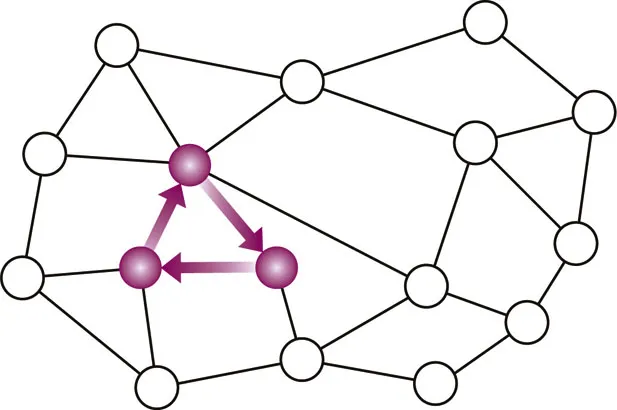
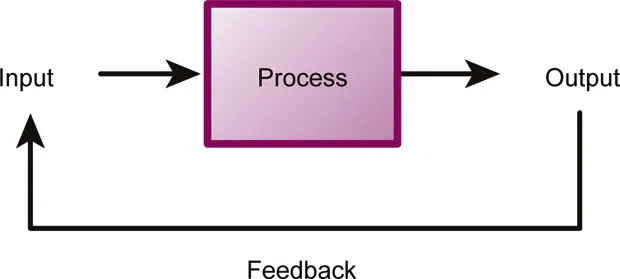
Partnering is consistent with seeing the construction industry as a self-organizing network. It provides a set of actions that reinforce the natural grain of all effective living organizations and turns construction projects into efficient controlled systems. These characteristics explain why partnering is fundamentally more efficient than other ways of working. Figure 1.2 shows the key elements of controlled systems, all of which need attention from project teams.
Figure 1.2 Controlled system
1.5 Traditional Practice
Traditional practice relied on independent firms brought together by competitive bids and tough contracts. Identifying the weaknesses of this approach helps explain how partnering provides benefits.
Traditionally the construction industry had a structure based on the perceived status of the various professions and trades. But it provided no explicit coordination or control. Consultants fiercely maintained their independence, contractors competed for work and specialists struggled to maintain the integrity of their skills and knowledge against marketdriven demands for lower costs and faster delivery. Clients dealt with an industry that appeared chaotic by using competitive tenders and tough contracts to protect their own interests.
Project teams, assembled from work teams brought together often for the first time, relied on professional and trade practice to coordinate their work. The approach failed because it provided no overall direction, reducing everyone involved to defending their own interests. It ignored the need for well-developed links between workers that are the hallmark of effective teams. Despite these weaknesses, some clients are attracted by the simplicity of inviting competitive bids and, encouraged by advice from professionals with a vested interest in old ways of working, continue to use traditional methods. All too often they are sadly disappointed as they discover that claims, delays, defects and disputes make this an expensive and ineffective approach.
1.6 Project Management
Project management provides a better approach for construction. Cost, time and quality are controlled to achieve the client’s objectives. Some designers claim to be inhibited by these management controls but in practice design outcomes tend to be better than on traditional projects where designers take the lead. Indeed many leading designers welcome havin...
Table of contents
- Cover
- Halftitle
- Title
- Copyright
- Contents
- Foreword
- Preface
- Acknowledgements
- How to use this code of practice
- 1. Project partnering explained
- 2. Selecting firms for partnering
- 3. Actions at the start of projects
- 4. Actions during projects
- 5. Developing partnering skills
- 6. Developing strategic collaborative working
- 7. Techniques and checklists
- Bibliography
Trusted by 375,005 students
Access to over 1.5 million titles for a fair monthly price.
Study more efficiently using our study tools.
Frequently asked questions
Yes, you can cancel anytime from the Subscription tab in your account settings on the Perlego website. Your subscription will stay active until the end of your current billing period. Learn how to cancel your subscription
No, books cannot be downloaded as external files, such as PDFs, for use outside of Perlego. However, you can download books within the Perlego app for offline reading on mobile or tablet. Learn how to download books offline
Perlego offers two plans: Essential and Complete
- Essential is ideal for learners and professionals who enjoy exploring a wide range of subjects. Access the Essential Library with 800,000+ trusted titles and best-sellers across business, personal growth, and the humanities. Includes unlimited reading time and Standard Read Aloud voice.
- Complete: Perfect for advanced learners and researchers needing full, unrestricted access. Unlock 1.5M+ books across hundreds of subjects, including academic and specialized titles. The Complete Plan also includes advanced features like Premium Read Aloud and Research Assistant.
We are an online textbook subscription service, where you can get access to an entire online library for less than the price of a single book per month. With over 1.5 million books across 990+ topics, we’ve got you covered! Learn about our mission
Look out for the read-aloud symbol on your next book to see if you can listen to it. The read-aloud tool reads text aloud for you, highlighting the text as it is being read. You can pause it, speed it up and slow it down. Learn more about Read Aloud
Yes! You can use the Perlego app on both iOS and Android devices to read anytime, anywhere — even offline. Perfect for commutes or when you’re on the go.
Please note we cannot support devices running on iOS 13 and Android 7 or earlier. Learn more about using the app
Please note we cannot support devices running on iOS 13 and Android 7 or earlier. Learn more about using the app
Yes, you can access Partnering in the Construction Industry by John Bennett,Sarah Peace in PDF and/or ePUB format, as well as other popular books in Technology & Engineering & Construction & Architectural Engineering. We have over 1.5 million books available in our catalogue for you to explore.