This book offers a critique of the all pervasive Western notion that other communities often live in a timeless present. Who Needs the Past? provides first-hand evidence of the interest non-Western, non-academic communities have in the past.
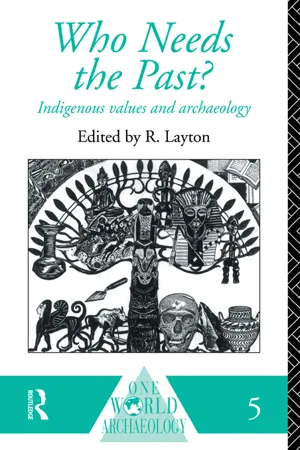
- 240 pages
- English
- ePUB (mobile friendly)
- Available on iOS & Android
eBook - ePub
About this book
Information
1 A child’s perspective on the past: influences of home, media and school
The past is what all people build their present and future on; without this they sit in a void waiting to reclaim their history, suspended in a bottomless pit
(Garrison 1986, p. 1).
Our image of the present, our consciousness of ourselves and other peoples is founded on our knowledge of the past. This knowledge reflects the history we are taught as children. As Ferro points out: ‘This history marks us for life’ (Ferro 1986, p. ix).
In the 1970s educationalists and politicians started to talk about education for ‘this country’s multicultural society’. Has the past decade seen a radical shift towards multicultural education? Have elements of multicultural education been introduced into teaching about the past? What do children learn about the past of other countries at school, and what do they and their parents think about multicultural education? Do children from other cultures feel cut off from their history and culture if it remains invalidated and undervalued by the host society? What are the factors which mould children’s perceptions of prehistory, history and archaeology, and do their perceptions vary from culture to culture? These are just some of the questions to which this chapter is devoted.
Definition of multicultural education
Multicultural education is a term which is open to a variety of interpretations. To some, introducing multicultural education merely involves adding a few new lessons about Asia, Africa and the Caribbean to the old curriculum. Others have interpreted multicultural education as a means of providing a special curriculum for ‘ethnic minority’ children. A broader and more wide-ranging interpretation is that multicultural education recognizes and celebrates the cultural diversity of our modern society by including the study of both ‘host’ and ‘minority’ cultures in the school curriculum, and treating them with equal respect and seriousness. This last view was endorsed by the Home Affairs Committee (1981, p. xvi) and the Rampton Committee (1981, p. 34), and it is the definition adopted in this chapter. However, some educationalists have expressed reservations that equal treatment of all cultures is virtually impossible, due to the unequal power relations within society (Sarap 1986, pp. 17–18).
One of the aims of the survey reported here was to ascertain whether learning more about other cultures would be of benefit in the context of the Britain of today, where many people have unrealistic views of the past and present, and where racial attacks are happening increasingly. ‘British’ society has long cherished a tolerant, just and humane image which is contradicted by the facts of racial discrimination and attacks (Fryer 1984, p. 387).
If the education system gave ‘British’ people a more thorough understanding of the mixed nature of ‘British’ culture, the normality of human migration from the dawn of time, and the historical background to migration, then it could have a positive effect on racial attitudes.
Swann observes
The diversity of British society today and the interdependence of the global community also has clear implications for the teaching of history. … A global perspective to the teaching of history can help to counter and overcome the negative stereotypes of ethnic groups which lie at the heart of racism
(Swann 1985, p. 330).
Survey procedure
This survey is intended to enlarge on Suffield’s (1986) work, which involved questioning 40 children in the 11 to 14 age-group and their parents from four religio-cultural groups: Hindus, Moslems, Chinese and ‘English’. It involved 117 children from six schools. The schools were selected, from local knowledge, to include a range of social class and ethnic composition. The children were in the 10 to 12 age-group, and were interviewed individually for about 30 minutes. All of the interviews were conducted in an informal conversational manner, and they were taped to form an archive.
This chapter concentrates on the findings from the children’s questionnaire, and includes some of their parents’ comments (see key to abbreviations at the end of the chapter).
Terms relating to nationality
The selection of terms referring to race and nationality is fraught with problems. Here, children from white ‘Anglo-Saxon’ families are referred to as ‘British’, and children whose parents originated in other countries are referred to as ‘ethnic minority’ children. The term ‘British’ was chosen instead of ‘English’, as used by Suffield (1986), because the sample included small numbers of Scots (1), Irish (2) and Welsh (2). A few ‘European’ children (one each from Norway, Hungary, Bulgaria and Poland) were included in this category because their numbers were too small for effective statistical comparison.
All of these terms are unsatisfactory, but have been used in the absence of other suitable ‘umbrella’ words. The distinction is drawn only for the sake of comparison, and is not meant to cast doubt on any person’s right to British nationality.
The composition of the sample
Of the children, 91% were born in Britain: 66% were ‘British’ and 22% were ‘Asian’, which included children born in Bangladesh, India, Kenya, Pakistan and Mauritius, 3.4% (4) were Greek Cypriot and 2.5% (3) were classed as Afro-Caribbean, consisting of one each from Nigeria, St Vincent and Ghana, 2.5% were Arab (1 Lebanese, 1 Saudi-Arabian and 1 Iraqi), 1 child was Iranian and 4% (5) were of mixed race.
For statistical purposes, ethnic origins were classified as:
| Group 1 | ‘Asian’ |
| Group 2 | Afro-Caribbean |
| Group 3 | ‘British’ |
| Group 4 | Arab |
| Group 5 | Greek-Cypriot |
| Group 6 | Iranian |
| Group 7 | Mixed race |
The ethnic minority composition of the school classes varied quite significantly (from 83.3% in a class to 23.4% in a class), which made it possible to examine whether this affected the teaching content. All of the classes had some proportion of ‘ethnic minority’ children. The religions of the sample included Anglican, Roman Catholic, Greek Orthodox, Sikh, Hindu and Moslem, with one-third professing to have no religion. Social class was determined by assessing the school’s location, based on a multidimensional scaling analysis of the City of Southampton (Mar Molinero & Leyland 1986). As this was not assessed for each individual, it can only be taken as a broad generalization.
Findings of the survey
Definitions
The terms ‘prehistory’, ‘history’ and ‘archaeology’ are used throughout this chapter and require some definition. The conventional division between history and prehistory on the basis of the widespread introduction of writing has been used. ‘Archaeology’ is defined as the study of the material remains of the past.
In order to ascertain whether their personal definitions of these terms were similar to those given above, both the children and the parents were asked to explain what prehistory, history and archaeology were. Of the children, 47% stated that they did not know the meaning of these terms. This question, involving such a series of long words, may have proved rather intimidating for some who may have plumped for the ‘Don’t know’ alternative rather than struggle with the words. History did not feature as a subject heading in the curricula of any of the classes surveyed; instead the children were given projects on such themes as ‘clothes’ or ‘transport’, in which history played some part. ‘Correct’ responses to this question were taken as those which most closely approximated to the definitions given above. Other responses were encouraged and noted. After this question the above definitions were explained to ensure that the children understood what we meant by these terms.
History (53.8%) and then archaeology (47%) were the most familiar terms to the whole sample. Many children associated archaeology with digging for and finding ancient bones – usually dinosaur bones – and treasure.
According to one child, archaeologists reflected their subject, for, he remarked,
‘All archaeologists are 60 years old’ (57.B.*3).
Another believed that
‘Archaeologists are “poshish”’ (84.B.*3).
‘British’ children were more confident about these terms, for 49.4% gave the ‘correct’ definition of history, as opposed to 30% of the other ethnic groups; 44% to archaeology, in contrast with 35%; and 16.85% to prehistory, as opposed to 10%. Archaeology was most familiar as a term to the ‘ethnic minority’ children (35%). One class, consisting of a large number of ‘ethnic minority’ children, had visited York Buildings excavation with the City Museums Education Officer, and many of the recent digs in Southampton have been located in the inner city area of St Mary’s, where there is a large concentration of ‘ethnic minorities’. It was the distinction between prehistory and history which caused the most confusion to the whole sample. Having decided that history was the past, some found it difficult to conceive of the place of prehistory, to the extent that one even thought it must be the future. Others expressed the belief that prehistory was a very, very long time ago.
The parents generally thought of history as a school subject, and expressed reservations about their ability to answer the questions because they could not remember any dates. Dates and history seemed to be synonymous for some parents, who felt unsure of the validity of their comments without them. This probably reflects the emphasis on dates in their schooling. In contrast, the children did not mention dates at all.
History was often conceived of as remote in time and significance:
‘When you said “history” I thought you meant 600, 700, 800 years ago sort of time’ (84.B.*3).
Of the children, 93% chose the ‘Long time ago’ alternative from a checklist on history, while 59% thought it involved ‘10 years ago’ and 32% ‘what is happening now’ (see Table 1.1, below). A few children pointed out that the past had little relevance to them:
‘I don’t see how it could help you nowadays. Nowadays is so different’ (90.B.*3).
‘You’re in this world now. The past is gone’ (39.B.*3).
Whose history did they think it was? Nearly 80% selected ‘the lives of kings, queens and powerful people’, while 64% felt it involved ordinary men and women. Responses showed that history is often seen as the preserve of the élite,
‘It seems to be in books. It’s more about politics, kings and queens and battles’ (P. 122).
While analysing the choice of alternatives from the checklist (see Table 1.1, below) it should be noted that these categories were not treated separately, i.e. kings, queens and powerful people were not differentiated and, although men and women were given subsections, the children always gave the same response to both. The part of the question about women was regarded as an afterthought by the children. A subsequent question revealed that few children could name more than two women in history (see Table 1.2), and the ones most frequently mentioned were Joan of Arc, various queens and Florence Nightingale. Most of the children from one particular school mentioned Mary Seacole, a black nurse in the Crimean War, whose life formed part of their curriculum. When asked this question one boy shook his head thoughtfully and replied:
‘No, there were only men’ (23.B.*1).
Girls recorded far more ‘Don’t know’ answers in the questionnaire than boys did, which could be due to a sense of lack of involvement in history. Such hesitance or ignorance may be a consequence of the virtual invisibility of women in most school textbooks and curricula. Reading many history books one could be forgiven for thinking that women had no role to play in the past, apart from cooking or raising children.
Scott comments:
Even among highly qualified history scholars the centrality of women in history is not yet accepted. Since school texts so frequently seem to depend on the received knowledge of at least one intellectual generatio...
Table of contents
- Cover
- Halftitle
- Title
- Copyright
- Contents
- List of contributors
- Foreword
- Preface and Recent developments
- Introduction: Who needs the past?
- 1 A child’s perspective on the past: influences of home, media and school
- 2 Inuit perceptions of the past
- 3 From the raw to the cooked: Hadzabe perceptions of their past
- 4 An 11th century literary reference to prehistoric times in India
- 5 The valuation of time among the peasant population of the Alto Minho, northwestern Portugal
- 6 Understanding Yolngu signs of the past
- 7 Geography and historical understanding in indigenous Colombia
- 8 Past and present of Andean Indian society: the Otavalos
- 9 Oral tradition and the African past
- 10 Classical Greek attitudes to the past
- 11 Ancient Egyptian concepts and uses of the past: 3rd and 2nd millennium BC evidence
- 12 Beginning of agriculture: a synchronism between Puranic and archaeological evidence
- 13 Holding on to emblems: Australian Aboriginal performances and the transmission of oral traditions
- 14 Perceptions of the past among north Queensland Aboriginal people: the intrusion of Europeans and consequent social change
- 15 The past as perceived by the Bali Nyonga people of Cameroon
- 16 Archaeology and oral traditions in the Mitongoa-Andrainjato area (Betsileo region of Madagascar)
- 17 Interpretations and uses of the past in modern Britain and Europe. Why are people interested in the past? Do the experts know or care? A plea for further study
- Index
Trusted by 375,005 students
Access to over 1.5 million titles for a fair monthly price.
Study more efficiently using our study tools.
Frequently asked questions
Yes, you can cancel anytime from the Subscription tab in your account settings on the Perlego website. Your subscription will stay active until the end of your current billing period. Learn how to cancel your subscription
No, books cannot be downloaded as external files, such as PDFs, for use outside of Perlego. However, you can download books within the Perlego app for offline reading on mobile or tablet. Learn how to download books offline
Perlego offers two plans: Essential and Complete
- Essential is ideal for learners and professionals who enjoy exploring a wide range of subjects. Access the Essential Library with 800,000+ trusted titles and best-sellers across business, personal growth, and the humanities. Includes unlimited reading time and Standard Read Aloud voice.
- Complete: Perfect for advanced learners and researchers needing full, unrestricted access. Unlock 1.5M+ books across hundreds of subjects, including academic and specialized titles. The Complete Plan also includes advanced features like Premium Read Aloud and Research Assistant.
We are an online textbook subscription service, where you can get access to an entire online library for less than the price of a single book per month. With over 1.5 million books across 990+ topics, we’ve got you covered! Learn about our mission
Look out for the read-aloud symbol on your next book to see if you can listen to it. The read-aloud tool reads text aloud for you, highlighting the text as it is being read. You can pause it, speed it up and slow it down. Learn more about Read Aloud
Yes! You can use the Perlego app on both iOS and Android devices to read anytime, anywhere — even offline. Perfect for commutes or when you’re on the go.
Please note we cannot support devices running on iOS 13 and Android 7 or earlier. Learn more about using the app
Please note we cannot support devices running on iOS 13 and Android 7 or earlier. Learn more about using the app
Yes, you can access Who Needs the Past? by R. Layton in PDF and/or ePUB format, as well as other popular books in Social Sciences & Museum Studies. We have over 1.5 million books available in our catalogue for you to explore.