Destination management and resort development and planning are strong core areas in the final year of most undergraduate degrees and a popular area of study at postgraduate level.
Using original case studies based on his own research, Resort Destinations uses examples from Australia's Gold Coast, Britain's Brighton, USA's Las Vegas, as well as Hong Kong, New Zealand and the Caribbean.
- 288 pages
- English
- ePUB (mobile friendly)
- Available on iOS & Android
eBook - ePub
Resort Destinations
About this book
Chapter 1
Introduction
When confronted by change innovation is a strategy for success
Tourism destinations are an important and intellectually fascinating component of the global tourism system. From an academic perspective destinations (and resorts) have provided a fertile ground for research. The three-decade long debate sparked by the publication of Butler’s Tourism Area Life Cycle in 1980 testifies to the passion that issues related to destinations and resorts have aroused. Surprisingly, the debate has focused on specific forms of destinations and resorts and the problems they face with less emphasis on a more general discussion about the role of destinations within the overall tourism system. Moreover, there has been a dearth of research into a number of significant issues including climate change, climbing rates of urbanization and peak oil that are now beginning to have an impact on the structure and operation of destinations. The WTO (2002) and leading tourism sector firms including Airbus Industries (Airbus Industries, 2007) continue to forecast significant growth in international travel, but the reality as Becken (2008) reminds us is that the oil-dependent aviation sector will face a significant shortfall in jet fuel availability as we begin to move into an era of declining oil output but increasing demand. The implications for destinations of changes of this magnitude have yet to be assessed in detail. To begin the process of redressing this research gap this book examines destinations from a new perspective by integrating research on specific aspects of destinations (modelling, planning, transport and crisis management) with the responses of specific destination types (cities, coastal zones, mountains and islands) to these challenges. The book then moves the debate on these issues forward to focus on how destinations might respond to the significant challenges of the future.
There are dangers in this approach given that some of these areas of enquiry have already developed an extensive literature. A single book cannot hope to cover each area of interest in detail resulting in some issues being glossed over and others ignored. But the aim of the book is not to undertake an exhaustive analysis of specific aspects of destination research. Rather, the aim is to draw together a number of themes and apply them in a more holistic manner to stimulate a new direction in the ongoing study of the destination and resort phenomenon. The structure of the book is outlined in Figure 1.1. This chapter sets the scene for the discussion of a range of issues later in the book, commencing with the approach taken in individual chapters. The chapter concludes with a brief overview of a number of key concepts discussed in later chapters.
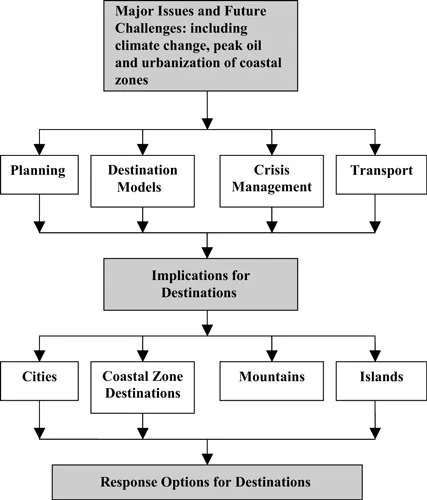
FIGURE 1.1 Structure of this book.
Approach Taken
Chapter 2 commences with a discussion on destination models, their purpose, how they are used and in some cases abused. Models are a popular method of explaining complex problems but it is apparent that models have limitations including an inability to move beyond the explanatory stage. As a consequence few models have been operationalized to the extent that they are able to be regularly used by policy makers and planners to find solutions to real-life situations. This situation reflects similar difficulties encountered by other areas of the social sciences when attempts are made to model complex, time-sensitive, multi-faceted problems. In the physical sciences computer modelling has been successfully used to build complex structures including aircraft, spacecraft, bridges and ships. The unpredictability of consumer demand has and will continue to be a major impediment to social science modelling of this type but that should not be an excuse for failing to try. Even simple measures of the nature suggested in Chapter 2 (Figure 2.8) can enrich our understanding of the operation of destinations, given that the majority of tourism models are necessarily a simplified version of a more complex reality. As a consequence, the application of a group of specialist models to problem solving in specific areas of enquiry is likely to give a more detailed and informed view than the application of a single model can hope to achieve. Of even more importance is the need to recognize that most tourism models can more properly be described as theories and should be treated as such. Models of this nature are excellent as teaching tools and for explaining the trends of the past. They are not adequate for planning the future. Just as economists seek to model national economies using complex econometric computer-based models, there is a need for tourism researchers to team with economists and other experts to build a new generation of predictive models that can assist in destination planning and management.
The fundamental requirement for effective destination governance and a sustainable future cannot be achieved without effective, thoughtful science and mindful consultative planning as highlighted in later chapters. While complex and time consuming planning should not been seen as an administrative process that is used to archive a preferred outcome but as a process that encourages multi-party dialogue, debate, acceptance that there are constraints imposed by the physical and natural environment, and recognition of the voice of all stakeholders. In the coming age of great change it is essential that the debate recognizes that the future will be different from the present. This has not always been the reality of destination planning and in their haste to develop plans administrators, planners and investors have often ignored the complexities of time and the mechanisms of change. Even a passing analysis of history reveals the dynamic nature of time and change, the difficulty of prediction and the cost of ignoring warnings. Forecasts rarely achieve a high level of accuracy, essentially because the relationships of the past are rarely mimicked in the future. Yet more than ever there is a need to identify the forces that are shaping the future and develop strategies for forward planning that will minimize disruption and maximize opportunities.
New Orleans was poorly prepared for the disaster that occurred when Hurricane Katrina struck the city on 29 August 2005. Over 1800 persons perished and the damage bill was estimated to be in excess of US$ 80 billion (Khadd et al., 2006). The city and the various agencies of the state and federal governments were simply not prepared for the disaster that unfolded. Fast forward 3 years to Hurricane Gustav (which struck on 2 September 2008) and we see an entirely different situation. Evacuation of nearly 3 million residents commenced several days before the Hurricane was predicted to strike the city, and the civilian emergency authorities and the military were better equipped and trained to assist the city’s administration. Before Hurricane Katrina disaster planning had largely ignored what was then regarded as a one in one hundred year chance of being struck by a hurricane of the force of Katrina. After Hurricane Katrina it was apparent that the one in one hundred year chance did not mean the event would happen in a hundred years time and repair works were undertaken to prepare for a future hurricane of this intensity. As is argued in Chapter 5 disaster planning needs to be shifted from an optional activity to be included as a necessary element of destination planning and in marketing strategies.
A central tenant of planning is to develop a future that is desirable and that is an improvement on today’s situation. For many, the desirable future is viewed as a bigger and more attractive destination than the present. In reality it is of more importance to create destinations that are sustainable. Forecasts of future tourism flows used for planning investment by the private and public sectors have a poor record of accuracy over the long term and often fail to incorporate the unexpected. In Chapter 3 and later in Chapter 10 the discussion considers a number of factors that influence the future and how the future can be understood within the context of the factors of change currently observable in society, economy and nature. Scenarios are suggested as an additional planning tool that, used in conjunction with other forecasting methodologies, offer the promise of a more sophisticated glimpse into the future than can be achieved with the methods currently used. Despite their promise alternative methods of forecasting have been largely ignored, perhaps because numerical predictions of future tourism flows are easier to understand than a more conceptual version of the future that passes the onus of selection of alternatives onto the user. Given the poor track record of existing quantitative forecasting, it is apparent that other complementary or alternative methodologies should be considered. The reality is that unexpected shocks that deflect forecasts from their predicted path are normal rather than exceptional (Prideaux and Laws, 2007).
Although forecasting specific patterns of tourism flows on an annualized basis has been difficult, the aggregate pattern of flows over the last century have been upward, spurred on by increasing global GDP and assisted by a global transport system that has consistently adopted new technologies to reduce travel costs while increasing safety, comfort and reach. Surprisingly, the literature has largely ignored the role of the transport system as an agent in tourism growth leaving it to other disciplines to undertake transport-related research. As Chapter 4 argues, transport is an important element in the global tourism system and an element will come under increasing pressure in the near future from policies designed to mitigate the effects of climate change and from the anticipated global shortfall in oil supplies (Duval, 2007; Becken, 2008). It is apparent that the role of transport has been either taken as a given or ignored for so long that many researchers and destinations remain unaware of the potential dangers that lie ahead, or worse, are in denial of these dangers. The chapter seeks to place transport issues to the forefront of future research arguing that the manner in which the transport industry responds to the cost challenges of climate change mitigation policies including carbon trading, is able to adopt new technologies including third generation biofuels and other substitute fuel sources, and adapt to the pressures of rapid urbanization will be a major factor in shaping future pattern of demands for all types of destinations.
The theme of crisis management is developed in Chapter 5 and should be seen as an essential component of destination management. Crises are rarely predictable as a specific event but are common and should be incorporated into planning and management of destinations. The previous discussion on New Orleans highlights the difference between an unprepared destination (New Orleans in 2005) and a prepared destination (New Orleans 2008). It is apparent that crises are a complex phenomenon and deserve considerable attention from academics, policy makers, planners and the private sector.
As later chapters argue the genesis of some of the crises that will confront tourism and destinations in the future can be found in the present. The previous discussion on the major issues facing the global transport system is one example amongst many. We now realize that oil availability will be a significant problem and policy makers in some countries have commenced the task of looking for solutions. While the tourism literature has now elevated the study of crisis to a more mainstream position in the research agenda there remains a reflective or reactive feel about the direction of crisis research. Crises of the near past have been analysed and response frameworks suggested, but the consideration of future crises has been largely neglected. This book argues that emerging crises, some of which are now apparent, have the potential to profoundly change the structure of global tourism flows. It is now time to move the study of crisis forward to consider the future while continuing to draw on the lessons of the past.
Understanding that the past is a key requisite for developing an appreciation of how structures and relationships have developed and where institutions and individuals fit into the mosaic of the contemporary world. While concern for the present is important it is how we prepare for the future that will determine the long-term success or otherwise of destinations. If we seek to shape and direct policies and other activities to achieve a better future we need to understand how the factors that have shaped today will play out over time and where, through intervention, it is possible to create a more desirable future. Figure 1.2 highlights the concept of change that is developed in greater detail in Chapter 10. Change is constant, often not understood, usually unnoticed but often precedes a new order or state of being. Change drives society and tourism. As Chapter 10 argues, successful destinations must seek to understand change and channel the implications of change into directions that enhance the competitiveness and desirability of the destination. Successful destinations are also innovative destinations and understand the competitive advantages of being the leader in introducing new ideas.
As much as possible the various aspects of destinations considered in this book look at the past, present and future in the belief that the past informs the present and that the present informs, to some degree, the future. Figure 1.2 seeks to encapsulate this idea of time and events.
To explore how the themes of planning, modelling, crisis management, future and issues of sustainability may be understood in a destination context, four specific types of destinations were selected for analysis. Each destination type provides an opportunity to measure the impact of the preceding themes.
I...
Table of contents
- Cover
- Half Title
- Title Page
- Copyright
- Dedication
- Contents
- Preface
- Chapter 1. Introduction
- Chapter 2. Modelling Destination Development
- Chapter 3. Planning for the Future – A New Approach
- Chapter 4. Transport – A Key Element in Destination Development and Operations
- Chapter 5. Responding to Crisis – The Destination Perspective
- Chapter 6. City Destinations – The New Focus of Tourism Activity
- Chapter 7. Coastal Tourism
- Chapter 8. Mountain Destinations
- Chapter 9. Island Destinations
- Chapter 10. Sustainability, Change and Drivers – Shaping Future Destinations
- References
- Index
Trusted by 375,005 students
Access to over 1.5 million titles for a fair monthly price.
Study more efficiently using our study tools.
Frequently asked questions
Yes, you can cancel anytime from the Subscription tab in your account settings on the Perlego website. Your subscription will stay active until the end of your current billing period. Learn how to cancel your subscription
No, books cannot be downloaded as external files, such as PDFs, for use outside of Perlego. However, you can download books within the Perlego app for offline reading on mobile or tablet. Learn how to download books offline
Perlego offers two plans: Essential and Complete
- Essential is ideal for learners and professionals who enjoy exploring a wide range of subjects. Access the Essential Library with 800,000+ trusted titles and best-sellers across business, personal growth, and the humanities. Includes unlimited reading time and Standard Read Aloud voice.
- Complete: Perfect for advanced learners and researchers needing full, unrestricted access. Unlock 1.5M+ books across hundreds of subjects, including academic and specialized titles. The Complete Plan also includes advanced features like Premium Read Aloud and Research Assistant.
We are an online textbook subscription service, where you can get access to an entire online library for less than the price of a single book per month. With over 1.5 million books across 990+ topics, we’ve got you covered! Learn about our mission
Look out for the read-aloud symbol on your next book to see if you can listen to it. The read-aloud tool reads text aloud for you, highlighting the text as it is being read. You can pause it, speed it up and slow it down. Learn more about Read Aloud
Yes! You can use the Perlego app on both iOS and Android devices to read anytime, anywhere — even offline. Perfect for commutes or when you’re on the go.
Please note we cannot support devices running on iOS 13 and Android 7 or earlier. Learn more about using the app
Please note we cannot support devices running on iOS 13 and Android 7 or earlier. Learn more about using the app
Yes, you can access Resort Destinations by Bruce Prideaux in PDF and/or ePUB format, as well as other popular books in Business & Business General. We have over 1.5 million books available in our catalogue for you to explore.