Music in the Early Years is for teachers working across the 3 to 8 age phase who want to make music integral to the life of the nursery and early years classroom.
Music has often been taught as if it were different, something outside the mainstream curriculum, with teaching approaches quite at odds with early years work. This book takes children's development as its basis and works towards building a music pedagogy within early years practice. A readiness to listen, observe and reflect is central to the practice which threads through the book.
Based on the authors' extensive experience and drawing on that of other teachers and researchers, lots of well-tried, practical ideas show how teachers, parents and carers can help children fulfil their music potential. Sample activities model ways of working with children and have been written in such a way that they can be substituted with other material and adapted for further use. Earlier and later stages of learning and progression are described as a basis for matching activities with children's learning needs, as well as a companion book, Primary Music: Later Years.
- 188 pages
- English
- ePUB (mobile friendly)
- Available on iOS & Android
eBook - ePub
Music in the Early Years
About this book
Information
music for voice
From earliest days young children use their voices with great versatility and expressive power. First babblings and cooings give way to playing with sounds and newly learnt words, making dramatic voice sounds as part of play and private sing-talking. Children discover the varieties of sound possible with the voice and are learning to use these to communicate, not just through speech but through all the vocal sounds, the small inflexions, the timings and changes in dynamic which run alongside speech.
So the young child arrives at school already practised at making voice-music. For the teacher here, in voice play, is a ready made starting point for making music with voices upon which to build. But one which is perhaps overlooked, and the teaching of standard songs, to quite large groups of children, very often comes to dominate in the early years of schooling. Singing is one important strand of musical experience but it is valuable to think of music with the voice in broader terms as a network of many kinds of vocal activity. This is, after all, in keeping with the way young children themselves use the voice. Indeed, learning to sing taught songs might be seen as an endpoint, something to aim for in early years music, rather than a starting point. Children arrive in school sometimes with very little prior experience of singing and will need much preparatory work in finding their voices and learning to pitch them. Varied vocal activity, spontaneous song singing, voice play and teacher-led games provide such opportunities for finding voice freedoms and practising.
The following list introduces the range of ways children might be involved in making music with the voice in early years schooling:
- voice play;
- joining in rhymes or songs;
- playing with words, rhyming;
- improvising and composing chants and songs;
- learning to sing songs;
- learning voice skills.
Where to start? First by discovering what children’s voice play and spontaneous singing sounds like; listening.
voice play
Taking time to observe children at play in an early years setting will reveal a wealth of voice play. Here are two observations and listenings transcribed from video recordings:

In these examples, and many others like them, the teacher might notice children playing with word sounds and syllables, a continuation from babyhood babbling. Children sing-talk to themselves or make up on-the-spot chants which they sing repeatedly. The child’s voice play seems to be closely connected with movement; either the child’s own physical movement as he jumped up and down or the movement of a toy being sung along the track. It would be difficult to separate out the vocal play from the whole activity; the moving, the thinking and feeling.
Notice the roles taken by the teachers in each example. To have intervened and joined with Kylie’s solitary train play would have intruded. The teacher stood back, watched, listened and recorded the moment. In James’ case he was calling to the adult who joined in the game creating a spontaneous call and response sequence with him. In both examples the intervention was carefully matched in response to the child’s contribution.
The child’s interest in spontaneous singing will be sustained by verbal and non-verbal responses of the teachers around. Eye-contact, facial expression and gesture adds to the special quality of listening to children. A comment will acknowledge that the voice activity has been listened to and can describe back, helping the child to become aware on a different level of their own voice play and how it has sounded to others.
In research carried out by Tarnowski (1994) she explored the effects of different styles of teacher intervention upon the voice play of young children in a nursery. Those children who had been supported by an ‘observer’ who was attentive and provided verbal feedback but no form of direct instruction later showed much more variety and inventiveness in their voice play than other groups whose teachers had adopted a more directive role.
joining in with rhymes and songs
The teacher may initiate vocal play by playing voice games, improvising song play or singing known songs with and for children. This might be spontaneous on the part of the teacher, to capture a moment or to accompany a routine, or it might be part of the planned day, to sit on the carpet for singing with a songbook just as one might be available for story reading. Puppet play in which the puppet sing-plays with the child (see page) can be particularly successful in encouraging young children to find their singing voices (Suthers, 1996).
The youngest children are probably not ready to take part in formal group singing experiences but will cluster around anyone who looks ready to play. The teacher models singing and other voice play for the child and provides opportunities for them to listen attentively and take part in whatever way they are able. Children often begin by joining in with just a fragment of the rhyme or song and by taking part in game actions and rhythmic movements. Taking part is the essence so that singing is primarily a sociable experience.
This one-to-one interaction between teacher and child enables the teacher to notice and build upon the child’s contribution, introducing small step by step challenges in a playful but guided situation.
The teacher might observe whether the child can:
- listen attentively;
- respond with eye contact and facial expression;
- produce a range of vocal sounds;
- find their singing voice;
- join in with fragments of the song or rhyme;
- take part in game actions or rhythmic movement.
one-liners
Many first ‘joining in with’ songs are chant-like one-liners which sit somewhere on the borderline between speech and song. Teachers may make such songs out of often repeated classroom instructions (Flash, 1990) such as ‘clearing-up time!’ or ‘come and sit on the carpet’. In this way small songs emerge from and become part of the fabric of daily classroom life.
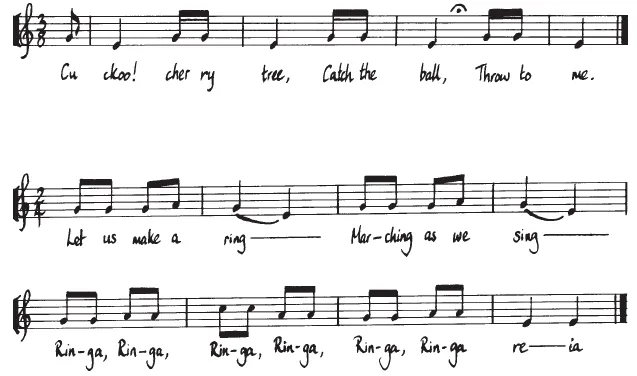
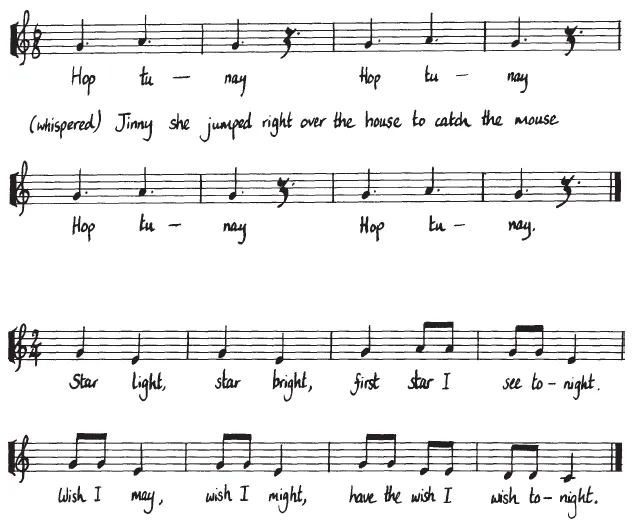
Here are four songs for first singing:
joining-in song: Bluebells, Cockle Shells
Childhood has its own songs, baby and toddler lullabies, bouncing games, jig-jog ditties and tickling rhymes; songs which are sung by adults for young children to take part in. Older children out playing have traditionally had their own singing games. This is an English skipping game in which the challenge is to see who can do the most ‘stitches’ or skips. The game is adapted for teachers to sing for and with the youngest children to encourage them to take part.
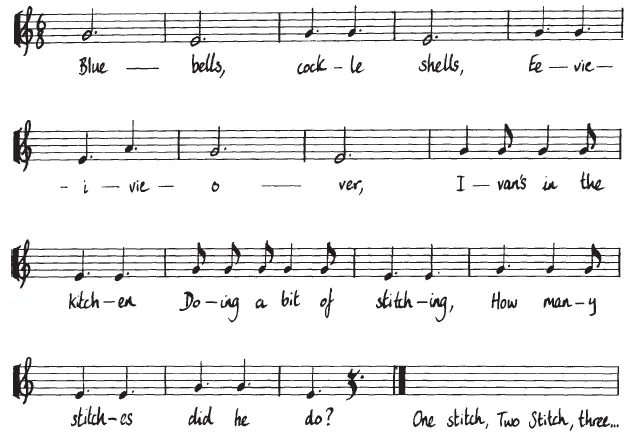
Hold both hands with a partner. (Teachers should offer children just one finger for clasping so that the child can release the grasp when they wish.) Swing both arms gently from side to side in time to the song. When it comes to ‘stitching’ mark out the counting with a downward bounce of both hands. The children decide how many stitches to count out each time. Children will have their own names for their primary carers, substitute these for each child in turn.
listen and watch for
- each child’s response to joining in with others;
- how each child joins in with voice (or not);
- how each child moves, level of coordination and control.
notice
- if joining in with singing, how their voice pitching matches the song;
- if joining in with movement, whether the child is swinging to a regular tempo.
intervention
In this song the teacher might partner children in turn and adjust the singing each time to the new child’s contribution. Careful observation will tell the teacher just what support the child needs.
progression
When children are able to join in with singing confidently new challenges are set:
- changing the pitch of the song, higher or lower;
- the tempo of the arm sway is changed and the singing becomes faster/slower;
- the dynamics are varied, sung quietly, louder or with variations of dynamics.
playing with words and rhyming
There is music in language. Creating an early years environment rich in rhymes, poems, chants, riddles and word games, drawn from a range of oral traditions, is not only valuable for laying the foundations of language learning (Whitehead, 1996) but for music also.
Patterns of words can be taken from songs and spoken rhythmically.
For example:
eevie ivie
eevie ivie
eevie ivie
over—
—perhaps repeated in sequence and said with many different voices, whispering, shouting, growling, squeaking and so on. Opportunities to discover and try out different voices are important for developing vocal freedom and variety. The one-liner chant (see above) ‘Hop tu nay’ combines singing with whispering and requires the children to change quickly from one to the other. Children can be encouraged to play around with their voices, ‘Can you wobble it, stretch it, twang it, slide it?’ (Victor-Smith, 1996).
Rhyming activities offer opportunities to explore the musical elements; where the accents fall, steady beat and metre, rhythm patterning and silences. For example, this well-known rhyme:
One potato
two potato
three potato
four—
five potato
six potato
seven potato
MORE! —
—has a skipping rhythm throughout but a silence after ‘four’ and ‘more’. The repetition builds towards the climax on MORE! The rhyme can get louder and louder, or start loud and become much quieter and end with a surprise shout and clap on the MORE! The possibilities for variation with such simple materials are endless. The inventiveness will come from the children who can be given the opportunity to offer their own versions.
The next chanting game is more suitable for older children. The rhyme has a vigorous, syncopated rhythm to it which is picked up in the strong consonants of the words ‘Kourilengay, Kalengena’.
children’s chanting game from Tanzania: Kourilengay Kalengena
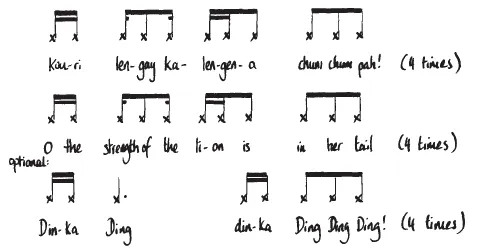
The children process, conga style, and stamp three times on the ‘chum chum pah!’. Think of dance in the African way, that the dancer is a drummer with the ground for a drum.
Children then stand and chant rhythmically the phrase ‘O the strength of the lion etc.’ and one child improvises a lion dance.
Different animals are chosen for the next verses and where the strength lies must be decided. (Be sure to alternate gender for animals.)
The chant ‘dinka ding’ is a kind of vocal percussion and should be spoken with lively rhythm and clear diction. These are the word sounds given in the rhyme, but the children could invent their own vocal percussion from short rhythmic sound words.
improvising and composing
Young children readily make up their own songs as part of all kinds of play. In the early years the differentiation between song and speech is hardly marked. Later children gradually separate out the two kinds of voice use and singing becomes limited to a particular and intentional kind of activity. Unfortunately, teachers often reinforce this separation earlier than necessary, sometimes even discouraging singing either directly as ‘being noisy’ or indirectly by negative attitudes or modelling. The initial readiness children have to use song as a quite normal medium of expression can be built on as a basis for improvising and composing songs.
Composing with the voice has the substantial advantage that children can tap directly into their musical sense, without the difficulty of managing to control sound produced externally on an instrument. In most cases they also have substantial direct experience of hearing and singing songs, which is not paralleled in instrumental music. The connection of language use and vocal music adds a further dimension at a stage when children are particularly sensitive to the intonation and rhythms of speech. As a result of all this, children’s early song compositions are usually much more advanced musically than their instrumental pieces (Glover, 1993).
spontaneous song making
Coral Davies (1986) notes how a spontaneous song sung by a 3-year-old reveals ‘how much music she has already absorbed from her experience in the nursery and at home’. Children’s songs draw on asp...
Table of contents
- Cover Page
- Title Page
- Copyright Page
- introduction
- planning for early years music
- playing games
- talking about music
- music through movement
- early stages in composing
- investigating music
- notating
- music for voice
- music with instruments
- assessment points
- books and resources
Trusted by 375,005 students
Access to over 1.5 million titles for a fair monthly price.
Study more efficiently using our study tools.
Frequently asked questions
Yes, you can cancel anytime from the Subscription tab in your account settings on the Perlego website. Your subscription will stay active until the end of your current billing period. Learn how to cancel your subscription
No, books cannot be downloaded as external files, such as PDFs, for use outside of Perlego. However, you can download books within the Perlego app for offline reading on mobile or tablet. Learn how to download books offline
Perlego offers two plans: Essential and Complete
- Essential is ideal for learners and professionals who enjoy exploring a wide range of subjects. Access the Essential Library with 800,000+ trusted titles and best-sellers across business, personal growth, and the humanities. Includes unlimited reading time and Standard Read Aloud voice.
- Complete: Perfect for advanced learners and researchers needing full, unrestricted access. Unlock 1.5M+ books across hundreds of subjects, including academic and specialized titles. The Complete Plan also includes advanced features like Premium Read Aloud and Research Assistant.
We are an online textbook subscription service, where you can get access to an entire online library for less than the price of a single book per month. With over 1.5 million books across 990+ topics, we’ve got you covered! Learn about our mission
Look out for the read-aloud symbol on your next book to see if you can listen to it. The read-aloud tool reads text aloud for you, highlighting the text as it is being read. You can pause it, speed it up and slow it down. Learn more about Read Aloud
Yes! You can use the Perlego app on both iOS and Android devices to read anytime, anywhere — even offline. Perfect for commutes or when you’re on the go.
Please note we cannot support devices running on iOS 13 and Android 7 or earlier. Learn more about using the app
Please note we cannot support devices running on iOS 13 and Android 7 or earlier. Learn more about using the app
Yes, you can access Music in the Early Years by Joanna Glover,Susan Young in PDF and/or ePUB format, as well as other popular books in Education & Education General. We have over 1.5 million books available in our catalogue for you to explore.