eBook - ePub
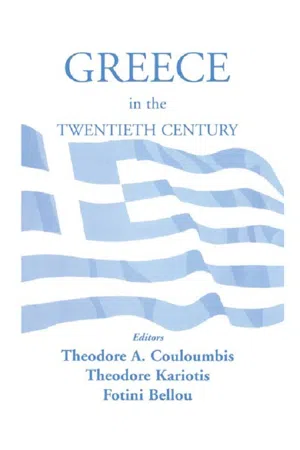
Greece in the Twentieth Century
- 336 pages
- English
- ePUB (mobile friendly)
- Available on iOS & Android
eBook - ePub
Greece in the Twentieth Century
About this book
This collective study examines the transformation (metamorphosis) that Greece has experienced over the course of the 20th century by exploring its gradual evolution into a consolidated democracy, an advanced economy in the Eurozone and a balanced partner in the EU and NATO promoting a stabilizing role in southeastern Europe.
The book examines the variables contributing to the profiling of contemporary Greece, emphasizing the conceptual inertia bedevilling the studies of Greece in recent years by focusing on the elements that indicated the slow pace in the country's modernization. In conclusion, there is a need for Greece's constant commitment to functional adjustments regarding the country's economic, political and strategic priorities in order to promote effectively the role of regional stabilizer acting in concert with NATO and EU partners.
PART I
1
The Evolving Content of the Greek Nation
THANOS VEREMIS and JOHN KOLIOPOULOS
The notion of a newly born nation is a convenient starting point to the question of the identity of the 1821 insurgents. The major themes in this respect are terms such as ethnos (nation) and genos (people), as well as the idea of the necessary space for the new nation state referred to as epikrateia (domain). The meaning of the term ethnos in revolutionary Greece is elusive and, more often than not, misleading: it was frequently used in the sense of the Orthodox Christians, irrespective of their mother tongue, or in the sense of the term genos, as well as in the sense of nation state.1 Religion and residence, as well as language and ‘descent’, were used in various combinations to define the identity of the members of the insurgent nation.
Religion was one determinant on which everyone agreed, while residence was accepted only in determining citizenship. Language was only grudgingly conceded for spreading Greek education to all the Orthodox subjects. One aspect of the early debates on the criteria for defining the ‘newly born’ nation, was the lack of consensus on any single criterion or combination of criteria. Two conflicting trends, a ‘modern’ and a ‘traditional’, clashed over the suitable criteria for defining the new nation and the identity of its members, the former favouring language, while the latter insisting on religion. Eventually, religion prevailed as the dominant criterion for defining the modern Greek nation while irredentist ideology became the hallmark of its modern history.
Most significant for the growth of a modern national identity and ideology, what came to be known as the ‘Great Idea’ (Megali Idea), projected the state as the arbiter of Greek fortunes. Eventually the nation state, it secured unchallenged supremacy in the ideological restructuring of the traditional Greek world outside the state’s boundaries and succeeded in forcing the Ecumenical Patriarchate to relinquish its leading role in the Greek world.
However, before this ‘Helladic’ ideological imperium was established, the Greek nation state had first to develop a coherent ideology out of the diverse ideas put forward in insurgent Greece. Religious differentiation from the Turks was no longer sufficient in the new political framework. It was, above all, essential to define modern Greek identity in relation to the other Orthodox peoples in the Balkans, Bulgars, Albanians and Vlachs, with claims to the same lands. What was the relation of the Greeks to these ‘others’, and who were the Greeks?
The name Hellenes for these post independence Greeks was irresistible and perhaps unavoidable, in view of the early and strong identification with ancient Hellas. Graecoi was also recommended as a conscious departure from Romaioi or Romioi, which were still in use in insurgent Greece but too much identified with the nation’s eastern antecedent. Graecoi was thought to be most appropriate and in accord with Western usage.2 The denomination Hellenes prevailed, because it was thought to be most appropriate for the ‘descendants’ of the ancient Greeks; this notion, however, undermined the potential appeal of the modern Greeks to their co-religionists in the Sultan’s dominions, whose antecedents could not be traced as far back as those of the Greeks. This departure from tradition, which reflected the conscious effort to resurrect the classical past in as many ways as possible, in conjunction with the inelegant parting from the Ecumenical Patriarchate, vitiated the very vision of a Greek cultural imperium over the other Orthodox Christians of the East, and at the same time dug a deep ditch between popular culture and the ‘new state culture’.
How could the Greeks present themselves credibly as leaders of all the Orthodox Christians of the East, when their choice of name signified a turn to an antecedent that placed language at the centre of national identity and made it the major, if not the sole determinant, of that identity? Was language alone, even as highly esteemed a language as Greek among non-Greek speaking co-religionists, an adequate instrument for the establishment of the new Greek empire? All the declarations that the insurgents had been fighting for, ‘the faith and the cross’ and for the establishment of a ‘Christian nation’, were these solemn protestations made to dupe those who had always been suspicious of Greek aims?
These were legitimate questions for the non-Greek speaking Orthodox Christians of the Ottoman Empire to pose and for the Greeks of the time and subsequent times to answer. The crux of the matter was this: how could the Greeks possibly aspire to build a Western nation state based on their own language as the primary determinant of identity and hope to incorporate and accommodate the non-Greek speaking Orthodox Christians in that nation state as their equals? For more than 50 years no one had real cause to either ask this question or try to answer it. Albanian-speaking Suliots and Hydriots, Vlach-speaking Thessalians and Epirots and Slav-speaking Macedonians had fought in revolutionary Greece along with the other Greeks, and no one had thought that non-Greek speakers were any less Greek than Greek speakers. When most of the northern Greek fighters settled in southern Greece as refugees, they were not made to think that they were lesser Greeks for speaking little or no Greek, the ongoing debate on Greekness and Greek identity notwithstanding. Essentially, this question was never posed before the Greeks met the Bulgars in the north as competitors; even then, however, the real issue was circumvented by superimposing ‘sentiments’ or ‘consciousness’ on language.
The vision of a Greek Christian empire, however, was no longer a driving force behind the objectives and actions of those who held power in the ‘model’ kingdom. At best it was a harmless fantasy, at worst a show of bravado put on for the benefit of the masses who still held fast to that vision. The protagonists of the ‘first’ Greek war of liberation were now comfortably established as army generals, senators and ambassadors, decorated by the Greek and foreign monarchs, while their progeny were manning the civil service and were well on the way to giving the country an indigenous but thoroughly Westernized intelligentsia. This generation of Greeks offered the nation a truly modern theory of Greek history and nationality. Building on existing scholarship and working in the changed atmosphere of the 1850s and 1860s, Spyridon Zambelios and especially Konstantinos Paparrigopoulos were able to construct a historical edifice that survived the onslaught of many subsequent historiographers and served the reconstruction of the union as no other theory has.3
Some of the major and lasting contributions of the Zambelios-Paparrigopoulos school have been: i) the restoration of Byzantium in the history of Eastern Christendom and of the Greek nation; ii) the establishment of the cultural continuity of the Greek nation in time and in space; and iii) the convincing projection of the modern Greek nation as a cultural community consisting of all the linguistic groups and peoples it has incorporated in its long history from antiquity to modern times. All three concepts reaffirmed contemporary opinion about culture as the primary determinant of modern Greek national identity and placed that identity on what appeared at the time a safe and solid course of national development.
Paparrigopoulos’ concept of Greek history and the modern Greek nation provided the principal arguments in support of Greek claims to the Sultan’s European and Asia Minor dominions. It also strengthened the conviction of the generation of Greeks that confronted the Turks and the Bulgars in the period between the Congress of Berlin (1878) and the Treaty of Lausanne (1923), that the Greek cause rested on solid historical and moral ground. Subsequent developments and particularly the insecurity associated with a long and vulnerable border and the presence of minorities claimed by neighbours as their brethren, derailed these concepts and arguments from their old cultural tracks.
The Greeks of the interwar period were led to believe that all people inhabiting Greece were or ought to have been Greek, not only in sharing the same culture, but also in speech. Greek national ideology and assumptions about the Greek nation were led, under the influence of the threat from Bulgaria and international communist sedition, into a narrow path which did not allow differences in speech or in any other way. The broad and all-embracing approach to national identity of the nineteenth century, which did not distinguish Albanian, Vlach, Slav or Turkish speakers from the dominant Greek-speaking component of the nation, had given way to a narrow interpretation of modern Greek identity. Before settling down for the more modern approach, which defines the modern Greek nation as a cultural community embracing all the linguistic groups that the Greeks have incorporated and absorbed in their history, Greek officials would frown upon what had come to be considered dangerous deviations from the model Greek and manifestations that negated the homogeneous nation. The Greek state of course did not invent assimilation, nor did it remain attached to such national visions longer than others in the West. Suppression of Slav Macedonian speech in Greece came much later than the ordeal of such ‘others’ in the West as the Huguenots, the Moriscos, the Irish or the American Indians, but was followed by the ordeal of the Jews, the Gypsies and the Blacks.
A disgruntled group of intellectuals, who included Ion Dragoumis and looked back to an idealised and fictitious pre-independence past, turned back to the Greek kingdom as the ‘beacon’ of the West in the East and searched in that past for guidance to re-fashion the Greek nation. There was only a slight and subtle shift from the traditional position on the Greek nation, but this shift cast doubts on the Western liberal tradition as the proper premise for the nation. Violent death before the rise of fascism saved Dragoumis from seeing his ideas seized upon by the theorists of the Metaxas dictatorship between 1936 and 1940, and turned into ideological caricature.4
The content of Greek nationalism was transformed during the interwar period. The Asia Minor debacle of 1922 that put an end to the largest Greek community outside the realm, signified the end of Greek irredentism and the beginning of a parochial definition of ‘Greekness’. At the same time the Comintern decided in 1924 that Greek, Bulgarian and Serbian inhabitants of the geographic region of Macedonia ought to unite into an autonomous whole under Bulgarian tutelage. The decision initially split the Greek Communist Party before it fell in line with the Comintern, but its ultimate compliance made it the target of much abuse by the state. Besides threatening the established social order, the communists were viewed as conspiring to cede territory from the national body. The ‘danger from within’ was an entirely new threat to a state that had known only external adversaries. The fear of encirclement on both external and internal fronts forged a mentality that looked for overt and covert enemies. Whereas during the years of irredentism state ideology reflected a generosity of spirit towards potential convertees and tolerance for ethnic idiosyncracies, the interwar state pursued its mission in history. The exclusive relationship with antiquity became one of the two legitimising elements of ethnicity. The other was ideological purity.
The new content of Greek nationalism was a negative reflection of the communist creed. Class analysis and Historical Materialism that cut across national distinctions indirectly shaped the future of the Greek state’s ideological orientation. The Greek Communist Party (KKE) provided the state with ample opportunity to persecute it. In 1931, responding to the Comintern’s insistence that it should ‘wage the struggle for the right of true self-determination of the nations, including secession’,5 the KKE accused Greece of being ‘an imperialist state, which conquered by force entire regions inhabited by other nationalities …’6 The Liberal government of Eleftherios Venizelos had already drafted laws in 1929 which authorized the persecution of those whose thoughts and acts were believed to undermine the social order.
In the elections of 1936 the KKE received 5.76% of the votes and sent 15 MPs to Parliament who held a pivotal ‘balancer’ role between the conservative and liberal parties. This development diminished the popularity of the Parliamentary system among the supporters of the two larger parties and rendered the long-standing dictatorship of Greece’s Italian neighbour all the more attractive.
The Metaxas regimé of 1936–40 featured some of the trappings of its contemporary dictatorships but failed to secure the enthusiasm of a public that defied regiméntation. The fragmentation of Greek society by familial and patronage loyalties precluded the dissemination of ‘collec-tivistic nationalism’.7 Metaxas’ doctrine was based on the general will and the nation state as the highest repository of liberty. The regimé was defined as the ‘Third Civilization’, succeeding the Classical and Byzantine traditions and combining elements of both.8
Since most ethnic groups in Greece were conservative in their political affiliations and declared their identification with the nation, they did not suffer from the regimé. The traditional benign relationship of the major anti-liberal political forces with ethnic groups in Greece was thus carried over to the Metaxas government.9 The blatant exception to this rule were those Slavonic speakers of northern Greece who had viewed Asia Minor refugees settled in Greek Macedonia in 1923 as their natural adversaries. Not only were refugees given the coveted property of the exchanged Turks, but the destitute Asia Minor Greeks enjoyed preferential treatment by the state. The above reasons and the highhanded methods of the Metaxas functionaries in the north, who considered the ethnic Slavs politically suspect, compelled the latter to shift their loyalties to the Communist Party. Thus the Comintern decision of 1923 became a self-fulfilling prophecy with some ‘help’ from the Greek authorities.
During the Second World War Eastern Macedonia and Thrace were annexed by the Bulgarian forces in the name of a united Macedonia and Thrace. The western part of Macedonia was occupied by Italian and German forces that gave the secessionist element a free hand. The about-face turn of Nazi collaborators after the departure of the Germans brought them once more within the ranks of the communist guerillas -Greek and Yugoslav. The civil war of 1944–49 pitted the loyalist Slavonic speakers who fought on the side of the Greek army, against the secessionists, who joined the ranks of the communist-controlled ‘Democratic Army’. The latter’s defeat signified the exodus from Greece of people who had placed their hopes first on an autonomous Macedonia under Bulgarian tutelage, and subsequently on a Socialist Republic within Tito’s Yugoslavia.10 Throughout the post-war years, the voting patterns in western Macedonia, where most of the present day Slavonic speakers reside, have favoured right-wing parties.
The Greek Civil War polarised society, politics and ideology. This did not occur under conditions of dictatorial rule in a state which, in spite of various constitutional irregularities and extraordinary measures, continued to observe the essential rules of parliamentary democracy. The Communist Party that abstained in the 1946 elections and called upon its followers to defy their outcome, was outlawed following the outbreak of hostilities, but all the other parties continued to operate undeterred by the Civil War and the social chal...
Table of contents
- Cover
- Half Title
- Full Title
- Copyright
- Contents
- List of figures
- List of tables
- Notes on Contributors
- Foreword
- Acknowledgements
- Introduction
- PART I
- PART II
- PART III
- PART IV
- PART V
- Index
Trusted by 375,005 students
Access to over 1.5 million titles for a fair monthly price.
Study more efficiently using our study tools.
Frequently asked questions
Yes, you can cancel anytime from the Subscription tab in your account settings on the Perlego website. Your subscription will stay active until the end of your current billing period. Learn how to cancel your subscription
No, books cannot be downloaded as external files, such as PDFs, for use outside of Perlego. However, you can download books within the Perlego app for offline reading on mobile or tablet. Learn how to download books offline
Perlego offers two plans: Essential and Complete
- Essential is ideal for learners and professionals who enjoy exploring a wide range of subjects. Access the Essential Library with 800,000+ trusted titles and best-sellers across business, personal growth, and the humanities. Includes unlimited reading time and Standard Read Aloud voice.
- Complete: Perfect for advanced learners and researchers needing full, unrestricted access. Unlock 1.5M+ books across hundreds of subjects, including academic and specialized titles. The Complete Plan also includes advanced features like Premium Read Aloud and Research Assistant.
We are an online textbook subscription service, where you can get access to an entire online library for less than the price of a single book per month. With over 1.5 million books across 990+ topics, we’ve got you covered! Learn about our mission
Look out for the read-aloud symbol on your next book to see if you can listen to it. The read-aloud tool reads text aloud for you, highlighting the text as it is being read. You can pause it, speed it up and slow it down. Learn more about Read Aloud
Yes! You can use the Perlego app on both iOS and Android devices to read anytime, anywhere — even offline. Perfect for commutes or when you’re on the go.
Please note we cannot support devices running on iOS 13 and Android 7 or earlier. Learn more about using the app
Please note we cannot support devices running on iOS 13 and Android 7 or earlier. Learn more about using the app
Yes, you can access Greece in the Twentieth Century by Fotini Bellou,Theodore A. Couloumbis,Theodore C. Kariotis in PDF and/or ePUB format, as well as other popular books in History & 20th Century History. We have over 1.5 million books available in our catalogue for you to explore.