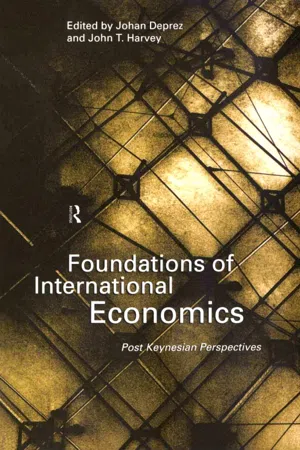
This unique collection presents a Post-Keynesian perspective on international economics and trade. All the major areas in international economics are covered, with the Post-Keynesian approach giving a welcome fresh perspective. The book is divided into five main sections:
* foreign trade
* open economy
* international payments systems
* exchange rate determination
* development.
Unavailable elsewhere, the readings present original, state-of-the-art research by leading Post-Keynesian scholars.
Contributors include: Philip Arestis, Robert Blecker, Paul Davidson, Sheila Dow, Bruce Elmslie, Ilene GrabelJohn McCombieEleni Paliginis, A.P. ThirlwallL. Randall WrayJohan Deprez, John T. Harvey,
eBook - ePub
Foundations of International Economics
Post-Keynesian Perspectives
- 296 pages
- English
- ePUB (mobile friendly)
- Available on iOS & Android
eBook - ePub
About this book
1 Introduction
Johan Deprez and John T. Harvey
It is difficult today to read any economic literature, popular or scholarly, without soon encountering references to ‘globalization,’ ‘transnationals,’ ‘multinationals,’ and the like. As we are reminded every day, the world is getting smaller and smaller and, in the process, more interdependent. A financial crisis in East Asia can be a cause of genuine concern to farmers in Iowa. Chinese labor laws significantly affect the economic and social status of workers (employed and unemployed) in Birmingham. The prospect of a European central bank has ramifications well beyond the borders of the European Union. All of this is increasingly evident to both participants and bystanders in this process.
What is not evident, however, is how to fully explain the effects, present and future, of these developments. In fact, one of the chief concerns of the authors in this volume is that a number of dangerously misleading ‘truths’ have arisen in the subject of international economic relations. Especially frightening is the fact that these myths are not confined to the financial pages or the after-hours conversations of business professionals; instead, they inform and guide public policy. Policy cannot be designed in the absence of theories that adequately explain the underlying relationships. Little wonder so few years pass between crises in the international monetary system.
The chapters in this book offer ‘Post Keynesian’ perspectives on international economic issues. It is our contention that these essays, because they are based on a more realistic view of the nature of economic activity, are better able to explain the character of the contemporary world economy. Though this Post Keynesian literature has been growing rapidly in recent years, the present volume is the first attempt to assemble the views from the leading Post Keynesian scholars in one work. The chapters address a variety of theoretical, applied, and empirical issues ranging from exchange rates and capital flows to trade and development. Our hope is that this book can serve as a comprehensive reference to others interested in the current state of Post Keynesian research and that it may stimulate other explorations and policy discussions in this direction. The book is also aimed at upper-level undergraduate and graduate students in order that their interest can be stimulated, as well.
We believe that the reader will find that the foundations of Post Keynesian theory are not opaque or mysterious (in fact, to us they seem like common sense), and that the policies Post Keynesians recommend are very reasonable. Indeed, while the programs advocated often require substantial overhauls of existing institutions, they call neither for the collapse of capitalism nor the privatization of all economic functions. Such extremes are not necessary to correct the flaws of our system. The particular topics addressed by the authors are such that the reader should finish this book with an understanding of the theoretical bases of Post Keynesian international economics, an appreciation of the policies those theories would suggest, and a grasp of how the structure of the current system is bound to lead to instability and deflation.
What is Post Keynesian economics? Though there are several strands of thought, a number of commonalities can be identified. First, economic agents are understood to operate in an environment of uncertainty. This creates the conditions that make money important in the macroeconomy, thereby invalidating Say’s Law. No other characteristic of Post Keynesian modeling has more farreaching effects. When money plays a causal role, full employment is no longer guaranteed by free markets. As a consequence, the government plays an important, even vital, role in the economy and microeconomic issues become clouded as the concept of opportunity cost becomes irrelevant. ‘Free Traders’ can no longer argue that workers whose jobs are destroyed by foreign competition will, after a short period of adjustment, find themselves automatically employed in industries that better reflect their economy’s comparative advantage (in the process raising world welfare). Without Say’s Law, nations accumulating balance of payments surpluses become antisocial drains on the level of world production and employment, rather than international role models for aspiring capitalists. The whole array of policy choices and consequences is changed when money matters.
Second, Post Keynesians believe that the economy is best modeled as existing in historical rather than logical or mechanical time. This means that they believe that the past has a real, qualitative impact on the future, that economic agents’ decisions are affected by past events. As economic outcomes are realized, so market participants take these into account and their behavior is thus changed. When time is important in this way, the general equilibrium framework is not appropriate. At the very least, it must be used with great care, for general equilibrium models typically assume that everything happens simultaneously. That is, prices are set, contracts are struck, wages are earned, inputs are purchased, capital is built, incomes are spent, and output is produced all at the same instant. The economy reaches a state of equilibrium and stays there until one or more parameters change (until a function shifts, for example). The realized equilibrium does not somehow affect future ones by changing parameters (and therefore the underlying behavior). The parameters, the outcome, the equilibrium, and, therefore, the economy are assumed stable in the general equilibrium approach. Not so in the Post Keynesian.
In terms of market structure, Post Keynesians realize that oligopolies play a terribly important political and economic role in the real world. Oligopolists (or ‘megacorps’) have market power. They set price by marking up over cost, and they use the funds so generated to finance investment. Oligopolists compete with one another not through price, but via purchases of new plant and equipment, product differentiation, erection of barriers to entry, and public relations efforts (Eichner1976). Because of the nature of the industries that tend toward oligopoly (manufacturing and mining in particular), ‘the production subsystem of the economy is essentially dominated by the megacorp’ (Arestis 1992: 89).
The fourth distinguishing characteristic of Post Keynesian economics is the recognition of the importance of income distribution in explaining the macrodynamics of modern economies, as well as the socially determined nature of the distribution of income. The split between wages and profits and the rates of each are seen to be determined by investment, growth, historical circumstances, power relationships, institutional conditions, expectations of firms and households, and social policy. The distribution of income and wage and profit rates are not seen as physically determined and to be functions of the marginal products of labor and capital, even if one assumes these are identifiable concepts. While the specific justification for arguing that income distribution is socially determined may vary within Post Keynesian economics, all agree on its general nature and that it is a very appropriate realm for socioeconomic policy.
This book is divided into four parts: Balance of Payments Issues; Open Economy Macroeconomics; International Money and Exchange Rates; and Real and Portfolio Capital Flows and the Role of Technology. The individual chapters run the gamut from theory to empiricism to policy. Whenever possible, technical detail has been kept to a minimum in the hope that this text will be accessible to both scholars and students.
The opening chapter is, appropriately, from the editor of the Journal of Post Keynesian Economics: Paul Davidson. Professor Davidson’s theme is one that is repeated throughout this volume: capital market activity aimed at earning speculative profits is only coincidentally beneficial to output and employment growth. Indeed, the opposite is far more likely. His specific focus is international portfolio capital movements, and it is his contention that the progressive post-war liberalization of markets, including especially the collapse of the Bretton Woods exchange rate agreement, has created an international economic system with a deflationary bias (that is, a tendency toward economic stagnation and unemployment). What is required is both a reform of the payments system such that surplus countries are punished for the drain they create on world economic activity and a conscious recognition on a national level that governments must work to maintain full employment. Until that is achieved, trade is far more likely to play a predatory role than a constructive one.
The next chapter, by John S.L. McCombie and A.P. Thirlwall, is an excellent review of the literature related to balance of payments growth constraints, or Thirlwall’s Law. Their basic premise is that, just as Post Keynesians argue that the gap between desired investment and full-employment saving is an obstacle to economic growth, so is that between export earnings and full-employment imports. They begin with an outstanding historical overview of the theory, then work through a theoretical exposition, and close with implications and empirical evidence. The lesson learned from this chapter is that closed economies exist only on paper and that, in our increasingly interdependent world, the maintenance of full employment requires careful analysis of balance of payments issues in addition to domestic macroeconomic considerations.
The next part of the book is entitled Open Economy Macroeconomics. Johan Deprez’s chapter takes Keynes’ aggregate supply and demand as it has been articulated and developed by Sidney Weintraub and Paul Davidson for closed economies and extends it to deal with open economies. This model reaffirms the basic Keynesian conclusion that production and employment is constrained by the effective demand that exists in an economy and the role of exports in this. The model is articulated in such a way as to highlight the rarely understood role of firms’ expectations in determining employment, output, and patterns of trade. In a manner that is consistent with Post Keynesian explanations of the determination of exchange rates, it is also argued that there is no tendency within modern economies towards a balance of trade. Finally, by having an explicit supply side in the model, it is capable of addressing a wide range of other issues. Specifically, the question of cost reductions as a means of expanding exports is addressed and is found to be much more problematic than usually assumed.
Robert Blecker follows with a Kaleckian open-economy model. While both reviewing Kalecki’s contributions to international economics and extending that work, Blecker makes three main points: (a) trade in the presence of oligopolistic industries can be conflictive; (b) in contrast to the implications of closed-economy Kaleckian models, it is possible when a foreign sector is introduced for a redistribution of income from wages to profits to be contractionary rather than expansionary; and (c) the relative effects of a currency devaluation on the trade balance and national income are not clear without taking into account the impact on income distribution. Though he finishes by cautioning the reader that the model needs to be extended, the preliminary results are nonetheless thought provoking. They serve to remind us that however well designed a domestic macro model might be, adding international trade and investment often involves more than simply a new variable or two.
Sheila Dow’s chapter opens the next part of the book, International Money and Exchange Rates. She develops a Post Keynesian international finance theory in which liquidity preference and endogenous credit creation play a central role. Dow argues that, though all economic units have balance of payments problems the ‘solutions’ to which are likely to be deflationary, that bias is made worse in the international context by currency speculation. The solution is to provide financial stability and low interest rates, which may be possible on the necessary scale only given a truly international money.
L. Randall Wray’s chapter addresses similar concerns from a different direction. He starts by outlining the orthodox view of money, capital flows, and exchange rates, wherein free markets ensure independent domestic macro policies and rapid adjustments to optimal equilibria. He then presents the Post Keynesian view, which leads him to Keynes’ famous bancor proposal for the international monetary system. Wray argues that while the latter is appropriate in a world where money matters, Keynes’ original justification for it was flawed. Wray remedies this and thus provides additional support.
In his chapter, John Harvey explains the exchange rate volatility and misalignment characteristic of the post Bretton Woods era. He sees these as a function of the spectacular growth of short-term capital flows and the fact that portfolio investment now, for all intents and purposes, determines exchange rates. He concludes that the effect of this transformation has been payments imbalances, resource misallocation, reduced government policy autonomy, and wasted entrepreneurial skills.
The last part is Real and Portfolio Capital Flows and the Role of Technology. There, Philip Arestis and Eleni Paliginis examine recent economic developments on the periphery of the European Union and the North American Free Trade Area. Their thesis is that these economic unions have not created the institutions necessary to promote convergence, and that as a consequence the peripheral economies remain at a significant disadvantage. Though orthodox theorists and policymakers have argued that multinational capital will be attracted to these regions and therefore spur their development, the reality is that it is too volatile and generally unreliable to be of much help. Arestis and Paliginis suggest that though multinational enterprises could play a positive role if properly controlled, the best solution would be encouragement of indigenous capital accumulation.
Ilene Grabel shows that the pitfalls of dependence on international capital for development are not limited to those described in the previous chapter. Third World reliance on portfolio investment, she shows, tends to adversely constrain macro policy choices and increase risk. Grabel both makes this argument on a theoretical level and uses the 1994–6 Mexican financial crisis to illustrate her points.
The last contribution is from Bruce Elmslie and Flavio Vieira. Unique in the volume, their chapter is the only one to take a closer look at the determinants, rather than the effects, of foreign trade. In particular, they focus on the role technology plays in generating trade patterns, an approach consistent with the Post Keynesian emphasis on the megacorp as the most important representative firm. They start by reviewing the history of technology gap theory, beginning with the mercantilists. They then review modern attempts to reconcile technology gap theory within the framework of both comparative and absolute advantage, discuss testing issues, and review the empirical literature. Their theme is that though technology gap theory is difficult to operationalize, the fact that it is a much more powerful explanation of the real world than the orthodox alternatives more than justifies the efforts to do so.
We hope that the eleven chapters in this volume give the reader a fresh perspective on the international economy. As the world shrinks and nations become more and more interdependent, so the need for penetrating analyses of those conditions becomes more pressing. We believe that the Post Keynesian approach – relying on the non-neutrality of money, the oligopolistic nature of industry, and the existence of the economy in historical time – is best poised to offer these analyses.
References
Arestis, P. (1992) The Post Keynesian Approach to Economics, Aldershot, Hants. Edward Elgar.
Eichner, A. (1976) The Megacorp and Oligopoly: Micro Foundations of Macro Dynamics , Armonk, N.Y: M.E. Sharpe.
Part I
Balance of payments issues
2 Global employment and open economy macroeconomics
Paul Davidson
Keynes’ (1936) General Theory of Employment Interest and Money1 is developed primarily in a closed economy context. Keynes did, however, introduce an open economy analysis when he noted that:
- trade could modify the magnitude of the domestic employment multiplier (120);
- reductions in money wages would worsen the terms of trade and therefore reduce real income, while it could improve the balance of trade (263); and
- stimulating either domestic investment or foreign investment can increase domestic employment growth (335).
In a world where governments are afraid that to deliberately stimulate any domestic spending will unleash inflationary forces, export-led growth is seen as a desirable alternative path for expanding domestic employment. A ‘favorable balance [of trade], provided it is not too large, will prove extremely stimulating’ to domestic employment (338), even if it does so at the expense of employment opportunities abroad.
In a passage that is particularly a propos for today’s global economic setting, Keynes noted that ‘in a society where there is no question of direct investment under the aegis of public authority [due to fear of government deficits per se], the economic objects, with which it is reasonable for the government to be preoccupied, are the domestic interest rate and the balance of foreign trade’ (335). If, however, nations were permitted free movement of funds across national boundaries, then ‘the authorities had no direct control over the domestic rate of interest or the other inducements to home investment, [and] measures to increase the favorable balance of trade [are]. . . the only direct means at their disposal for increasing foreign investment’ (336) and domestic employment.
Keynes was well aware that the domestic employment advantage gained by export-led growth ‘is liable to involve an equal disadvantage to some other country’ (338). When countries pursue an ‘immoderate policy’ (338) of export led growth (for example, Japan, Germany and the newly industrializing countries (NICs) of Asia in the 1980s), the unemployment problem is aggravated for the surplus nations’ trading partners.2 These trading partners are then forced to engage in a ‘senseless international competition for a favourable balance which injures all alike’ (338–9). The traditional approach for improving the trade balance is to make one’s domestic industries more competitive by either forcing down nominal wages (including fringe benefits) to reduce labor production costs and/or by a devaluation of the exchange rate.3 Competitive gains obtained by manipulating these nominal variables can only foster further global stagnation and recession as one’s trading partners attempt to regain a competitive edge by similar policies.
Unlike the classical theorists of his day (and our day as well4) Keynes recognized that ‘the mercantilists were aware of the fallacy of cheapness and the danger that excessive competition may turn the terms of trade against a country’ (345) thereby reducing domestic living standards, so that, as President Clinton noted in his 1992 campaign, ‘people are working more and earning less.’
Keynes realized that if every nation did not actively undertake a program for public domestic investment to generate domestic full employment, then the resulting laissez-faire system of prudent fiscal finance in tandem with a system of free international monetary flows would create a global environment where each nation independently sees significant national advantages in a policy of ...
Table of contents
- Cover Page
- Title Page
- Copyright Page
- Figures
- Tables
- Contributors
- Acknowledgements
- 1 Introduction
- Part I Balance of payments issues
- Part II Open economy macroeconomics
- Part III International money and exchange rates
- Part IV Real and portfolio capital flows and the role of technology
Trusted by 375,005 students
Access to over 1.5 million titles for a fair monthly price.
Study more efficiently using our study tools.
Frequently asked questions
Yes, you can cancel anytime from the Subscription tab in your account settings on the Perlego website. Your subscription will stay active until the end of your current billing period. Learn how to cancel your subscription
No, books cannot be downloaded as external files, such as PDFs, for use outside of Perlego. However, you can download books within the Perlego app for offline reading on mobile or tablet. Learn how to download books offline
Perlego offers two plans: Essential and Complete
- Essential is ideal for learners and professionals who enjoy exploring a wide range of subjects. Access the Essential Library with 800,000+ trusted titles and best-sellers across business, personal growth, and the humanities. Includes unlimited reading time and Standard Read Aloud voice.
- Complete: Perfect for advanced learners and researchers needing full, unrestricted access. Unlock 1.5M+ books across hundreds of subjects, including academic and specialized titles. The Complete Plan also includes advanced features like Premium Read Aloud and Research Assistant.
We are an online textbook subscription service, where you can get access to an entire online library for less than the price of a single book per month. With over 1.5 million books across 990+ topics, we’ve got you covered! Learn about our mission
Look out for the read-aloud symbol on your next book to see if you can listen to it. The read-aloud tool reads text aloud for you, highlighting the text as it is being read. You can pause it, speed it up and slow it down. Learn more about Read Aloud
Yes! You can use the Perlego app on both iOS and Android devices to read anytime, anywhere — even offline. Perfect for commutes or when you’re on the go.
Please note we cannot support devices running on iOS 13 and Android 7 or earlier. Learn more about using the app
Please note we cannot support devices running on iOS 13 and Android 7 or earlier. Learn more about using the app
Yes, you can access Foundations of International Economics by Johan Deprez,John T. Harvey in PDF and/or ePUB format, as well as other popular books in Economics & Business General. We have over 1.5 million books available in our catalogue for you to explore.