- 215 pages
- English
- ePUB (mobile friendly)
- Available on iOS & Android
eBook - ePub
About this book
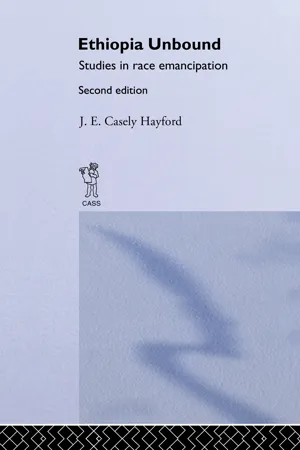
First published in 1969. This is the second edition of this colection of studies on Ethiopia, with a new introduction by F. Nnabuenyi Ugonna of the University of Ibadan in 1966.
Information
This impression first published by
FRANK CASS AND COMPANY LIMITED
This edition published by Routledge – 2012
2 Park Square, Milton Park, Abingdon, Oxon, OX14 4RN
711 Third Avenue, New York, NY 10017
Routledge is an imprint of the Taylor & Francis Group, an informa busines
This edition Copyright © 1969
| First edition | 1911 |
| Second edition | 1969 |
Transferred to Digital Printing 2005
ISBN: 978-1-136-25253-2(ebk)
ISBN: 978-0-714-61753-4(pbk)
Introduction to the Second Edition
1. THE IMAGES OF AFRICA
IN their early contacts, the African cultural milieu was most unfamiliar to the European adventurer, administrator, trader or missionary. Stone castles, gigantic steel works, cannon, or engine-driven machines with which they had been familiar were nowhere to be found. Neither were cities with well planned streets, buildings and public conveniences easily in evidence. Confronted with this disparity in the level of technological advance between Europe and Africa, the European groped for pseudo-scientific explanations to account for the differences in culture. He was convinced of the superiority of his own culture. Later, to justify the colonization of Africa and racial subjugation, he created and fostered the myth of the natural inferiority of the Negro race. “Divines and politicians, physiologists and scientists,” remarked Edward W. Blyden, “exhausted the resources of their intellect in the endeavour to prove the Negro only quasi-human, an excellent animal, but only an animal—born to serve a superior race.”1 To many Europeans the strongest point in favour of the supposed natural inferiority of the Negro race seemed to be the apparent absence of writing. Together with the rudimentary state of African technology, the absence of writing provided ready “proof” for the belief that the African possesses a distinct type of psyche, a being sui generis. This belief has led to such amusing conclusions as A. B. Ellis’s contention that Africans evince a degree of intelligence
which, compared with that of the European child, appears precocious; and they acquire knowledge with facility till they arrive at the age of puberty, when the physical nature masters the intellect, and frequently deadens it. This peculiarity, which has been observed amongst others of what are termed the lower races, has been attributed by some physiologists to the early closing of the sutures of the cranium…. They can imitate but they cannot invent or even apply. They constantly fail to grasp and to generalize a notion.1
Or Sir Richard Burton’s conviction that once an African has become adult,
his mental development is arrested, and thenceforth he grows backwards instead of forwards.2
The general image of the African as conceived by many Europeans especially in the past was that of a child-like monster, incongruously violent and tame, noisy, credulous, dishonest, inconsistent, and incapable of ruling himself. These beliefs, no doubt, provided the ideological justifications for colonialism and imperialism. The reactions of educated Africans to these prejudices in part took the form of cultural nationalism and a keen interest shown by them in African studies. J. E. Hayford, with the exception of E. W. Blyden, is probably the best known nationalist literati who sought through African studies to counteract the horrible and tendentious image of Africa and the African which had accumulated over the centuries.
2. THE “UNCROWNED KING” OF WEST AFRICA
Joseph Ephraim Casely Hayford, the author of Ethiopia Unbound, was perhaps the greatest nationalist leader in West Africa in his time. He combined good breeding and education with political sagacity and thorough-going patriotism. He was well-equipped for his political role, having been an educationist, a journalist and a legal practitioner.
Born on September 3, 1866, Casely Hayford was the fourth son of Rev. Joseph de Graft Hayford, of Anona Clan, Gold Coast (now Ghana). He attended the Wesleyan Boys’ High School at Cape Coast. He later went to Fourah Bay College, Freetown, Sierra Leone, and eventually returned to Cape Coast and became a teacher. In due course, he was appointed the Principal of Accra Wesleyan High School.
For a time Hayford served as an articled clerk to one Eiolart, a European legal practitioner in Cape Coast. From there he went to England where he entered the Inner Temple and Peter-house, Cambridge. On November 17, 1896 he was called to the bar and soon after, he returned to the Gold Coast (Ghana), and practised at the Cape Coast, Axim, Sekondi and Accra.
His first wife Beatrice Madeline was the mother of Archie Casely Hayford, a learned barrister, politician, and a minister in post-independence Ghana government. Archie appears to be suggestive of Ekra Kwow, the son of Kwamankra, “whose political wisdom was learnt at the feet of his father while yet he was in his teens” (Ethiopia Unbound, p. 107); and Casely Hayford no doubt had in mind Beatrice Madeline when he was creating the almost surrealistic relationship between Kwamankra and his wife Mansa. Hayford’s second wife, after Madeline, was Adelaide Casely Hayford, an educationist in her own right, born in Freetown. She was the mother of the late Gladys Hayford who was an actress with a remarkable poetic sensibility. Adelaide was the founder and Principal of an Industrial Institution for girls in Freetown.1
Casely Hayford was one of the early nationalist-journalists. He began his journalistic career under his uncle, Prince Drew of Dunkwa, editor of the Western Echo. Later, in 1893, he joined his uncle’s Gold Coast Chronicle as its sub-editor. Hayford afterwards became the editor of the Gold Coast Echo for two years. He was joint-editor with Attoh Ahuma of the Wesleyan Methodist Times.
The part played by the press in awakening the political consciousness of the masses of African people has been profound. The press was the most important link between the small but expanding group of educated West Africans in Gambia, Sierra Leone, Ghana and Nigeria, especially during the latter part of the 19th and the early part of the present centuries.
In Freetown, The Sierra Leone Weekly News which serially published Blyden’s African Life and Customs (1908), was instrumental in disseminating nationalistic ideas and propaganda. There was a proliferation of newspapers both in Lagos and Ghana between the 1880’s and the 1930’s. Most were, however, short-lived. Between 1890 and 1930 the Lagos Standard, The Lagos Weekly Record, the Lagos Daily News, the Lagos Daily Record, the Nigerian Times, the Times of Nigeria, the Nigerian Pioneer, the Nigeria Spectator and the Nigeria Advocate were among the papers published in Nigeria. In general, these papers had one objective in common: to inspire African nationalism and expose African discontent and frustrations with British imperial policy, which was characterised by discriminatory measures against the educated Africans and a “go-slow” attitude towards modernisation. James Coleman has remarked, for example, that “From 1891 to the early 1930’s, The Lagos Weekly Record owned and edited by John Payne Jackson (and after his death in 1918 by his son Thomas Horatio Jackson) was a determined agent in the propagation of racial consciousness.”1 For about forty years, The Record, the most vitriolic commentator on alien rule in Africa, had urged Africans to unite and become conscious of their common nationality. According to A. B. Laotan, editor of the Catholic Press, Lagos, “The Record was so powerful that at one time, on account of its uncompromising attitude in the national interest, all foreign advertisements were withdrawn, but it stood its ground unflinchingly…. It was by far and away the best paper in West Africa.”2
In Ghana by 1897, the proposed Crown Lands Bill of that year gave added impetus to the growth of a powerful newspaper press. Jones-Quartey has observed, “At the time of the Crown Lands dispute—indeed partly because of it—there was quite a formidable press in Ghana.”1 The Gold Coast People, The Gold Coast Independent, The Gold Coast Chronicle, The Gold Coast Express, and The Gold Coast Aborigines were the most important papers of the period.
Educated Ghanaians regarded the Crown Lands Bill as a step towards land alienation by the British Government. In 1897 the Gold Coast Aborigines Rights Protection Society was formed to oppose the Bill. John Mensah Sarbah (1864–1910), the first Ghanaian Barrister, ably fought for the preservation of the rights of his countrymen over their lands. No doubt, his handling of the Lands Bill thrust him into national leadership. With his death in 1910, the leadership of the Aborigines Society devolved upon Casely Hayford.
On his return to Ghana after having been called to the Bar, in 1896, Casely Hayford, in addition to his legal practice, continued his journalistic interest. With Herbert Brown, John Buckman, Attoh Ahuma and G. Acquah, he founded The Gold Coast Leader, a paper he employed (as Nnamdi Azikiwe was later to utilize The West African Pilot) to publicize the nationalists’ aspirations and programmes. Hayford soon emerged a national figure. He did much pioneering work in the Aborigines Rights Protection Society. On September 25, 1916, he was nominated as member of the Gold Coast Legislative Council, a position he held throughout his life save for a very short break. In September 1927, he became an elected municipal member for Sekondi in the Legislative Council.
Like John Mensah Sarbah, E. W. Blyden, Henry Carr of Nigeria, and many other pioneer leaders of West Africa, Hayford was particularly concerned with the question of African education. African leaders to this day believe, and quite rightly too, that the basis of rapid economic and cultural development is a sound system and high standard of education. Many cultural associations formed both in Ghana and Nigeria between 1860 and 1940 had as their most important objective the establishment of educational institutions. Many Yoruba cultural associations, for instance the Egba Union, interested themselves in the promotion of education. The primary aim of the Ibo Union inaugurated in 1936 in Lagos was to promote education among the Ibo youths. As one of the early leaders of this Union observed:
Give a boy a good secondary education and he can rise to any height in the world without being dragged down by the dead weight of inferiority complex.1
In Ghana, the same trend was evident in the 1890’s and 1900’s. The Fanti Confederation stressed none of its projects as strenuously as it did the education policy. The famous Mfantsipim School, established in 1904, was the result of the joint effort of Mensah Sarbah, Casely Hayford and a private company The Fanti Public Schools Limited. Considering this general preoccupation with education throughout West Africa, it is not at all surprising that in Casely Hayford’s public and private speeches educational issues were predominant. What is significant, however, is his unique educational philosophy in the African context; this aspect of his life work is discussed later. As an unofficial member of the Legislative Council he sought to bring pressure to bear upon the colonial government to ensure the liberalisation of education in Ghana. He pointed out that children from Ghana had to go to Freetown, Lagos or England for higher education. In the Gold Coast Independent of September 7, 1918, Hayford wrote: “We have already indicated that we stand for national institutions, for… Heaven helps those who help themselves.” As a practical step towards the realisation of his education project, he launched in 1919 the Gold Coast National Education Scheme. There were invitations to 200 founders each to pay £50 over a 5 year period.1 A Board of Trustees comprising T. Hutton Mills, M. C. Hansen, H. Van Hein, Rev. G. R. Acquah, J. E. Casely Hayford and R. J. Hayfron, was constituted. It is significant that all the Board members were leading figures in the National Congress of British West Africa, a nationalist movement in which Hayford played a dominant role.
Hayford served on many Boards and Government Commissions. He was a member of the Board of Education and of Achimota Council, and the numerous Commissions in which he served included the Takoradi Harbour Construction Commission, Town Council Reorganisation, Water Rate, Achimota Construction, Government Transport Department, Town Planning, Railway Mechanics’ Sales, and the African Officials’ Salary Scheme (1920).
Magnus J. Sampson has argued that “in politics Casely Hayford ros...
Table of contents
- Cover
- Title Page
- Copyright
- Dedication
- Contents
- I. An Ethiopian Conservative
- II. Sowing the Wind
- III. Love and Life
- IV. Love and Death
- V. In the Metropolis of the Gold Coast
- VI. The World, the Flesh, and the Devil
- VII. Signs of Empire: Loyal Hearts
- VIII. A Magisterial Function
- IX. The Yellow Peril
- X. The Black Peril
- XI. On the “Great North Western”
- XII. A Leader of Society
- XIII. Reaping the Whirlwind
- XIV. The Black Man’s Burden
- XV. As in a Glass Darkly
- XVI. Race Emancipation — General Considerations: Edward Wilmot Blyden
- XVII. Race Emancipation — Particular Considerations: African Nationality
- XVIII. Race Emancipation: The Crux of the Matter
- XIX. A Similitude: The Greek and the Fanti
- XX. And a Little Child shall Lead them
Trusted by 375,005 students
Access to over 1.5 million titles for a fair monthly price.
Study more efficiently using our study tools.
Frequently asked questions
Yes, you can cancel anytime from the Subscription tab in your account settings on the Perlego website. Your subscription will stay active until the end of your current billing period. Learn how to cancel your subscription
No, books cannot be downloaded as external files, such as PDFs, for use outside of Perlego. However, you can download books within the Perlego app for offline reading on mobile or tablet. Learn how to download books offline
Perlego offers two plans: Essential and Complete
- Essential is ideal for learners and professionals who enjoy exploring a wide range of subjects. Access the Essential Library with 800,000+ trusted titles and best-sellers across business, personal growth, and the humanities. Includes unlimited reading time and Standard Read Aloud voice.
- Complete: Perfect for advanced learners and researchers needing full, unrestricted access. Unlock 1.5M+ books across hundreds of subjects, including academic and specialized titles. The Complete Plan also includes advanced features like Premium Read Aloud and Research Assistant.
We are an online textbook subscription service, where you can get access to an entire online library for less than the price of a single book per month. With over 1.5 million books across 990+ topics, we’ve got you covered! Learn about our mission
Look out for the read-aloud symbol on your next book to see if you can listen to it. The read-aloud tool reads text aloud for you, highlighting the text as it is being read. You can pause it, speed it up and slow it down. Learn more about Read Aloud
Yes! You can use the Perlego app on both iOS and Android devices to read anytime, anywhere — even offline. Perfect for commutes or when you’re on the go.
Please note we cannot support devices running on iOS 13 and Android 7 or earlier. Learn more about using the app
Please note we cannot support devices running on iOS 13 and Android 7 or earlier. Learn more about using the app
Yes, you can access Ethiopia Unbound by J.E.Caseley Hayford,J.E.C. Hayford in PDF and/or ePUB format, as well as other popular books in Histoire & Histoire du monde. We have over 1.5 million books available in our catalogue for you to explore.