- 224 pages
- English
- ePUB (mobile friendly)
- Available on iOS & Android
eBook - ePub
About this book
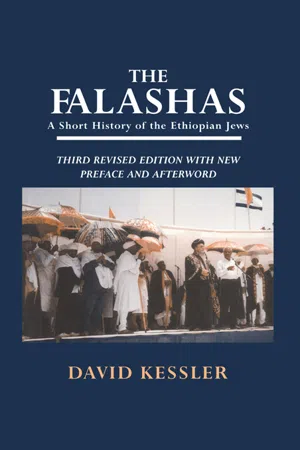
This third, revised edition comprises the whole of the original volume and is enhanced by the addition of a new preface and afterward which seek to reply to criticisms of the authors argument about the origins of the Falashas, and include some new thinking on the subject. Drawing on tradition and legend to reinforce his argument, the author again traces the source of the community to the Jewish settlements which existed in ancient Egypt (particularly at Elephantine on the Nile) and in the ancient Meroitic Kingdom, in present day Sudan known in the Bible as Cush.
The story told in this book is remarkable, heroic and stimulating and makes a valuable contribution to our understanding of the history of the horn of Africa.
1
Strangers in the Midst
THE state of Socialist Ethiopia, the successor since 1974 to the empire of Haile Selassie I, holds a unique position on the African continent. It is the only African state which has never succumbed to foreign rule, if we exclude the five years of Italian occupation, and the only country of black Africa to develop its own written language. The pattern of its history is shot through with legend and romance. Even today, as it struggles to find its destiny in a new world, an air of mystery attaches to the country with its superb mountain scenery and fascinating archaeological sites. In Byzantine times it was at one period rated the third most important power in the world. Hamito-Semitic or Afro-Asian, by language and culture, and basically a product of the civilisations of the Nile and the Red Sea, it shows a closer affinity with the Middle East than with sub-Saharan Africa. Hebraic traditions run deep in the only country of its continent which can claim that its rulers have always been Christian since the fourth century.
Ethiopia is a state composed of many peoples, many languages and several religions. Accurate statistics are hard to come by but it is estimated that of the present population of about 32 million, Christians of the Orthodox Coptic Church represent 60 per cent, Sunni Muslims 25 per cent, and others, including Jews, 15 per cent. There is a homogeneity in the appearance of most of the population. With the exception of small numbers of people of negroid stock along the southern and south-western borders and of Arabs on the Red Sea littoral the majority are a brown-skinned people of ‘Caucasian’ stock with a slight admixture of negro blood which has darkened their colour. Their features tend to be regular, many of them are tall and well built and both men and women are often strikingly handsome. The main languages of the country can be roughly divided between those of the older Hamitic or Cushitic family and those of the relatively more recent Semitic group. The latter are today the dominant tongues and are divided between Amharic, the official language of Ethiopia; Tigrinya, prevalent in Tigrai Province and the central highlands of Eritrea; and Tigre, spoken in northern Eritrea. The principal languages of the Cushitic group are Galla (or Oromo), Somali, Afar and Agau. Numerically, the two language groups are approximately equal and their members display a common range of physical characteristics. The country is overwhelmingly agricultural and exports considerable quantities of coffee, hides and skins, pulses and oilseeds. The rate of literacy in 1970 was only 8.1 per cent and the G. N. P. in 1972 stood as low as US $80 per capita.
This is the home of the Falashas, the indigenous Jews who still practise a pre-rabbinic form of Judaism. Their presence in the country pre-dates both the Christians and Muslims and their origin has for long been a subject for speculation. Their small clan, numbering today probably fewer than 30,000 souls, represents the relic of a tribe which has behind it a record of courage and endurance in the face of adversity which bears comparison with any other section of the Jewish people. They played a significant role in the formative period of the Ethiopian variety of Christianity, and for over a thousand years they maintained their independence, at one time, it is said, even overthrowing the paramount power of the Amhara kings.
The name Falasha derives from an ancient Ethiopic, or Ge'ez word, meaning to emigrate1 and hence signifies an exile, immigrant or stranger. It is sometimes used pejoratively, much as the word Jew is in English. Some Falashas prefer to call themselves Beta Israel (House of Israel) or else they use the more ancient Agau term kayla. Their original language is a dialect of Agau known as Kwarinya which is now almost extinct, having been replaced by Amharic or Tigrinya.
The Falashas, unlike their co-religionists in almost every other country of the Diaspora, are primarily agriculturists. Until the socialist revolution in 1974, when the land was nationalised, they were nearly all tenants of mostly rapacious landlords, though a few owned their own smallholdings. They live in scattered, primitive villages principally in the highlands of the north-west of the country in the neighbourhood of Lake Tana, in the Semien mountains further north, in Lasta and in Tigrai provinces and in small groups elsewhere.2 In common with their gentile neighbours they lead a life which is simple in the extreme and can have altered little in 2,000 years. In the remote districts, scarcely touched by western progress, they still live virtually an Iron Age existence. Their standard of living is among the lowest in the world and over the years the central government has done little to improve their lot.
They are undistinguished by their dress, and the visitor would not be able to differentiate an Ethiopian Jew from his fellow countryman any more than he could readily recognise a European Jew in the streets of Europe or America, unless it be for that slightly apologetic mien worn the world over by persecuted minorities which it takes several generations of freedom to lose. They grow the same crops, raise the same cattle and farm the land in the same way as their neighbours. An important difference is that in addition to being cultivators they are also artisans. They work as blacksmiths, weavers and tanners, while the women are the potters and basket-makers for the district and sometimes travel considerable distances to sell their wares. They used to be stonemasons but with the general decline of the country the craft has largely fallen into disuse and today masons are hard to find. It is said by the villagers of Aba Entonis and Tedda that as a reward for their work as craftsmen in building the castles and churches in neighbouring Gondar, two hundred and fifty years ago, King Fasilidas gave them land some of which they still own.
The smiths journey from village to village making ploughshares and other simple implements for the farmers, and the Falasha women may be seen in many a market selling their pots and pitchers and gaily coloured basket-ware. But there is a penalty attached to the pursuit of these handicrafts. The proud Amharas, the Christian ruling caste, like the Arabs on the other side of the Red Sea, hold handiwork and craftsmen in contempt. They associate the blacksmith, in particular, with the evil eye and regard his products as the work of the devil. The new regime is attempting to eradicate these traditional superstitions and, at a recent government-sponsored exhibition in Gondar, a sign was erected by the Falasha exhibitors reading (in translation): ‘There is no despised or unworthy craft and we are proud of our calling.’ In recent years factory-manufactured metalwork and utensils have tended to displace the village-made articles, thus producing additional economic hardship for the villagers.
Living cheek by jowl with their neighbours in the predominantly Christian areas of the country, the Falashas are tolerated but unloved. Their groups of mostly round, thatched dwellings are separated from the other huts but share a common village with the Christians something like the ghettos of mediaeval Europe or the mellahs of Muslim countries. In some respects they can be compared with the outcasts of India though with the important distinction that for the observant Falasha it is as improper to touch a gentile as to be touched by him. As in India, so too in Ethiopia these expressions of untouchability are rapidly disappearing. The suspicions and superstitions, however, after so many centuries and among a population which is approximately 90 per cent illiterate die hard. The Falashas complain bitterly that their neighbours ascribe to them occult and evil powers, called buda, and accuse them of turning themselves at night into hyenas and of raiding the Christian homes and committing monstrous crimes.
Added to the disadvantages which they have suffered in common with other Ethiopian minority communities (such as the Kemant and Agaus, and pagans like the Shangellas), the Falashas have also had to bear the stigma of deicide, the doctrine that their forebears killed Christ. Not only are they reviled for this deed in the liturgy of the Ethiopian Coptic Church, the established religion, but in the Kebra Nagast, the book of the Glory of Kings, the great national epic, they are stigmatised as ‘enemies of God’1 and their extermination is foretold. This kind of teaching is scarcely calculated to endear the Jews to their neighbours, despite the strong influence exercised by the Mosaic religion on the monophysite version of Christianity practised in the country and notwithstanding the weight of Hebraic-inspired traditions which colour Ethiopian life and culture.
The Bible is greatly venerated by the Christians and the story of King Solomon and the visit paid to him by the Queen of Sheba has been elaborated and virtually appropriated by them. In Ethiopian tradition it is axiomatic that the Queen of Sheba was an Ethiopian monarch. The Kebra Nagast relates how, by a ruse, King Solomon inveigled the queen into sharing his bed with the result that she bore a son named Menelik, who in due course became king or negus of Ethiopia. The queen was so deeply impressed by her visit to the Holy Land that, according to the Kebra Nagast, she adopted the Jewish religion. When Menelik grew up he visited his royal father and (perhaps in retaliation for the deceit practised on his mother) surreptitiously transferred the Ark of the Covenant from Jerusalem to his capital at Axum. Thereafter the role of the chosen people was assumed by the Ethiopians as, they said, the Jews had forfeited the honour. Such myths, which have all the force of religious dogma, have helped to accentuate the suspicion felt for the ‘unbelieving’ Falashas by their simple fellow countrymen.
Christianity was proclaimed the official religion of Abyssinia, with its capital at Axum, in the reign of King Ezana, about the middle of the fourth century, when the new church placed itself under the patronage of the Patriarchate of Alexandria, at that time the centre of the Christian world. When the Coptic Church in Egypt refused to accept the doctrines proposed by the Oecumenical Council of Chalcedon in the year 451, the Ethiopian Church followed the Copts, in company with the Armenians and the Jacobites of Syria, to form the monophysite branch of Christianity. Briefly, its doctrine maintains ‘that Christ was one person with one nature which was made up of the indissoluble union of a divine and a human nature’.1 This may be contrasted with the Chalcedonian definition, which declared ‘that Christ was con-substantial with the Father as touching his Godhead and con-substantial with us as touching his manhood, and that the two natures concur in one person, without confusion, without change, without division, and without separation’.2 A fine distinction, one might say, more suited to the expert than the layman. The Council of Chalcedon marked the end of the supremacy of Alexandria and its place was taken by Constantinople.
Although the Ethiopian Church continued until 1951 to look to the Coptic hierarchy of Alexandria to supply it with its Patriarch, or Abuna, after Chalcedon the ties with Egypt gradually weakened, and the Church became increasingly isolated from the outside world. It is a characteristic of Coptic Christianity that it incorporates a greater measure of Jewish practices, including circumcision, than other denominations, but the Ethiopians went even further than the Egyptians in this respect. It seems likely that the retention of many Mosaic ordinances was a consequence partly of the isolation of the country, which provided a relative immunity from European influences, and partly of the conviction that the people, having inherited the biblical responsibilities of the chosen people, were under an obligation to adhere strictly to Old Testament precepts. This conviction was no doubt reinforced by their position as subjects of a monarch who claimed direct descent from King Solomon and whose supposed emblem, the double triangle or Star of David, was until recently much in evidence on the uniforms of the Imperial Guard. Besides circumcision, which is performed, as with Jews, on the eighth day after birth, Ethiopian Christianity also observes the Mosaic dietary laws, with special emphasis on the ban on pork, recognises the Sabbath in addition to Sunday as the day of rest, and incorporates – in theory at least – many other Jewish rituals, including those dealing with personal cleanliness. Little wonder that visitors are often struck by the Old Testament atmosphere which pervades much of Ethiopian life. Female circumcision (or excision), which is widely practised in Ethiopia by Jews as well as by other groups, is an African custom without justification in Scripture. Just as Ethiopian Orthodoxy can no doubt tell us much about early Christianity before it was subjected to Greek and Roman and other influences, so too the Falasha brand of Judaism, cut off at a very early date from the mainstream of Jewish thought, can throw much light on the Jewish religion before it developed under the impact of rabbinic teaching. In both areas there is still plenty of room for research. If the two religions have become ‘fossilised’, as is often said, as the result of their isolation from the centres of civilisation, it can be argued that fossils have much to teach the inquiring mind.
The unique way in which Jewish customs have influenced Ethiopian Christianity seems to attest, as Joseph Halevy suggested – and Donald Levine among others has agreed1 – to the probable presence of Jews in the early days of the spread of Christianity. Indeed, the Jewish religion appears to have been widely adopted and, in Professor A. H. M. Jones's opinion, it was the conversion of the royal house to Christianity which ‘prevented Judaism from becoming the official religion of the Abyssinian Kingdom, but was not in time to prevent the conversion of various independent Agau tribes to Judaism, nor the adoption by the Abyssinians of certain Jewish practices’.2 Professor Edward Ullendorff,3 more cautiously, states that ‘Old Testament influences and reflections had probably reached Ethiopia even before the introduction of Christianity in the fourth century and before the translation of the Bible’. In these circumstances, it is a little surprising that as most contemporary Jewish communities received some attention in the Talmud there is no mention in it of Jews living in Ethiopia, though its few references to the country itself are friendly. For example, in the discussion of the nations offering gifts to the Messiah, Ethiopia is praised for never having been Israel's taskmaster, and there is a tradition that Dan, one of the lost ten tribes, had migrated to Cush, that is to say Ethiopia, and made its home there.4
While the strength of Jewish practices in the Ethiopian Church has given rise to controversy and even hostility within Christendom, the origin and credentials of the Falashas have likewise occasioned considerable argument in Jewish circles. The question has frequently been asked whether the Falashas are Jews and whence they came. It is largely the doubts and uncertainties aroused by these questions, coupled with their remoteness, that have resulted in the long separation of the Falashas from the rest of world Jewry, condemning them to fight their battle for recognition ill equipped and almost single-handed.
Two hundred years ago, Gibbon epitomised the isolation of the country when he wrote how, ‘encompassed by the enemies of their religion, the Ethiopians slept for near a thousand years, forgetful of the world by whom they were forgotten’, and added that ‘they were awakened by the Portuguese, who, turning the southern promontory of Africa, appeared in India and the Red Sea, as if they had descended through the air from a distant planet’. If that lapidary phrase represented a somewhat exaggerated view when applied to the nation as a whole, it was, nevertheless, broadly applicable to the Jewish section of the population. When the Falashas were first visited by European Jews in the nineteenth and...
Table of contents
- Cover
- Halftitle
- Title
- Copyright
- Contents
- Dedication
- List of Illustrations and Maps
- List of Abbreviations
- Preface to the Second Edition
- Preface to the Third Edition
- Introduction
- 1 Strangers in the Midst
- 2 Legend and History
- 3 Judaism, Christianity and Islam
- 4 The Middle Ages
- 5 Resistance and Defeat
- 6 Missions and Missionaries
- 7 Jacques Faitlovitch
- 8 The Struggle for Recognition
- Postscript to the First Edition
- Afterword
- Select Bibliography
- Index
Trusted by 375,005 students
Access to over 1.5 million titles for a fair monthly price.
Study more efficiently using our study tools.
Frequently asked questions
Yes, you can cancel anytime from the Subscription tab in your account settings on the Perlego website. Your subscription will stay active until the end of your current billing period. Learn how to cancel your subscription
No, books cannot be downloaded as external files, such as PDFs, for use outside of Perlego. However, you can download books within the Perlego app for offline reading on mobile or tablet. Learn how to download books offline
Perlego offers two plans: Essential and Complete
- Essential is ideal for learners and professionals who enjoy exploring a wide range of subjects. Access the Essential Library with 800,000+ trusted titles and best-sellers across business, personal growth, and the humanities. Includes unlimited reading time and Standard Read Aloud voice.
- Complete: Perfect for advanced learners and researchers needing full, unrestricted access. Unlock 1.5M+ books across hundreds of subjects, including academic and specialized titles. The Complete Plan also includes advanced features like Premium Read Aloud and Research Assistant.
We are an online textbook subscription service, where you can get access to an entire online library for less than the price of a single book per month. With over 1.5 million books across 990+ topics, we’ve got you covered! Learn about our mission
Look out for the read-aloud symbol on your next book to see if you can listen to it. The read-aloud tool reads text aloud for you, highlighting the text as it is being read. You can pause it, speed it up and slow it down. Learn more about Read Aloud
Yes! You can use the Perlego app on both iOS and Android devices to read anytime, anywhere — even offline. Perfect for commutes or when you’re on the go.
Please note we cannot support devices running on iOS 13 and Android 7 or earlier. Learn more about using the app
Please note we cannot support devices running on iOS 13 and Android 7 or earlier. Learn more about using the app
Yes, you can access The Falashas by David F. Kessler in PDF and/or ePUB format, as well as other popular books in History & African History. We have over 1.5 million books available in our catalogue for you to explore.