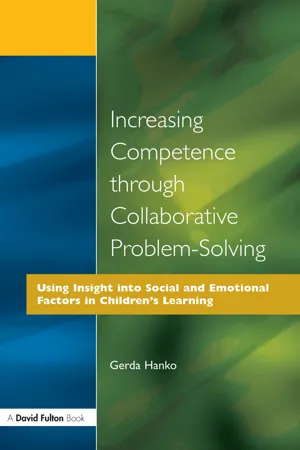
eBook - ePub
Increasing Competence Through Collaborative Problem-Solving
Using Insight Into Social and Emotional Factors in Children's Learning
- 162 pages
- English
- ePUB (mobile friendly)
- Available on iOS & Android
eBook - ePub
Increasing Competence Through Collaborative Problem-Solving
Using Insight Into Social and Emotional Factors in Children's Learning
About this book
First Published in 1999. This book is about the use of a specific collaborative problem-solving approach as part of a Continuing Professional Development policy. Collaborative staff development programmes - now envisaged in a DofE (1998) Programme of Action - can assist teachers in responding more appropriately, as an integral part of their daily professional task, to the learning needs of pupils with emotional and behavioural problems.
Information
PART I
Enriching the Learning Environment for Pupils and Teachers: Maximising Existing Expertise
Chapter 1
Social and Emotional Factors as Aspects of Cognition
This chapter focuses on understanding how children’s emotional and social experiences may affect their learning and on the extent to which teachers should use such understanding in aid of it in the classroom. The word ‘emotional’ is a difficult word in the English language. When used in an educational context it can give rise to ambivalent interpretations and unwarranted attacks as an ‘elevation of feeling over reason’. Nor are terms like ‘emotional education’ or an ‘emotional curriculum’ very helpful to those who agree with the DfE’s emphasis on the importance of children’s emotional development as a central concern for mainstream education (DfE 1994). To forestall such polarisations, a quick reminder of available complementary workable paradigms about the interactive nature of emotional, social and cognitive development may be useful. They permit us to recognise the limits of any one ideology and to work with multiple concepts (Norwich 1996a).
Piaget’s and Kohlberg’s theory of stages of cognitive development and moral learning gives a developmental account of reasoning, of how rules are conceived and followed and how children learn to see things from somebody else’s point of view. Psychodynamic schools of psychology analyse rational and irrational emotional expression and how feelings may originate and develop from social experiences. Applied to curriculum studies this would suggest that we learn best when we care most and that emotional involvement plays an important part in learning. Kubie speaks of the right to know what one feels and that children need to be helped to understand their loves and hates, their fears and curiosities, their strained and stressful relationships. Social learning schools suggest coordinating emotional, social and cognitive growth through normal daily classroom encounters, utilising children’s spontaneous happenings as well as those introduced and created by the teacher. Bruner, in his seminal course on ‘Man’, emphasises the knowledge-getting process with reference to the nature of the child as learner who ‘learns to master himself, disciplines his taste, deepens his view of the world’ (Bruner 1968) as his emotional energies are engaged. Erikson’s life cycle theory, attributing specific tasks for each phase of development (such as the development of basic trust in childhood), suggests a wide scope for teachers.
An education of the emotions or educating children in social competence, by definition, has a cognitive dimension. Misunderstandings abound where these are seen as additional to an academic curriculum. Thus mere references to social aspects frequently lead to pseudo-social grouping practices where no real social learning takes place. Insight into social and emotional factors as aspects of children’s learning, and using such insight effectively, thus makes the issue one of professional competence.
Social factors in learning
Bennett (1991) exposes the ‘aridity of mere classroom grouping practices’ with children merely sitting together but being engaged solely in individual work, and contrasts these with the true impact of social processes on children’s performance through genuinely cooperative approaches. He describes how cooperative group endeavours provided children with social and emotional experiences, such as giving and receiving explanations, which did indeed improve learning, and that the sharing of knowledge between children and between children and teacher facilitated task enhancing talk. Teachers who were offered training in cooperative group work were impressed by how much the children enjoyed it, and reported how surprised they were that ‘the children were in fact able to use each other and help each other more than [I] realised’. They were delighted how for instance a cooperative poetry activity developed the conditions for high quality learning to take place. The results were greater enjoyment, independence, cooperation and better quality work from both low and high attainers.
The current national emphasis on standards in literacy will require an equally strong emphasis on the effectiveness of cooperative teaching methods for raising standards. This underlines the need for teachers to find their own best ways of improving on merely prescribed statutory requirements. Enhancing teachers’ competence through using their insight into the affective/social dimensions in both learning and teaching would be a case in point.
Bennett refers to Vygotsky’s concept of the ‘zone of proximal development’ as that stage at which ‘learning awakens a variety of internal developmental processes that are able to operate only when the child is interacting with people in his environment and in cooperation with (his)peers’ (italics added). Bennett asks ‘Can we design tasks (for instance) in maths, science and technology that generate abstract talk? Can children be trained to function more effectively in groups, at both a social and intellectual level? What should the nature of teacher intervention be in cooperative group work?’ (Bennett 1991).
Vygotsky’s work on the links between learning and small group social interaction, social dialogue, language and knowledge has led a number of British educators to study its educational implications. Daniels (1993) discusses the individual in the organisation and comments on the importance of understanding the relation between the social conditions of learning and development and of speech serving to mediate social processes. Pollard (1993), studying innovative practices in primary schools, emphasises how group work shows the capacity of children to construct their understanding together, in subjects like mathematics, science, design technology, and in ‘process writing’ in English which encourages children to draft, share and discuss, redraft and ‘publish’ their stories. Saxe et al. (1993) look at peer interaction and the development of mathematical understandings through cooperative learning, and how the use of insight into peer processes within cooperative learning structures influences student motivation and achievement. Levine (1993), in her chapter on learning English in multilingual classrooms, discusses the effect of teachers’ perception of the social composition of their racially and ethnically mixed classrooms. The ‘pedagogic space’ will clearly differ if this is seen as threatening or as full of liberating potential for socially egalitarian relations in support of learning. Evans (1993), in the light of Vygotsky’s own work with ‘problem children’ as well as with children of all abilities, examines its implications for special education and the current inclusion debate, while Vygotsky’s (1978) stress on the importance of play for cognitive development has led play therapists to revise both their technique and understanding of play (Alvarez and Phillips 1998).
Vygotsky’s emphasis on the importance of such understanding for teachers to be able to create a successful learning environment both in the special needs field and for children in general has obvious implications for staff development, since it has also afforded the opportunity of ‘perceiving the learning difficulties experienced by children with special needs as potentially highlighting problem areas in teaching and learning in general, which need to be addressed for the benefit of all’ (Mongon and Hart 1989, Hart 1996). One such problem area clearly relates to how to attend to children’s emotional needs.
Emotional factors in learning
There now exists a rich field of knowledge and understanding of children’s emotional growth, of the processes of social interactions and relationships which influence it, and of the part these play in enhancing or impeding the capacity for learning (see Greenhalgh’s comprehensive account (1994) of the wealth of knowledge available). Not all of it has been made sufficiently available to teachers. Most of them, however, will be aware that what children are being taught and how they are being taught is of at least equal importance in children’s learning, and that attention paid to their feelings and social experiences which matter to them stimulates their learning. But teachers’ opportunities to do so have been severely reduced in an over-competitive teaching climate (cf. Warnock (1996) airing widespread concerns).
There is then a tension between what teachers know to be important for the process of learning and the perceived official emphasis on its measurable content. Working conditions seem to impede their capacity to act in the best interest of their charges. Constantly changing priorities and uncertainties cumulatively seemed to conspire against their professional task. Staff support initiatives have therefore been concerned with enhancing teachers’ professional capacities under these difficulties and suggesting that what professionals need is ‘a learning environment which accepts anxiety and uncertainties and promotes thinking and understanding’ to optimise their resources (Woodhouse and Pengelly 1991, also Hanko 1993a).
Trying to understand children’s emotional learning needs and what is involved in the task of meeting them has occupied workers in a range of professions and disciplines. Philosophers accept an education of the emotions as forms of cognition, involving knowledge and understanding (Peters 1974). Psychologists and psychoanalytical therapists agree that the link between emotions and motivation is not a mere linguistic coincidence. As Bennett’s findings (1991) in relation to Vygotsky’s theory demonstrate, the give-and-take experience of heightened motivation in a group that learns together, with each other and with a teacher aware of its importance, provides a positive feeling of belonging, of being valued. It develops children’s confidence as learners and affects their sense of self-worth. Bowlby writes about the ‘secure base’ which children need, to ‘learn without fear’ (1988, see also Barrett and Trevitt 1991). Bion (1962, 1970) develops the theory of learning that comes from the experience of ‘thinking about feelings’, of ‘liberation into conceptualisation’ that comes from children having their ‘unbearable’ feelings – such as defiance and hatred – understood by a ‘containing’ adult who, empathising with what the child may be thinking and feeling, shows him that he is being appreciated, and thereby transforms the ‘unbearable’ into more manageable, thinkable ones. Mental development is thus seen as deriving from thinking through ‘being thought about’. Similarly, Winnicott (1965) shows how a tentative verbalisation of a child’s difficult feelings can be a sign to him of the adults attempt to understand his ‘own version of his existence’. (We will see in Chapter 3 how jointly exploring a case like Tony’s (pp. 19–24) facilitated his teacher’s ability to use these insights to optimum effect).
When Bloom (of taxonomy fame) commented on the importance of affective objectives in teaching and their erosion from course practice in face of the cognitive bias in school testing, he ascribed this erosion to the mistaken ‘assumption that the affective would develop without teaching’ (cited in Watkins 1996). This, we now know, is indeed erroneous and many teachers now use approaches that set out to attend to the affective/social dimension. Among these are Circle Time (Mosley 1993), Circles of Friends (Newton and Wilson 1996) and the No Blame Approach to Bullying (Maines and Robinson 1991, 1992), which lead children to experience each other as valued members of a group by learning to support and empathise with others in their difficulties. These are liberating experiences that help to create a good learning environment.
Many children’s school experiences, however, lead to disaffection. A UNISON survey (Special Children, May 1998) reported deep-seated feelings of rejection, of being ignored, ridiculed, even of just not being encouraged in their efforts. Interviews with truants show their perception of school as ‘controlling regimented environments’ with unsupportive teachers making it hard to return to school (’I felt all the teachers were extremely sarcastic’, ‘I didn’t feel any of them wanted to help me’). Devlin (1997) was told of similar regrets by prisoners when she asked about any particular features in their lives that might have made a difference, while a Social Exclusion Unit report (Archer 1998) comments on some of the reasons given as to why children drop out of education: that school is experienced as boring, too difficult, not leading anywhere.
Thus, school experiences matter. How children experience school, however, has also much to do with the experiences they bring into it. Their self-image may already be so dented that learning anything seems to them an impossible task (as it did with a little Year 3 boy who exclaimed through tears that he ‘will never manage’ [as he] ‘was born stupid’). Others have become similarly discouraged, convinced that nobody likes them (’so what is the point of trying?’), joining the ranks of those who ‘do not respond even to praise’ (Hanko 1994). Anxieties arising from difficulties experienced in their private lives will carry over and affect their work and interactions at school, may remain hidden or may be displayed as problem behaviour, and easily provoke negative responses in their teachers who are then faced with their own emotional vulnerability. Having to deal with their own negative feelings when it matters to be seen as ‘in control’, they may respond, not with their trained ‘professional self (Kahn and Wright 1980), but with their ‘personal kneejerk’ self; may add their own anger to the child’s; and, at that moment, will not be able to offer that emotionally supportive environment, that ‘secure base’, in which it becomes possible to explore and ‘to learn without fear’.
If we can accept that to be able to create a good learning environment teachers also need for themselves such ‘a learning environment which accepts anxiety and uncertainty and promotes thinking and understanding’ (Woodhouse and Pengelly 1991), how can a structure of continuing professional development help to bring this about?
Chapter 2
Collaborative Consultation
Continuing development of competence
Examining different models of pedagogic practice, Daniels discusses the concept of a Responsive Pedagogy as a basic requirement for all education. Capable of responding to learners, it ‘treats teaching as a competency to be continuously developed… informed by learning, and learning that is informed by the right kind of teaching’ (1996) in response to the learner’s needs. Finding ways of supporting its development is therefore seen as urgent.
Collaborative problem-solving approaches have been advocated in support of developing such responsive competence. Doubts about their large-scale introduction in schools have, however, been raised, under the assumption that to be feasible certain preconditions are required. For institutions unused to a professional culture of dialogue and sharing of experience and expertise, the number of obstacles raised is legion. They are seen in the degree of interprofessional sharing skills that these approaches require, impeded by status hierarchies and professional rivalries (heightened by proposed legislation on ‘performance-related pay’ via assessment by ‘results’); that shortage of time (excessive workload and administrative pressures) with consequent stress prevent both reflective action in the classroom as well as opportunities for meetings with colleagues; and teachers may deny having difficulties, fearful of having their professional competence questioned or being thought to be in need of ‘improvement’, or are just innovation-weary, due to too many ‘hero innovators’.
If we accept a good learning environment as being one where ‘teaching as a competency’ is continuously further developed, then the presence of any of these obstacles must be seen as a challenge to its creation. From an interactional systems perspective, Osborne (1998) describes a good learning culture as ‘one whose boundaries are robust enough to offer reasonable security to those working within it, yet these boundaries are permeable … such an open system would be willing to receive and consider new ideas to accept and cope with change’. She refers in this context to the great deal of consultative work with teachers taking place in the schools, which shares these principles, especially as ‘attention is paid to the context of the whole classroom group and to the nature of the teacher pupil interaction, including the teachers understanding of their own reactions to… difficulties’ (Osborne 1994).
Creating a good learning environment: the concept of consultation and its practice in schools
It would be a contradiction in terms to demand an absence of problems as a precondition for setting out to create a good learning environment. Accepting the above problems as real, a consultatively collaborative problem-solving approach is geared to addressing them. Those aiming to offer it therefore need to take account of the psychological and institutional difficulties which are likely to militate against its acceptance or implementation.
The principles of this approach have been formulated by pioneers of group consultation such as Balint (1956) for the medical profession and Caplan (1970) for professionals in social work and teaching, followed by relevant accounts from individuals practising the approach in a variety of school settings (see Skynner 1974, Dowling and Osborne 1994, Hanko 1987, 1995) and through LEA behaviour support services adapting problem-solving approaches to whole-school settings. Working with groups of teachers, they interpret their role in various ways, such as ‘engaging colleagues in [general] joint problem-solving’ or as ‘helping teachers to develop their responses to [specific problems like] emotional and behavioural difficulties’ (DfEE 1997c).
Consultation has become a well-defined...
Table of contents
- Cover
- Title Page
- Copyright Page
- Table of Contents
- Acknowledgments
- Preface
- Introduction
- Part I: Enriching the Learning Environment for Pupils and Teachers: Maximising Existing Expertise
- Part II: Continuing Professional Development: A Framework
- Part III: Collaborative Staff Development: Guidelines and Tasks
- Appendix to Chapter 5
- Bibliography
Trusted by 375,005 students
Access to over 1.5 million titles for a fair monthly price.
Study more efficiently using our study tools.
Frequently asked questions
Yes, you can cancel anytime from the Subscription tab in your account settings on the Perlego website. Your subscription will stay active until the end of your current billing period. Learn how to cancel your subscription
No, books cannot be downloaded as external files, such as PDFs, for use outside of Perlego. However, you can download books within the Perlego app for offline reading on mobile or tablet. Learn how to download books offline
Perlego offers two plans: Essential and Complete
- Essential is ideal for learners and professionals who enjoy exploring a wide range of subjects. Access the Essential Library with 800,000+ trusted titles and best-sellers across business, personal growth, and the humanities. Includes unlimited reading time and Standard Read Aloud voice.
- Complete: Perfect for advanced learners and researchers needing full, unrestricted access. Unlock 1.5M+ books across hundreds of subjects, including academic and specialized titles. The Complete Plan also includes advanced features like Premium Read Aloud and Research Assistant.
We are an online textbook subscription service, where you can get access to an entire online library for less than the price of a single book per month. With over 1.5 million books across 990+ topics, we’ve got you covered! Learn about our mission
Look out for the read-aloud symbol on your next book to see if you can listen to it. The read-aloud tool reads text aloud for you, highlighting the text as it is being read. You can pause it, speed it up and slow it down. Learn more about Read Aloud
Yes! You can use the Perlego app on both iOS and Android devices to read anytime, anywhere — even offline. Perfect for commutes or when you’re on the go.
Please note we cannot support devices running on iOS 13 and Android 7 or earlier. Learn more about using the app
Please note we cannot support devices running on iOS 13 and Android 7 or earlier. Learn more about using the app
Yes, you can access Increasing Competence Through Collaborative Problem-Solving by Gerda Hanko in PDF and/or ePUB format, as well as other popular books in Education & Education General. We have over 1.5 million books available in our catalogue for you to explore.