eBook - ePub
Design and Technology in the Primary School
Case Studies for Teachers
- 160 pages
- English
- ePUB (mobile friendly)
- Available on iOS & Android
eBook - ePub
About this book
The inclusion of technology among the National Curriculum foundation subjects is an exciting , but at the same time somewhat daunting challenge for primary teachers. This series of case studies shows how real teachers across the primmary age range have put design and technology into practice as a focus for their topic work. Through these examples Margaret Rogers and Hind Makiya show what is meant by design and technology in the primary school and how problem solving activiies can be used to fulfil the requirements of the National Curriculum across several subjects. Useful appendices summarize the technology requirements of the National Curriculum and give extra guidance in common areas of difficulty such as the introduction of electricity and the use of electricity and the use of technical lego.
Information
1
Design and technology in the primary curriculum
The incorporation of design and technology in the National Curriculum is one of the most exciting developments in primary education in recent years. Pupils thrive on the types of activities that are involved, and the impact of this involvement and excitement is quick to reach the home, as a parent commented when a school organized a ‘Design and Technology Workshop Evening’ for parents: ‘Sharon never talks about what she does in school—now all I hear is Design and Technology this and Design and Technology that. Do they do anything else in school, and what is this Design and Technology?’ In fact, primary schools have been involving their pupils in design and technology activities for a long time. However, there is a need to make these activities more explicit and to co-ordinate them so that they can be used more effectively to draw out different curricular areas. This factor, together with the excitement pupils feel through engaging in design and technology activities, leaves us in no doubt that the subject has to be placed more centrally in teachers’ plans of work. One of the main aims of this book is to demonstrate how design and technology activity can be used to draw out the other areas of the curriculum.
The introduction of new tools, materials and areas of technology and the need for teachers to familiarize themselves with these whilst engaging in practical problem-solving activities are paramount. However, whilst pupils are excited by the work that is developing in schools, many teachers are worried about their own training and confidence to handle the skills and concepts they associate with the area. We hope this book will both provide teachers with a variety of suggestions for organizing the classroom, including different methods of introducing the work, and stimulate them to develop a wider range of possibilities than those outlined in the case-studies.
Before describing the work in this book, we feel it is important to raise a number of questions and issues that teachers need to consider when they are involved in work described as ‘design and technological’ in nature.
• What are design and technology activities?
• Where do design and technology activities fit into the primary curriculum and what do they offer pupils?
• Is there a place for teaching design and technology across the curriculum in the National Curriculum?
• What is the gender dimension of design and technology?
• Where is the cultural dimension of design and technology?
What are design and technology activities?
In the Interim Report of the National Curriculum Design and Technology Working Group (1988) it is argued that design and technology:
Is always purposeful (i.e. developed in response to perceived needs or opportunities, as opposed to being undertaken for its own sake), takes place within a context of specific constraints (e.g. deadlines, cash limits, ergonomic and environmental requirements as opposed to Blue-sky research) and depends upon value judgments at almost every stage.
(p. 4, para.1.11)
Design and technology activity is seen as the process of satisfying needs by solving practical problems that involve pupils in working in a variety of materials. These materials include clay, paint, wood, metal, plastics, fabrics, leather and many others.
In this book we concentrate on a narrower range of materials, processes and techniques, because teachers are concerned about how they can be used in classrooms and across the age ranges. We also include concepts, such as mechanical movements, electricity, energy and control, that many primary teachers have not been familiar with. All the projects described in the book were done by classroom teachers before the publication of any of the National Curriculum documents on design and technology. We believe, however, that the methods of working and the philosophy behind them are consistent with all the attainment targets and statutory orders of the design and technology profile component (i.e. profile component 1: design and technology. See Figure 17 ).
Where do design and technology activities fit into the primary curriculum and what do they offer pupils?
Design and technology is regarded as a foundation subject in the National Curriculum. Its inclusion into every primary classroom is now statutory. The technology document has been published, indicating attainment targets and appropriate programmes of study for design and technology at different levels. The emphasis of the report is on the processes particular to design and technology activities: namely the design processes which involve solving practical problems within contexts that have meaning and relevance to pupils, and according to their abilities and experiences. The phrase ‘problem solving’ not only has several meanings, it is becoming an over-used expression and, in many instances, it is no longer clear what type of problem solving one refers to. In this book we hope to distinguish between three types of problem solving:
Puzzle problems
These refer to problems where teacher and children are aware that a specific answer is required and the teacher looks at ways to arrive at the correct answers. These are often referred to as ‘closed problems’ and the process is often immaterial. Examples can be seen in ‘sums’ in arithmetic, or punctuation exercises in English, or such questions as ‘what is a square?’, ‘what is the name of this tool?’ These problems are ‘fact’-based and are used by teachers to check the understanding of pupils in a particular area. Many tests, such as comprehension tests and mathematics tests, are examples of these. The onus is on the pupil to answer the questions correctly. The process by which the pupil has come up with an answer is often not important.
Technical and investigative problems
In this situation, although there may be a series of solutions, the criteria for judging these are objective enough for participants to realize that some solutions are better than others. However, the process by which pupils have solved the problems is paramount. These problems tend to be subject-specific, i.e. mathematical investigations, science investigation including the design of fair tests, and technical problems. One example is the investigation into which materials float or sink (chapter 5); another, calculating the amount of wood used in a construction (chapters 2 and 7).
The processes by which these problems are ‘solved’ are very important. Science method, which accounts for 50 per cent of the assessment at the age of eleven (Science AT 1), is concerned with the skills of hypothesis, carry out tests and monitoring and recording methods leading to a particular evaluative statement—skills which are essential to the development of scientific rigour, as well as the fairness of the tests.
A mathematical investigation, such as finding the area of the school playground, may require pupils to discuss this in small groups, devise a method and then apply the method to find the result, either individually or in partnership groups. The decisions about how to proceed with the measurements are of greatest interest in analysing the pupils’ understanding of the particular mathematical concepts. The actual measuring and following recording enables the teacher to monitor application skills of measurement, pupils’ use of computation skills, estimation and concepts of accuracy.
Building the fastest moving buggy to cross a particular distance is an example of a technical problem, where the criteria are also specific and it is possible to judge and evaluate the most successful solution.
For the teacher, it is possible when devising these problems to plan carefully a series of activities that enable particular attainment targets to be addressed across the different areas of the curriculum.
Open-ended problems
These are also referred to as ‘design problems’. They are more complex. The criteria for evaluating the work involve objective criteria (such as: how does it serve a particular function? how well is it made?), as well as subjective criteria (how does it look? is it appropriate for that particular need? how ingenious or ‘appropriate’ is the solution?) It opens up a debate about what is ‘good’
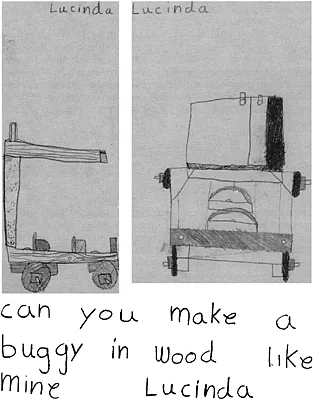
Plate 1 The buggy
design and what is ‘bad’ design, about who makes these value judgements and what these values are based on.
The pupils will be involved in a process of compromise between these subjective and objective criteria. The process of compromise and decision making becomes important in discussing and evaluating the solutions. The evaluation process is more complex, and it is not always clear which is the ‘best’ solution. Open-ended problems have many ‘good’ solutions. They also reflect the reality of many daily problems, as well as those faced by designers, architects and economists. They raise issues of value, choice, and social, cultural and ethical decision making. They are particulary useful in raising debate amongst pupils as part of the process of resolving differences in perception. The emphases on making value judgements and helping pupils build a sense of personal aesthetic and design philosophy have been considered as central to these types of problems.
A problem set in a social context can inspire pupils and give them a greater sense of purpose and reason. As a result, the work involving technology, science, maths and language that has been planned and linked to the project becomes integral to solving the problem.
The differentiation between these three types of problem solving cannot be seen as rigid. They are described to highlight many issues that are central to design and technology activity and to show where design and technology fits into the primary curriculum. Design and technology is more than a distinct subject area in the curriculum (such as mathematics or science). The requirements for design and technology require teachers to involve their pupils in situations that enable them to engage i...
Table of contents
- Contents
- Plates
- Figures
- Acknowledgements
- 1 Design and technology in the primary curriculum
- 2 The early years
- 3 Starting in the classroom
- 4 Links with mathematics
- 5 Science and technology
- 6 Links with information technology
- 7 Whole school development
- 8 Topic planning
- Conclusion
- Appendix
- References
- Index
Trusted by 375,005 students
Access to over 1.5 million titles for a fair monthly price.
Study more efficiently using our study tools.
Frequently asked questions
Yes, you can cancel anytime from the Subscription tab in your account settings on the Perlego website. Your subscription will stay active until the end of your current billing period. Learn how to cancel your subscription
No, books cannot be downloaded as external files, such as PDFs, for use outside of Perlego. However, you can download books within the Perlego app for offline reading on mobile or tablet. Learn how to download books offline
Perlego offers two plans: Essential and Complete
- Essential is ideal for learners and professionals who enjoy exploring a wide range of subjects. Access the Essential Library with 800,000+ trusted titles and best-sellers across business, personal growth, and the humanities. Includes unlimited reading time and Standard Read Aloud voice.
- Complete: Perfect for advanced learners and researchers needing full, unrestricted access. Unlock 1.5M+ books across hundreds of subjects, including academic and specialized titles. The Complete Plan also includes advanced features like Premium Read Aloud and Research Assistant.
We are an online textbook subscription service, where you can get access to an entire online library for less than the price of a single book per month. With over 1.5 million books across 990+ topics, we’ve got you covered! Learn about our mission
Look out for the read-aloud symbol on your next book to see if you can listen to it. The read-aloud tool reads text aloud for you, highlighting the text as it is being read. You can pause it, speed it up and slow it down. Learn more about Read Aloud
Yes! You can use the Perlego app on both iOS and Android devices to read anytime, anywhere — even offline. Perfect for commutes or when you’re on the go.
Please note we cannot support devices running on iOS 13 and Android 7 or earlier. Learn more about using the app
Please note we cannot support devices running on iOS 13 and Android 7 or earlier. Learn more about using the app
Yes, you can access Design and Technology in the Primary School by Hind Makiya,Margaret Rogers in PDF and/or ePUB format, as well as other popular books in Education & Education General. We have over 1.5 million books available in our catalogue for you to explore.