The nature of childhood, the consideration of whether a certain age denotes innocence or not, and the desire to teach good citizenship to our children are all issues commonly discussed by today's media. This book brings together a variety of perspectives on the study of childhood: how this has been treated historically and how such a concept is developing as we move into the next century.
The book is divided into five main sections:
* part one sets the scene and provides the reader with an overview of attitudes towards childhood.
* part two surveys the contribution of literature from the nineteenth and twentieth centuries
* part three examines educational issues such as childrens' play, language acquisition and spiritual development
* part four looks at the representation of children in film, television and other mass media
* part five offers further help for study and research
This book draws on a number of academic disciplines including education, literature, theology, language studies and history. It will be of particular use to those on Childhood studies courses and all those studying for a teacher qualification. Teachers of children aged between 4-12 years old will find its contribution to their continuing professional development extremely helpful.
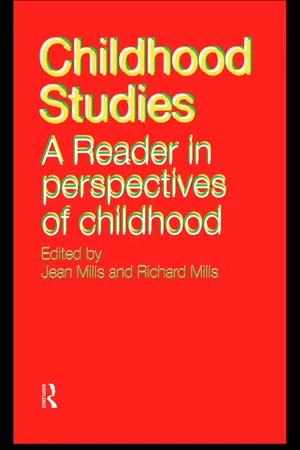
eBook - ePub
Childhood Studies
A Reader in Perspectives of Childhood
- 224 pages
- English
- ePUB (mobile friendly)
- Available on iOS & Android
eBook - ePub
Childhood Studies
A Reader in Perspectives of Childhood
About this book
Information
Part One
Overview
Chapter 1
Per spectives of childhood
Richard Mills
Summary
This first chapter sets out to establish some of the key themes of any investigation of childhood. It lists the disciplines which may be involved in studying the phenomenon; the difficulties in defining what childhood is and who children are; and the factors affecting the various social constructions of childhood. The chapter offers six possible perspectives and describes how each of these comes about (i.e. children as innocent/as apprentices/ as persons in their own right/as members of a distinct group/as vulnerable/as animals). Some of these perspectives are mirrored in a variety of ways in the chapters which follow but, as the appendix shows, there are many more possible constructions of childhood, each with its own interests and limitations.
Tread softly because you tread on my dreams. W.B.Yeats, ‘He Wishes for the Cloths of Heaven’ (1899)
This book is not about childhood, but about perspectives of childhood and children. As explained in the introduction, such is the nature of childhood that its study cannot be confined within one academic discipline. It must draw on such areas of study as are felt to be appropriate, and these might include, in large or small degree: anthropology, art, computing, education, history, literature, medicine, philosophy, physiology, psychology, psychoanalysis, psychotherapy, sociology, statistics, or theology.
So much for the tools of enquiry but, however wide or narrow one’s subject, defining terms remains crucial and, in this search for definition, the word ‘childhood’ presents problems. Does the investigation relate to boys, or girls, or both (Waksler, 1991: 234, 244)? Are they in rural or urban areas? (Cunningham contrasts the two states 1991: 150ff.) From which social class do they come? (This is a key issue for Humphries et al., 1988: 35.) Are they contemporary children or from the past? (Ariès, 1996, maintains that childhood did not begin until the seventeenth century; Pollock, 1983 and others forcibly dispute this.) Do the children come from the United Kingdom or elsewhere in the world? (La Fontaine, in Richards and Light, 1986: 10ff., sees cross-cultural comparisons as crucial.) How old is a child? (Gamage, 1992, states that the early childhood period is between birth and ten years; the social historian Walvin, 1982: 11, decides it is age fourteen and under; Miles, 1994: 263, reports childhood as including the years up to eighteen, as a matter of international law, binding on the twenty countries which ratified the United Nations agreement of 1990.)
These are some of the questions relating to the actual people involved. What of the phenomenon itself? What are some of its distinguishing features? Is childhood a state of powerlessness and adaptation to a lack of power (as Waksler maintains, 1991: 69)? Or a time and condition of secrets and shame (according to Postman, 1983: 80)? Or dependency (Shipman, 1972: 13)? Can it not simply be regarded as a period of biological, intellectual, and social development; as a time for the ‘accumulation of experience’ (Wadsworth, 1991: 7), leading to self-definition (1991: 12)? In these terms, is it not best linked with a series of school transitions such as: nursery–infant–junior–secondary, in the state system, and nursery–kindergarten–prep–public school in the private system (see James and Prout, 1990: 233)? Or, should it be perceived as a category of child such as ‘The Country Child’ (Dudgeon, 1992)? If the talk is in terms of categories, do the terms ‘institutional’ and ‘normative’ (Wringe, 1981: 88) offer a useful perspective? The former refers to the legal or quasi-legal status of childhood, and the latter to an expectation of certain capacities of children.
Perhaps approaches such as these outlined are too mundane and functional. If so, should an approach be adopted which seeks to capture the timeless essence of childhood in some kind of mystical manner, uniting ‘a mythical past with a magical present’ (James and Prout, 1990: 229)? One way into such a world is through fiction and the work (in English, at any rate) of such writers as J.M. Barrie, Lewis Carroll, Kenneth Grahame, Charles Kingsley, C.S. Lewis, A.A. Milne and J.R.R. Tolkien. The world these writers create is timeless and (despite certain potential terrors) safe and contained. In extraordinary and individual ways, these authors are regarded as having captured something elusive and indefinable (see Wullschläger, 1995, for a fascinating commentary on five of these writers). It is not the world of modern children’s authors, such as Leila Berg, Edward Blishen, Roald Dahl, Anne Fine, Philippa Pearce and Robert Westall (see Meek et al., 1977; Styles et al., 1996; Tucker, 1991), who seek to represent more immediate ‘real’ experiences; it is beyond time, and often archetypal. In this regard it either creates for us, or reflects to us, something which we cannot replicate for ourselves. As George Eliot observed in The Mill on the Floss:
Is there anyone who can recover the experience of his childhood, not merely with a memory of what he did and what happened to him … but with an intimate penetration, a revived consciousness of what he felt then – when it was so long from one Midsummer to another?
(1985: 123)
Such, then, are the problems of defining childhood, with its shifting visions, its lack of watertight compartments, its illusory and elusive nature: what Steedman refers to as its ‘extraordinary plasticity’ (1995: 7). It is clear that childhood or, rather, childhoods, are social constructions, cultural components inextricably linked to variables of race, class, culture, gender and time. In sociological terms, ‘To recognise that “child” is a role is to suspend the assumption that childhood has some absolute, real, transcendent existence beyond the social’ (Waksler, 1991: 146). It needs to be seen as ‘a shifting social and historical construction … a continually experienced and created social phenomenon which has significance for its present, as well as the past and future’ (James and Prout, 1990: 231).
The eclecticism apparent earlier in the range of relevant disciplines will now be apparent as some of the key social constructions of childhood are outlined. These are presented in no hierarchical order and the intention at this stage is to keep them fairly discrete, although in reality they cannot be isolated but are interlinked and overlapping, in the manner of a Venn diagram. The constructions I have chosen are:
- children as innocent
- children as apprentices
- children as persons in their own right
- children as members of a distinct group
- children as vulnerable
- children as animals
Children as innocent
They are idols of heart and of household; They are angels of God in disguise;
His sunlight still sleeps in their tresses, His glory still gleams in their eyes.
His glory still gleams in their (Dickinson, ‘The Children’)
The notion of the child as innocent has had, and still has, a powerful hold on the imagination. Its origin or appeal seems to reside in one or more (or possibly an undifferentiated amalgam), of the following perspectives:
- child as theological construct
- child as being in need of protection
- child as a force for good
Child as theological construct
From a sociological point of view, the term ‘theological construct’ would be quite acceptable; from a religious point of view it might be more debatable, since what is being addressed is nothing less than the essence of human life. As Shipman has suggested, up until the twentieth century child-rearing and education in the western world had been dominated by two contrasting, and hardly compatible, Christian viewpoints: ‘One view stressed the angelic, unsullied, natural goodness of children. The other stressed their devilish, potentially evil, self-willed nature’ (1972: 8). As a sample of the first view, Shipman quotes from the essayist, John Earle, subsequently Bishop of Salisbury, who in 1628, at the age of eighteen, wrote in Microcosmographie:
The child is the best copy of Adam before he tasted of Eve or the apple; and he is happy whose small practice in the world can only write his Character. He is Nature’s fresh picture newly drawn in oil, which time, and much handling, dims and defaces. His soul is yet a white paper unscribbled with observations of the world, wherewith, at length, it becomes a blurred notebook.
(Shipman, 1972: 9)
It is a view for which some justification could be found in the New Testament of the Bible and which foreshadowed later thinking. Words such as ‘best’, ‘fresh’ and ‘white’, denote a quality of purity and newness which found powerful endorsement in much late eighteenth-century and nineteenth-century writing, not least in Rousseau, who announces his personal manifesto early in Émile by stating: ‘God makes all things good; man meddles with them and they become evil’ (1762: Book 1, p. 5).
However they might disagree theologically about Original Sin or Original Innocence, both Earle and Rousseau are united in believing that something goes wrong, that the new beginning promised in childhood somehow founders. Postman is specific about the polarity. He writes:
In the Protestant view, the child is an unformed person who, through literacy, education, reason, self-control and shame, may be made into a civilized adult. In the Romantic view, it is not the unformed child but the deformed adult who is the problem. The child possesses, as his or her birthright, capacities for candour, understanding, curiosity and spontaneity that are deadened by literacy, education, reason, self-control and shame.
(1983: 59)
John Locke’s metaphor of the ‘tabula rasa’, the clean slate (1693), clearly fits the first of these polarities in that it assumes an incremental build-up of knowledge, skills and attitudes through the acquisition and practice of literacy. For Rousseau, the child was within ‘a state of nature’ and, given the absence of adverse circumstances, that would be sufficient to develop what Postman calls ‘the childhood virtues of spontaneity, purity, strength, and joy, all of which came to be seen as features to nurture and celebrate’ (1983: 59).
The controversy, which goes back to the early Christian church, still has significance for the secular twentieth century, although the language has changed and the debate is more pragmatic, focusing not so much on essence but on practical import: namely, how should parents and professional educators treat young children? Hannah More faced this issue in 1799 in her book Strictures on the Modern System of Female Education, and asked the question:
Is it not a fundamental error to consider children as innocent beings, whose little weaknesses may, perhaps, want some correction, rather than as beings who bring into the world a corrupt nature and evil dispositions, which it should be the great end of education to rectify?
(Brown, 1993: 44)
The question, albeit in different terms, is still with us. Should parents follow the advice of John Wesley ‘to break the will of your child, to bring his will into subjection to yours’ (quoted by Hendrick in James and Prout, 1990: 38), or should a more sensitive, subtle, enabling route be followed? Expressed in that loaded form, the choice is perhaps fairly simple, but as we shall see throughout this book, such is the multi-faceted nature of the enquiry into the essence of human nature that the ground appears constantly to be shifting: one discipline offers insights which might seem to conflict with those from another discipline, one set of practical experiences is often at variance with another set, and new knowledge, particularly in the area of genetics (see Jones, 1994: 68ff), can enforce radical reappraisal of previously held convictions.
In short, the philosophical and ideological stances taken by parents, carers, and educators, whether precisely articulated or merely implicit, will determine how children are treated. That is a key premise of this present work.
Child as being in need of protection
It is axiomatic that, however the period of childhood is defined, children are in need of physical protection and nurture for their well-being. This is true of the young of any animal species. However, within the literature of childhood innocence, protection has a different significance. It refers to the preservation of a state of ignorance, of unknowingness, about certain areas of life which adults feel should best remain secret from those inhabiting the world of childhood.
Indeed, based on this premise, the movement out of childhood is seen as the gradual acquiring of secret knowledge. The transition from childhood in the western world is thus not some sudden act of ritualised initiation, as in some societies. Rather, it is a slow, increme...
Table of contents
- Cover Page
- Title Page
- Copyright Page
- Contributors
- Acknowledgements
- Introduction
- Part One: Overview
- Part Two: Literature
- Part Three: Education
- Part Four: Cultural studies
- Part Five: Research
Trusted by 375,005 students
Access to over 1.5 million titles for a fair monthly price.
Study more efficiently using our study tools.
Frequently asked questions
Yes, you can cancel anytime from the Subscription tab in your account settings on the Perlego website. Your subscription will stay active until the end of your current billing period. Learn how to cancel your subscription
No, books cannot be downloaded as external files, such as PDFs, for use outside of Perlego. However, you can download books within the Perlego app for offline reading on mobile or tablet. Learn how to download books offline
Perlego offers two plans: Essential and Complete
- Essential is ideal for learners and professionals who enjoy exploring a wide range of subjects. Access the Essential Library with 800,000+ trusted titles and best-sellers across business, personal growth, and the humanities. Includes unlimited reading time and Standard Read Aloud voice.
- Complete: Perfect for advanced learners and researchers needing full, unrestricted access. Unlock 1.5M+ books across hundreds of subjects, including academic and specialized titles. The Complete Plan also includes advanced features like Premium Read Aloud and Research Assistant.
We are an online textbook subscription service, where you can get access to an entire online library for less than the price of a single book per month. With over 1.5 million books across 990+ topics, we’ve got you covered! Learn about our mission
Look out for the read-aloud symbol on your next book to see if you can listen to it. The read-aloud tool reads text aloud for you, highlighting the text as it is being read. You can pause it, speed it up and slow it down. Learn more about Read Aloud
Yes! You can use the Perlego app on both iOS and Android devices to read anytime, anywhere — even offline. Perfect for commutes or when you’re on the go.
Please note we cannot support devices running on iOS 13 and Android 7 or earlier. Learn more about using the app
Please note we cannot support devices running on iOS 13 and Android 7 or earlier. Learn more about using the app
Yes, you can access Childhood Studies by Jean Mills, Richard Mills, Jean Mills,Richard Mills in PDF and/or ePUB format, as well as other popular books in Social Sciences & Education General. We have over 1.5 million books available in our catalogue for you to explore.