We are now in the 'third wave' of Knowledge Management - the first was focused on the potential of new technology, while the second focused on the nature of knowledge and how people 'know' and learn. The focus in the third phase is two-fold: building individual and team productivity, and proper alignment of Knowledge Management efforts in helping deliver on strategic goals of the organization.
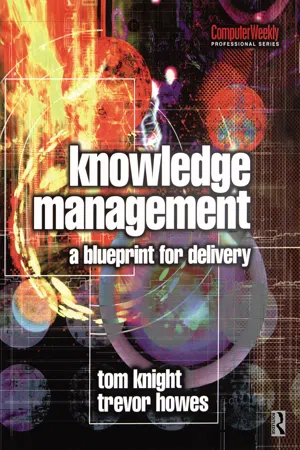
Knowledge Management- a Blueprint for Delivery explores and builds on current ideas about the dynamics of knowledge in organizations, answering such questions as: 'What is knowledge management?' and 'What does it mean for today's companies and organizations?'
Written by two leading knowledge management practitioners, this book looks beyond academic theory and software company hype to focus on the roles that knowledge and information play in creating high-performance organizations.
Built on their extensive experience of Knowledge Management programme design and delivery, Knowledge Management- a Blueprint for Delivery:
- 234 pages
- English
- ePUB (mobile friendly)
- Available on iOS & Android
eBook - ePub
Knowledge Management - A Blueprint for Delivery
About this book
 | Introduction – understanding knowledge management |
1.1 Making sense of knowledge . . . and how you manage it
What drives modern organizations to explore knowledge management (KM)? What exactly do we mean by the term? There have been some fairly unflattering answers to this question. It has been accused of being just a management fad, like the early 1990s enthusiasm for Quality Management or the hype around Business Process Re-engineering (BPR), which after their fairly brief moment in the spotlight, stood accused of being little more than the repackaging of a few genuine good ideas and practices, wrapped in a rich and largely unnecessary consultancy mystique (interestingly, both have since become part of the general business toolset, though the promises and project scope have become more moderate and realistic).
Others, meanwhile, have argued knowledge management is a new name for something else – information management, or document management. Still others see in knowledge management a revival of the 1980s enthusiasm for ‘expert systems’ created around a ‘knowledge base’ – a technology that at the time failed to achieve its potential, now reborn with the same promises of cost saving and easy access to expertise, but with the benefit of enhanced performance due to the rise of internet-related technologies.
There is some truth in all of the above, but the whole story is of a much richer picture. Clearly, we, the authors, wouldn't have written this book if we didn't believe that knowledge management as a discipline had significant potential to improve organizational performance. But as consultants working in some of the UK's largest organizations, we avoid imposing a strict definition of knowledge management.
This may sound like a cop-out, but we believe that one more definition of knowledge management doesn't really add anything to the debate, and certainly doesn't help us in a customer perspective. Depending on the individual you are speaking to, on the organization he or she works for, and the business sector involved, you can ask 100 people and get 100 different answers. Even where people agree on the basics, particular emphasis will vary according to experiences and priorities.
We believe there are two main reasons for this:
• First, knowledge management, which as a discrete discipline is certainly less than 10 years old, is not mature enough to have coalesced into a single, coherent world view (or even a smallish number of competing views) – a major difference from the patented, systematized Quality and BPR movements.
• Second, and consequent to this, practitioners themselves occupy a huge spectrum: from tightly drawn, technology focused purveyors of ‘knowledge management systems’, often with a mechanistic viewpoint, perhaps working for software vendors; through to practitioners with perspectives that are more focused on skills, behaviours and motivational issues – a ‘learning organization’ view.
Theorists are also involved – in what is becoming a thriving academic knowledge management ‘industry’ – who more typically take a starting point in cognitive and behavioural science, or analysing the strategic choices organizations make. The non-academic literature available – much of it industry sponsored – tends to focus on the ‘technical’ perspective, and given that much of early interest in knowledge management came from those seeking to exploit new technologies such as the World Wide Web. Indeed this is the view that is most prevalent and we still often hear the phrase ‘knowledge management system’ in our daily work.
Theorists are also involved – in what is becoming a thriving academic knowledge management ‘industry’ – who more typically take a starting point in cognitive and behavioural science, or analysing the strategic choices organizations make. The non-academic literature available – much of it industry sponsored – tends to focus on the ‘technical’ perspective, and given that much of early interest in knowledge management came from those seeking to exploit new technologies such as the World Wide Web. Indeed this is the view that is most prevalent and we still often hear the phrase ‘knowledge management system’ in our daily work.
The authors’ response is to acknowledge that there does indeed exist a plurality of viewpoints and approaches, skills and tools, and ‘solutions’, with a huge variety of reasons for taking action and many different desired and possible outcomes. All of these are valid in each specific context. If we insist on asking ‘What drives modern organizations to look at knowledge management?’ then we have to answer, ‘lots of reasons’.
But this is not a reason for giving up on the struggle to make sense of this vast and growing area, for failing to seek patterns and connections, or finding a best way through the maze. As knowledge management consultants, organizations have looked to us to help them find an appropriate way forward, and their concerns can differ markedly from place to place: for example, one Fujitsu customer, the UK University for Industry, was conceived from day one to operate electronically (an e-business), with a unique ‘centre and hub’ configuration, essentially a franchised arrangement for course and tuition delivery, with very few staff at the centre and a heavy reliance on online systems for information distribution. Clearly, the knowledge management requirements of an organization like this will be radically different from those facing a very different customer, for example former gas utility company Centrica, which has made rapid strides to move away from its ‘privatized utility past’, but nevertheless controls its own extensive people and technology infrastructure, seeking to deliver value from its customer base and ability to handle mass consumer transactions across telecoms, motoring and financial services as well as energy supply. And Centrica's concerns are different again to those of a more asset-based organization combined manufacturing and services, like Nortel Networks, or a retail company like WH Smith where the overriding drivers are meshing together the demands of marketing, logistics, and stock control.
This book is our effort to capture and codify – make ‘explicit’, if you like – our own learning from the past seven years or so of knowledge management practice in the UK. It boils down to five Golden Rules that we will refer to repeatedly as we go along:
Golden Rule #1: Be crystal clear on the expected benefits – Always have a business case that details the agreed benefits that the knowledge management initiatives must deliver. Progress towards their realization must be properly managed and measured.
Golden Rule #2: People's behaviours must change for the long term – People's beliefs must be affected if long-term improvements in behaviour are to be achieved. You must do more than just ‘build an IT system’.
Golden Rule #3: Nothing happens without leadership – Those responsible for running the organization must inspire and encourage all staff throughout the ‘voyage of discovery’ that is the change programme, continuing on after implementation to ensure lasting change.
Golden Rule #4: Process change leads to improved performance – Organizations need to build in new processes and routines through job redesign, to ensure knowledge capture and reuse, and to establish and reinforce desired behaviours and activity.
Golden Rule #5: Organizational learning leads to organizational success – Organizations can only survive and prosper by learning from the business environment, and putting that learning to practical use by responding to it in some way. The capability to do this learning well is what distinguishes successful companies from also-rans.
We believe that these principles underpin efforts to mobilize knowledge in pursuit of business value – ultimately, knowledge management must be about turning ‘what people know’ and what they know ‘how to do’ into outputs that create added value for an organization – the art of the knowledge management practitioner is to deploy appropriate approaches and techniques to achieve this end.
1.1.2 The roots of knowledge management
This is an essentially practical book based on experience of the process of helping organizations devise a knowledge management strategy and deliver the required changes that it requires. But we believe that it is vital to have some background in the context of modern approaches to mobilizing knowledge, so we will now step through a brief look at the discipline's history.
The ancient Greeks speculated a great deal about the nature of knowledge. From their deliberations, we have the modern science of epistemology. But alongside their academic speculations, the Greeks knew as well as anybody the importance of practical techniques for communicating knowledge. The practice of sitting alongside experts to learn their craft – from playwrights to carpenters – is as old as civilization itself. This notion of apprenticeship – a noble and ancient method of transmitting knowledge between individuals – was brought to something of a high point in the high medieval period, between 1200 and 1500. At this time, the keepers of knowledge were very separate and secretive.
• A very specialized kind of learning existed only in monasteries – the surviving knowledge of the Greek classics, along with knowledge of biblical and liturgical Latin. To a degree this kind of learning was communicated to the ruling classes – the aristocracy required familiarity with Latin as the language of diplomacy.
• A quite separate kind of learning existed among the merchant classes – knowledge of the rules of commerce, of interest payments and the rules of barter and exchange, again kept strictly within merchant families. From this period stems western use of the Arabic numerals for book-keeping (rather than the hard-to-use Roman character-based methods), along with sophisticated rules around ownership of property and conduct of trade.
• Another body of knowledge again existed among artisans and craftsmen (which at this time included certain trades we now think of as professions, such as medicine), who protected their knowledge through the creation of guilds, and transferred it through long apprenticeships where initiates were indentured to a particular master, and were bound to obey the rules of the guild and to give service to the master for many years in return for learning the trade. Such guilds are certainly the precursors to today's secret societies like the Freemasons, and even of trade unions (where the now defunct closed shop can be traced directly to medieval working practices). But in terms of their role in maintenance of standards and policing of behaviour, they are also the precursors to professional bodies such as the British Medical Association or the Law Society, who to this day police standards of teaching and practice in their respective professions.
To some extent, the walls in these divisions began to crack with the rise of the urban universities in the late medieval period, which opened up the world of book learning, previously the preserve of clerics and the aristocracy, to the sons (though not yet the daughters) of the merchant classes. The process was hastened at the end of the medieval period by the Reformation, and by the growth of mass literacy that accompanied the invention of printing. But a large-scale breakdown of the separate worlds of knowledge between different groups in society didn't seriously begin to happen in the mass population until the rise of industrialization, and moves to open up education to provide the baseline of skills and knowledge employers required of their urban workforce.
In today's world, the difficulties of coping with a skills shortage – attempting to leverage the skills of a small number of key staff, assisted by a combination of less-skilled individuals and the application of technology – is a common motivation for investment (call centres clustered around a highly developed knowledge base is a good example). To go back to the early part of the last century, the early industrialists faced similar problems, trying to manufacture goods on a large scale, while only having a small number of ‘expert’ staff. The first efforts at mass production really came along during the American Civil War, where the sheer demand for firearms led to the first use of sequential production lines. ‘Armoury’ methods, as they were known, took some time to work their way into general thinking about manufacturing, but by the early part of last century, advocates of large-scale mass production, such as Henry Ford, were trying to find ways to speed up and scale up the production process by breaking down the complex body of knowledge required by traditional craftsmen. This was done by reducing difficult tasks into groups of simpler ones which could be performed by less-skilled workers, many workers each having knowledge of just a tiny part of the whole.
Mass production techniques have moved on, of course, since the days of Ford. The industrial age was one of standardization (Ford's most famous saying is, after all, ‘Any colour as long as it's black’). But as society has changed (post-war, and in particular post-1960s), expectations are considerably higher. Mass production is still with us, but increasingly we live in a world where individually held knowledge and specialization are the key requirements for individual wealth and productivity. By the 1960s and the dawn of the Information Age, it was already becoming clear that rather than semi-skilled production work, the complex web of knowledge held by groups of individual workers was becoming more and more important to organizational success. In 1969, the management guru Peter Drucker wrote:
Knowledge is the central capital, the cost centre and the crucial resource of the economy.
This is quite a departure from Karl Marx's notion – which an industrialist like Ford would not have challenged – that ‘Land, Labour and Capital’ are the key economic resources. But while Drucker's statement may have been a quite radical notion in 1969, it appears common sense today.
Yet much of business thinking – and business decision-making – has still to catch up with this new world. For example, while accounting rules (some of which date back to the medieval period) are very firm on the management of capital assets, thanks to complex and long-defined bodies of custom, practice, law-making and professional regulation, the accounting profession is largely unable to properly value or manage knowledge assets (with the exception of a few intangible assets that might have a market value, such as brands or patents). This is a real management problem, having a real impact on the accuracy of things like company valuation, for which some creative solutions (incorporating concepts such as the Balanced Scorecard, which will be discussed in a later section) have been devised but are not yet in general use. Nevertheless, evolution of complex new sets of skills, and in particular (with the arrival of Internet technology) new tools for storing, aggregating and publishing information, have helped bring about a shift in the classical, market-driven view of the organization from one based on transactions to one based on knowledge.
The eighteenth century Scots ‘inventor’ of the modern science of economics, Adam Smith, held a fairly simple view of the firm: he believed that organizations come into being (growing from sole trader, partnership, small family concern) because the costs of doing business within a single organization – the transaction costs – are less than paying some outside body to perform the work. It was a simple cost equation to gauge whether managing work in-house, or buying in a particular product or service, was the correct course of action or not.
Of course, even back in Smith's time, organizations did not always behave that way. There are lots of reasons why firms might seek to keep in-house some activities that might be cheaper to buy in from outside – for example, ‘national interest’ might mean ensuring strategic access to raw materials or components, such as subsidizing shipbuildi...
Table of contents
- Cover Page
- Half Title
- Title Page
- Copyright Page
- Contents
- Computer Weekly Professional Series
- Foreword
- Acknowledgements
- 1 Introduction – understanding knowledge management
- 2 New challenges, new vision
- 3 From strategy to action
- 4 Designing the new reality
- 5 Making it all happen
- 6 Reaping the rewards
- 7 Epilogue: Lessons from the journey
- Appendix 1 Issue identification
- Appendix 2 Knowledge role audit
- Appendix 3 Knowledge process audit
- Appendix 4 Resistance to change
- References
- Index
Trusted by 375,005 students
Access to over 1.5 million titles for a fair monthly price.
Study more efficiently using our study tools.
Frequently asked questions
Yes, you can cancel anytime from the Subscription tab in your account settings on the Perlego website. Your subscription will stay active until the end of your current billing period. Learn how to cancel your subscription
No, books cannot be downloaded as external files, such as PDFs, for use outside of Perlego. However, you can download books within the Perlego app for offline reading on mobile or tablet. Learn how to download books offline
Perlego offers two plans: Essential and Complete
- Essential is ideal for learners and professionals who enjoy exploring a wide range of subjects. Access the Essential Library with 800,000+ trusted titles and best-sellers across business, personal growth, and the humanities. Includes unlimited reading time and Standard Read Aloud voice.
- Complete: Perfect for advanced learners and researchers needing full, unrestricted access. Unlock 1.5M+ books across hundreds of subjects, including academic and specialized titles. The Complete Plan also includes advanced features like Premium Read Aloud and Research Assistant.
We are an online textbook subscription service, where you can get access to an entire online library for less than the price of a single book per month. With over 1.5 million books across 990+ topics, we’ve got you covered! Learn about our mission
Look out for the read-aloud symbol on your next book to see if you can listen to it. The read-aloud tool reads text aloud for you, highlighting the text as it is being read. You can pause it, speed it up and slow it down. Learn more about Read Aloud
Yes! You can use the Perlego app on both iOS and Android devices to read anytime, anywhere — even offline. Perfect for commutes or when you’re on the go.
Please note we cannot support devices running on iOS 13 and Android 7 or earlier. Learn more about using the app
Please note we cannot support devices running on iOS 13 and Android 7 or earlier. Learn more about using the app
Yes, you can access Knowledge Management - A Blueprint for Delivery by Tom Knight,Trevor Howes in PDF and/or ePUB format, as well as other popular books in Business & Business General. We have over 1.5 million books available in our catalogue for you to explore.