- 408 pages
- English
- ePUB (mobile friendly)
- Available on iOS & Android
eBook - ePub
Performance Through Learning
About this book
Performance Through Learning is a practical guide to the key issues surrounding knowledge management from a human resource perspective and provides incisive insights into developing a strategy linked to organizational learning. The authors present a framework and model that practitioners within organizations can adapt to increase performance through learning using knowledge management tools. The book is divided into two parts and includes:
*An overview of theory
*Case studies and practitioner stories from a range of KM initiatives
*Tools and techniques for implementing an effective KM strategy.
Written by a respected international author team, the book provides an understanding of the theory that supports knowledge management in the current business environment. Drawing upon real-life examples across a variety of organizational settings, from large global financial and professional services firms, to multinational oil and mining companies, to a small charity in the voluntary sector
PART I
Setting the Context for Knowledge Management as a Method for Organizational Learning
CHAPTER 1
The Knowledge Management Mandate Performance Through Learning
WHAT IS KNOWLEDGE MANAGEMENT?
Knowledge Management is fundamentally a systematic approach for optimizing the access, for individuals and teams within an organization, to relevant actionable advice, knowledge and experience from elsewhere. Actionable is the critical element for the KM practice. If you cannot use the knowledge, it does not have measurable value. Organizations which are not yet applying Knowledge Management may be aware that they don't capture and reuse good or best practices, that they risk repeating the same mistakes, and that they are likely to lose what employees learn, but never share, about suppliers, customers, or competitors. The primary business problem that Knowledge Management is designed to solve is that teams and individuals are performing sub-optimally, because they do not have access to knowledge acquired through experience elsewhere. In addition, new endeavors and innovations may be impeded from lack of access to knowledge via Knowledge Management practices and tools.
Knowledge Management is a vehicle to systematically and routinely help individuals, groups, teams, and organizations to learn what the individual knows
- learn what others know (e.g., individuals and teams)
- learn what the organization knows
- learn what you need to learn
- organize and disseminate these learnings effectively and simply
- apply these learnings to new endeavors
This is simple and clear as a statement, but is difficult to accomplish. Although managing knowledge has been a human task for more than 5 million years, it has only recently gained attention as a business discipline.
GROWING INTEREST IN KM
Sandra, a managing director at a large financial services firm, is typical of managers who want to know more about KM. She was on a mission to implement a successful Knowledge Management initiative in her business unit. From experience, she knew that sharing knowledge and continuous learning were critical to meeting the constantly changing needs in her revenue-producing business. Her goal had been to isolate knowledge-related factors associated with revenue and bottom-line business results. Her focus was on return on investment (ROI) and the levers that affect organizational readiness for Knowledge Management tools. She wanted to know more about cost-effective tools that could support her efforts to make individual and collective learning an integral component of any project. She was determined to expand her success to the rest of the firm but knew that she could not meet her objective alone. She read voraciously and met with several consulting firms that were anxious to support her efforts, but Sandra was not convinced that the packaged methodologies described and proposed would work in her company.
Sandra is not alone. She grapples with issues that many managers have faced or are facing when they begin to identify knowledge as a critical resource and want to capture, disseminate, and use information and knowledge efficiently and effectively. Sandra wanted to increase the adoption rate of Knowledge Management in her firm.
Experience shows that she has common questions that anyone starting or involved in a Knowledge Management initiative might have. These questions include:
- Why should I implement or expand Knowledge Management initiatives in my firm now?
- Are there cultural prerequisites for Knowledge Management?
- What level of senior management support is required for KM to be implemented successfully in my firm?
- Are there structures that need to be in place before KM can be successful?
- How can I effectively implement Knowledge Management practices and tools?
- What is the role of information technology (IT) and human resources (HR) in Knowledge Management?
- How can I measure or assess the results of Knowledge Management initiatives?
These questions are answered in this book by presenting an organizational learning model, with a Knowledge Management framework and system that can be implemented in combination with any organization's strategy. The framework is designed to integrate learning with performance, and identifies factors and levers that contribute to improved performance, including several KM tools that help to create a system for continuous learning. Part II contains 11 cases told in the voice of, or from the point of view of, active participants in a KM initiative. Each case focuses on one or more elements of the framework. To ensure that we have a common starting point and language, this chapter begins by describing definitions and a framework for Knowledge Management. It sets the context for the rest of the book that will answer Sandra's questions, as well as those that someone starting a Knowledge Management initiative, wanting to encourage adoption or wanting to add to their tool kit, might ask.
DEFINITION OF TERMS
As in any new discipline, many KM terms are used inconsistently and have multiple meanings. Sharing common language is a critical factor for successful Knowledge Management initiatives. The following terms are frequently used within the book. Brief definitions, which will be expanded on later, are:
- Explicit knowledge—Knowledge contained within some artifact, such as a process, a document or a video, that has typically been created with the goal of communicating with another person. It is an intellectual asset of an organization.
- Intangible assets—Things owned by a company that have no physical existence but have value. As compared with tangible assets, they are predominantly invisible and may be difficult to track and quantify.
- Intellectual or knowledge capital—The intangible assets of an organization which are held by individuals. Relationships, customer loyalty, employees' know-how, culture, and values are elements of intellectual capital.
- Intellectual property—Legally protected knowledge components of a company. Inventions or patents, trademarks, industrial designs, copyrights are examples of intellectual property.
- Knowledge Assets—Compilations of the knowledge of an organization, structured in such a way as to provide guidance and to be a resource for future knowledge users. The compilations of knowledge are often stored electronically.
- Physical capital—Infrastructure and natural resources combined to be useful.
- Tacit knowledge—What the knower knows, that is not obvious to others and is derived from experience.
- Tangible assets—Physical capital that depreciates with use (e.g., plant and equipment).
Whereas tangible or physical assets usually depreciate with use, Knowledge Assets can grow when they are shared and transferred. For example knowledge about a customer leads to repeat business and loyalty, one employee's skill can be learned by others in the department, and so on. Knowledge Assets may be a source of competitive advantage because they can be unique. Saint-Onge (Saint-Onge and Wallace, 2003) categorized intellectual or knowledge related assets as follows:
- Knowing how—Human capital: individual capabilities
- Knowing what—Structural capital: organizational capabilities, including processes
- Knowing who—Relationship capital: knowledge of all stakeholders (people inside and outside the organization who have an interest in the organization; e.g., employees, stockholders, and customers)
In summary, Knowledge Management promotes a collaborative environment for identifying and accessing existing knowledge, creates opportunities to generate new knowledge, and provides the tools and approaches needed to apply what the organization knows in its efforts to meet its strategic goals.
KNOWLEDGE MANAGEMENT AND ORGANIZATIONAL LEARNING
The interest in Knowledge Management as a discipline is relatively new, beginning in the 1990s.1 The interest has been driven by a realization that Knowledge Management methods and tools can be instrumental in increasing performance. However, without continuous learning, sustainable increases in performance are not viable. This has been challenging in practice because Knowledge Management builds on and integrates several business and management disciplines: organizational learning, business management, anthropology, sociology, intellectual capital, virtual teams, and communities of practice. The solution provided in this book is to approach Knowledge Management by integrating people, process, and technology into a framework for implementation (see Figure 1-1).
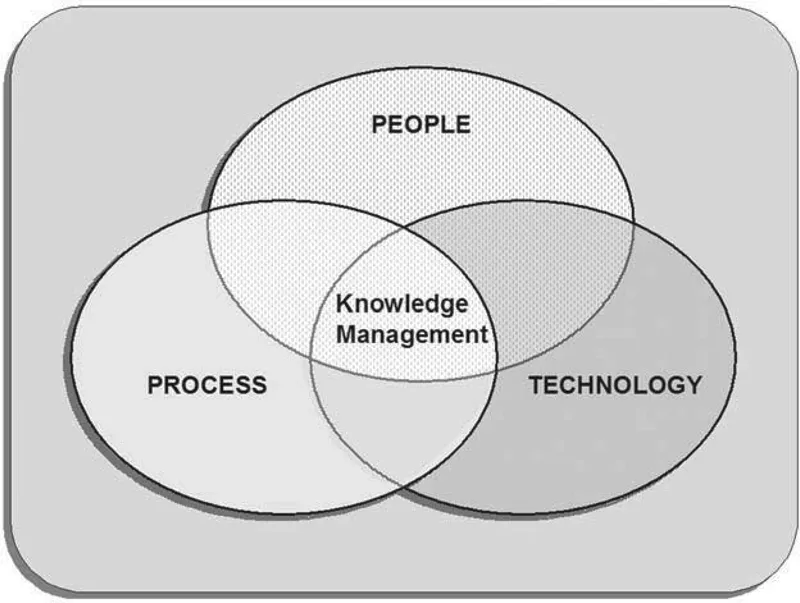
Figure 1-1 Knowledge Management = people, process, technology in a background of organizational culture.
The challenge is to design and implement a system that meets the needs of the organization. One source of debate about Knowledge Management is differentiating between knowledge as a stock (an asset) and as a flow or process. The Knowledge Management framework presented in this book addresses knowledge as an entity (stock) as well as a process (flow). Our framework eliminates the either/or dichotomy and, instead, uses both. Much as a plumbing system in a house includes stocks (tanks and reservoirs) and flows (pipes and pumps), so a Knowledge Management system in an organization also needs to include both stocks and flows.
HISTORY OF KNOWLEDGE MANAGEMENT
Moving from the industrial era to the knowledge era created a constant state of change. Peter Drucker identified a major trend in the 1970s when he coined the term “knowledge workers” and began to write about people whose minds and experience are more important to the organization than their physical skills. Change has become a constant. The pace of change is accelerating as we move further into the knowledge era. The change, in part, is a response to outdated organizational patterns that were built during the industrial era, when business decisions were primarily made to allocate scarce capital, specifically financial capital, to produce results. Whatever drives the change, companies need to learn to adapt if they are to survive. An organization that does not learn faster than the speed of change, is ultimately doomed. In the knowledge era, financial capital is more readily available through global resources than it was in the industrial era. The current challenge is to identify new sources and create new capabilities for organizations to grow. Financial capital is only one element. People and their associated knowledge as well as processes and technology have become major factors in organizational effectiveness. During the 1980s and '90s organizations embraced programs to improve productivity through quality initiatives—e.g., total quality management, business process reengineering, and Six Sigma. Now strategists recognize that the intangible assets of most enterprises are the key to the organization's ability to create competitive advantage and to grow at an accelerated pace. When these intangible assets are captured, stored, and shared, Knowledge Management is taking place.
When Knowledge Management became popular in the business press in the 1990s, many business practitioners initially considered it a fad. While KM gained credibility as conference programs and the press popularized the discipline, there is an ongo...
Table of contents
- Cover
- Half Title
- Title Page
- Copyright
- Contents
- Preface
- Acknowledgements
- Part I: Setting the Context for Knowledge Management as a Method for Organizational Learning
- Part II: Voices of Experience: Applying Knowledge Management Tools
- Appendix A: Readiness Survey for a KM Initiative
- Appendix B: Conversational Practices
- Appendix C: Knowledge Management Processes
- Index
- Author Bios
Trusted by 375,005 students
Access to over 1.5 million titles for a fair monthly price.
Study more efficiently using our study tools.
Frequently asked questions
Yes, you can cancel anytime from the Subscription tab in your account settings on the Perlego website. Your subscription will stay active until the end of your current billing period. Learn how to cancel your subscription
No, books cannot be downloaded as external files, such as PDFs, for use outside of Perlego. However, you can download books within the Perlego app for offline reading on mobile or tablet. Learn how to download books offline
Perlego offers two plans: Essential and Complete
- Essential is ideal for learners and professionals who enjoy exploring a wide range of subjects. Access the Essential Library with 800,000+ trusted titles and best-sellers across business, personal growth, and the humanities. Includes unlimited reading time and Standard Read Aloud voice.
- Complete: Perfect for advanced learners and researchers needing full, unrestricted access. Unlock 1.5M+ books across hundreds of subjects, including academic and specialized titles. The Complete Plan also includes advanced features like Premium Read Aloud and Research Assistant.
We are an online textbook subscription service, where you can get access to an entire online library for less than the price of a single book per month. With over 1.5 million books across 990+ topics, we’ve got you covered! Learn about our mission
Look out for the read-aloud symbol on your next book to see if you can listen to it. The read-aloud tool reads text aloud for you, highlighting the text as it is being read. You can pause it, speed it up and slow it down. Learn more about Read Aloud
Yes! You can use the Perlego app on both iOS and Android devices to read anytime, anywhere — even offline. Perfect for commutes or when you’re on the go.
Please note we cannot support devices running on iOS 13 and Android 7 or earlier. Learn more about using the app
Please note we cannot support devices running on iOS 13 and Android 7 or earlier. Learn more about using the app
Yes, you can access Performance Through Learning by Kurt April,Nick Milton, Ph.D.,Carol Gorelick in PDF and/or ePUB format, as well as other popular books in Business & Business General. We have over 1.5 million books available in our catalogue for you to explore.