- 176 pages
- English
- ePUB (mobile friendly)
- Available on iOS & Android
eBook - ePub
About this book
Indie Rock 101 is a clear, concise, all-in-one primer for beginning to mid-level musicians looking for the essential fundamentals behind running, recording and promoting their band. It's all the basics that can take years to collate from more specialized or technical books, magazines and websites-and it's written by a real independent musician.
* Part I, Running Your Band covers the topics most relevant to forming and running the band: the people, practice and songwriting
* Part II, Recording covers pre-production considerations, gear and how-to basics, and timeless fundamentals and techniques around recording, mixing and mastering
* Part III, Promoting covers what you need to know to establish and grow your fan base, including graphic design, your press kit and website, sharing and selling your music, playing out and making a video
Whether you're just starting out or looking for a 360-degree primer to help take your music to the next level, Indie Rock 101 is the one book that covers it all.
Featuring photos and Q&As from:
Birdmonster * CDBaby founder Derek Sivers * Juliana Hatfield * John Vanderslice * Karate * Mark Kozelek of
Information
PART 1
Running Your Band
There’s a certain magical quality to a great band. Any band essentially consists of people standing on a stage playing instruments, but a great band’s collective chemistry, proficiency and energy inspire proportionate enthusiasm in their audience. As music is a universal language, the connection between performer and audience can be very powerful, even transcendent.
A great band is a matter of working with the right people, using practice time wisely and writing great songs. (All of this, of course, results in having a great live act, and we’ll cover performance in Part III, Promoting). While a great band is usually the result of the members’ collective experience and dynamism, there are certain basic principles that can help you make your band the best it can be, or at least better than it already is. Let’s start by looking at your…
CHAPTER 1
People
How to find good band members
Post ads online, hang flyers
Network
Find like-minded players
No weak links
Every team needs a captain
Next, consider…
Your band name
Know when to part ways
Even if you’ve already formed your band, the following information is still pertinent to optimizing and running it most efficiently. And if you’re just starting to look for people, let’s start by covering the following sections.
HOW TO FIND GOOD BAND MEMBERS
Post ads online, hang flyers
There are plenty of places online to find other musicians to work with (www.craigslist.org is a no-brainer), but it can be just as effective—if not more so—to advertise with flyers.
The best place to post is in rehearsal spaces in your area because this is where real musicians go, the ones who are actually rehearsing, recording, and probably playing out. Other good spots to post include those where other musicians are known to hang out, like coffeehouses and bookstores. Below is a sample flyer with typical fundamentals and comments below each “field.”
Headline (Who You Are And What You Want)
Attractive female indie rock-minded singer/songwriter seeks band.
Get to the point and make it sound interesting.
Influences (Who Do You Like, Sound Like, Want To Sound Like)
Veruca Salt, Breeders, Juliana Hatfield, Donnas, to name a few.
Try to limit this list to 4 to 5 artists. We all have eclectic tastes, but you don’t have to list everything you like since you’re trying to establish your overall vision here
Links/Samples
Samples and photos at myspace.com/yourname Official website: www.yourwebsite.com.
I Have
A van, a rehearsal space, I know how to record, mix, and master on my computer
Talk about what you have to offer.
Where/When
I live in the Mission District and am looking to practice twice a week in or near that area.
No one likes a long commute to band practice after work, and you won’t either. Plus, GUDs (Geographically UnDesirables–nyone more than, say, 20–45 minutes away from the space) are often chronically late and eventually drop off. Save yourself some hassle and try to get someone in the neighborhood.
Age/Experience
I’m 22 and looking for people between 18 and 30. I’ve recorded and put out three records with different bands throughout college, and I’ve played at a good number of clubs in Philadelphia.
Setting expectations regarding your age and experience further helps you screen flakes and bad fits before you both waste time with an audition.
Goals
I want to do this for a living. Serious inquiries only, please.
A statement like this may sound a little strong, but you’ll more likely hear from someone equally as ambitious if that’s what you want. If not, be up front and say something a touch lighter like “I have a day job and plan on keeping it–ust looking to jam locally on weekends and do the occasional local show.”
For Consideration
Please send links to MP3s and preferably, photo(s).
As you get more experienced–or you’re paying for your rehearsal room time–you’ll want to screen with samples and, yes, even photos (especially for lead singers) before you potentially waste time auditioning them. At least get a recording–any recording: it’s still the best way to judge people’s level of experience and tastes without meeting them.
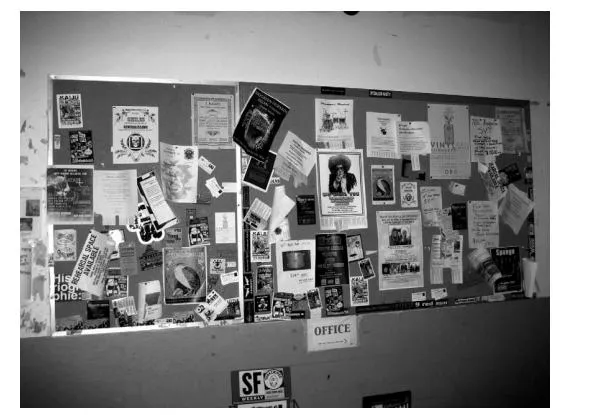
FIGURE 1.1
This is one of the best places to find your next band: flyer boards at the local rehearsal studios. (Photo by R. Turgeon).
Network
In business and in the music business, there’s no faster way to fill a post than through referrals (who also come with at least one reference right off the bat). If you’re just starting out or are new to town, go to local shows, start chatting with good bands, and pass out your music. Don’t be shy: ask if they know anyone who’s looking for someone like you to play with. Every local music scene features a smaller cast of characters than you think. So start passing out demos to bands you like or want to sound like. If you’re polite and have good material, most people will be happy to help you. (More on networking with other bands as it pertains to live shows will be discussed in “Playing Out,” Chapter 12.)
A word on appearance
It would be nice to think that bands are judged solely on the merit of their music, but in the music biz, that’s never really been the case. Some might say that it’s superficial to concern oneself with one’s band’s image or appearance, but whether it’s fair or not, doing so gives you an advantage. Even if the rest of the band doesn’t want to amp it up out of some misguided sense of purity or comfort, it’s important that at least the singer projects their band’s ethos, music, and image by carefully considering what they wear on stage. It’s less important that your act try to dress cool than it is to at least discuss how you’ll be presenting yourselves–and that there’s self-awareness cohesion and competence in this area. Regardless of what your image (or non-image) may be, a useful exercise is to look at video or rough photos of your stage presentation and ask yourself a few questions: Do we look like a unit? Do we somehow stand out from the millions of other bands out there? Would ours be a band someone might pay to see or hear based solely on our photo?
As you start to meet and audition people, you’ll also want to be sure to:
Find like-minded players
It’s said that the things that bind and break couples are sex, money, values, and beliefs. When mates are aligned on these things, the relationship has a better chance of lasting. It’s not surprising that similar considerations might be made in choosing band mates. More specifically:

Collaborating with diverse opinions and personalities can be rewarding and result in some great music, but you ultimately want to be able to say at least a soft “yes” to these questions. As you gain more experience in your band and possibly in other bands, you should be able to more quickly and instinctively evaluate whom you should associate with or avoid.
Once things start tO firm up a bit, or it’s time to narrow down to a few choice candidates, it’s important to keep a few things in mind…
No weak links
When choosing your bandmates, it’s important that everyone adds value and that there are no obvious weak links performance or business-wise. People who are playing at the same level but who can also push and challenge each other make a good team. Ideally, you want to choose people who are happy in their respective roles and who work well with others—a valuable, developed skill in itself that plenty of good musicians never develop.
The lead singer is, of course, the band member whose primary role is to ini- tiate and maintain that connection to the audience, so they’re naturally the most prominent member of any collectively decent band. In the minds of general audiences, the singer sets the level for the band as a whole. while it’s important for every member to be good, it’s important to keep in mind that a band even with the best musicians will rarely rise above the charisma and ability—or lack thereof—of their singer.
Regarding related roles and how they relate to the logistics and business around running a band, it’s most effective when roles are clearly defined and everyone contributes. The bands that tend to get ahead fast are those who are clear on what their role is as both a performer and as part of the business, if th...
Table of contents
- Cover
- Half Title
- Full Title
- Copyright
- Dedication
- Contents
- Book outline
- Introduction
- Part 1 Running Your Band
- Part 2 Recording
- Part 3 Promoting Your Band
- Appendix A Audio production magazines
- Appendix B Glossary of audio terminology
- Appendix C Recording process and gear list
- Index
- Acknowledgements
- About the Author
Trusted by 375,005 students
Access to over 1.5 million titles for a fair monthly price.
Study more efficiently using our study tools.
Frequently asked questions
Yes, you can cancel anytime from the Subscription tab in your account settings on the Perlego website. Your subscription will stay active until the end of your current billing period. Learn how to cancel your subscription
No, books cannot be downloaded as external files, such as PDFs, for use outside of Perlego. However, you can download books within the Perlego app for offline reading on mobile or tablet. Learn how to download books offline
Perlego offers two plans: Essential and Complete
- Essential is ideal for learners and professionals who enjoy exploring a wide range of subjects. Access the Essential Library with 800,000+ trusted titles and best-sellers across business, personal growth, and the humanities. Includes unlimited reading time and Standard Read Aloud voice.
- Complete: Perfect for advanced learners and researchers needing full, unrestricted access. Unlock 1.5M+ books across hundreds of subjects, including academic and specialized titles. The Complete Plan also includes advanced features like Premium Read Aloud and Research Assistant.
We are an online textbook subscription service, where you can get access to an entire online library for less than the price of a single book per month. With over 1.5 million books across 990+ topics, we’ve got you covered! Learn about our mission
Look out for the read-aloud symbol on your next book to see if you can listen to it. The read-aloud tool reads text aloud for you, highlighting the text as it is being read. You can pause it, speed it up and slow it down. Learn more about Read Aloud
Yes! You can use the Perlego app on both iOS and Android devices to read anytime, anywhere — even offline. Perfect for commutes or when you’re on the go.
Please note we cannot support devices running on iOS 13 and Android 7 or earlier. Learn more about using the app
Please note we cannot support devices running on iOS 13 and Android 7 or earlier. Learn more about using the app
Yes, you can access Indie Rock 101 by Richard Turgeon in PDF and/or ePUB format, as well as other popular books in Media & Performing Arts & Music. We have over 1.5 million books available in our catalogue for you to explore.