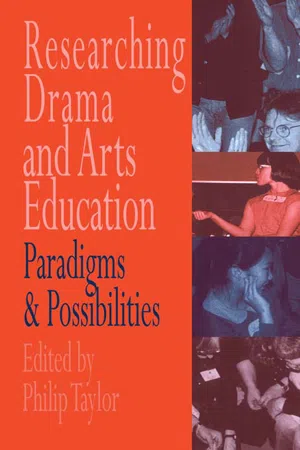
This volume examines the current major issues in research design for arts teachers. It aims to answer two key questions: how do researchers design their studies? What research methods are appropriate for specific investigative questions?
eBook - ePub
Researching drama and arts education
Paradigms and possibilities
- 224 pages
- English
- ePUB (mobile friendly)
- Available on iOS & Android
eBook - ePub
About this book
Information
Part One
Paradigms
1 Doing Reflective Practitioner Research
in Arts Education
Philip Taylor
Prologue: Millennium Approaches
In ‘Millennium Approaches’, Part One of Tony Kushner's epic two-part play Angels in America (1992), the audience is thrust into a hypercritical vortex where honour is fleeting, a brutal disease savages young lives, and betrayal guides human action. Kushner has a 1980s middle-America myopically seeking guidance from a detestable breed of self-serving individuals who are motivated by guilt, lust, or their own need for self-aggrandizement. The young, ambitious and closeted gay Mormon Republican, Joe Pitt, who aspires for a Washington appointment demonstrates this breed. ‘I think things are starting to change in the world,’ Joe says to his alienated and drug-dependent wife Harper, appealing that she share in his dream. ‘For the good,’ he continues:
Change for the good. America has rediscovered itself. Its sacred position among nations. And people aren't ashamed of that like they used to be. This is a great thing. The truth restored. Law restored. That's what President Reagan's done, Harper. He says, ‘Truth exists and can be spoken proudly.’ And the country responds to him. We become better. More good. I need to be a part of that, I need something big to lift me up. I mean six years ago the world seemed in decline, horrible, hopeless, full of unsolvable problems and crime and confusion and hunger and … (Kushner, 1992, p. 15)
But Harper knows better. The world for her is becoming a more frightening and lurid denizen every day where the environment's decay is mirrored in the gradual breakdown of humanist values. Harper's disconnectness from the planet is no more evident that in her growing estrangement from Joe, an estrangement which plunges her into chemical addiction and provokes a rapid retreat into a hallucinatory maelstrom.
Angels in America has been an extraordinary success for its playwright, playing to packed houses in London, San Francisco, New York and Sydney, as well as being the recipient of numerous theatre awards, including the Pulitizer Prize for Drama. While dealing with gay themes, perhaps it is more the human struggle to find meaning in a nonsensical world which has contributed to the play's following among an eclectic audience? Perhaps Kushner's harsh depiction of the corrupt establishment resonates with a universal understanding of how power destroys life and soul?
As I write these words, I contemplate the desperately confusing times that we live in. Every day seems to bring a continual parade of government inquiries into political misdemeanours where ministers and senators are accused of misleading the public. I am reminded of the frequent abuses of power and privilege which can have responsible citizens physically and sexually harass those they employ. While I watch the TV images of beguiling politicians with their contracts for a better society, and hear the moral majority and Christian Coalition who preach their homily of containment and self-control, I see the Pro-Choice lobby under attack, the National Endowment for the Arts fading, and minorities of every kind continually suppressed and struggling to speak, let alone be heard. I go into classrooms where kids come to school hungry because there isn't any cash or time at home to feed them. I see teachers who receive little moral support, who work with class sizes of thirty-five plus, and who are often the first ones attacked by parents and politicians when economic times are tough. I watch from my window and see a homeless man in Brisbane, a city known as the most livable in Australia, approach a teenage skateboard rider for a few coins and being told to ‘Fuck Off!’ And I do all of this being reminded of Angels in America and Joe's belief that ‘Truth exists and can be spoken proudly.’
The politicians would have us believe that there is such a truth but my experience tells me otherwise. Truths are constructed from within the circumstances in which people find themselves, and just as those circumstances may change at any given time, so might the truths. In 1987, for example, when I began my graduate study, I was told that the only way I could investigate classroom drama was to establish an experimental study with two groups, a control and treatment group. The control group would not participate in drama but the treatment group would. Both groups would have the same test at the beginning and at the end of the experiment, usually a written test, and the results would be graded and then tabulated. Believing in this truth, I was quite prepared to launch myself into the experiment until it was later suggested to me by Professor Margot Ely, who became a supervisor of my doctoral work and who is also a contributor to this volume, that learning and children could not be controlled in this way. ‘Surely your background in drama, Phil,’ she asserted, ‘would tell you that human activity is multi-dimensional and complex. How could you ever hope to study an aesthetic moment by drawing on a conventional scientific instrument?’
And, so, I date that time, 1987, as a point where I learned that there was more than one truth in research design. I learned that not only could I describe rather than measure learning processes of students but I could also describe my own learning processes as a teacher. I learned that there was a strong tradition of teacher research in education, especially in the social sciences and humanities. I discovered the power of qualitative and interpretive-based research design, became very excited by ethnography, and began what I hope will be a lifelong interest in what I describe as reflective practitioner research. And while there are many Joe's out there who inhabit university offices as well as government ones, I constantly remind myself that while I do this work they still need to be told that there are many truths in research design which can be proudly spoken of.
The Reflective Practitioner Researcher
So what is reflective practitioner research, and, how can this design access the multiplicity of visions and permit the multiplicity of truths that I am interested in? Often when people hear the term reflective practitioner research they think of intense introspective activity, or navel-gazing as one colleague of mine recently suggested, a more inward thinking approach toward research methodology. While I would agree that the stance of the reflective practitioner requires the ability to scrutinize the immediate context, there is the unfortunate connotation that navel-gazing implies being lost in oneself, or removed from the group. I don't see myself as a navel-gazer. On the contrary, the reflective practitioner stance demands a discovery of self, a recognition of how one interacts with others, and how others read and are read by this interaction. It is a stance peculiarly neglected by drama and arts education researchers. This is so perhaps because of various misconceptions and concerns about how the stance interacts with ongoing and comprehensive inquiry, or perhaps because of the discipline that it involves. However, it will be a central argument in this chapter that for arts educators to ignore reflective practitioner design is to remain ignorant to the kind of artistic processes which are the lifeblood of our work.
The work of Chris Argyris and Donald Schön (1974) at the Massachusetts Institute of Technology has been invaluable in my understanding of the reflective practitioner, especially in their recognition that professional competence is linked to an ability to try out ideas on-line and to understand how these trials might lead to improvement within the workplace context. In his book The Reflective Practitioner, Schön (1983) examines five professions — engineering, architecture, management, psychotherapy, and town planning — to show how professionals go about solving the questions, dilemmas and problems which they encounter on a daily basis. Although he does not specifically examine arts education, Schön draws on artistic processes, notably improvisational modes of inquiry, as vital to the ongoing and sustained competence of professional development.
In brief, Schön claims that the language of the bureaucrats and the technicians, which is housed in the positivist and neo-positivist world of technical rationality, is not immediately translatable to situations of daily practice. When dealing with the immediate challenges that professionals encounter, they not only draw on an intuitive knowledge base as a way for dealing with these challenges, what Schön refers to as knowing-in-action, but they utilize reflection-in-action as a means for directing their own and others' behaviour. This immediate process of reflection is characterized by a complex internal dialogue which requires prompt decisions about what the practitioner is seeing and how that seeing should influence behaviour:
When someone reflects-in-action, he [sic] becomes a researcher in the practice context. He is not dependent on the categories of established theory and technique, but constructs a new theory of the unique case. His inquiry is not limited to a deliberation about means which depends on a prior agreement about ends. He does not keep means and ends separate, but defines them interactively as he frames a problematic situation. He does not separate thinking from doing, ratiocinating his way to a decision which he must later convert to action. Because his experimenting is a kind of action, implementation is built into his inquiry. This reflection-in-action can proceed, even in situations of uncertainty or uniqueness, because it is not bound by the dichotomies of Technical Rationality. (Schön, 1983, pp. 68–9)
Rather than pursuing other people's idea of truth, like Joe does with President Reagan's idea in Angels in America, reflective practitioners interrogate the character of their own truths. Although there are aspects of Schön 's model which don't translate easily into the artistic-aesthetic curriculum — for instance, his weighted emphasis on problem-solving and experimental inquiry tend to defy the interpretive features of the paradigm often required in arts education research — his text does highlight one of the principal means through which arts educators operate, i.e., through their reflection-in-action, or their reflective conversation with the situation (1983, p. 268).
I am drawing an important distinction here between reflection-in-action and reflection-on-action. Readers might be familiar with the kind of action research models or the approaches to teacher research as inspired by the work of Lawrence Stenhouse (1975) in England. These models have been quite popular in educational research given that they empower teachers to take control over their own classrooms. However, there is a significant difference I would like to make between the action research model and that informed by reflective practice. Whereas action researchers tend to emphasize evaluation, rather than ongoing reflection, as a culminating activity, i.e., one plans, one acts, one evaluates, then one plans again, reflective practitioner researchers are concerned with documenting and understanding the tacit and known knowledge base which enables reflection-in-action to occur. What leads teachers to make on-the-spot decisions with their classes? How do educators know what course of action to assume within a challenging circumstance? How do teachers' interventions in a pedagogical moment impact upon the learning? These are the kind of questions which reflective practitioner researchers ask.
For arts educators, there is an attractiveness in reflective practitioner design because it honours the intuitive and emergent processes that inform artistic meaning-making. It seems to me that at the heart of the artistic act is a willingness by both the arts' makers and spectators, to transcend the boundaries of fixed realities and to enter virtual ones. Now, I would argue that the ability to transcend and to enter occurs in part because the makers and watchers engage immediately with the situation, and allow that situation to work upon them.
The opening of Stephen Sondheim's musical Sunday in the Park with George is a classic illustration of the decisive features of reflective practice and will help illuminate how reflective practitioner approaches are informed by artistry. As the curtain rises on a stark white space, the audience is greeted by Georges Seurat, the nineteenth-century French neo-impressionist. As this seated figure sits downstage with canvas and easel in front of him, a series of ascending arpeggios press the artist into motion. While playfully manipulating the tools of his craft, he verbalizes his understanding of significant form:
White: A blank page or canvas.The challenge: bring order to the whole.Through design.Composition.Tension.Balance.Light.And harmony. (Sondheim and Lapine, 1984/91, pp. 17–18)
The images that he dabs and daubs begin to inhabit the world of the stage. Just as Seurat's white canvas is transformed into blocks of coloured patterns, the theatrical work is swept into motion. The artist's reflective conversation with himself, with the artwork, with the people and objects which inhabit that work, and with the audience, is what gives the craft its li...
Table of contents
- Cover
- Half Title
- Dedication
- Full Title
- Copyright
- Contents
- Acknowledgments
- Preface
- Foreword
- Introduction: Rebellion, Reflective Turning and Arts Education Research
- Part One Paradigms
- Part Two Possibilities
- Afterword: Drama as Research
- Notes on Contributors
- Delegates at the Institute of Drama Education Research
- Index
Trusted by 375,005 students
Access to over 1.5 million titles for a fair monthly price.
Study more efficiently using our study tools.
Frequently asked questions
Yes, you can cancel anytime from the Subscription tab in your account settings on the Perlego website. Your subscription will stay active until the end of your current billing period. Learn how to cancel your subscription
No, books cannot be downloaded as external files, such as PDFs, for use outside of Perlego. However, you can download books within the Perlego app for offline reading on mobile or tablet. Learn how to download books offline
Perlego offers two plans: Essential and Complete
- Essential is ideal for learners and professionals who enjoy exploring a wide range of subjects. Access the Essential Library with 800,000+ trusted titles and best-sellers across business, personal growth, and the humanities. Includes unlimited reading time and Standard Read Aloud voice.
- Complete: Perfect for advanced learners and researchers needing full, unrestricted access. Unlock 1.5M+ books across hundreds of subjects, including academic and specialized titles. The Complete Plan also includes advanced features like Premium Read Aloud and Research Assistant.
We are an online textbook subscription service, where you can get access to an entire online library for less than the price of a single book per month. With over 1.5 million books across 990+ topics, we’ve got you covered! Learn about our mission
Look out for the read-aloud symbol on your next book to see if you can listen to it. The read-aloud tool reads text aloud for you, highlighting the text as it is being read. You can pause it, speed it up and slow it down. Learn more about Read Aloud
Yes! You can use the Perlego app on both iOS and Android devices to read anytime, anywhere — even offline. Perfect for commutes or when you’re on the go.
Please note we cannot support devices running on iOS 13 and Android 7 or earlier. Learn more about using the app
Please note we cannot support devices running on iOS 13 and Android 7 or earlier. Learn more about using the app
Yes, you can access Researching drama and arts education by Edited by Philip Taylor. in PDF and/or ePUB format, as well as other popular books in Education & Education General. We have over 1.5 million books available in our catalogue for you to explore.