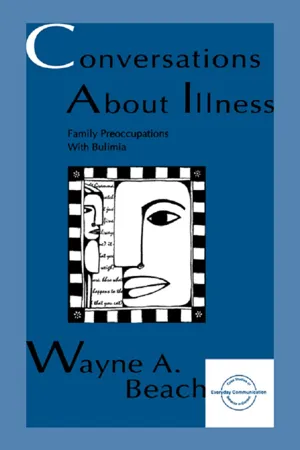
The grandmother granddaughter conversation examined in this book makes explicit what the detailed study of interaction reveals about two social problems--"bulimia" and "grandparent caregiving." For the first time, systematic attention is given to interactional activities through which family members display ordinary yet contradictory concerns about health and illness:
* a grandmother's (who is also a registered nurse) attempts to initiate, confront, and remedy her granddaughter's lack of responsibility in admitting bulimic "problems" and committing to professional medical assistance;
* a granddaughter's methods for avoiding ownership of the alleged bulimic problems by discounting the legitimacy of her grandmother's expressed concerns.
Through analysis of a single audio-recorded and transcribed conversation, Wayne Beach reveals the altogether pervasive and often troubled talk surrounding family medical predicaments. From a careful review of extant theories that seek to explain eating disorders and grandparent caregiving, it becomes clear that an overreliance on self-report data has promoted underspecified understandings of "social contexts" -- conceptualizations void of real time practices and interactional consequences mirroring how families manage their daily affairs and understandings regarding health and illness. In contrast, this volume draws attention to family members' embodied interactional activities. Here it is seen, for example, how methods for expressing concern and caring by individuals may nevertheless eventuate in interactional troubles and problems between family members. The analysis reveals that, while displays of basic concerns for others' health and well being are routine occurrences between family members in home environments -- and of course, across friendship and various support networks -- even the delicate and well-intended management of such occasions guarantees neither agreement on the nature of the alleged "problems" nor, consequently, a commitment to seek professional help as a means of remedying a medical condition. In such cases, the very existence of an illness is itself a matter of some contention to be interactionally worked out. And it is perhaps both predictable and symptomatic that those explicitly denying (or as with the granddaughter, indirectly failing to admit) that problematic health behaviors exist, also somehow let it be made known that far too much attention is being given to possibilities and consequences of illness in the first instance.
Implications of this investigation extend well beyond "bulimia" and "grandparent caregiving" to a vast array of casual and institutional involvements between family members, friends, and bureaucratic representatives such as those involved in long-term caregiving, dealing with cancer and Alzheimer's disease, or conducting psychiatric interviews and HIV/AIDS counseling sessions. Findings regarding the interactionally organized nature of talk about bulimia, as well as the problematic nature of caregiving, will be of value to researchers focusing on language and social interaction, health practitioners, and families alike.
This volume includes the full transcript of the conversation in the case study. A copy of the audio-recording is available for classroom adoption and/or personal purchase by contacting: Wayne A. Beach, School of Communication, San Diego State University, San Diego, CA 92182-4516.
- 168 pages
- English
- ePUB (mobile friendly)
- Available on iOS & Android
eBook - ePub
About this book
Information
Table of contents
- Cover
- Half Title
- Title Page
- Copyright
- Dedication
- Contents
- Series Editors’ Preface
- Introduction
- 1. Finding Bulimia
- 2. From Troubles to Problems
- 3. Overcoming Resistance
- 4. Avoiding Ownership
- 5. Preoccupations
- 6. Interaction and Social Problems
- Appendix: Transcription Notation Symbols and G–S Transcript
- References
- Author Index
- Subject Index
Trusted by 375,005 students
Access to over 1.5 million titles for a fair monthly price.
Study more efficiently using our study tools.
Frequently asked questions
Yes, you can cancel anytime from the Subscription tab in your account settings on the Perlego website. Your subscription will stay active until the end of your current billing period. Learn how to cancel your subscription
No, books cannot be downloaded as external files, such as PDFs, for use outside of Perlego. However, you can download books within the Perlego app for offline reading on mobile or tablet. Learn how to download books offline
Perlego offers two plans: Essential and Complete
- Essential is ideal for learners and professionals who enjoy exploring a wide range of subjects. Access the Essential Library with 800,000+ trusted titles and best-sellers across business, personal growth, and the humanities. Includes unlimited reading time and Standard Read Aloud voice.
- Complete: Perfect for advanced learners and researchers needing full, unrestricted access. Unlock 1.5M+ books across hundreds of subjects, including academic and specialized titles. The Complete Plan also includes advanced features like Premium Read Aloud and Research Assistant.
We are an online textbook subscription service, where you can get access to an entire online library for less than the price of a single book per month. With over 1.5 million books across 990+ topics, we’ve got you covered! Learn about our mission
Look out for the read-aloud symbol on your next book to see if you can listen to it. The read-aloud tool reads text aloud for you, highlighting the text as it is being read. You can pause it, speed it up and slow it down. Learn more about Read Aloud
Yes! You can use the Perlego app on both iOS and Android devices to read anytime, anywhere — even offline. Perfect for commutes or when you’re on the go.
Please note we cannot support devices running on iOS 13 and Android 7 or earlier. Learn more about using the app
Please note we cannot support devices running on iOS 13 and Android 7 or earlier. Learn more about using the app
Yes, you can access Conversations About Illness by Wayne A. Beach in PDF and/or ePUB format, as well as other popular books in Medicine & Communication Studies. We have over 1.5 million books available in our catalogue for you to explore.