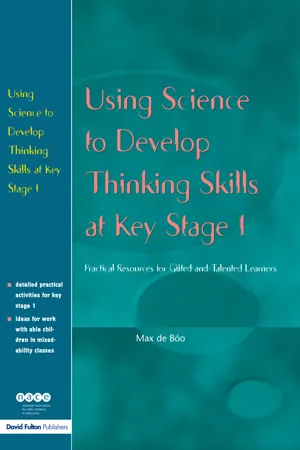
This work presents a series of practical activities designed to help teachers build an effective science curriculum for more able children. Activities range from short discussion topics and problems to solve, to whole-day masterclasses.
- 168 pages
- English
- ePUB (mobile friendly)
- Available on iOS & Android
eBook - ePub
Using Science to Develop Thinking Skills at KS1
About this book
Information
CHAPTER 1
Introduction
Identifying scientifically gifted children
Five Reception children (four-to five-years-old), were being interviewed on their thinking about ‘heat’, using a picture of a volcano to initiate the discussion.
Teacher with Kylie and Sheena
| Teacher: | I wonder what made the volcano get so hot? |
| Kylie and Sheena: | Fire. |
| Sheena: | And smoke. |
| Teacher: | I see what you mean. And is there any way of making the volcano cool down, do you think? |
| Kylie: | Water! |
| Sheena: | Firemen… |
| Kylie: | You could get a hose pipe. |
| Teacher: | A hose pipe? |
| Kylie: | Yeah, ‘cos some pipes are really big and the firemen can stretch it right over to the volcano. |
Teacher with Tony and Alex
| Teacher: | I wonder what made the volcano get so hot? |
| Tony: | Well, Jesus done it. I mean God. |
| Teacher: | Yes, I see. Is there any way of making the volcano cool down, do you think? |
| Alex: | Only from the sky. |
Teacher with Sanjiv
| Teacher: | Do you know where the volcano gets its heat from? |
| Sanjiv: | Yes. When the Earth plates stuck … touch together. |
| Teacher: | Why, what does that do? |
| Sanjiv: | It makes the heat … the Earth plates push together … and then the fire comes out. |
| Teacher: | Is there any way of stopping the Earth plates pushing together? |
| Sanjiv: | No. |
We meet children like Sanjiv rarely; his responses are unusual and exceptional. We meet children like Kylie and Sheena more often; they draw conclusions using cause and effect and are potentially high achievers. We meet children like Tony and Alex most frequently; their answers a mixture of the subjective and objective, although they are capable of responding with higher order thinking if given enough stimuli and regular challenges.
The definitions of gifted and talented children generally used for inspection purposes by Ofsted (Office for Standards in Education) define these children as those who show higher ability in all or some areas of the curriculum. The statement is clarified by defining ‘gifted’ children as showing high ability or potential in academic subjects and ‘talented’ children showing high ability or potential in the expressive, creative arts or sports. Researchers and government guidelines work on the principle that there are probably 5 to to per cent of school children who can be described as gifted and talented and a further 10 per cent who are very high achievers. In Wales (ACCAC) Awdurdod Cymwyskron Cwricwlwm ac Asesu Cymru, the standard definition is that 20 per cent of children are ‘more able and talented’ and the Scottish Office agrees with these notional figures. However, it is often confusing to classify children, especially from four to seven years, so we need to keep an open mind and assume a figure of about 15 to 20 per cent of highly talented children. We can proceed on the assumption that in an average group of children there are likely to be some high achievers and occasionally, an exceptionally gifted or talented child.
The difficulty in identifying young children with high ability arises because their cognitive, emotional and physical development is uneven ‘and the more gifted a child is the more pronounced the unevenness [can] be’ (Silverman 1993). However, Silverman identified some of the characteristics that help us identify these children:
Intellectual characteristics
| • exceptional reasoning ability | • intellectual curiosity |
| • rapid learning rate | • facility with abstraction |
| • complex thought processes | • vivid imagination |
| • early moral concern | • passion for learning |
| • powers of concentration | • analytical thinking |
| • divergent thinking/creativity | • keen sense of justice |
| • capacity for reflection |
Personality characteristics
| • insightfulness | • need to understand |
| • need for precision/logic | • need for mental stimulation |
| • perfectionism | • excellent sense of humour |
| • sensitivity/empathy | • perseverance |
| • intensity | • non-conformity |
| • acute self-awareness | • tendency towards introversion |
| • questioning of rules/authority |
Some of the children we teach will show some or many of these characteristics. However, the most important thing about teaching able young children is that, first and foremost, they are children. Their social and emotional needs are similar to their peers. The fact that they are highly intelligent can be daunting enough to make us concentrate on their abilities, as we might focus on a person’s disabilities, rather than on them as a person.
Sanjiv
At one time I was asking Sanjiv [the gifted child mentioned earlier] his thoughts about candles and melting, using a tape recorder. After a few minutes, he got fed up talking about the burning candle and wanted to take the tape recorder apart. When I protested, he began speaking in a very quiet whisper.‘Now the tape recorder can’t hear me anyway,’ he said. And smiled.
The official requirement to ‘identify giftedness’ is not easily satisfied; in young children, ability is often latent and will develop in the quality of the provision made. It is not helped if those talented children are also impatient, demanding, disrespectful or short-tempered with us or the other children. The world of the gifted and talented child must present a great deal of confusion – ‘Why don’t grown-ups think as quickly as I do? Why do other children offer silly (naïve) ideas in response to questions? Why do I have to work so slowly when I can do ioo things twice as fast as the others?’ Koshy (2002: 109) stated that able children underachieve for the following reasons:
- Frustration – bored with the content on offer
- Resentment – prefer to read instead of listen or do instead of talk
- Fear of failure – perfectionism or nothing
- Bored with the topic – need stimuli
- Low level of intellectual stimulation
- Hiding real ability to obtain acceptance from peers
- Frustrated by and resentful of low level of ability of peers
This negative behaviour can mask their ability – although there can be no excuse for disrupting lessons. Young gifted children need support – they will not thrive all on their own. They can help other children some of the time and acquire social skills but this should not dominate their experience. Furthermore, in an ordinary classroom setting, many other children require our support also. Appeals to the local education authority for psychologists to assess gifted children can take time, as these psychologists have a big caseload. My experience of this process includes waiting a whole year for a six-year-old gifted child to be assessed, and then the test was incomplete.
Noah
The local authority psychologist came to assess six-year-old Noah. After 45 minutes of the IQ test, Noah got bored. He said ‘I don’t want to do any more!’ After pleas to stay, he carried on for five minutes. Then the dinner bell rang. ‘I want my dinner now,’ declared Noah and walked out. His IQ at the walking out stage was 187!
Given the difficulties in identifying scientifically gifted children, this book is designed as follows:
• First, the book offers strategies for teaching all children who may yet be recognised as very capable learners in science. When young children are offered stimulating opportunities and challenging questions in situations where they feel safe and confident, they can perform at a much higher level than previously expected (de Bóo, unpublished research, 1989–1995). That is, with the supportive ‘scaffolding’ described by Bruner (1968), children’s learning advances into what...
Table of contents
- Cover
- Half Title
- Full Title
- Copyright
- Contents
- Dedication
- 1 Introduction
- 2 Life Processes and Living Things
- 3 Materials and Their Properties
- 4 Physical Processes
- Appendix: Tables of Significant Attainment
- Bibliography
- Useful Resources
- Index
Trusted by 375,005 students
Access to over 1.5 million titles for a fair monthly price.
Study more efficiently using our study tools.
Frequently asked questions
Yes, you can cancel anytime from the Subscription tab in your account settings on the Perlego website. Your subscription will stay active until the end of your current billing period. Learn how to cancel your subscription
No, books cannot be downloaded as external files, such as PDFs, for use outside of Perlego. However, you can download books within the Perlego app for offline reading on mobile or tablet. Learn how to download books offline
Perlego offers two plans: Essential and Complete
- Essential is ideal for learners and professionals who enjoy exploring a wide range of subjects. Access the Essential Library with 800,000+ trusted titles and best-sellers across business, personal growth, and the humanities. Includes unlimited reading time and Standard Read Aloud voice.
- Complete: Perfect for advanced learners and researchers needing full, unrestricted access. Unlock 1.5M+ books across hundreds of subjects, including academic and specialized titles. The Complete Plan also includes advanced features like Premium Read Aloud and Research Assistant.
We are an online textbook subscription service, where you can get access to an entire online library for less than the price of a single book per month. With over 1.5 million books across 990+ topics, we’ve got you covered! Learn about our mission
Look out for the read-aloud symbol on your next book to see if you can listen to it. The read-aloud tool reads text aloud for you, highlighting the text as it is being read. You can pause it, speed it up and slow it down. Learn more about Read Aloud
Yes! You can use the Perlego app on both iOS and Android devices to read anytime, anywhere — even offline. Perfect for commutes or when you’re on the go.
Please note we cannot support devices running on iOS 13 and Android 7 or earlier. Learn more about using the app
Please note we cannot support devices running on iOS 13 and Android 7 or earlier. Learn more about using the app
Yes, you can access Using Science to Develop Thinking Skills at KS1 by Max de Boo in PDF and/or ePUB format, as well as other popular books in Education & Education General. We have over 1.5 million books available in our catalogue for you to explore.