eBook - ePub
Curriculum Provision for the Gifted and Talented in the Primary School
English, Maths, Science and ICT
- 160 pages
- English
- ePUB (mobile friendly)
- Available on iOS & Android
eBook - ePub
Curriculum Provision for the Gifted and Talented in the Primary School
English, Maths, Science and ICT
About this book
The authors of this book offer practical help to teachers in making day-to-day provision for the gifted and talented pupils in their classroom. Designed mainly for primary teacher, intending teachers and teacher trainers, the book draws together current findings in curriculum provision in the core subjects, links theory and practice in such a way that the readers can benefit from exemplar material, and allows them to adapt their own teaching to provide an inclusive curriculum for the gifted and talented children they teach.
Information
Chapter 1
An Effective Primary School for the Gifted and Talented
A School-Wide Approach to Gifted and Talented
This chapter outlines the areas which need to be considered if a school is to improve its provision for the gifted and talented. The gifted and talented are not a homogeneous group and therefore provision needs to be responsive to individual needs and sufficiently flexible to take account of particular ages and contexts. This chapter aims to help schools to understand not only what they should do, but also why it is appropriate and how to tailor the general guidance on provision to fit their own particular context. Finally it provides guidance on how to monitor provision and judge whether the school really is an effective school for gifted and talented children.
For most schools, meeting the needs of their gifted and talented children is part of a commitment to ensuring suitable educational opportunities for all children. Schools are not looking to provide for their gifted and talented at the expense of other children but rather to ensure that all children, including those with gifts and talents, are receiving good quality educational provision. In considering education for gifted and talented children it is not surprising to find that schools who are judged to be successful generally are also most likely to be among those successful in providing for their gifted and talented children. Schools who meet the criteria for effective schools (Sammons, Hillman and Mortimore 1996) are also likely to be effective in meeting the needs of the gifted and talented (see Figure 1.1).
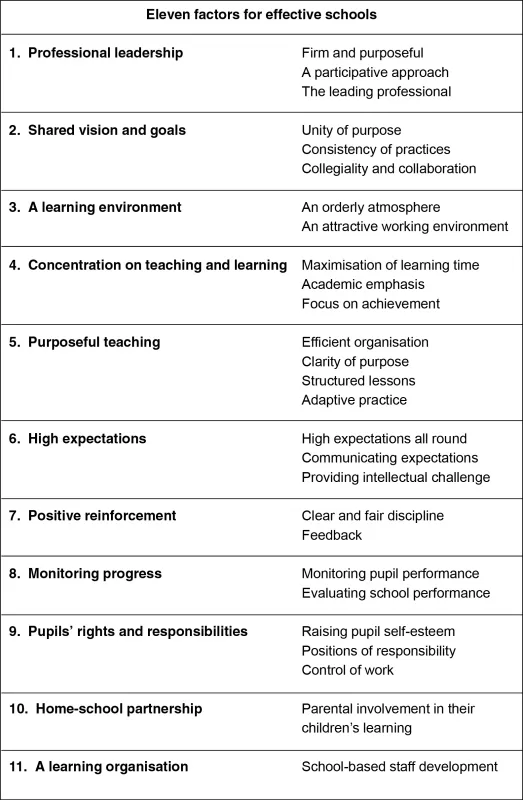
Figure 1.1 Eleven factors for effective schools
Key Point
Meeting the educational needs of the gifted and talented is about building on good general school provision, not about providing something entirely different.
Therefore, in judging the effectiveness of a school in providing for its gifted and talented children, a look at overall school provision is one aspect of the process. For a school to be a good school for the gifted and talented it must first be a good school for the majority. Such factors as systems for assessment, planning and monitoring must exist before they can be modified to meet the needs of the gifted. Two more aspects, in addition to those found in any effective school, form the basis of judgements in respect of effective provision: first, the availability of opportunities for challenge and the access of individuals to them, and second, the quality of the opportunities on offer. Do they really present a stimulating and challenging range of opportunities and are all those with the potential to benefit from them able to gain access? This section of the chapter looks briefly at the range of opportunities which should be provided and indicators of quality.
Classroom Provision
In the primary school the majority of educational opportunities for gifted and talented children should be available as part of general classroom practice. Kerry and Kerry (2000) describe pedagogy as being the key to able student’s teaching and learning, and they assert that the key components to effective classroom provision are:
- defining learning objectives;
- setting effective classroom tasks;
- differentiating work;
- questioning effectively;
- explaining effectively.
In providing well for gifted and talented children a school needs to consider how each of these might operate in respect of those of high ability. When considering learning objectives, more challenging objectives for the most able will be a regular feature of classroom planning. This does not mean that different worksheets always need to be provided for the most able; learning objectives can be linked to understanding of additional or more complex concepts and may be achieved through careful questioning. It does mean that a teacher should be able to demonstrate an understanding of the kinds of approaches that are most likely to provide a challenge and justify the choice of a particular approach in a particular set of circumstances. The following goals for extension tasks (Eyre 1997) provide a useful aide mémoire:
- critical thinking;
- creative thinking;
- increased independence;
- problem solving ability;
- reflection;
- self-knowledge.
School-Wide Opportunities
While much of the provision in curriculum areas will be part of classroom practice, the development of the wider framework of opportunities is likely to be part of a school-wide offer. Good provision for gifted and talented is broad-based and balanced. All children, including the gifted and talented, benefit from access to a wide range of experiences. If, as Gardner (2000) suggests, ability exists in a variety of possible domains, then children need to experience opportunities to operate within those domains if their ability is to be revealed. This is particularly important in the Foundation Stage and Key Stage 1 as a child’s interest in particular domains is still at an early stage of formation. In practical terms, the child who hears a steel band perform in school may develop an interest in music which is triggered by this single event. A visit to school from a local historian may, indirectly, lead to a child studying history at university. Some opportunities can only be made available at whole-school level – major drama performances or involvement in clubs and societies. These are an important part of provision for all children and equally important for the gifted. Some children may have gifts in areas which are not catered for in the classroom at all and only catered for at whole-school level, e.g. chess.
School-wide opportunities have always been to some extent dependent on the particular skills and interests of teachers in the school. A good school for the gifted and talented ensures a range of opportunities in different domains. If a school chooses to specialise by, for example, offering outstanding musical opportunities, then they need to ensure that the artistically talented or sporting child can also gain access to high-quality opportunities, whether this is provided within the school or beyond it.
School-wide opportunities might include:
- whole-school drama or musical productions;
- clubs and societies;
- competitions;
- access to experts, e.g. artist in residence or book week;
- residential visits;
- specialist workshops;
- visits and events;
- links with schools in other countries.
School-Based Enrichment Opportunities
These are defined as opportunities that are offered to help selected children who have particular abilities and skills. In the primary school the boundary between that which is offered as a school-wide opportunity and that which is offered to selected groups is often blurred. The school is trying to offer experiences to many but also accelerated skills development for some. When deciding whether a particular opportunity should have open access or be for a selected group this distinction is useful. The purpose and nature of the activity should determine to whom it is offered.
Enrichment programmes invoke strong support and also extensive criticism in the research literature. On the plus side able/gifted pupils do benefit from the stimulation of their intellectual peers (Shore 2000) and increases in pace and complexity are easier to achieve in this kind of context (see Figure 1.2). On the minus side, no research evidence has proved significant long-term educational impact resulting from withdrawal programmes, although increases in motivation and enjoyment are widely reported (Freeman 1998).

Figure 1.2 Offering enrichment to selected groups of pupils
This research is important to note because schools tend to be drawn towards enrichment opportunities as a simple way to make provision, and to offer them without sufficient thought.
Key Point
Overall, an effective school may choose to include enrichment for selected children as part of its provision. It will however have addressed the issues related to the rationale for this choice of approach, have clear learning outcomes for the sessions, and have taken into account issues around continuity and progression prior to embarking on the project.
Community-Based Opportunities
A particular dilemma in the education of the gifted and talented is the extent to which the school is the primary context for the nurturing of abilities or talent. Of course it will never be the sole educator;; even for the most academic of subjects home and school educate the child jointly. However, it is also the case that the school plays relatively little part in the development of some kinds of talent – a child learning karate or ballet may do so entirely in a location outside of school. Bloom (1985) found that some of the adults in his study began the development of their talent or ability in school but all later developed it outside the school context.
In the past, schools have not seen their role in relation to the gifted and talented as extending beyond the school (and advice to parents on home support). Excellence in Cities (DfEE 1999), however, gives schools responsibility for alerting children and their parents to opportunities for talent development which exist on a local, regional or national basis. This is particularly important for the development of talents not well catered for in school. Local opportunities may include sports clubs and interest clubs (e.g. chess or archaeology) as well as ‘explorers’ clubs’ which are provided specifically for the gifted and talented. National opportunities include schemes run by museums and art galleries as well as the National Trust, etc. Finally, an increasing number of opportunities are appearing on the Internet, and many families have found sites like ‘nrich’ to be invaluable in extending opportunities to develop skills in maths.
Key Point
An effective school for the gifted and talented publicises local and national opportunities for the development of abilities and talent and alerts parents of children with particular abilities to the opportunities available.
Organisational Arrangements
An effective school for the gifted and talented will consider the needs of high ability children when it makes decisions on organisational matters such as pupil grouping or assessment. Opportunities will exist to cater for the needs of able individuals, including the chance to work with others of like ability (even where this necessitates working with older children) and opportunities to access extension papers in SATs. It is likely that, in small or generally low-achieving schools, academically able individuals will be seen as having particular individual needs and their provision and progress will be charted accordingly, e.g. by an Individual Education Plan. In larger schools, setting or pupil grouping arrangements will take account of the needs of the gifted and talented.
Effective schools for gifted and talented may use any form of pupil grouping but are likely to set for maths and literacy by the upper end of the primary school. Setting is not in itself a form of provision for the gifted and talented. Even within a top set, levels of achievement can vary considerably and differentiation will be needed. Setting is also problematic in that it requires a decision to be made about the child’s potential for achievement at a time when talent development may be fluid and uneven. Setting does provide a good context for presenting challenging opportunities and gifted children, especially in Key Stage 2, tend to prefer setted groups. However, for those children with latent potential or uneven skills, setting may lead to less challenge or withdrawal of opportunities when they are relegated to a lower set. Research on setting in the secondary school (Ireson and Hallam 1999) suggests that there is a poor correlation between academic ability and sets in some schools, and so setting arrangements need to be monitored carefully.
Social and Emotional Considerations
Stopper (2000) describes the relationship between intellectual and social/emotional development as complex. Work on definitions of high ability includes the role of emotional states, e.g. motivation, and work on high-achieving adults points to the role of emotional wellbeing in high achievement.
For the young child emotional and intellectual needs are difficult to disentangle. Children need to be confident and secure if they are to strive and take risks. This is the same for gifted and talented children as it is for others. Therefore, any provision made by schools for gifted and talented children should take into account its effect on the child or children. For one child, working with older children might be desirable and enjoyable; for another of similar ability it might be stressful and problematic.
Freeman (1998) is unequivocal in saying: ‘There is no reliable scientific evidence to show that exceptionally high ability per se is associated with emotional problems, or that inadequate education results in delinquent or disturbed beha...
Table of contents
- Cover
- Half Title
- Title Page
- Copyright
- Contents
- Preface
- Introduction
- Contributors to the book
- 1. An effective primary school for the gifted and talented
- 2. English
- 3. Mathematics
- 4. Science
- 5. Information and Communication Technology
- 6. Conclusions
- Appendix One
- Index
Trusted by 375,005 students
Access to over 1.5 million titles for a fair monthly price.
Study more efficiently using our study tools.
Frequently asked questions
Yes, you can cancel anytime from the Subscription tab in your account settings on the Perlego website. Your subscription will stay active until the end of your current billing period. Learn how to cancel your subscription
No, books cannot be downloaded as external files, such as PDFs, for use outside of Perlego. However, you can download books within the Perlego app for offline reading on mobile or tablet. Learn how to download books offline
Perlego offers two plans: Essential and Complete
- Essential is ideal for learners and professionals who enjoy exploring a wide range of subjects. Access the Essential Library with 800,000+ trusted titles and best-sellers across business, personal growth, and the humanities. Includes unlimited reading time and Standard Read Aloud voice.
- Complete: Perfect for advanced learners and researchers needing full, unrestricted access. Unlock 1.5M+ books across hundreds of subjects, including academic and specialized titles. The Complete Plan also includes advanced features like Premium Read Aloud and Research Assistant.
We are an online textbook subscription service, where you can get access to an entire online library for less than the price of a single book per month. With over 1.5 million books across 990+ topics, we’ve got you covered! Learn about our mission
Look out for the read-aloud symbol on your next book to see if you can listen to it. The read-aloud tool reads text aloud for you, highlighting the text as it is being read. You can pause it, speed it up and slow it down. Learn more about Read Aloud
Yes! You can use the Perlego app on both iOS and Android devices to read anytime, anywhere — even offline. Perfect for commutes or when you’re on the go.
Please note we cannot support devices running on iOS 13 and Android 7 or earlier. Learn more about using the app
Please note we cannot support devices running on iOS 13 and Android 7 or earlier. Learn more about using the app
Yes, you can access Curriculum Provision for the Gifted and Talented in the Primary School by Eyre Deborah,Lynne McClure in PDF and/or ePUB format, as well as other popular books in Education & Education General. We have over 1.5 million books available in our catalogue for you to explore.