- 240 pages
- English
- ePUB (mobile friendly)
- Available on iOS & Android
eBook - ePub
John Chrysostom
About this book
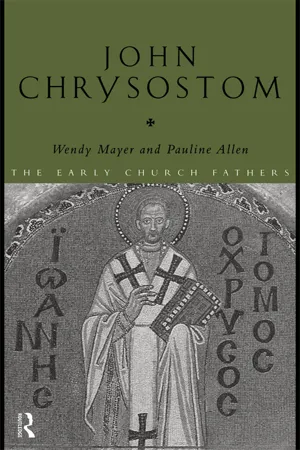
This book examines John Chrysostom's role as preacher and his pastoral activites as deacon, presbyter and bishop. It also provides fresh and lively translations of a key selection of sermons and letters.
Texts
GENERAL INTRODUCTION TO THE TEXTS
Care has been taken in this volume to present only sermons which can be attributed to Antioch or Constantinople with certainty or something approaching near certainty, so that the information which they contain can be situated carefully in context. Likewise, in our selection we have tried to avoid material which is frequently quoted in other publications, such as the letters to Olympias. Our intention is to present a side of John Chrysostom which is less well known to the reader. We have made an exception in the case of the sermons On Eutropius and Against the Jews oration 1, because of the wealth of detail which they contain regarding John’s preaching and the relationship between John and his audiences, and the balance that they bring to the picture. It is also our policy to present the full text of a sermon wherever possible in order to avoid giving a false impression to the reader, as is often the case when only an extract is supplied. We have relaxed this rule in the instance of Baptismal instruction 8, where a careful modern translation in English already exists (Harkins 1963), and in the case of On the Acts of the apostles hom. 3, where the available Greek text of the first half of the homily contains certain difficulties. In the latter instance these problems make it preferable to adjourn a full translation of the homily until one of the promised new critical editions of the series appears in press (Gignac 1987; Devine 1989). In the cases of On: ‘I opposed him to his face’, On 1 Corinthians hom. 21 and On: ‘My father’s working still’ we present a shortened text likewise, for reasons of space and because the style of homily is already well represented.
The letters we have selected are here translated into English for the first time as are a number of the homilies. The majority of those texts which have previously been translated into English appeared in the Library of the Nicene and Post Nicene Fathers in the late nineteenth century in language which now fails to convey the immediacy and vitality of John’s preaching. In the case of Against the Jews oration 1, we present a full text of the homily in a fresh translation because of the significance of the detail which it contains. This has been prepared with the recent translation by Paul Harkins (1979) in mind.
Because of the numerous biblical citations which occur in a majority of the sermons selected, in the case of citations from the Old Testament we refer the reader to the standard modern titles and numbering of the texts unless the book in question is exclusive to the Septuagint, or the Septuagint reading differs substantially from the Hebrew (e.g., Gen. 22:3; Isa. 41:2 LXX). By this same rationale the psalms are cited according to the Hebrew rather than the Greek numbering. This preference for the Hebrew over the Greek reference system is purely for the convenience of the modern reader. John himself used only the Greek versions of both the Old and New Testament which were at the time available to him. It should be noted that in some cases these deviate from the standard text. In two instances apparent scriptural citations are unidentifiable. In these cases the citation is italicised, but no reference appears in parentheses after it. Attention is drawn in the notes to the lack of identification. Italicisation is also used to set apart from the rest of the text formulae which John cites from the liturgy. The translations of scriptural citations are largely our own.
Parentheses are employed in two ways in our translations. Where John makes an aside, the comments are placed within parentheses as is usual in English syntax. Parentheses are also used to indicate to the reader where we have inserted words into the text which do not exist in the Greek original. In these cases, the words have been added to improve the clarity of the translation. Occasionally we also explain in parentheses what should be understood by a particular word or phrase. Such explanations are always prefaced by ‘sc.’ (scilicet).
There are several words which recur throughout the sermons and letters which have a range of meanings and are difficult to translate with consistency. One such term is philosophia. This is sometimes translated by us as ‘philosophy’ (in the general sense), sometimes as ‘wisdom’. In a very broad sense it can also mean ‘a Christian way of life’ or ‘the ascetic way of life’. More rarely it is used by Chrysostom in its technical sense (philosophy). Where the word is translated by us as other than ‘philosophy’, indication is given in the notes. Parrhēsia is another word to which there attaches difficulty. Sometimes we translate it as ‘frank speech’, sometimes as ‘confidence’ or ‘boldness’. In the context of speech with the emperor the meaning becomes something like ‘easy access’. Again, where the translation differs from the primary meaning (‘frank speech’), indication is given in the notes. Philanthrōpia likewise presents difficulties. In relation to God it is most often translated by us as ‘love for humankind’. However, in Hellenistic society it can also constitute a technical term which refers to acts of public benefaction. In cases where this sense is stronger we tend to translate it as ‘generosity’. One final word which presents particular difficulty is spoudē. While in the sermons we have selected it can usually be translated as ‘zeal’, in the context of the letters it takes on a more complex range of meanings. There it has been translated by us variously as ‘enthusiasm’ or ‘attention’.
The text from which the sermons and letters are translated is most commonly that of Montfaucon, as preserved in volumes 48–63 of the Patrologia Graeca. The majority of John’s sermons have yet to appear in modern scientific editions. In the case of On Ephesians hom. 11, On Colossians hom. 1 and On 1 Corinthians hom. 21, a. text based on a more discriminating view of the manuscripts than is provided by Montfaucon was prepared by Frederick Field in the mid-1800s. This text represents the most scientific edition of these homilies to date and is generally more reliable. In these three cases we have based our translation on the Field text. All instances in which we prefer the punctuation or reading of the Montfaucon text as preserved in PG are indicated in the notes to each of the three homilies. An exception to the use of the Montfaucon and Field editions occurs in the case of On his return and Baptismal instruction 8. In the first instance the only edition of the Greek text was published in the twentieth century in an article by Antoine Wenger in the journal Revue des Études byzantines. In the second, an edition of the homily was made available for the first time in 1970 in the series Sources Chrétiennes. We regret that the new edition of the letters by Anne-Marie Malingrey and Roland Delmaire, which is scheduled for publication in 1999 in Sources Chretiennes, will appear too late to influence our translation of the nine letters which are presented at the end of this volume.
It has been our policy to adopt inclusive language throughout our translations. It should be borne in mind by the reader, however, that in the sermons John habitually refers to and addresses people in the masculine, distinguishing women by gender only when he wishes to address them directly. Since women were almostly certainly present in the audience on every occasion that he preached (Mayer forthcoming (b)), the use of inclusive language in our translations serves to present a more faithful rendering of the reality, even if it does not reproduce exactly the style of the preacher. We have also adopted a policy of employing contractions (don’t, can’t, etc.) in our translations of the sermons to convey the more familiar tone which John adopts in them. By contrast, we employ a varied but generally more conservative approach in the letters in order both to preserve their more formal style and to help convey the different levels of familiarity which existed between John and his correspondents. The division of sermons and letters into paragraphs is largely our own. In those homilies which are presented in an abbreviated form, the reference to the number of paragraphs that have been skimmed over is necessarily somewhat arbitrary. Its purpose is simply to give the reader some idea of the proportion of the homily that has been omitted.
For the benefit of the reader who wishes to examine the texts more closely, the corresponding column or page and line numbers of the Greek edition are located in the margin to each translation. The numbers conform to the edition indicated at the end of each introduction.
ON EPHESIANS HOMILY 11
INTRODUCTION
The city in which this homily was preached is almost certainly Constantinople, since in the final paragraph John makes it clear that the so-called ‘schism’ in the local church is caused by once faithful members of his audience transferring their allegiance to a rival peer, whose activities in the city have the appearance, at least, of legality.1 The emphatic but inexplicit manner in which John finds himself obliged to press his case makes it clear that the members of his congregation are unaware that by attending worship in another church presided over by another bishop they are doing anything that might be considered questionable. This situation accords well with the circumstances at Constantinople, where from the beginning of his episcopate large numbers of bishops took up residence in the city for short to lengthy periods in order to curry favour with the bishop, the élites of the city and the imperial household. To have twenty or more bishops enjoying the hospitality of the episkopeion at any one time was not unusual (Palladius, Dial, 14; ACW 45:89).2 As we shall see in the homily On: ‘My father’s working still’, John was obliged to permit his visiting colleagues to preach, if they so wished, in the churches of the capital.3
The situation to which John alludes in this homily, then, is most likely one in which one of the more permanent visiting bishops is preaching regularly in a church other than the Great Church and is beginning to draw to himself a loyal crowd of adherents. The emphasis on ‘adultery’ (‘you are consorting with him, when you are married to me’) and the fact that John feels unable to do more than allude to the person and situation in question support this conclusion. It is even possible that the bishop is Severian of Gabala, who had ample opportunity to build up a devoted crowd of followers while he acted as locum preacher during the months of John’s journey to Ephesus. If this is the case, it would locate the homily somewhere between mid-402 and early 403.4
A solution which cannot be discounted, however, is that the bishop to whom John alludes is Sisinnius, head of the Novatian community at Constantinople. Socrates alludes to a dispute between John and Sisinnius over the existence of two bishops in the capital (HE 6.22), as well as attesting to Sisinnius’ eloquence as a wit and preacher. His talent as a preacher was clearly sufficient to have set him up in competition with John from the point of view of their respective audiences, while the failure of the laity to distinguish between the legitimacy of the two bishops in this instance is readily explained by the status of the Novatian church in Constantinople at this time. If this scenario is the correct one, then the homily is perhaps more likely to date to the earlier years of John’s episcopate.
Regardless of which solution is correct, this homily illustrates the competition that a preacher inevitably faced from both visiting or local peers and his own clergy. It provides an insight into the attendance habits of the audience. It also demonstrates the pastoral emphasis of John’s exhortation. His concern is not for his own immediate welfare but for the long-term well-being of the church and of his parishioners’ souls.
Translated from Field (1852:214–27).
TEXT
There is one body and one spirit, just as, when you were called, you were called in one hope. There is one Lord, one faith, one baptism; one God, Father of all, who is over all and through all and in us all. Grace was given to each one of us according to the measure of Christ’s gift (Eph. 4:4–7).
Paul seeks from us no ordinary love, but one which binds us together and makes us inseparable from one another—a love which supplies as great and as precise a union as if we were limb (joined) to limb. It’s this love which produces great blessings. That’s why he says ‘one body’, meaning both feeling the same things and not being put out at others’ blessings and rejoicing together, and he has demonstrated all of these qualities together in this expression. He speaks well when he says ‘one spirit’, showing that the one body will result in one spirit. Either it’s possible for the body to be unified, but not the spirit (for instance, if someone were an associate of heretics); or, through this statement, Paul is shaming us-that is, he means that you who’ve received one spirit and have drunk from one spring ought not to have differences of opinion; or by ‘spirit’ he means in this instance ‘willingness’.5
Then he says: ‘Just as, when you were called, you were called in one hope’. ‘God has called you’, he says, ‘for the same purpose.’ He allots no more to one person than to another. He has given everyone the gift of immortality, everyone eternal life, everyone undying glory, everyone brother- or sisterhood; he has made everyone his heir. He is the head of everyone, he has aroused everyone equally and has seated them equally in the one place. Seeing that you possess so much equality in spiritual matters, on what grounds, then, do you feel proud? Is it because the one person is rich, and another is powerful? In what respect 215 wouldn’t that be ridiculous? Tell me, if the emperor happened to take ten individuals and dress them all in purple and sit them on the imperial throne and give all of them the same honour, which of the ten would dare disdain the other, on the grounds that they (81) were richer or held greater prestige? None. I haven’t yet stated the whole case, for the distinction in heaven is not as great as we experience here below.
One Lord, one faith, one baptism. Indeed the hope in which you were called. One God and Father of all, who is over all and through all and in us all. Is it the case that yours is the greater, that person’s the lesser calling? Is it the case that you are saved by faith, while that person is saved by works? Is it the case that your sins are remitted through baptism, while that person’s are not? One God and Father of all, who is over all and through all and in us all. Who is over all, namely who is Lord and above all things. And through all, namely the one who plans and administers. And in us all, namely who dwells (in all). And yet people claim that this refers to the Son, such that, if it were a matter of diminution, it couldn’t have been said about the Father.
Grace was given to each one of us. ‘Why?’, someone asks. ‘On what basis are there different gifts of the Spirit?’ This question continually reduced the Ephesians, the Corinthians and many others to desperation, on the one hand, and to C despondency and envy, on the other. That’s why Paul adduces the example of the body everywhere. That’s why he has employed it also at this point, because he was about to mention different spiritual gifts. While he addresses the issue more precisely in the Letter to the Corinthians, since this sickness held sway there in particular, he only hints at it here. See what he says. He doesn’t say: ‘Each according to their faith’, so that he doesn’t cast into despondency those who haven’t received much. What does he say? ‘According to the measure of Christ’s gift.’ The most important gifts of all—baptism, salvation through faith, that we have God as Father, that we all share the same Spirit—Paul says, are shared by all. Don’t grieve, however, if someone does possess something more by way of a spiritual gift, since their burden is greater also. The servant who received the five talents extracted five more. The one who received the two talents, on the other hand, added only another two and yet he possessed no less than the first (Matt. 25:14–17). In this situation Paul therefore comforts the listener on the same basis. ‘For the preparation of the saints’, he says, for the task of serving, for the building up of the body of Christ’ (Eph. 4:12). That’s why he said too: ’Woe is me, if I don’t preach the good news’ (1 Cor. 9:16). For instance, should someone receive the gift of being an apostle, there is woe to them, because they received it. You, on the other hand have had that risk removed. According to the measure. What does according to the measure mean? It means this: not for our own merit, since (had that been the case), no-one would have received what they have received. Rather, we have all received what we have as a gift.
Why, then, has one received more, another less? This is of no moment, Paul says. Rather, it’s a matter of indifference. This is because each contributes to the building process. In this way he shows that it isn’t as a result of individual merit that to the degree of God’s measure. Since in another place Paul says: one has received mor...
Table of contents
- Cover Page
- Half Title page
- Title Page
- Copyright Page
- Contents
- Preface
- Abbreviations
- Introduction
- Texts
- Notes
- Bibliography
- Index
Trusted by 375,005 students
Access to over 1.5 million titles for a fair monthly price.
Study more efficiently using our study tools.
Frequently asked questions
Yes, you can cancel anytime from the Subscription tab in your account settings on the Perlego website. Your subscription will stay active until the end of your current billing period. Learn how to cancel your subscription
No, books cannot be downloaded as external files, such as PDFs, for use outside of Perlego. However, you can download books within the Perlego app for offline reading on mobile or tablet. Learn how to download books offline
Perlego offers two plans: Essential and Complete
- Essential is ideal for learners and professionals who enjoy exploring a wide range of subjects. Access the Essential Library with 800,000+ trusted titles and best-sellers across business, personal growth, and the humanities. Includes unlimited reading time and Standard Read Aloud voice.
- Complete: Perfect for advanced learners and researchers needing full, unrestricted access. Unlock 1.5M+ books across hundreds of subjects, including academic and specialized titles. The Complete Plan also includes advanced features like Premium Read Aloud and Research Assistant.
We are an online textbook subscription service, where you can get access to an entire online library for less than the price of a single book per month. With over 1.5 million books across 990+ topics, we’ve got you covered! Learn about our mission
Look out for the read-aloud symbol on your next book to see if you can listen to it. The read-aloud tool reads text aloud for you, highlighting the text as it is being read. You can pause it, speed it up and slow it down. Learn more about Read Aloud
Yes! You can use the Perlego app on both iOS and Android devices to read anytime, anywhere — even offline. Perfect for commutes or when you’re on the go.
Please note we cannot support devices running on iOS 13 and Android 7 or earlier. Learn more about using the app
Please note we cannot support devices running on iOS 13 and Android 7 or earlier. Learn more about using the app
Yes, you can access John Chrysostom by Pauline Allen,Wendy Mayer in PDF and/or ePUB format, as well as other popular books in History & Ancient History. We have over 1.5 million books available in our catalogue for you to explore.