- 264 pages
- English
- ePUB (mobile friendly)
- Available on iOS & Android
eBook - ePub
Interpersonal Communication
About this book
This fully revised and updated second edition:
* outlines the main components and distinctive characteristics of interpersonal communication
* offers detailed analysis of communication structures, considering their everyday applications and implications
* includes new material on race, gender and sexuality
* looks to the future of interpersonal communication.
Information
Section B
The components of interpersonal communication
Chapter 5
The social context
In this chapter, I shall:
• discuss the meaning and significance of the social context
• define and discuss each of the components of the social context
• discuss how these components interact with one another, using examples from research into the relationships we have with others
• discuss the way these components develop over time, again using examples from research into personal relationships
What is the social context and how does it affect communication?
If you read any number of recent texts about human communication, you will probably find a strong emphasis on the social aspects of communication. Authors are very insistent that communication is a ‘social process’ and that communication always takes place within a given society at a given time. But what does this actually mean when we come to try to analyse communication?
One reason why modern authors place a strong emphasis on the social context is simply because early authors tended to neglect it. For example, there is little concern for the social context in early models of communication which simply concentrated on encoder–channel–decoder propositions. There is also something of a battle which is carried on within the social sciences between those who regard society as the backdrop against which humans choose to act and those who feel that society creates or determines the ways in which we act. If you follow the first viewpoint then you are likely to believe that there are features of human experience which are universal or common to all races and cultures. If you follow the latter viewpoint then you are likely to believe that all human action is relative to the society in which it occurs, i.e. that there are no universal features of human nature or experience.
These arguments may seem very abstract or remote but you will find that they do have very concrete practical implications. For example, communication between different cultures depends on the different cultures being able to develop a common understanding. If all experience is relative to your own culture then this communication could be impossible.1
I have oversimplified this argument simply because I do not have the space to explore it fully. If you want to put me on the spot for an opinion then I will argue that there are some aspects of human experience which are virtually universal. If this was not the case then communication would be impossible. On the other hand I also maintain that you cannot fully understand any process of human communication without understanding the social context in which it occurs. But if I simply say that communication is affected by the social context then that does not take us very far. What we need is a more systematic definition of the social context:
• What are the relevant components?
• What are the specific factors which affect us?
• How do they operate?
Unfortunately many authors have been at great pains to emphasise the importance of the social context but have been rather less painstaking at saying what that means! Thus, my definition reflects a collection of rather disparate areas of research which have yielded important results.
Environment and social structure
Firstly I shall make a distinction between environment and the social structure.
Environment
The environment is the setting or background and has both physical and social elements. For example, one research study found that experimental subjects saw the experimenter as more ‘status-ful’ if the laboratory was untidy. Another study showed that people judged faces differently depending on whether they were in a ‘beautiful’ or ‘ugly’ room.2
Social structure
By social structure, I mean the ways in which the particular event we are looking at is organised. For example, if you attend a British wedding you will notice that people behave in fairly predictable ways as if they were following particular rules or codes of behaviour. You will notice that some people are behaving in very specific ways – for example, the best man – as they are fulfilling specific roles. If their performance goes wrong in some way then chaos and embarrassment is likely to follow. Consider the best man at a very formal wedding who tried to relax the groom as they were standing at the altar by whispering ‘This is your last chance to escape. I’ll cover if you want to make a run for it!’ This comment was not so well received when the bride’s parents proudly played back the tape of the ceremony at the reception. The best man had been standing almost next to the microphone so the comment came out loud and clear.
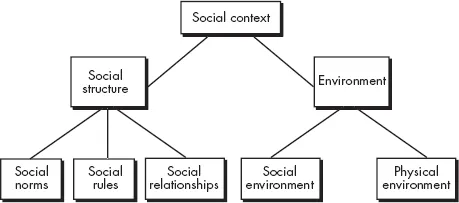
Figure 5.1 Components of the social context
There is also a very definite sequence of events, e.g. the order of speeches at the reception. All these facts will vary depending on the location and status of the participant: for instance, compare a high-society upper-class wedding with a typical church wedding or with a registry office wedding. In a different culture you will notice even more dramatic differences. But the important point I want to make here is that the participants recognise the invisible ‘rules of the game’, i.e. they know what is required of them and act out their parts. People can feel very uncomfortable if they are unsure of the proceedings, and a lot of humour is based upon careful observation of the idiosyncrasies or ironies of some of our more formal occasions, e.g. as in the British film Four Weddings And A Funeral or the American film by Robert Altman, A Wedding.
What are the components of the social context?
I have already distinguished between the environment and the social structure but I need further to subdivide these categories in order to arrive at a more comprehensive definition. This is illustrated in Figure 5.1. I shall now discuss each of these latter categories individually.
Physical environment
The physical environment is the collection of physical objects and factors which surround us, such as the shape and size of the room, colour, lighting, heating, etc. All of these can influence our behaviour in ways we might not necessarily be aware of.3 For example, different types of neon bulb give off rather different qualities of light and it has been suggested that one type creates a more friendly atmosphere than others. At first sight this may seem a rather unlikely effect but you can easily suggest a chain of events which could lead to such a result. Harsh lighting can lead to eye strain and fatigue – this will make people feel irritable and unsettled; irritable people will tend to be short tempered and grumpy; this will lead to arguments etc.; and this will create an unfriendly atmosphere.
Consider how different physical environments influence you in terms of your mood feelings. And consider how designers try to create a particular atmosphere in buildings:
• the fast food restaurant with a ‘bright, cheerful’ colour scheme, and fast ‘cheerful’ music
• the ‘posh’ restaurant with subdued lighting and very soft background music
• the dentist’s waiting room set out like a front room so that you ‘forget’ where you really are!
The physical environment can affect us in a number of different ways which influence our behaviour and communication, as follows.
Direct physical effects
The environment can have direct physiological effects. If specific neon bulbs, or specific levels of heating, do have predictable consequences upon us, then this could be because these have direct effects on our physiology.
Symbolic meaning
The environment can have symbolic meaning. Manufacturers of products are often very concerned about the colour of packaging because of the way certain colours have certain associations or symbolic meanings. White and blue seem to be associated with cleanliness whereas red and yellow have associations of warmth and excitement. Green is becoming a more widespread colour because of its connotations of ‘environment-friendliness’. There is no direct physical effect here – although some types of light may be more arousing to our nervous system, this arousal could be interpreted in different ways. We respond to the different colours primarily because of their symbolic meaning. Thus, the colour of decorations or the feel of different furniture materials can have significant effects on how we feel and how we decide to behave.
Impact on behaviour
The physical environment can make certain behaviours easier or more difficult. In both the UK and the USA, high-rise flats were once regarded as the answer to urban housing problems. They were relatively cheap to build and could accommodate large numbers of people. They were seen as the ‘modern’ replacement for inner-city slums, with many advantages and no real disadvantages.
Now most high-rise flats either are problem areas or have been demolished. They have a reputation for vandalism, hooliganism, social isolation, etc. Many people put up with much poorer physical home conditions rather than move into one of the flats. And yet these social problems were not characteristics of the housing areas they replaced, where people seemed to suffer mainly from poor physical conditions, such as damp and lack of hygiene.
One major problem with high-rise flats is that they are designed in such a way as to make casual social meetings rather difficult. In the old properties they replaced, you usually met someone the moment you opened your front door. It was easy to have a casual chat over the back fence or on the doorstep. Local shops were at the end of the street where again you would inevitably meet neighbours and local residents. There were often very strong feelings of local community. In contrast, the high-rise developments unwittingly destroyed many of these features. And they replaced them with the worst possible compromise.
Rather ironically the high-rise flat creates problems of social isolation and also lack of privacy. You are surrounded by people you have probably not met but you cannot find a place to be on your own because you are always liable to be disturbed. The partition walls are often very thin so you know exactly what TV channel the neighbours next door are listening to!
Social environment
I can talk about some places which have a warm or cold physical environment because of the way they are designed and built. In the same way I can distinguish different types of social environment or social climate. Just as you might perceive another person as supportive or controlling you may also perceive a social environment as supportive or controlling or any other adjectives which suit. But one important finding is that we do seem to make consistent judgements about particular environments. And particular environments do have measurable effects. For example, a number of studies have shown that a very supportive social climate is associated with a reduction in stress or tension. And there is a good deal of research relating social factors to measurable physiological changes.
One major reason why the social environment can affect our behaviour is simply that we are continually looking for information from our environment which will help us to decide what to do. Schachter illustrated this point with a rather devious set of experiments where subjects were given an injection of what they thought was a vitamin with various explanations about what effect it should have.4 For my purposes I shall concentrate on those subjects who were not told what physical effects the ‘vitamin’ would have. The vitamin was in fact adrenaline, which has a number of predictable physiological effects – heart rate increases etc.
Each of these subjects was sitting in a waiting room thinking they were waiting for the real experiment to begin. Each thought that the other person was another waiting subje...
Table of contents
- Cover
- Half Title
- Title Page
- Copyright Page
- Table of Contents
- List of illustrations
- Acknowledgements
- Introduction
- SECTION A Understanding interpersonal communication
- SECTION B The components of interpersonal communication
- SECTION C Issues and controversies in interpersonal communication
- SECTION D Going beyond interpersonal communication
- Notes
- Index
Trusted by 375,005 students
Access to over 1.5 million titles for a fair monthly price.
Study more efficiently using our study tools.
Frequently asked questions
Yes, you can cancel anytime from the Subscription tab in your account settings on the Perlego website. Your subscription will stay active until the end of your current billing period. Learn how to cancel your subscription
No, books cannot be downloaded as external files, such as PDFs, for use outside of Perlego. However, you can download books within the Perlego app for offline reading on mobile or tablet. Learn how to download books offline
Perlego offers two plans: Essential and Complete
- Essential is ideal for learners and professionals who enjoy exploring a wide range of subjects. Access the Essential Library with 800,000+ trusted titles and best-sellers across business, personal growth, and the humanities. Includes unlimited reading time and Standard Read Aloud voice.
- Complete: Perfect for advanced learners and researchers needing full, unrestricted access. Unlock 1.5M+ books across hundreds of subjects, including academic and specialized titles. The Complete Plan also includes advanced features like Premium Read Aloud and Research Assistant.
We are an online textbook subscription service, where you can get access to an entire online library for less than the price of a single book per month. With over 1.5 million books across 990+ topics, we’ve got you covered! Learn about our mission
Look out for the read-aloud symbol on your next book to see if you can listen to it. The read-aloud tool reads text aloud for you, highlighting the text as it is being read. You can pause it, speed it up and slow it down. Learn more about Read Aloud
Yes! You can use the Perlego app on both iOS and Android devices to read anytime, anywhere — even offline. Perfect for commutes or when you’re on the go.
Please note we cannot support devices running on iOS 13 and Android 7 or earlier. Learn more about using the app
Please note we cannot support devices running on iOS 13 and Android 7 or earlier. Learn more about using the app
Yes, you can access Interpersonal Communication by Peter Hartley in PDF and/or ePUB format, as well as other popular books in Languages & Linguistics & Communication Studies. We have over 1.5 million books available in our catalogue for you to explore.