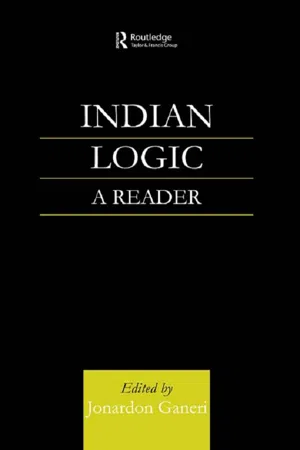
The articles in this volume are all landmarks in the evolution of modern studies in Indian logic. The book traces the development of modern studies in Indian logic from their beginnings right up to the latest work.
The Philosophy of the Hindus: On the Nyāya and Vaiśeṣika Systems1
Henry T. Colebrooke
In the preceding essay, the Sāṃkhya, theistical as well as atheistical, was examined. The subject of the present essay will be the dialectic philosophy of Gotama,2 and atomical of Kaṇāda,3 respectively called Nyāya4 “reasoning,” and Vaiśeṣika “particular.” The first, as its title implies, is chiefly occupied with the metaphysics of logic; the second with physics: that is, with “particulars” or sensible objects; and hence its name.5 They may be taken generally as parts of one system, supplying each other’s deficiencies;6 commonly agreeing upon such points as are treated by both, yet on some differing, and therefore giving origin to two schools, the Naiyāyika and Vaiśeṣika.
From these have branched various subordinate schools of philosophy; which, in the ardour of scholastic disputation, have disagreed on matters of doctrine or of interpretation. The ordinary distinction between them is that of ancients and moderns; besides appellations derived from the names of their favourite authors, as will be more particularly noticed in another place.
The text of Gotama7 is a collection of sūtras or succinct aphorisms, in five books or “lectures,” each divided into two “days” or diurnal lessons; and these again subdivided into sections or articles, termed prakaranas, as relating to distinct topics. It is a maxim, that a section is not to consist of so little as a single sūtra; and to make good the rule, some stress is occasionally put upon the text, either splitting an aphorism or associating it incongruously.
Kaṇāda’s collection of sūtras is comprised in ten lectures, similarly divided into two daily lessons, and these into prakaranas, or sections, containing two or more sūtras relative to the same topic.8
Like the text of other sciences among the Hindus, the sūtras of Gotama and of Kaṇāda have been explained and annotated by a triple set of commentaries, under the usual titles of Bhāṣya, Vārtṭīkā and
kā. These (the Bhāṣya especially) are repeatedly cited by modern commentators, as well as by writers of separate treatises; but (so far as has come under my immediate notice) without naming the authors; and I cannot adventure, having no present opportunity of consulting the original scholia in a collective form, to assign them to their proper authors, from recollection of former researches.9
They are of high authority, and probably of great antiquity; and it frequently becomes a question with the later commentators, whether a particular passage is to be taken for a sūtra and part of the text, or for a gloss of the ancient scholiast.
Commentaries which are now at hand, and which have been consulted in the course of preparing the present treatise, are the Vārttika-tātparya-pariśuddhi of the celebrated Udayana-ācārya, and the Vārtṭīkā-tātparya-ṭīkā of the no less celebrated Vācaspati-miśra. The more modern scholia of Vivanatha upon Gotama’s text, and Śankara-miśra upon Kaṇāda’s, are those to which most frequent reference has been made for the present purpose.
Separate treatises of distinguished authors teach, and amply discuss, the elements of the science. Such are the Nyāya-līlāvatī of Vallabha-ācārya,10 following chiefly Kaṇāda’s system.
An easier, and more concise introduction than these abstruse and voluminous works afford, is found requisite to the initiatory study of the science. One of the most approved elementary treatises is the Tarka-bhāṣā of Keśava-miśra, author of many other tracts. Though adapted to the comprehension of the learner without the aid of a gloss, it has nevertheless employed the labour of many commentators, expounding and illustrating it. Among others may be named, in order of seniority, Govardhana-miśra in the Tarka-bhāṣā-prakāśa; Gaurīkānta11 (author likewise of the Sadyukti-muktavalī) in the Bhardrtha-dīpikā; Madhavadeva (author of the Nyāyasāra) in the Tarka-bhāṣā-sāra-ma
jarī; besides Ramalinga-kṘti in the Nyāyasangraha, whose relative antiquity is less certain; and Balibhadra,12 who is known to me only from Gaurīkānta’s citations.
Another compendious introduction to the study of Indian logic is the Padārtha-dīpikā13 by Koṇ
a-bhaṭṭa, a noted grammarian, author of the Vaiyākarana-bhuṣaṇa, on the philosophy of grammatical structure. It does not appear to have had any commentator, and it needs none.
Metrical treatises, or memorial verses, comprising the elements of the science, bear the ordinary denomination of Kārikā. A work of this description is the Kusumā
jali,14 with its commentary, by Nāyanatīrtha; another, which likewise is expounded by its author, is the Nyāya-sankṣepa of Govinda-bhaṭṭāchārya.
Elementary works only have been here spoken of.15 Distinct treatises on diverse branches of the whole subject, and on various emergent topics, are innumerable. No department of science or literature has more engaged the attention of the Hindus than the Nyāya;16 and the fruit of their lucubrations has been an infinity of volumes, among which are compositions of very celebrated schoolmen.17
The order observed, both by Gotama and by Kaṇāda, in delivering the precepts of the science which they engage to unfold, is that which has been intimated in a passage of the Vedas cited in the Bhāsya, as requisite steps of instruction and study: viz. Enunciation, definition, and investigation.18 Enunciation (uddeśa) is the mention of a thing by its name; that is, by a term signifying it, as taught by revelation: for language is considered to have been revealed to man. Definition (lakṣaṇa) sets forth a peculiar property, constituting the essential character of a thing. Investigation (paītkṣā) consists in disquisition upon the pertinence and sufficiency of the definition. Consonantly to this, the teachers of philosophy promise the terms of the science, proceed to the definitions, and then pass on to the examination of subjects so premised.
In a logical arrangement the “predicaments” (padātha), or “objects of proof”, are six, as they are enumerated by Kaṇāda;19viz. Substance, quality, action, community, particularity, and aggregation or intimate relation: to which a seventh is added by other authors; privation or negation.20 Thus augmented, they compose a two-fold arrangement, positive and negative (bhāva and abhāva); the first comprising six, the latter one.21
The Bauddhas, or followers of Buddha, are said to identify the predicaments with knowledge (j
āna); and according to the Vedāntis, who are pantheists, the predicaments are identified with the universal being (Brahma) in whom all exists.22
Other categories are alleged by different authorities; as power or energy (śakti); similarity or r...
Table of contents
Cover
Half Title
Full Title
Copyright
Contents
Preface
Introduction: Indian Logic and the Colonization of Reason
Chapter 1: The Philosophy of the Hindus: On the Nyaya and Vaisesika Systems (1824)
Chapter 2: On Indian Logic (1853)
Chapter 3: A Note on the Indian Syllogism (1924)
Chapter 4: Studies in Indian Logic (1932-3)
Chapter 5: On the Method of Research into Nyaya (1933)
Chapter 6: Logic in India (1955)
Chapter 7: The Indian Variety of Logic (1956)
Chapter 8: The Concept of Paksa in Indian Logic (1973)
Chapter 9: Some Aspects of the Navya-Nyaya Theory of Inference (1987)
Chapter 10: Introducing Indian Logic (1998)
Readings in Indian Logic
Trusted by 375,005 students
Access to over 1.5 million titles for a fair monthly price.
Study more efficiently using our study tools.
Frequently asked questions
Yes, you can cancel anytime from the Subscription tab in your account settings on the Perlego website. Your subscription will stay active until the end of your current billing period. Learn how to cancel your subscription
No, books cannot be downloaded as external files, such as PDFs, for use outside of Perlego. However, you can download books within the Perlego app for offline reading on mobile or tablet. Learn how to download books offline
Perlego offers two plans: Essential and Complete
Essential is ideal for learners and professionals who enjoy exploring a wide range of subjects. Access the Essential Library with 800,000+ trusted titles and best-sellers across business, personal growth, and the humanities. Includes unlimited reading time and Standard Read Aloud voice.
Complete: Perfect for advanced learners and researchers needing full, unrestricted access. Unlock 1.5M+ books across hundreds of subjects, including academic and specialized titles. The Complete Plan also includes advanced features like Premium Read Aloud and Research Assistant.
Both plans are available with monthly, semester, or annual billing cycles.
We are an online textbook subscription service, where you can get access to an entire online library for less than the price of a single book per month. With over 1.5 million books across 990+ topics, we’ve got you covered! Learn about our mission
Look out for the read-aloud symbol on your next book to see if you can listen to it. The read-aloud tool reads text aloud for you, highlighting the text as it is being read. You can pause it, speed it up and slow it down. Learn more about Read Aloud
Yes! You can use the Perlego app on both iOS and Android devices to read anytime, anywhere — even offline. Perfect for commutes or when you’re on the go. Please note we cannot support devices running on iOS 13 and Android 7 or earlier. Learn more about using the app
Yes, you can access Indian Logic by Dr Jonardon Ganeri in PDF and/or ePUB format, as well as other popular books in Philosophy & Eastern Philosophy. We have over 1.5 million books available in our catalogue for you to explore.