- 576 pages
- English
- ePUB (mobile friendly)
- Available on iOS & Android
eBook - ePub
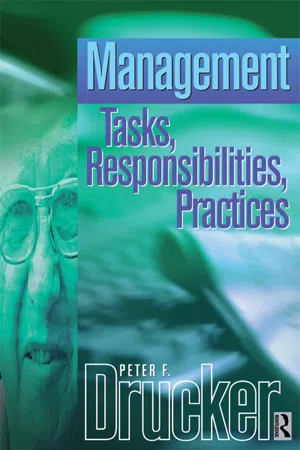
Management
About this book
In this classic text, Peter Drucker studies how modern-day managers, whether in business or public service, can perform effectively. He takes an international view, exploring management problems in Great Britain, Western Europe, Japan, and Latin
America, and suggests how these problems can be tackled.
The interactions between manager, the institution and the social and cultural environment are penetratingly examined, and the book is enhanced by telling examples from a wide spectrum of experience.
The essence of management is performance. And it is the management and managers of our institutions - business and government, educational and multinational - that will determine our future. The purpose of this landmark study is to prepare today's and tomorrow's managers for their tasks and responsibilities and to enable them to meet the formidable challenge ahead.
1 Introduction Management and Managers Defined
DOI: 10.4324/9780080939063-1
Management may be the most important innovation of this century – and the one most directly affecting the young educated people in colleges and universities who will be tomorrow’s ‘knowledge workers’ in managed institutions, and their managers the day after tomorrow. But what is management ? Why management ? How do you define ‘managers ?’ What are their tasks, their responsibilities ? And how has the study and discipline of management developed to its present state ?
When the first business schools in the US opened around the turn of this century, they did not offer a single course in management. About that same time the word ‘management’ was first popularized by Frederick W. Taylor, to describe what he had formerly (and more accurately) called ‘work study’ or ‘task study’; we call it ‘Industrial Engineering’ today. But when Taylor meant to talk about what we now call ‘management’ and ‘managers’ he said ‘the owners and their representatives’.
The roots of the disciplines of management go back 150 years (see the note on the Roots and History of Management at end of this chapter). But management as a function, management as a distinct work, management as a discipline and area of study – these are all products of this century. And most people only became aware of management after World War II.
Within the life span of today’s old-timers, our society has become a ‘society of organizations’. In this century, the major social tasks have come to be performed in and through an organized institution – business enterprises, large and small; school systems; colleges and universities; hospitals; research laboratories; governments and government agencies of all kinds and sizes; and many others. And each of them in turn is entrusted to ‘managers’ who practice ‘management’.
What is management?
Management and managers are the specific need of all institutions, from the smallest to the largest. They are the specific organ of every institution. They are what holds it together and makes it work. None of our institutions could function without managers. And managers do their own job – they do not do it by delegation from the ‘owner’. The need for management does not arise just because the job has become too big for any one person to do alone. Managing the business enterprise or a public service institution is inherently different from managing one’s own property or from running a practice of medicine or a solo law practice.
Of course many a large and complex business enterprise started from a one-man shop. But beyond the first steps growth soon entails more than a change in size. At some point (and long before the business becomes even ‘fair-sized’) quantity turns into quality. At this point ‘owners’ no longer run ‘their own’ business even if they are the sole proprietors. They are then in charge of a business enterprise – and if they do not rapidly become managers they will soon cease to be ‘owners’ and be replaced, or the business will go under and disappear. For at this point the business turns into an organization and requires for its survival different structure, different principles, different behaviour, and different work. It requires managers and management.
Legally management in the business enterprise is seen still as a delegation of ownership, even in the Soviet system; under Soviet Law the State controls because it is the ‘owner’ and has replaced private stockholders. But the doctrine that already determines practice, even though it is still only evolving in law, is that management precedes and even outranks ownership. The owner has to subordinate himself to the enterprise’s need for management and managers. There are, of course, many owners who successfully combine both roles, that of owner-investor and that of top management. But if the enterprise does not have the management it needs, ownership itself is worthless. And in enterprises that are so big or play such a crucial role as to make their survival and performance matters of national concern, public pressure or governmental action will take control away from an owner who stands in the way of management. Thus the late Howard Hughes was forced by the US government in the 1950s to give up control of his wholly-owned Hughes Aircraft Company, which produces electronics crucial to US defence. Managers were brought in because he insisted on running the company as ‘owner’. Similarly the German government in the 1960s put the faltering Krupp Company under autonomous management even though the Krupp family owned 100 per cent of the stock.
The change from a business which the owner-entrepreneur can run with ‘helpers’ to a business that requires management is a sweeping change. It can be made only if basic concepts, basic principles, and individual vision are changed radically.
One can compare the two kinds of business to two different kinds of organisms: the insect, which is held together by a tough, hard skin; and the vertebrate animal, which has a skeleton. Land animals that are supported by a hard skin cannot grow beyond a few inches in size. To be larger, animals must have a skeleton. Yet the skeleton has not evolved out of the hard skin of the insect; for it is a different organ with different antecedents. Similarly, management becomes necessary when a business reaches a certain size and complexity. But management, while it replaces the ‘hard-skin’ structure of the owner-entrepreneur, is not its successor. It is, rather, its replacement.
When does a business reach the stage at which it has to shift from ‘hard skin’ to ‘skeleton’ ? The line lies somewhere between 300 and 1,000 employees in size. More important, perhaps, is the increase in complexity. When a variety of tasks have all to be performed in cooperation, synchronization, and communication, an organization needs managers and management. One example would be a small research lab in which 20 to 25 scientists from a number of disciplines work together. Without management, things go out of control. Plans fail to turn into action. Or worse, different parts of the plans get going at different speeds, different times, and with different objectives and goals. The favour of the ‘boss’ becomes more important than performance. At this point the product may be excellent, the people able and dedicated. The boss may be – and often is – a person of great ability and personal power. But the enterprise will begin to flounder, stagnate, and soon go downhill unless it shifts to the ‘skeleton’ of managers and management structure.
The word ‘management’ is centuries old. But to apply it to the governing organ of an institution and particularly to a business enterprise is specifically American – and the American meaning of ‘management’ has no counterpart in any other language. (The English usually speak of ‘the Board’ or ‘the executive’, when Americans speak of ‘management’). Management denotes both a function and the people who discharge it. It denotes a social position and authority, but also a discipline and field of study.
Even in American usage, ‘management’ is not an easy term, for institutions other than business do not speak of management or managers, as a rule. Universities or government agencies have administrators, as have hospitals. Armed services have commanders. Other institutions speak of executives, and so on.
Yet all these institutions have in common the management function, the management task, and the management work. All of them require management. And in all of them, management is the effective, the active organ.
Without the institution there would be no management. But without management there would be only a mob rather than an institution. The institution is itself an organ of society and exists only to contribute a needed result to society, the economy, and the individual. Organs, however, are never defined by what they do, let alone by how they do it. They are defined by their contribution. And it is management that enables the institution to contribute.
Management is tasks. Management is a discipline. But management is also people. Every achievement of management is the achievement of a manager. Every failure is a failure of a manager. People manage rather than ‘forces’ or ‘facts’. The vision, dedication, and integrity of managers determine whether there is management or mismanagement.
Who are the managers?
Most people, when asked what they mean by ‘manager’, will reply ‘a boss’. But when the sign over the shoeshine stand in an airport reads ‘John Smith, Manager’, everybody (at least in America) knows that this means that Mr Smith is not the boss, but a hired hand with a minimum of authority and a salary just above that of the workers who shine the shoes.
Early in the history of management a manager was defined as someone who is ‘responsible for the work of other people’. This definition distinguished the manager’s function from that of the owner. It made clear that managing was a specific kind of work which could be analysed, studied and improved systematically. The definition focused on the essentially new, large, and permanent organization emerging to perform the economic tasks of society.
Yet, the definition is not at all satisfactory. In fact, it never was. From the beginning, there were people in the enterprise, often in responsible positions, who were clearly management and yet did not ‘manage’, that is, were not responsible for the work of other people. The treasurer of a company, the person responsible for the supply and use of money in the business, may have subordinates and in that sense be a manager in terms of the traditional definition. But clearly, the treasurer alone does most of the treasurer’s job – working with the company’s underwriters, with the financial community, and so on. The treasurer is an ‘individual contributor’ rather than a manager. But treasurers are members of top management. Also, the definition focuses on the tools for a task rather than on the task itself. The person in charge of market research in a company may have a large number of subordinates and is thus a manager in the traditional sense. But it really makes no difference to his or her function and contribution whether there is a large staff, a small staff, or no staff at all. The same contribution in terms of market research and market analysis can well be made by a person to whom no one reports. In fact, the market researcher may even make a greater contribution when not forced to spend a great deal of time with subordinates and on their work. He or she thus may make market research more effective in the business, better understood by management associates, and more firmly built into the company’s basic business decisions.
The most rapidly growing group in today’s businesss enterprise is composed of people who are management in the sense of being responsible for contribution to and results of the enterprise but who are not responsible for the work of other people. They are individual professional contributors of all kinds who work by themselves (perhaps with an assistant and a secretary) and yet have impact on the company’s wealth-producing capacity, the direction of its business, and its performance.
Such people are not to be found only in technical research work, though it was here that they first emerged as a distinct group. The senior chemist in the laboratory has major responsibility and makes major decisions, many of them irreversible in their impact. But so also does the person who works out and thinks through the company’s organizational structure and designs managerial jobs. Here also belongs the senior cost accountant who determines the definition and allocation of costs. By defining the measurements for management, he, in effect, largely decides whether a certain product will be kept or will be abandoned. Other people in the same category are the men charged with the development and maintenance of quality standards for a company’s products, the woman working on the distributive system through which the company’s products are being brought to the market, and the advertising director, who may be responsible for the basic promotion policy of a company, its advertising message, the media it uses, and the measurements of advertising effectiveness.
The traditional definition of management is responsible for the fact that the individual professional contributor presents a problem within the structure and a problem to himself. His or her title, pay, function, and career opportunities are confused, ambiguous, and a cause of dissatisfaction and friction. Yet the number of these career professionals is increasing fast.
The new definition of a manager
What really defines a manager ? Who should be considered management ? The first attempt at answering these questions, made in the early 1950s, merely supplemented the old definition of the manager by recognizing the ‘individual professional contributor’ and calling for ‘parallel paths of opportunity’ for both. This made it possible to pay properly for advanced ‘professional’ work rather than make higher pay dependent upon promotion into a position of responsibility for the work of others.
Yet this formula has not fully solved the problem. The companies that have adopted it report that individual professional contributors are only slightly less dissatisfied than they were before. They remain convinced that true opportunities for advancement still exist primarily within the administrative structure, and that one has to become a ‘boss’ to ‘get ahead’. Above all, the separation of the managerial world into two groups serves to emphasize the inferiority of those who do their own work as compared with those responsible for the work of others. The emphasis is still on power and authority rather than on responsibility and contribution.
Any analysis which does not start out from the traditional definition but looks at the work itself will come to the conclusion that the traditional definition of a manager as one responsible for the work of others emphasizes a secondary, rather than a primary, characteristic.
As we will see a little later, one can divide the work of a manager into planning, organizing, integrating, measuring, and developing people. Career professionals – for example, a market researcher who works alone, or a senior cost accountant – also have to plan, to organize and to measure results against objectives and expectations. What they do and how they do it has considerable impact on how people develop, especially if they also act as teachers to others in the organization. Career professionals also have to integrate their work with the work of other people in the organization. Above all, if they are to have results, they have to integrate ‘sideways’, that is, with people in other areas and functions who have to put their work to use.
The traditional definition of the manager focuses on ‘integrating downwards’ that is on integrating the work of subordinates. But even for managers who have subordinates, ‘sideways’ relationships with people over whom they have no supervisory authority are usually at least as important in the work, and usually more important in terms of decision and information. The district sales manager has to work closely with production scheduler, sales analyst, and cost accountant – and they in turn have to work closely with the district sales manager. Most of the day-to-day decisions these people have to make are decisions that affect their ‘peers’ rather than their subordinates. Integrating, in other words, is important because people work in organizations and with other people rather than because they have subordinates.
The essence of the job of the first-line supervisor in plant or office – the foreman on the assembly line or the forelady of the key-punch room in the insurance company – is indeed the management of people. But then the first-line supervisor is only marginally a ‘manager’ – which is the reason why first-line supervision presents so many ‘problems’. First-line supervisors, whether in the factory or in the office, are not commonly expected to plan and to organize, or to take much responsibility for their contribution and results. They are expected to deliver according to objectives set for them by others. In the typical mass-production plant this is all the supervisor possibly can or should do.
It would, therefore, seem appropriate to stress that the first criterion in identifying those people within an organization who have management responsibility is not command over people. It is responsibility for contribution. Function rather than power has to be the distinctive criterion and the organizing principle.
But what should these people be called ? Many organizations have experimented with new definitions or have tried to give old terms a new meaning. Perhaps the best thing is not to coin a new term but to follow popular usage that speaks of the ‘management group.’ Within the management group there will be people whose function includes the traditional managerial function, responsibility for the work of others. There will be others who do not carry this responsibility within their specific assignment. And there will be a third group, somewhat ambiguous and in between: people whose job is that of a team leader or task force captain, or people who combine the function of advisor to top management with supervisory and administrative responsibility over a staff in a given area. Managers will move into situations where they are not superiors, and career professionals will sometimes serve as task force leaders.
This is not a neat, let alone a perfect, solution. In every organization there are people who are true specialists and who, while anything but rank-and-file workers, do not see themselves as part of management either. Their allegiance is to their technical or professional skill, rather than to their organization. The psychologist within a personnel department would prefer to be thought of as a professional – that is, a member of the world of a particular academic specialty – rather than as an executive of this or that company (or even as a faculty member of this ...
Table of contents
- Cover Page
- Half Title Page
- Series Page
- Title Page
- Copyright Page
- Table of Contents
- Preface: Management as Profession and Commitment
- 1 Introduction: Management and Manager Defined (with a Note on the History of Management)
- Part One: Business Performance
- Part Two: Performance in the Service Institution
- Part Three: Productive Work and Achieving Worker
- Part Four: Social Impacts and Social Responsibilities
- Part Five: The Manager’s Work and Jobs
- Part Six: Managerial Skills
- Part Seven: Managerial Organization
- Conclusion: The Manager of Tomorrow
- Bibliography
- Glossary
- Index
Trusted by 375,005 students
Access to over 1.5 million titles for a fair monthly price.
Study more efficiently using our study tools.
Frequently asked questions
Yes, you can cancel anytime from the Subscription tab in your account settings on the Perlego website. Your subscription will stay active until the end of your current billing period. Learn how to cancel your subscription
No, books cannot be downloaded as external files, such as PDFs, for use outside of Perlego. However, you can download books within the Perlego app for offline reading on mobile or tablet. Learn how to download books offline
Perlego offers two plans: Essential and Complete
- Essential is ideal for learners and professionals who enjoy exploring a wide range of subjects. Access the Essential Library with 800,000+ trusted titles and best-sellers across business, personal growth, and the humanities. Includes unlimited reading time and Standard Read Aloud voice.
- Complete: Perfect for advanced learners and researchers needing full, unrestricted access. Unlock 1.5M+ books across hundreds of subjects, including academic and specialized titles. The Complete Plan also includes advanced features like Premium Read Aloud and Research Assistant.
We are an online textbook subscription service, where you can get access to an entire online library for less than the price of a single book per month. With over 1.5 million books across 990+ topics, we’ve got you covered! Learn about our mission
Look out for the read-aloud symbol on your next book to see if you can listen to it. The read-aloud tool reads text aloud for you, highlighting the text as it is being read. You can pause it, speed it up and slow it down. Learn more about Read Aloud
Yes! You can use the Perlego app on both iOS and Android devices to read anytime, anywhere — even offline. Perfect for commutes or when you’re on the go.
Please note we cannot support devices running on iOS 13 and Android 7 or earlier. Learn more about using the app
Please note we cannot support devices running on iOS 13 and Android 7 or earlier. Learn more about using the app
Yes, you can access Management by Peter Drucker in PDF and/or ePUB format, as well as other popular books in Business & Business Ethics. We have over 1.5 million books available in our catalogue for you to explore.