- 272 pages
- English
- ePUB (mobile friendly)
- Available on iOS & Android
eBook - ePub
Talk on the Wilde Side
About this book
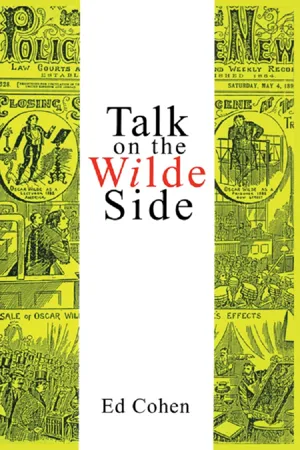
Talk on the Wilde Side focuses on the formation of a new `type' of sexual category in the newpaper reports of the trials of Oscar Wilde, relating this to middle-class discussions of masculinity throughout the nineteenth century.
PART I
AGAINST THE NORM
It is the value of all morbid states that they show us under a magnifying glass certain states that are normal—but are not easily visible when normal.Nietzsche
Unlike their Continental colleagues, who had by the 1890s become quite prolific on the topic, medical experts in Britain seemed hesitant to broach the subject of sexual relations between men directly. Indeed, until 1897, when Sexual Inversion appeared as the first volume published in Havelock Ellis's series Studies in the Psychology of Sex (and was shortly thereafter removed from circulation),1 the only references to male “homosexuality” in English texts were translations from German, French, and Italian medical works.2 Coined in 1869 by the Aus-tro-Hungarian translator and litterateur Karl Maria Kertbeny and popularized in the writing of the German sexologists, the word “homosexual”—the now ubiquitous, quasi-scientific denotation both for sexual intimacies between men and for the men who engage in them—made its first widespread British appearance in Charles Chad-dock's 1892 translation of Krafft-Ebing's seminal Psychopathia Sexualis.3 Here, as the descriptive assessment of a “contrary” or “inverted” “sexual nature,” “homosexual”4 came to signify a pathological deviation from monogamous, procreative sexual intercourse within marriage, which Krafft-Ebing unhesitantly called “the sexual instinct.” That this new characterization of sexual relations between men not only (negatively) confirmed the dominance of the “instinctual” sexual norm but also, to some extent, produced it can be seen in the concurrent emergence of the word “heterosexual.” For, coined by symmetry with and in opposition to “homosexual,”5 “heterosexual” also made its first English appearance in the 1892 translation of Psychopathia Sexualis as a description of the desired, “virile” outcome that therapeutic treatment should produce in the “pathological” male: “the object of post hypnotic suggestion is to remove the impulse to masturbation and homo-sexual feelings and impulses, and to encourage hetero-sexual feelings with a sense of virility.”6 In this (con)text, “heterosexual” emerges only as the “impulse” toward autoerotic and homoerotic behaviors and feelings are negated, so that the abnormal male is “encouraged” to conjoin proper sexual feelings (i.e., feelings that direct sexual desire toward a person of the “opposite” sex) with proper gender attributes (e.g., “a sense of virility”).
From the inception of its English usage, then, “homosexuality” has been clinically defined as marking out the boundaries of sexual and gender norms: as that presence whose absence (re)produces the possibility of social and sexual “reproduction.” The section heading introducing Krafft-Ebing's initial formulation clearly establishes the term as a signifier of what it lacks: “Great Diminution or Complete Absence of Sexual Feeling for the Opposite Sex, with Substitution of Sexual Feeling and Instinct for the Same Sex (Homo-sexuality or Contrary Sexual Instinct).”7 Introducing “homo-sexuality” in parallel with its more explicitly comparative equivalent, “contrary sexual instinct,”8 the title phrase sets out the parameters of Krafft-Ebing's discussion. Based on the “natural” determination of an “opposition” between male and female (itself predicated on the privileging of “male” as the unmarked term and “female” as its “opposite”), nonpathological, noncontrary “sexual feeling” stabilizes relations across sex. Thus, the “diminution” or “absence” of this “feeling” signals a pathological deviation from “a definite sexual personality and consciousness of desire … which, consciously or unconsciously, have a procreative purpose.”9 Desire for members of the “same” sex is depicted here as a substitution that displaces/replaces the absent or diminished (reproductive) feeling for the “opposite sex,” situating itself in this gap as a simulacrum of—or “contrary” to—“instinct.” In this medico-juridical text, then, “homosexuality” mimes the self-evident plenitude of the male/female dichotomy (here ideologically legitimated as “natural”) in order to become its negative double. That “homosexual” and “heterosexual” are born(e) into the English language together, each simultaneously legitimating and undermining the other, illustrates how such normative characterizations reproduce, and are reproduced by, larger cultural assumptions that are concomitantly inscribed within them as their “natural” confirmation.
Since by and large the binary pairing homosexual/heterosexual still continues to define the poles between which male gender identities are plotted both “scientifically” and colloquially, the legacy of this late nineteenth-century sexological formulation continues to impinge on male experiences even today. In a recent article noting the enduring effects of this opposition in structuring the meanings given to contemporary men's lives, Tim Calligan, Bob Connell, and John Lee explain that “the homosexual/heterosexual dichotomy acts as a central symbol in all rankings of masculinity. Any kind of powerlessness, or refusal to compete, among men readily becomes involved with images of homosexuality.”10 Homosexuality, it seems, continues to bear within it the mark of absence—the absence of power, of success, indeed, of all the ideological markers that masculine privilege engenders within a patriarchally organized, capitalist world system. For, unlike the terms “gay” and “lesbian,” which were popularized by the political struggles of the late 1960s and early 1970s and which explicitly seek to affirm same-sex relations (whether sexual or not), “homosexual” remains intimately linked to its nineteenth-century sexological origins.11 Moreover, having long ago leapt from the relatively obscure pages of medicoforensic texts onto the pages/screens of the contemporary mass media, the popular deployments of “homosexuality” today continue to reassert the normative potential of “procreative heterosexuality” along with the corresponding normative gender expectations in new, more expansive ways.
Consider for a moment one of the most egregious contemporary examples of “homosexuality's” normalizing function: In the early to mid-1980s, the first American mass media reporting on the emerging AIDS epidemic focused on the incidence of infection among those “high risk groups” that Paula Treichler has succinctly labeled “the four H's”: homosexuals, hemophiliacs, heroin addicts, and Haitians.12 Yet, in these press depictions, the horrifying images of dying “homosexuals” quickly came to serve as the metonymie embodiments of this risky list so that the disease was effectively constructed in the popular imagination as hovering just beyond the limits of sexual/social normalcy—a limit whose breach five years into the epidemic gave rise to a distinctly different social category: “heterosexual AIDS.”13 Following upon earlier newspaper accounts which portrayed as “innocent victims” those people who unwittingly contracted the human immunodeficiency virus (HIV) through blood transfusions or treatments for hemophilia, the appearance of “heterosexual AIDS” negatively suggested that those who tested positive for HIV could be clearly identified as either sexually “normal” or “pathological” despite the fact that the “origin” of the syndrome would be the same in all cases: i.e., the transmission of a human retrovirus. However, while such putative distinctions have been repeatedly challenged by the medical and scientific explanations of the illness—not to mention the explanations and descriptions offered by AIDS activists and people with AIDS themselves—they continue to provide the standard frame for journalistic representations.
Thus, the recent New York Times coverage of AIDS, to take just one highly influential and widely disseminated instance, continues to reiterate the attempt to draw a cordon sanitaire around the “normal” heterosexual population. In her reporting of the Fifth International AIDS conference in Florence (June 1991), Times correspondent Gina Kolata explains:
In this country, it is still uncertain whether there is an independent AIDS epidemic among heterosexuals. Although the AIDS virus spreads heterosexually and the total of heterosexual AIDS cases is rising steadily, such cases still appear linked to the infected pool of intravenous drug abusers, meaning the epidemic has not yet taken on a life of its own among heterosexuals who do not use drugs.14
The terms of this description clearly demonstrate the ways the popular representations of AIDS are invested in defining the boundaries of the “epidemic” by sexually specifying the “types” of individuals who manifest HIV related illnesses. In so doing, they mask the semantic work involved in producing such conceptual demarcations and instead make such categorical distinctions seem intrinsic to the “natural history” of the disease. In the New York Times article, this naturalizing occurs in the slippage between Kolata's use of the adverb “heterosexually” as a metonym for the unnamed sexual practices through which AIDS “spreads,“15 the adjective “heterosexual” as a designation for a particular group of people who have been diagnosed as “having” AIDS, and the noun “heterosexuals” as a signifier for the majority population of “this country” which may or may not be manifesting “an independent AIDS epidemic.” That the distinctness of the “heterosexual” is asserted here through its many grammatical guises suggests that embedded in this way of imagining and representing the complex constellation of somatic events, relationships, and meanings we call “AIDS” is a corollary interest in drawing (sexual) boundaries between kinds of people.16
In undertaking so much ideological labor in order to protect the sanctity of “heterosexuals”—or at least of “heterosexuals who do not use drugs”—such popular representations not only function implicitly to produce AIDS as a “naturally” “homosexual” disease in the American social imaginary, but conversely serve to reanimate the always available meanings of homosexuality as a disease. Hence, the significance of this contemporary reinvestment in a disease model of sexuality must be understood both as a way of making sense of the fear and uncertainty occasioned by an emerging epidemic and as a way of remapping the shifting boundaries of gender and sexuality that were destabilized by the politicized (sexual) practices of the feminist and lesbian/gay movements. For, when these political/sexual challenges to normative masculinity and to normative “heterosexuality” crystallized as visible alternatives to—if not interruptions of—the heretofore prevailing patriarchal and familialist expectations, they made available possibilities that did not symmetrically imagine women as the “opposite” of men, or lesbians and gay men as the “opposite” of “straight” women and men. In reasserting the underlying links between pathology and homosexuality, then, the popular discourse on AIDS once again seeks to “fix” the meanings of gender and sexuality in order to reinscribe them within the discernible boundaries of the bourgeois family. As Simon Watney has remarked, “homosexuality, understood by AIDS commentary as the ‘cause’ of AIDS, is always available as a coercive and menacing category to entrench the institutions of family life and to prop up the unstable identities those institutions generate.”17 What the recent evocations of the “hetero/homo” opposition within the discourse on AIDS illustrate, therefore, is the extent to which this conceptual divide continues to imbricate the normativity of gender and sexuality in order to make sense of and thereby contain any threats to the entrenched privilege and authority that (re)produce white, Western, patriarchal capitalism—to give the beast a name.
Since this book grows out of the intellectual foment of contemporary feminist and lesbian/gay politics, it attempts to interrupt the assertions of normative masculinities by tracing the emergence of the homo/hetero divide back beyond its point of entry into the English language and culture to explore the conditions that made both its appearance and proliferation possible. In order to produce this disruptive effect, I begin by examining a number of British (con)texts throughout the nineteenth century within which the normativity of male gender and sexuality were construed as a “problem.” For if, as Derrida tells us, “in a classical philosophical opposition we are not dealing with the peaceful coexistence of a vis-à-vis, but rather with a violent hierarchy,”18 then the emergence of “homosexuality” under the mark of pathology and powerlessness is clearly governed by the violent assertion of “heterosexual” superiority. By overturning the silent privilege of remaining unmarked, which has heretofore been accorded to definitions of “normal” male sexuality, the first half of this book seeks both to challenge the implicit hierarchy that such privilege establishes and to illuminate the cultural contradictions that the production of the norm attempts to mask. Thus, rather than focusing here on the emergence of “homosexuality” per se as a category of “deviance,” I seek instead to analyze the shifts in the discursive (re)production of normative male gender and (“hetero”)sexuality as the background against which “the homosexual” could appear. This initial section, then, addresses a variety of institutional texts that sought to demarcate the realm of “normal” or “healthy” male sexual activity in order to demonstrate the transformations in the nineteenth-century bourgeois conceptualization of masculinity. In particular, these next three chapters try to sketch out the ways class, national, generational, and gender ideologies crystallized into the normative figure of a “healthy” adult, middle-class male who imaginatively embodied the category for which Wilde would eventually become one of the most recognizable and most execrable of “others.”
1
EMBODYING THE ENGLISHMAN
A Theoretical Fiction
[A] man's body is given to him to be trained and brought into subjection and then used for the protection of the weak, the advancement of all righteous causes and the subduing of the earth which God has given to the children of men.Thomas Hughes, Tom Brown at Oxford
On 16 June 1895, a little over three weeks after Oscar Wilde's conviction and sentencing for committing seven “acts of gross indecency with another male person,” the popular Sunday newspaper the Weekly Sun published a full front page review of Max Nordau's controversial book Degeneration.1 Introducing Nordau's text as a “wise, sound, and necessary warning against the tendencies and perils of the age,” the anonymous author of the essay sketched the broad outlines of this timely work by quoting—at great length—Nordau's impassioned attacks on the “diseases,” “manifestations,” and “quacks” that he believed to be characteristic of fin-de-siècle Europe. Since Nordau's book primarily attempted to extend the theories of “degeneration” articulated by B. A. Morel and Caesar Lombroso2 from the realms of “psychiatry, criminal law, politics, and sociology” into the sphere of “art and literature,” the passages quoted in the Weekly Sun illustrated Nordau's belief that the most notable products of nineteenth-century literary and artistic “genius” were often actually the products of “diseased” intellects:
All these new tendencies, realism, or naturalism, “decadentism,” “neo-mysticism,” and their sub-varieties, are manifestations of degeneration and hysteria. … [E]veryone capable of logical thought will recognize that he commits a serious error if, in the aesthetic schools of the last few years, he sees the heralds of a new era. They do not direct us to the future, but point backwards towards the past. Their word is no ecstatic prophecy, but the senseless stammering and babbling of deranged minds, and what the ignorant hold to be outbursts of gushing, youthful vigour and turbulent constructive impulses are nothing but the convulsions and spasms of exhaustion.
Drawing upon a concept whose imbricated sexual and characterological meanings assumed a critical role in the coverage of Wilde's trials (as we will see in chapter 5), this quotation summarizes Nordau's attack on contemporary artistic and literary “tendencies.” In it we find the biologistic assumptions underlying Nordau's cultural analysis made explicit: the writings of the “decadents,” he thought, were not “ecstatic proph...
Table of contents
- Cover Page
- Half Title page
- Title Page
- Copyright Page
- Dedication
- Contents
- Acknowledgments
- Prologue: A Funny Thing Happened on the Way to the Trials; or, Why I Digress
- Part I: Against the Norm
- Part II: Pressing Issues
- Epilogue: What’s in a Name?
- Notes
- Index
Trusted by 375,005 students
Access to over 1.5 million titles for a fair monthly price.
Study more efficiently using our study tools.
Frequently asked questions
Yes, you can cancel anytime from the Subscription tab in your account settings on the Perlego website. Your subscription will stay active until the end of your current billing period. Learn how to cancel your subscription
No, books cannot be downloaded as external files, such as PDFs, for use outside of Perlego. However, you can download books within the Perlego app for offline reading on mobile or tablet. Learn how to download books offline
Perlego offers two plans: Essential and Complete
- Essential is ideal for learners and professionals who enjoy exploring a wide range of subjects. Access the Essential Library with 800,000+ trusted titles and best-sellers across business, personal growth, and the humanities. Includes unlimited reading time and Standard Read Aloud voice.
- Complete: Perfect for advanced learners and researchers needing full, unrestricted access. Unlock 1.5M+ books across hundreds of subjects, including academic and specialized titles. The Complete Plan also includes advanced features like Premium Read Aloud and Research Assistant.
We are an online textbook subscription service, where you can get access to an entire online library for less than the price of a single book per month. With over 1.5 million books across 990+ topics, we’ve got you covered! Learn about our mission
Look out for the read-aloud symbol on your next book to see if you can listen to it. The read-aloud tool reads text aloud for you, highlighting the text as it is being read. You can pause it, speed it up and slow it down. Learn more about Read Aloud
Yes! You can use the Perlego app on both iOS and Android devices to read anytime, anywhere — even offline. Perfect for commutes or when you’re on the go.
Please note we cannot support devices running on iOS 13 and Android 7 or earlier. Learn more about using the app
Please note we cannot support devices running on iOS 13 and Android 7 or earlier. Learn more about using the app
Yes, you can access Talk on the Wilde Side by Ed Cohen in PDF and/or ePUB format, as well as other popular books in History & Modern British History. We have over 1.5 million books available in our catalogue for you to explore.