- 311 pages
- English
- ePUB (mobile friendly)
- Available on iOS & Android
eBook - ePub
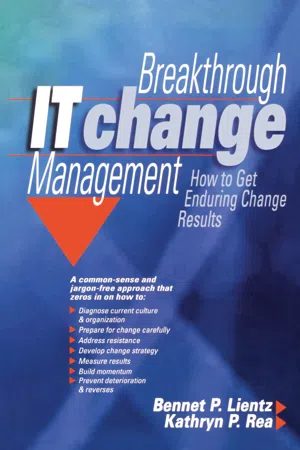
Breakthrough IT Change Management
About this book
This is a *different* book on change management. Using commonsense and practical advice tested in their work with hundreds of organizations, the authors walk the reader through clear guidelines and checklists to implement change that works.
Readers will develop a change management strategy
that starts by diagnosing the current culture and organization, then prepares for change carefully, addresses resistance to change, develops the change strategy, measures results, builds momentum for further change, and prevents deterioration and reversion.
The authors then apply their framework to two areas that are major targets for change management: implementing new technology and systems and implementing successful e-business strategies. Included throughout are real-world examples from a number of industries and government.
Part ISelect Your Change Management Strategy and Approach
Chapter 1Introduction
DOI: 10.4324/9780080500287-2
Background of Change
From childhood we are exposed to change. Most of us are taught that change is often good—reflecting a positive religious, political, and cultural outlook. As we all age, we tend to get more comfortable in patterns that do not change much from day-to-day. People may jokingly remark that they “live in a rut,” but when you offer people the opportunity to change, many decline. There is a lot behind this.
There is the fear of change and what might happen.There is the potential loss of power due to the change.There is the effort, sometimes, great to react to the change.
Psychologists indicate that the leading changes that cause real stress are divorce, changing jobs, moving, a death in the family, and marriage.
For centuries people have tried to make improvements to their lives through innovation, invention, government, automation, and other means. Things that we take for granted today were highly resisted when they were introduced. Several examples will help put change management in perspective.
You cannot assume that change markets and sells itself.
Edison created many inventions. When he demonstrated that electricity could be harnessed through electric lighting, many people were fearful and thought, “If God had meant for people to read and see in the dark, he would not have had night.” He showed that you could read books at night in the dark. To many this was irrelevant—they had no books. Some could not read. So for many years, electricity was resisted because there were few perceived useful applications. Edison spent much of his working life attempting to invent devices that could use electricity. The lesson learned here is that:
If there are no guidelines as to what to do after the change, then there will be issues and problems.
You cannot assume that people will automatically do other useful things.
An overall lesson learned from this example is that change must be managed and directed. You cannot just expose something new and expect that everyone will adopt it with wild enthusiasm.
Even when the change is obvious and life hangs in the balance, people resist change. Consider the Roman army. Based mostly on foot, the Roman cavalry did not use stirrups that allow the rider to fire a bow and arrow while guiding the horse with his legs. The Dacians and other enemies used stirrups to great advantage against Romans—Rome was too late in adopting the change. People must see the need for change.
Another example occurred with the early invention of the facsimile machine. The fax machine was demonstrated in New York in the early days of the telephone. A manager was shown how he could send and receive the image of a page with someone in another building. When he found out that the cost would be a nickel (a lot of money in those days), he replied, “No, thanks. I can use this errand boy to take the message over for less than one penny.” The fax machine languished for some years. The lesson learned here is that:
Timing is critical for successful change.
A fourth example occurred in the 1920s when industrial engineering and work measurement were born. Engineers went out and measured what people did at their workstations and workbenches. They considered detailed hand and body movements. They then instituted changes in procedures to improve production and efficiency. The engineers observed the workers doing the functions the new way and noted the improvements. They then left. It should be no surprise that when they returned some time later, people had reverted back to working the old way. Efficiency was lost.
There is another basic lesson learned here.
When you successfully implement change, you cannot assume that it will continue. Processes and work are subjected to continuous pressure that can lead to reversion.
Here are some factors to watch for:
- A new type of work can arrive. People don't know what to do so they revert.
- New employees are brought in without proper training in the work so they employ what they knew from before—the methods for doing the work have just been subverted.
- Somebody comes up with some new idea and unplanned change occurs— maybe good or bad.
Keeping these in mind, you can see that it is important to follow these guidelines.
- Very few processes or work patterns are stable—there is always pressure and factors that challenge the current methods.
- The effects of change and the work must be measured on an ongoing basis to detect reversion and to look for further improvement.
- There must be something in the change for the employee or person doing the work—self-interest is critical in change.
- The change and new ways must be protected from new situations that arise that can pervert or cause stress to the new process.
A list of factors that can cause work to revert back to an earlier state or to deteriorate is given in Figure 1.1.

Motivation and Triggers for Change
In order to understand change, it is important to understand what the trigger or impetus is or was for the change. From experience it is common that change results from multiple trigger factors. These can be a combination of external and internal pressures. Figure 1.2 gives a list of specific factors along with comments.

It is important to understand these triggers before you embark on planning and implementing change since they affect the dimensions of change differently. Looking at the list again in Figure 1.2, you can discern that there are identifiable categories that include the triggers. These include:
- Upper management, organization change, mergers
- Competition
- Regulation
- Customers/suppliers (change in the work)
- Failure of the current methods in the work
- Technology
Look at this and you see that most of these are uncontrollable and are also external to the process and work. What does this say? Well, the employees involved in the work will still feel that their existing methods will work since they may not be aware or pay much attention to external factors. This fact fuels the fires of resistance to change. Thus, whatever the other triggers are for change, it is important that:
Failure of the current methods in the work must be one of the triggers for change.
Here is a lesson learned. If the current methods work for the old situation still, then you would show the employees that they fail in the new situation.
There is another observation on these triggers for change related to the number of triggers. If there are too many triggers for change, the design and implementation of change become more difficult and complex.
Dimensions of Change
Let's move from the triggers to the change itself. What are you going to change overall? Answering this is important for planning and success. Here are some of the major dimensions for change.
- Management (how work is directed)
- The work itself (what work is performed—scope)
- Procedures (how work will be done)
- Systems and technology (how work is to be done)
- Staffing and organization (who does the work and its supervision)
- Policies (how work is governed)
- Facilities, location, and infrastructure (where the work is done)
- Timing (when the work is done)
You can now construct a spider chart or radar chart using each item in the list as a dimension. An example is given in Figure 1.3. Here there are two versions of change. In the solid version there are changes in procedures and policies, but the technology and other elements are basically retained. The dotted version corresponds to more radical change in E-Business where automation replaces traditional transactions. In any spider chart, where the lines are actually placed on the dimensions is subjective. The purpose of using these types of charts is to generate discussion in planning for change and to achieve consensus on the actions and approach to be taken.

Benefits of Change
Most people think of benefits in terms of cost or headcount reduction. However, real life is more complex. There are many other tangible benefits. Some key ones are listed below. Intangible benefits will be covered in Chapter 4.
- Elimination and/or simplification of work (reduced labor, training, supervision)
- Increased efficiency (higher productivity, volume and/or reduced labor)
- Improved management of the work (better planning and less labor)
- Increased automation (more structure of work, less rework)
- Increased revenue
- Simpler organization (management, staffing)
- Improved customer/supplier relations
- Improved employee morale (reduced turnover, improved productivity)
You can draw another spider chart for these benefits (see Figure 1.4) so that you can now perform trade-offs between the scope of change and the benefits. The same two examples of Figure 1.3 are shown here. Of course, each situation is unique. In the solid line case, the benefits tend to lie in simplification and efficiency. Morale may be improved as well. In the dotted line case, the benefits for a business-to-business E-Business implementation are shown.

How do you use this? In your planning for change, you will be examining alternatives for objectives, areas of change, and impacts. Thus, you can define an alternative for change using Figure 1.3. Then, after analyzing the impact you can fill in Figure 1.4 so as to link the two.
Expectations for Change
One might think that expectations for change are the same as benefits from change. However, because change is often political and cultural, this may often not be true. Why is this important to you? Here are some answers.
- High expectations of management tend to push more radical change to get the results.
- Low expectations can lead to no change.
To understand this, you have to see how expectations are created and treated. Expectations are often created before there has been any analysis of the work. You say, “This doesn't make sense. How can you determine what will happen without information?” Well, management wants to have some idea of impact before they kick off a change or improvement effort.
How do expectations get created? Here are some exa...
Table of contents
- Cover Page
- Half Title Page
- Title Page
- Copyright Page
- Contents
- Preface
- Part I Select Your Change Management Strategy and Approach
- Part II Get Ready for Change
- Part III Implement Change
- Part IV Address Specific Situations and Issues
- Appendix 1: The Magic Cross Reference
- Appendix 2: Further Reading
- About the Authors
- Index
Trusted by 375,005 students
Access to over 1.5 million titles for a fair monthly price.
Study more efficiently using our study tools.
Frequently asked questions
Yes, you can cancel anytime from the Subscription tab in your account settings on the Perlego website. Your subscription will stay active until the end of your current billing period. Learn how to cancel your subscription
No, books cannot be downloaded as external files, such as PDFs, for use outside of Perlego. However, you can download books within the Perlego app for offline reading on mobile or tablet. Learn how to download books offline
Perlego offers two plans: Essential and Complete
- Essential is ideal for learners and professionals who enjoy exploring a wide range of subjects. Access the Essential Library with 800,000+ trusted titles and best-sellers across business, personal growth, and the humanities. Includes unlimited reading time and Standard Read Aloud voice.
- Complete: Perfect for advanced learners and researchers needing full, unrestricted access. Unlock 1.5M+ books across hundreds of subjects, including academic and specialized titles. The Complete Plan also includes advanced features like Premium Read Aloud and Research Assistant.
We are an online textbook subscription service, where you can get access to an entire online library for less than the price of a single book per month. With over 1.5 million books across 990+ topics, we’ve got you covered! Learn about our mission
Look out for the read-aloud symbol on your next book to see if you can listen to it. The read-aloud tool reads text aloud for you, highlighting the text as it is being read. You can pause it, speed it up and slow it down. Learn more about Read Aloud
Yes! You can use the Perlego app on both iOS and Android devices to read anytime, anywhere — even offline. Perfect for commutes or when you’re on the go.
Please note we cannot support devices running on iOS 13 and Android 7 or earlier. Learn more about using the app
Please note we cannot support devices running on iOS 13 and Android 7 or earlier. Learn more about using the app
Yes, you can access Breakthrough IT Change Management by Bennet Lientz,Kathryn Rea in PDF and/or ePUB format, as well as other popular books in Business & Business General. We have over 1.5 million books available in our catalogue for you to explore.