eBook - ePub
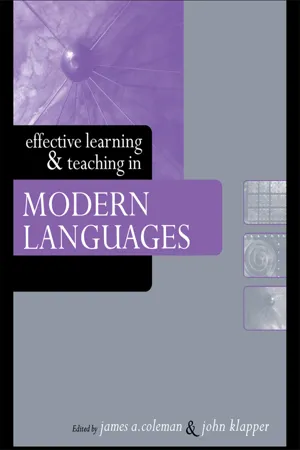
Effective Learning and Teaching in Modern Languages
- 252 pages
- English
- ePUB (mobile friendly)
- Available on iOS & Android
eBook - ePub
Effective Learning and Teaching in Modern Languages
About this book
Effective Learning and Teaching in Modern Languages offers insights from the latest research into learning and teaching a language, and also outlines innovative teaching techniques, covering all the critical subjects including:
- the demands made of students and staff in modern languages
- the four language skills
- assessment, grammar, vocabulary and translation
- technology-enhanced learning
- residence abroad
- subdisciplines such as business, area, cultural and literary studies, and linguistics
- professional development.
Providing both a clear overview of the discipline and a wealth of techniques, practical advice and useful resources, this book will be welcomed by lecturers or tutors new to the profession and experienced lecturers wanting to keep up with the latest developments and improve their students' learning.
Trusted by 375,005 students
Access to over 1 million titles for a fair monthly price.
Study more efficiently using our study tools.
Information
Topic
EducationSubtopic
Education GeneralPart I
University Modern Languages: students and staff
1
Modern Languages as a university discipline
James A. Coleman
Academics working in ‘Modern Languages’ are perhaps the most disparate disciplinary group in the whole of higher education. ‘The study of languages and related studies is essentially multifaceted; few other subject areas combine in such an integrated way the intellectual, the vocational and the transferable’ (QAA 2002: 1). So runs the Quality Assurance Agency benchmarking statement which we, in the UK, have developed as a reference point for ourselves. The professional identities of Modern Languages academics and students are so varied that an ethnographic study memorably portrayed them as rival ‘tribes’ (Evans 1988: 175–77).
As the conventional label implies, Modern Languages were established in European universities in contradistinction to Classical Languages, whose curriculum and teaching methods they initially adopted a century or more ago. For as long as university entrance was reserved for fewer than one in twenty of the age cohort, it could be assumed that entrants were already highly proficient in manipulating the written systems and rules of the target language. Language classes could therefore focus on the historical evolution of the language and on mastering its stylistic richness through grammar and translation (see Chapter 13), while the majority of study hours were given over to literature. In the canon, Chrestien de Troyes and Corneille, or Goethe and Schiller, replaced Euripides and Virgil, but the underlying assumptions remained unchallenged for decades: my father’s French Finals papers of 1932 are interchangeable with my own from 40 years later. Successive centuries of literary output were considered to be the finest embodiment of a nation’s culture and its highest linguistic achievement, study of which would bring intellectual and moral improvement.
Language teaching focused exclusively on formal written registers. Practical mastery of the spoken language was so little regarded that even into the 1960s the oldest universities actively discouraged students from spending a year abroad, lest the acquisition of merely linguistic skills interrupt the intellectual intensity of a Modern Languages degree.
But towards the end of the 1960s, the hegemony of Single Honours began to be challenged, initially by Joint or Combined Honours courses linking two languages, and soon, especially in the new universities and polytechnics created in that decade, by courses concentrating less on artistic creation and more on contemporary society.
By the 1970s, it was becoming increasingly evident that UK language students’ proficiency no longer equipped them to write fluently and accurately or to tackle even modern target-language texts. Comprehensivization of secondary education and the adoption of communicative competence as the goal of language learning (see Chapter 2) meant that schools now concentrated on providing worthwhile but partial competence across the ability range, rather than helping future university entrants to approach native-speaker proficiency (see Chapter 2). While traditionalist language academics have for half a century put the blame on the secondary sector for no longer providing suitably proficient linguists, other responses have been more positive and appropriate. Le Français en Faculté (Adamson et al. 1980) based teaching on what surveys identified as the areas of weakness for university entrants, and since then university language teaching has increasingly built upon scientific data (see Chapter 5) and demonstrably effective techniques rather than merely traditional approaches.
The content of Modern Language degrees has evolved too. Literature teaching is no longer defined unproblematically as a set of great texts, but rather as a critical questioning of creative processes and of the nature of cultures and identities. Film and other media have acquired the status, the theoretical underpinnings and the methodological approaches once reserved for the written word. The natural alliance between foreign language learning and international commerce has been recognized in a multiplicity of Business Studies courses. Area Studies has expanded its domain from sociocultural knowledge of nation states and imperially based language groups to questions of borders, communities and critical approaches. Linguistic content has grown from dry History of the Language to a range of sub-disciplines exploring language systems, their uses and their roles in society. Chapters 22 to 26 of the present volume address these developments in more detail, while Phipps and Gonzalez (2004) provide a challenging, contemporary take on the evolution of the discipline.
In curriculum terms, the acquisition of foreign language proficiency is, today, allied to a multitude of ‘content’ domains, from the literary, cultural, linguistic, sociological, historical and political study of the country or countries where the target language is spoken, through cognate areas such as other foreign languages and cultures, to widely different specialisms from Economics to Mechanical Engineering. The typical language student is also different.
Alongside the specialist student profiled ethnographically by Evans (1988) and quantitatively by Coleman (1996), specialists in other disciplines were also following language courses. To the Combined Honours programmes with Law or Chemistry pioneered by the technological universities in the late 1960s and 1970s were added, through the modularization of curricula that typified the late 1980s and 1990s, a wide range of subject combinations. Modular-ization also saw the birth in the late 1980s of the Languages for All or Institution-Wide Languages Programmes (IWLP) movement (see Chapter 14). For a time, openness to other cultures was fashionable, and students from across all disciplines opted for timetabled, certificated language courses to complement their subject specialism. By 1992 (Thomas 1993), such students outnumbered specialist linguists, a position that continued until the turn of the century (Pilkington 1997, Marshall 2001). A concise but detailed history and bibliography of the IWLP movement is in Ferney (2000). Currently, market forces are painting a mixed picture with regard to non-specialist linguists. A decline in accredited courses – partly due to the refusal of other disciplines to release credits and related funding, as centrally funded schemes are replaced by devolved budgets – is matched by a continuing increase in the numbers of specialists in other disciplines opting for independent language study (see Chapter 14). Meanwhile, the loss of impetus within the IWLP movement is countered by the inexorable rise of university language centres, both in the UK with the Association of University Language Centres (AULC) and across Europe with the Confédération Européenne des Centres de Langues dans l’Enseignement Supérieur (CercleS).
In the specialist domain, since admissions peaked in 1992, a sustained fall in recruitment to Modern Languages degrees has led to the progressive closure of language departments in the UK. There are parallel developments across the English-speaking world, in North America, Australia and Ireland. And despite local variations, and in contradiction of the European Union’s explicit policy of multilingualism, across the whole of Europe the rise of English and the decline of other languages is inescapable. The widely used acronym ‘EFL’ has become a misnomer, as in many countries English is less like a foreign than a second language, whose acquisition is a social and economic necessity, akin to ICT skills and a driving licence. To participate in student exchanges, and above all to share in the globalized higher education market, universities teach through the medium of English. And the ugly term LOTE – Languages Other Than English – is acquiring wider currency, defining by negation just as ‘non-white’ did in Apartheid South Africa, and with not dissimilar power implications.
The response of Britain’s threatened Modern Languages departments has been to unite for self-protection, either voluntarily or more frequently by diktat from above. Single-language departments have typically been collapsed into Schools of Modern Languages, and frequently into broader conglomerates. There is some irony in the fact that many depend on income from English language courses and from international students to sustain the viability of LOTE programmes.
The universities that now teach the majority of specialist language students have managed to retain the link between studying the language and studying the culture(s) of relevant nation states. But in some institutions, Modern Languages have been split, with language teaching separated from ‘content’, and delivered by the university’s specialist language centre. Meanwhile, thanks to the modularization of the curriculum, which allows students from different programmes to share individual modules, combined with financial pressures to maximize attendance within each module, the ‘content’ traditionally associated with Modern Languages departments is taught through English (McBride 2000). It may well be located in a Department of Cultural Studies, Humanities, Media Studies or European Studies to which, in the most extreme cases, language academics have been transferred en masse: the tribe members’ primary allegiance is thus no longer necessarily defined by the foreign language they speak, and the common factor of shared language teaching has gone. In such cases, specialist students lose the horizontal integration of language and content (Parkes 1992) which has been central to both traditional and communicative approaches to language learning.
In at least one leading university, all essays, tutorials and examinations, other than those specifically examining language skills, are in English. The avoidance of target-language use in academic contexts is justified by several arguments:
- intellectually challenging material is beyond learners’ competence in the target language;
- the aim is simultaneously to develop students’ skills in English;
- a degree from the university is internationally recognized as demonstrating a high-level command of English;
- ‘We would be swamped by native speakers.’
The last argument is palpably false since recruitment procedures rely on far more than just language proficiency. However, given the importance for developing high-level proficiency of using the target language in all settings, including the most intellectually demanding, the separation of target-language use and content teaching through English must tend to devalue the former. The split will inevitably be accentuated when content is delivered by departments and language by the language centre. Some of the implications of structural changes on staffing policies are spelled out in Chapter 4.
The progressive collapse of recruitment to specialist language degrees can be traced through three successive Nuffield Foundation reports (Moys 1998, The Nuffield Languages Inquiry 2000, Kelly and Jones 2003). Single Honours has imploded faster than Combined Honours, but both are increasingly restricted to a dozen or so universities, and specialist provision of other than French, German and Spanish is now geographically limited too. One unintended result has been to make language students more of an elite than ever: the high proportion from independent schools, the low proportion from disadvantaged postcode areas or schools providing a high percentage of free school meals, and the high proportion with exceptionally good advanced level grades mark out language students from all other disciplines bar Medicine and Veterinary Science. At least this implies that they will be capable of benefiting from traditional literary courses or the more exciting type of curriculum delineated in Chapter 26.
An unsuccessful and perhaps misguided attempt to halt the decline in applications by stressing the marketability of foreign language proficiency in the employment marketplace is reported in Chapter 3. An example of a more enlightened approach to mapping the true benefits of a language degree is the Criticality Project (www.critical.soton.ac.uk/index.htm).
Meanwhile, at school level, 60 per cent of state comprehensive schools have already made languages optional a year before the legislation becomes statutory (CILT, ALL and UCML 2003), and the proportion is even higher in disadvantaged areas. The change has resulted in more than half of 14-year-olds dropping languages, in a reduction in vocational and short-course options, and in an apparent loss of interest in languages among younger pupils. Chapter 2 expands on the further shock in store once the marginalization of languages at GCSE cuts by more than half the numbers of pupils eligible even to consider A level, at a time when A level numbers are already in steep decline.
The pattern of departmental closures is disappointing to those who believe in innovation and diversity. Because they are located in the most prestigious universities, it is the most traditional courses, in departments and institutions where most importance is attached to literary research, which have the best survival rates, although students increasingly opt out of literary courses (Coleman 2004, Rodgers et al. 2002). An Oxbridge admissions officer asserts in 2004 that it would be ‘perverse’ to apply there for other than a predominantly literary student experience. Thus, as Modern Languages tribes face dwindling numbers or even extinction, it is sometimes those who have remained aloof from engagement with contemporary society who appear best protected – although it must also be recognized that many traditional departments have followed the pioneers into more flexible and diversified course offerings which embrace media, film, cultural studies and politics alongside literary specialisms.
The relationship between surviving Modern Languages departments and language centres can be a tense one. The former tend to cling to language teaching even if they are untrained for it and even if they resent the time and effort involved, lest transfer of all language modules to specialist language centres might induce management to phase out costly academic departments. This division of tasks also tends to perpetuate the inferior status of language centres, whose applied language work is perceived as subordinate to research into literary and cultural topics. Research assessment, and the prestige and income linked to successi...
Table of contents
- Cover Page
- Title Page
- Copyright Page
- Contributors
- Foreword
- Introduction
- Part I University Modern Languages: Students and Staff
- Part II The Theory and Practice of Language Teaching
- Part III Modes and Contexts of University Language Learning
- Part IV A Diverse Discipline
- References
Frequently asked questions
Yes, you can cancel anytime from the Subscription tab in your account settings on the Perlego website. Your subscription will stay active until the end of your current billing period. Learn how to cancel your subscription
No, books cannot be downloaded as external files, such as PDFs, for use outside of Perlego. However, you can download books within the Perlego app for offline reading on mobile or tablet. Learn how to download books offline
Perlego offers two plans: Essential and Complete
- Essential is ideal for learners and professionals who enjoy exploring a wide range of subjects. Access the Essential Library with 800,000+ trusted titles and best-sellers across business, personal growth, and the humanities. Includes unlimited reading time and Standard Read Aloud voice.
- Complete: Perfect for advanced learners and researchers needing full, unrestricted access. Unlock 1.4M+ books across hundreds of subjects, including academic and specialized titles. The Complete Plan also includes advanced features like Premium Read Aloud and Research Assistant.
We are an online textbook subscription service, where you can get access to an entire online library for less than the price of a single book per month. With over 1 million books across 990+ topics, we’ve got you covered! Learn about our mission
Look out for the read-aloud symbol on your next book to see if you can listen to it. The read-aloud tool reads text aloud for you, highlighting the text as it is being read. You can pause it, speed it up and slow it down. Learn more about Read Aloud
Yes! You can use the Perlego app on both iOS and Android devices to read anytime, anywhere — even offline. Perfect for commutes or when you’re on the go.
Please note we cannot support devices running on iOS 13 and Android 7 or earlier. Learn more about using the app
Please note we cannot support devices running on iOS 13 and Android 7 or earlier. Learn more about using the app
Yes, you can access Effective Learning and Teaching in Modern Languages by James A. Coleman, John Klapper, James A. Coleman,John Klapper in PDF and/or ePUB format, as well as other popular books in Education & Education General. We have over one million books available in our catalogue for you to explore.