- 320 pages
- English
- ePUB (mobile friendly)
- Available on iOS & Android
eBook - ePub
About this book
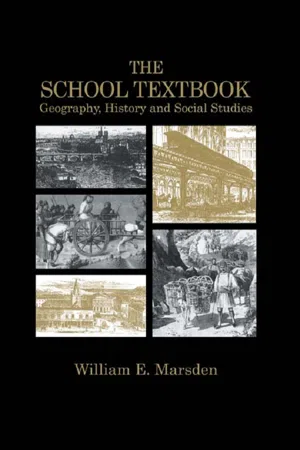
A study of the school textbook grounded in historical and comparative perspectives. The approach is broadly chronological, revealing changes in the theory and practice of textbook production and use. The book focuses largely on three associated subjects - geography, history and social studies.
Trusted by 375,005 students
Access to over 1.5 million titles for a fair monthly price.
Study more efficiently using our study tools.
Information
Print ISBN
9780713040432
Subtopic
Education General1
Introduction
Sir Oracle in pedagogy cries: ‘Throw text-books out of the window. Teach every subject as if there were no text-book in the universe.’(E.E. White, (1901) The Art of Teaching, p. 117)
BACKGROUND: COMPARATIVE RESEARCH INTO TEXTBOOKS
Textbooks are still the most widely used resource for teaching and learning in British schools (see Westaway and Rawling, 1998, p. 36). Even in the post-Plowden (1967) heyday of progressivism in primary education, hostile in principle to textbooks, government inspectors found three-fifths of upper junior classes used them in their geography and history lessons (DES, 1978, pp. 73–4). Yet the most conspicuous feature of attitudes in British educational circles towards school textbooks has remained a high level of negativism and/or neglect. Stray remarked that ‘textbooks have rarely been taken seriously as an object of study’ (1994, p. 1), while Wilkes described them as ‘… the most despised literary genre of all’ (1997, p. 44). Graves observed that research output was ‘pitifully small’ (1997a, p. 62).
While criticism of textbooks has always been evident, it has in recent decades in Britain become more strident, both formally, in the educational literature, and informally, as ‘a puzzling and continuing feature of many conferences and conversations’ (Wright, 1996a, p. 13). In pre- and in-service courses, the advice given to students and teachers, if any, has been either to discourage or even renounce textbook use (Lidstone, 1992, p. 177). The received wisdom remains that textbooks undermine professionalism, typify an undesirable transmission model of teaching and learning, and are generally incompatible with progressive educational practice. Such opinion embodies at the very least a thought chasm between élite definitions of what is deemed to be educationally appropriate, and the views of practising teachers, reliant to varying degrees on textbooks, and a factor in explaining why research in education ‘does not seem to have been very well received by the teaching community’ (Lidstone, 1988, p. 282). On a broader front it prompted Hargreaves to suggest that teachers are able to be effective in their practice in almost total ignorance of the research infrastructures of the educational theorist (1996, p. 2). ‘Is there any hope of ending this disheartening and debilitating lack of a dialogue?’ he queried (1999a, p. 240).
Research into textbooks has long been a more respected locus of interest in the United States than in Britain, though Cronbach and his team in the 1950s were indeed anticipating Hargreaves' concerns, regretting the yawning gaps to be discerned between educational ideology and classroom practice, ‘inhabiting two separate worlds of discourse’ which had lost contact with each other (1955b, p. 188). Much of the theoretical debate was empty because not based on evidence. If most teachers were over-reliant on textbooks and used them mechanically, while educational specialists were at the same time advocating high levels of teacher initiative and a more critical and flexible use of textbooks, then there was some neglect of duty in not developing the latter skills. Equally, if teacher initiative was shown to have educational advantages, and publishers were producing only teacher-proof materials, then they too were failing in their duty (p. 216). ‘Textbook bashing’ remained ‘a favourite pastime’ across a broad spectrum of educational opinion (Fleming, 1992, p. 55), but one which coexisted with a more pragmatic and constructive approach to textbook research. Many significant publications (see below), culminated in Chambliss and Calfee's monograph which, unlike the British literature, affirmed that it was not the intention to identify any ‘villains’ but, more constructively, was rather to probe the potential of textbooks for ‘nurturing children's minds’ (1998, p. xiii).
Three types of critical reaction to textbooks can be identified. The first bemoans their presence and campaigns for prohibition. The second accepts their necessity, but demands measures for effecting reform (Patton, 1980, p. iv; Chambliss and Calfee, 1998, p. 1). In general, a majority of American writers have taken the second stance. In Britain the first has been more evident. The third and more extreme variant is to ignore the textbook as a subject worthy of serious study, as has also happened in this country.
In the light of the enormous literature to be surveyed here, it may appear perverse to complain of neglect. It is a fact, however, that no comprehensive indigenous British survey of textbooks appears yet to have been published. If this book is indeed the first to plug the gap, then it comes 80 years behind what was claimed to be the original American contribution, Hall-Quest's The Textbook: How to Use and How to Judge It (1920, p. vii). Even before then Sellery was formally advising American history teachers how to use textbooks (1911). By contrast, Catling and Wurr's advice 90 years later on how to use geography textbooks could be construed as an exotic item for the British journal Teaching Geography (2000). It was one of only a handful of articles to be published on textbooks in the 25 years of the existence of that journal, aimed at secondary school practitioners. As will be demonstrated in Chapter 4, other educational journals and methodological articles over the same period appeared inhibited in publishing contributions to this topic.
Bearing in mind the paucity of home-grown intellectual support for a scholarly survey of textbooks, the question is where to look for transferable insights. To an extent the domestic historical experience can and will be used as a source (see Harper, 1980). More pertinent, however, have been the wide-ranging endeavours of educationists in the United States. Colleagues in mainland European countries have also regarded the textbook as a worthy subject for research. An outstanding example is Choppin's major series of publications on different types of textbooks, culminating in Les Manuels Scolaires (1992a). The latter was written with not dissimilar purposes to this text in mind. It offered, among other things, a significant historical perspective, and was a pioneering attempt to achieve an overall synthesis. Equally, Johnsen's extensive study, Textbooks in the Kaleidoscope (1993), a Scandinavian publication now translated into English, has been helpful in drawing attention to a wealth of European literature.
The task of considering all the European material would, however, have been overwhelming and impractical, not least in the light of this author's linguistic limitations. There also continue to be cultural differences between Anglo-American educational conventions and those of mainland Europe. For example, the concept of pedagogy, deployed here in the Anglo-American sense of its association with the art and science of teaching, means something similar to the European term didactics, which in turn in Britain carries connotations of ‘dogma and dullness’ and dead tradition (see Hamilton, 1999, p. 135). None the less, specific information and ideas have been drawn from relevant foreign language publications such as, to take one instance, a comparative study of the European dimension in geography textbooks from five different countries, including England (Weinbrenner, 1998). European literature appearing in English has been widely addressed with, in addition to Choppin, and Johnsen, the invaluable publications of the Georg-Eckert Institute for International Textbook Research in Braunschweig, Germany (1995). Some of these have been produced in association with the Council of Europe and UNESCO (see Bourdillon, 1992, and Pingel, 1999). Berghahn and Schissler's interesting comparative collection of articles on international history textbook research (1987) and, more generally, Selander's collection Textbooks and Educational Media (1997), have also proved useful sources.
Neglect of research into textbooks in Britain cannot be attributed to a shortage of historical source material. Goldstrom identified the school book as a key resource in research into the social history of schooling (1972, p. 3), as also did Ball (1983, p. 251). Choppin concurred, suggesting that school textbooks ‘represent one of the richest and least interrupted sources of evidence, not only for histories of education, but also of histories of thought, science and culture …’ (1992b, p. 347). In making this observation, Choppin calculated that 80, 000 textbooks had been produced in two centuries of schooling in France, where an outstanding national research collection has been assembled under the aegis of the French Emmanuelle project. The Scandinavian interest in textbook research is reflected not only in Johnse's monograph, but also through the International Association for Research on Textbooks and Educational Media (IARTEM) (Johnsen, 1995, pp. 128–30).
While it is contended that in general textbooks have been persistently under-researched in this country, this is less the case in relation to specific aspects, where there has, among other things, been address to issues of national identity, racist and sexist bias, and the analysis of text. Lunzer and Gardner (1979), and Newton's (1990) texts on language issues were genuinely indigenous sources, more so than De Castell and colleagues (1989), whose text, while published in this country, was a compilation of readings from predominantly overseas writers. There have also been articles referring to problems of the language used in geography and history textbooks, by Rosen (1967); Bernbaum (1972); Edwards (1978); Marsden (1979a); Davies (1986 and 1988); Wishart (1986); Williams (1978 and 1981); Slater (1989) and, more recently, under the heading of discourse analysis, by Bennett (1996), and Lester and Slater (1998).
RESEARCHING TEXTBOOKS IN THE CONTEXT OF CURRICULUM HISTORY
During the 1960s, many American educationists, among others Miel (1964), Goodlad (1966, p. 91) and Kliebard (1968), were drawing attention to the lack of historical study of the curriculum field. In Britain, little if anything in the way of an overall historical perspective on the field appeared in the post-war literature until the mid-1970s, with the possible exceptions of Bramwell's Elementary School Work 1900–1925 (1961), which focused on curriculum change in that period, and Goldstrom on the social content of school books (1972). More substantial breakthroughs were evident from the late 1970s. First, Gordon and Lawton's Curriculum Change in the Nineteenth and Twentieth Centuries (1978) discussed the processes of change in various curriculum areas. About the same time, the History of Education Society of Great Britain published Post-war Curriculum Development: An Historical Appraisal. In the associated conference papers an attempt was made to trawl existing literature, to draw on the American experience, and to suggest how messages from the past might legitimately be used in the contemporary situation (Marsden, 1979b).
During the 1980s, historical study of the curriculum gained the wider support of some curriculum theorists (see Reid, 1986), and was most comprehensively evident in the many variations on the theme of subject histories by Goodson (for example, 1983, 1985, and 1988a). Part of the new interest in curriculum history derived from the influence of the ‘new sociology’ of education (see Chapter 4), and from theoretical developments in curriculum studies (Baker, 1996, p. 109). However the issue was approached, it was clear that previous textbooks were crucially important sources in interpreting the history of the curriculum, whether in furnishing information about how teaching and learning was conducted in the past, or as materials that maintained their position over time, in some cases outstaying their welcome, as part and parcel of the continuity of curriculum development. Choppin indeed emphasised the need to illuminate from old textbooks ‘an understanding of social evolution’, placing ‘current practice in a more objective light’, and establishing ‘criteria of analysis which can claim some permanent value’ (1992b, p. 346).
In Britain archive collections of old textbooks have been an essential source of historic material, notably at the University of London Institute of Education, the University of Liverpool (the one most used for this study), the University of Cambridge, the University of Durham (history textbooks (see Batho, 1984)), and in the Fleure Archive of the Geographical Association held at the University of Sheffield. Obviously, the British Library holds an immense textbook archive, though by no means a complete one. Symptomatic of an increasing interest in Britain in historical study was the emergence of the ‘Textbook Colloquium’ group in the 1980s, dedicated to research into textbook history. From 1989 it produced the Paradigm journal. This has served to bring together what once were spasmodic and dispersed initiatives.
An important research focus of the historical work in general has been the political and social content of past textbooks, not least in geography and history, and children's literature, highlighting the dangers of bias and prejudice perceived in the promotion of nationalist, imperialist and racist ideologies through these sources. The interest in the history of the school subjects has been reinforced recently by Kent (2000) and Walford (2001). The study of bias and prejudice in textbooks post-war was pioneered in Dance's text, History the Betrayer: A Study in Bias (1960) though, as will be shown in Chapters 3 and 7, it was by no means the first to address such matters. The Library Association compiled a major bibliography covering bias in history textbooks (Smith, 1962). Similar accounts of bias in past textbooks appeared during the 1970s, including Chancellor for history (1970), and Vaughan for geography (1972). Many more were to follow in the 1980s and 1990s, including Gilbert (1984); Ahier (1988); Marsden (1988a, 1989, 1990); Walford (1989); Tidswell (1990); Hopkin (1994); Stray (1994); Graves (1996 and 1997); Ploszajska (1996); and Wright (1988, 1996a, 1996b, 1996c); and in some of the studies in Price's collection on The Development of the Secondary Curriculum (1986). The same has been true of other subjects, not least modern languages (see Byram, 1993). From such work stemmed attempts to offer criteria for avoiding stereotyping, bias and prejudice in current curriculum materials.
In itemising significant topics for international research on geography textbooks, Wright included analysis of text, maps and diagrams, and visual resources; historical research into change and continuity over time; pupil responses; interviews with authors; how used; coverage of controversial issues, particularly related to racism and sexism; stereotyping; cross-disciplinary comparisons; pupil activities; and pupil attitudes towards textbooks (1983a, 1983b, 1988 and 1996a). Clammer's agenda for textbook research was complementary if more general, related to his perception of a need for a more thorough historical, comparative and internationalist approach (1986).
Notwithstanding some pioneering work on the history of the curriculum, and even allowing for the significant monographs by Chancellor (1970), Goldstrom (1972) and Ahier (1988), there has been little to compare with the major American texts on the history of American school books. The scope of published bibliographies highlights the contrasts. Thus an annotated bibliography of textbooks in education, prepared as part of the little-known Keele Textbook Project, included a mere 130 items, the majority of which were from overseas, and mostly American (Parker, 1972). More substantial American examples were Grambs' bibliography (1980, pp. 71–5), and that of Woodward, Elliott and Nagel (1988), which included well over 500 citations. In Britain, a later compilation ...
Table of contents
- Cover
- Half Title
- Full Title
- Copyright
- Contents
- Illustrations
- Preface
- Acknowledgements
- 1 Introduction
- 2 Reviewing the American Experience
- 3 British Historical Perspectives
- 4 The British Anti-Textbook Ethos
- 5 Matter: Continuity and Change in Subject Content
- 6 Method: Continuity and Change in Pedagogical Processes
- 7 Mission: (1) Bias, Prejudice and Stereotyping
- 8 Mission: (2) Nationalism and Internationalism: Schooling for War and Peace
- 9 Mission: (3) Propaganda, Indoctrination and Censorship
- 10 Choosing and Using Textbooks
- 11 National Curricula, National Standards and Textbooks
- References
- Index
Frequently asked questions
Yes, you can cancel anytime from the Subscription tab in your account settings on the Perlego website. Your subscription will stay active until the end of your current billing period. Learn how to cancel your subscription
No, books cannot be downloaded as external files, such as PDFs, for use outside of Perlego. However, you can download books within the Perlego app for offline reading on mobile or tablet. Learn how to download books offline
Perlego offers two plans: Essential and Complete
- Essential is ideal for learners and professionals who enjoy exploring a wide range of subjects. Access the Essential Library with 800,000+ trusted titles and best-sellers across business, personal growth, and the humanities. Includes unlimited reading time and Standard Read Aloud voice.
- Complete: Perfect for advanced learners and researchers needing full, unrestricted access. Unlock 1.5M+ books across hundreds of subjects, including academic and specialized titles. The Complete Plan also includes advanced features like Premium Read Aloud and Research Assistant.
We are an online textbook subscription service, where you can get access to an entire online library for less than the price of a single book per month. With over 1.5 million books across 990+ topics, we’ve got you covered! Learn about our mission
Look out for the read-aloud symbol on your next book to see if you can listen to it. The read-aloud tool reads text aloud for you, highlighting the text as it is being read. You can pause it, speed it up and slow it down. Learn more about Read Aloud
Yes! You can use the Perlego app on both iOS and Android devices to read anytime, anywhere — even offline. Perfect for commutes or when you’re on the go.
Please note we cannot support devices running on iOS 13 and Android 7 or earlier. Learn more about using the app
Please note we cannot support devices running on iOS 13 and Android 7 or earlier. Learn more about using the app
Yes, you can access The School Textbook by William E. Marsden in PDF and/or ePUB format. We have over 1.5 million books available in our catalogue for you to explore.