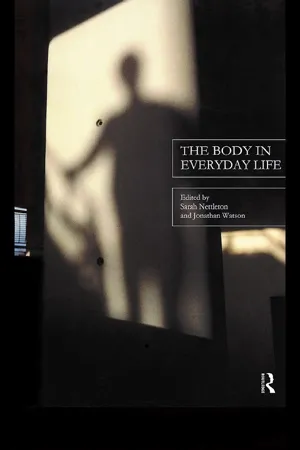
We all have a body, but how does it impact upon our day to day life? This book sets out to explore how ordinary women, men and children talk about their bodies, through four central themes:-
* physical and emotional bodies
* illness and disability
* gender
* ageing.
A coherent collection of such empirical research, The Body in Everyday Life provides an accessible introduction to the sociology of the body, a field previously dominated by theoretical or philosophical accounts.
- 320 pages
- English
- ePUB (mobile friendly)
- Available on iOS & Android
eBook - ePub
The Body in Everyday Life
About this book
Information
Chapter 1
The body in everyday life
An introduction
Sarah Nettleton and Jonathan Watson
If one thing is certain, it is that we all have a body. Everything we do we do with our bodies—when we think, speak, listen, eat, sleep, walk, relax, work and play we ‘use’ our bodies. Every aspect of our lives is therefore embodied. Sometimes we may be more aware of our bodies than others but from the moment we wake, we are to a greater or lesser extent, consciously or sub-consciously relying on our body. When we wake up in the morning we may automatically leave our beds and go to the bathroom and carry out our morning ‘bodily’ routines. Some of us, however, may do this less instinctively, and find that our body is cradled so comfortably within its ‘nest’ that extricating it from the bed becomes something of a challenge. This may be compounded by the fact that during the previous evening we poured large quantities of alcohol into our bodies and are then, in the morning, struck by the fact that our head is ‘pounding’, that we have a ‘raging’ thirst and a ‘rasping’ throat. For some ‘bodies’, perhaps those who are babies, or have certain forms of disability, getting out of bed might be something which requires the help of other ‘bodies’, be they those of parents, carers or partners, or perhaps other technical aids. Once we are ‘up’ we then prepare our body for public display, we probably groom it and select some clothes which might be appropriate for whatever we are doing on that particular day. We may look at our body in the mirror and notice bodily changes: yet another grey hair, the size of our stomach, a spot that has just appeared on our chin. Even the most minor bodily changes may, for some of us, impact upon how we feel about facing the day and all the social interactions that it may comprise. It may be that the spot on the chin occurred on the day of an interview, a wedding or an eighteenth birthday party.
The extent to which we are conscious of our bodies and how we feel about them will vary throughout our lives and within different social contexts. During our teenage years for example, we are likely to become especially sensitive to the biological changes which our bodies endure and our altered appearance. Such changes can impact upon our social relationships. Our body-image, how we perceive our body, may in turn affect our ability to relate to others and will influence how others respond to us. The physical changes associated with ageing must also figure prominently in how we feel about ourselves, and are tangible reminders of our mortality. A sprained back, the loss of hair, a trip to the optician only to discover that one can no longer read all the letters on the optician’s eye-test chart, may be an incident which triggers off reflection about the trajectory of one’s life.
Everyday life is therefore fundamentally about the production and reproduction of bodies. Given the centrality of the body to everyday life, and the fact that it is something that all humans share, it is perhaps surprising that there has been so little empirical investigation into the body as it is experienced by human beings, who both have and are bodies. In particular, there has been little research which involves engaging ordinary men and women in talk about their personal bodily experiences. There is however a whole industry of research and scholarship on the body. During the 1990s books have been published on the body (e.g. Gatens 1996; Turner 1996, 1992; Falk 1994; Grosz 1994; Shilling 1993; Featherstone et al. 1991; Leder 1990); conferences have chosen the body as their theme; new journals such as Body and Society have been launched; and students of sociology and cultural studies are offered courses on ‘the body’.
Ironically, whilst only in the late 1980s, sociologists were lamenting the absence of the body from sociology, the sociology of the body has, by and large, ignored the voices that emanate from bodies themselves. This is mainly because this sphere of study tends to suffer from theoreticisim, a condition which implies that attention is limited to theory, which in turn is not grounded in the empirical domain.1 Perhaps this is to some extent understandable because the study of the body does raise a whole series of philosophical and theological issues. However the lack of empirical data on the body as it is experienced is in marked contrast to a number of related areas of study, prime amongst which is the sociology of chronic illness and disability. Clearly the work in this field offers important insights into our understanding of the body, it has been dominated by research into the experience of chronic illness and disability, and as such has yielded rich empirical data (see for example Anderson and Bury 1988; Charmaz 1983).
The aim of this volume is to bring together a range of empirical studies which have examined how people experience their bodies from the perspectives of the people themselves. As such it ‘fills a gap’ in the literature on the sociology of the body. Just as investigations which have empirically explored the experience of the illness have generated valuable data which help to develop our sociological appreciation of concepts such as the relationship between the body, self and identity, we hope that the empirical material presented in this collection may be used by sociologists to reflect upon the recent debates within the sociology of the body. In this respect our aim is a modest one. We do not aspire to transform our sociological appreciation of the body, rather we try to inject the contemporary debates with some more grounded material. Approaching the literature in this field of study for the first time can be a rather alienating experience for the student or scholar, again this is rather ironic as the body is something that we all have in common. This is a view neatly captured by Wacquant (1995) who did in fact undertake an ethnographic study of boxers:
One of the paradoxical features of recent social studies of the body is how rarely one encounters in them actual living bodies of flesh and blood. The books that have appeared in recent years on the topic . . . typically offer precious few insights into the actual practices and representations that constitute the human body as an ‘ongoing practical achievement’, to borrow an expression from Garfinkel. . . . [T]he newer sociology of the body has paid surprisingly little focused attention to the diverse ways in which specific social worlds invest, shape, and deploy human bodies and to the concrete incorporating practices whereby their social structures are effectively embodied by the agents who partake of them.
(Wacquant 1995: 65)
What all the chapters in this volume have in common is that their analyses of the body derive from the point of view of ‘the agents who partake of them’. All the studies take an embodied perspective, that is they assume that action and lived experience may be grasped from the vantage point of the actor who is invariably embodied.
Whilst the aim is to counter the overly theoretical trend within the sociology of the body we do not want to lapse into overt empiricism. Inparticular there are certain wider social transformations which have both given rise to sociology’s recent interest in the body, and which shape how we currently experience our bodies. A central thrust of contemporary studies of the body is, after Foucault (1979), that the body itself has a history and so it is possible to write the history of the body (for a fascinating example see Duden 1991). Any analysis of empirical data must be placed in a broader context. It is for this reason that we briefly review the social transformations which have precipitated the current interest in the body. Analyses of empirical data are also shaped by or draw upon (albeit implicitly or explicitly) certain theoretical perspectives on the body. The various dominant perspectives on the body have been extensively reviewed elsewhere (see Nettleton 1995; Shilling 1993; Turner 1992) and so there is no need to rerehearse them in any great depth here. However, some attention will be devoted to the more phenomenological approaches which do appear to be particularly pertinent to the study of the body as it is experienced. When we examine the body in everyday life, we might therefore more accurately speak of a sociology of embodiment rather than a sociology of the body. Having set this context we will then delineate some of the themes which have emerged from this collection. We have organised these under the following headings: the ‘taken-for-grantedness’ of the body; bodily controls, body-image and gender.
Social change and the body
There is a consensus in the literature that the growing salience of the body is related to a number of factors (Turner 1996, 1992; Nettleton 1995; Shilling 1993). First, there has been something of a politisation of the body. It was the work of feminist writers and activities which has been of importance here in that they revealed the political status of the body and demonstrated how it was a medium through which women have been exploited by men. An example of this is the way in which women have attempted to reclaim control over their own bodies from a male dominated medical profession. Writers and activists who are concerned with disability provide another illustration of the political status of the body (Oliver 1990). Turner (1992: 12–13) has argued that the body has come to form a central field of political and cultural activity, in that the major concerns for governments revolve around the regulation of bodies. To capture this he describes contemporary society as a ‘somatic society’.
Second, demographic factors such as the ‘greying of populations’ have highlighted the changing nature of bodies. The processes associated with ageing now form a substantial field of study some of which are explored in this volume. Such changes raise moral and ethical debates on issues such as euthanasia, and again draw attention to tricky questions which pertain to the ‘ownership’ of bodies.
Another not unrelated transformation is the changing nature of the disease burden. Whilst people are living longer, they are not necessarily healthier as there has been a concurrent rise in people who suffer from long-standing limiting illnesses (Dunnell 1995). As we have already mentioned, chronic illness, like ageing, affords a substantial area of research, which is especially salient to our appreciation of embodiment (see for example Williams 1996; Helman 1990; Kleinman 1988; Murphy 1987). From this literature we have learned how biophysical changes have significant social consequences. The experience of chronic illness can impact upon the sufferers’ daily living, their social relationships, their identity and their sense of self. Responses to chronic illness are not therefore simply determined by either the nature of biophysical symptoms or individual motivations, but rather are shaped and imbued by the social, cultural and ideological context of a person’s biography. These insights have been developed predominantly by sociologists working within interpretative paradigms.
A third social change is one which is associated with modern industrial societies and that is the rise of the consumer culture. Featherstone (1991) and Glassner (1989) have pointed to the proliferation of commercial goods and services which are consumed by those who want to keep fit, retain their youthful appearance or simply ‘maintain’ their bodies. Appearance, Featherstone (1991: 186) argues, within this context becomes central to a person’s social acceptability. This in turn, he maintains, has important implications for ageing.
A fourth way in which wider societal developments may precipitate interest in the body, and indeed impact upon how bodies are experienced, is the advent of new technologies (Williams 1997; Featherstone and Burrows 1995). The boundaries between our physical and technological bodies are shifting more rapidly. In this merger of biological and technological technologies of corporeality ‘the body is reconceptualized not as a fixed part of nature, but as a boundary concept’ subject to ‘an ideological tug-of-war between competing systems of meaning’ (Balsamo 1995: 215). This is apparent, for example, in relation to differences between biomedical and feminist interpretations of the meaning of the menopause, and specificallyhormone replacement therapy. In this context Wei Leng (1996) drawing on Haraway’s cyborg myth (1991) comments that ‘against the heritage of metaphysical thought-systems, there is only room for the powerfully heretical; there is only room for the cyborg’ (Leng 1996: 49), a hybrid of machine and organism. This in turn may make us more uncertain about what our body is, where it begins and where it ends. Indeed, there is a degree of irony here, as Shilling (1993) has pointed out; the more we know about bodies, the more we are able to control, intervene and alter them, the more uncertain we become as to what the body actually is.
A further factor is the broader social transformations which are associated with the move from modernity to late or high modernity. The theme of uncertainty is central to the work of Giddens and a number of other commentators such as Beck (1992) and Douglas (1986) who have argued that a key feature of contemporary societies is risk. Doubt, Giddens (1991) argues, is a pervasive feature which permeates into everyday life ‘and forms a general existential dimension of the contemporary social world’. Within post-traditional societies, our identities and our sense of self are not givens. That is, we can no longer hang on to, or derive our identity from our traditional place in society— be it class, family, gender, or locality. Rather our self and identity becomes ‘a reflexively organised endeavour’. Less and less can we rely on continuous biographical narratives but these tend to be flexible and continually revised (see also Featherstone and Hepworth 1991). The reflexive self is one which relies on a vast array of advice and information provided in a myriad of sources. As Giddens points out, the self is of course embodied and so the regularised control of the body is a fundamental means whereby a biography o...
Table of contents
- Cover Page
- Title Page
- Copyright Page
- Figures
- Contributors
- Acknowledgements
- Chapter 1: The Body In Everyday Life: An Introduction
- Part I: Physical and Emotional Bodies
- Part II: Health and Illness
- Part III: Gender
- Part IV: Ageing
Trusted by 375,005 students
Access to over 1.5 million titles for a fair monthly price.
Study more efficiently using our study tools.
Frequently asked questions
Yes, you can cancel anytime from the Subscription tab in your account settings on the Perlego website. Your subscription will stay active until the end of your current billing period. Learn how to cancel your subscription
No, books cannot be downloaded as external files, such as PDFs, for use outside of Perlego. However, you can download books within the Perlego app for offline reading on mobile or tablet. Learn how to download books offline
Perlego offers two plans: Essential and Complete
- Essential is ideal for learners and professionals who enjoy exploring a wide range of subjects. Access the Essential Library with 800,000+ trusted titles and best-sellers across business, personal growth, and the humanities. Includes unlimited reading time and Standard Read Aloud voice.
- Complete: Perfect for advanced learners and researchers needing full, unrestricted access. Unlock 1.5M+ books across hundreds of subjects, including academic and specialized titles. The Complete Plan also includes advanced features like Premium Read Aloud and Research Assistant.
We are an online textbook subscription service, where you can get access to an entire online library for less than the price of a single book per month. With over 1.5 million books across 990+ topics, we’ve got you covered! Learn about our mission
Look out for the read-aloud symbol on your next book to see if you can listen to it. The read-aloud tool reads text aloud for you, highlighting the text as it is being read. You can pause it, speed it up and slow it down. Learn more about Read Aloud
Yes! You can use the Perlego app on both iOS and Android devices to read anytime, anywhere — even offline. Perfect for commutes or when you’re on the go.
Please note we cannot support devices running on iOS 13 and Android 7 or earlier. Learn more about using the app
Please note we cannot support devices running on iOS 13 and Android 7 or earlier. Learn more about using the app
Yes, you can access The Body in Everyday Life by Sarah Nettleton,Jonathan Watson in PDF and/or ePUB format, as well as other popular books in Social Sciences & Health Care Delivery. We have over 1.5 million books available in our catalogue for you to explore.