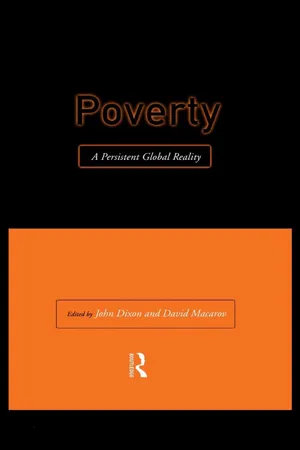
eBook - ePub
Poverty
A Persistent Global Reality
- 304 pages
- English
- ePUB (mobile friendly)
- Available on iOS & Android
eBook - ePub
Poverty
A Persistent Global Reality
About this book
This book addresses the long-standing global issue of poverty. An introductory chapter explores concepts and definitions of poverty, the subsequent chapters providing detailed examinations of poverty in ten different countries: UK, USA, Australia, Canada, Hong Kong, Ireland, Malta, The Netherlands, The Philippines and Zimbabwe.
Each chapter follows a consistent format, to facilitate comparison and focuses on the following issues:-
* the socio-economic and historical context within which poverty exists
* the extent and nature of poverty
its causes
* the measures that have been taken to mitigate it.
This book will be essential reading for students of social policy and administration as well as development studies and anthropology.
Information
Chapter 1
The meaning and measurement of poverty
Stewart MacPherson and Richard Silburn
Poverty is a persistent problem which has presented political and moral challenges to all societies at all times. The word itself, poverty, is a familiar one which everyone understands, or thinks they understand. But the specific meaning we attach to the word depends upon the underlying concept of poverty we have in mind. It is possible to conceptualise poverty in many different ways, each one leading towards a different understanding of the meaning and significance of the term, towards a different precise definition, which in turn will lead to parallel differences in the methods and measures used to estimate the numbers in poverty and gauge the depth of their impoverishment.
THE CONCEPTS OF POVERTY
At its simplest poverty refers to a basic lack of the means of survival; the poor are those who, even in normal circumstances, are unable to feed and clothe themselves properly and risk death as a consequence. This description would probably attract universal recognition and assent. Moreover such a situation would probably be seen as one which should if possible be rectified, although precisely how this should be done may be a matter of dispute. It is the case that there are some parts of the world where extreme poverty of this kind is prevalent and affects large numbers of people; in these cases it may be difficult in practice to argue convincingly for a less extreme concept and definition of poverty. A review of empirical studies suggests that the concept of poverty as absolute deprivation continues to be of primary relevance in countries where per capita income is low and the incidence of poverty is high.
This definition has become increasingly unacceptable in those parts of the world where higher general levels of living have been achieved. In countries experiencing rapid growth and apparent reductions in the incidence of absolute deprivation, poverty is increasingly defined in relative terms. As the threat of starvation recedes, questions concerning the appropriate distribution of income and opportunity assume greater importance. In this situation the definition of poverty moves away from a minimal, physical survival notion in the direction of a relative, varying definition which puts increasing emphasis on social survival and starts to attach value to the quality of life that even the poorest in a community should be able to enjoy. A different vocabulary is developed to introduce notions of social participation, of inclusion and exclusion, of citizenship, of empowerment. The idea of relative poverty is a powerful one, but it is also controversial, and hence the poverty debate is everywhere a hotly contested one, involving serious issues of social, political and ethical significance. In those societies where poverty is perceived to be a problem which requires remedial action of some kind, these arguments are further complicated. Is remedial action the responsibility of charitable individuals, and if so who, what and how? Is it a broader family or communal responsibility? Should the state or the government be involved and if so why and how? All of these are matters upon which people will feel entitled to have a view and therefore to disagree with one another.
Thus the first element in the analysis of poverty is to address the question of the material level which distinguishes the poor (those in poverty) from others. Sometimes the discussion stops altogether at this point. The problem of poverty (being poor) is presented as no more than a question of material resources, usually expressed in terms of cash. This is undoubtedly a necessary component, especially in those societies where most transactions are facilitated by transfers of cash for desired goods or services. But money for what? Any attempt to establish a poverty line expressed as a minimum cash requirement must be based upon some explicit or implicit assumptions about what that money is needed for; some sense of what needs must be addressed if the individual is not to suffer unacceptable deprivation, what goods or services it is reasonable for everyone, even the poorest, to enjoy. That this discussion is also contested reminds us that the fundamental issue is not the money itself – which has no intrinsic worth – but the effect that the lack of money has on the lives and lifestyles of the poor. A cash-deficiency definition of poverty serves as no more than a crude indicator, and to focus upon it exclusively may be to overlook other dimensions of poverty which cannot be simply reduced to monetary values.
The widespread emphasis upon cash-poverty is misplaced and myopic. The concept of poverty needs to be a much fuller and more inclusive one, concerned with much more than what money can buy. It has a moral dimension, which, if ignored, gravely impoverishes, even distorts, any poverty debate. Fundamentally, what is offensive about poverty, and why it matters so much, is that poor people are unable to maintain a degree of control over their own lives by the exercise of choice. For most people daily life is a constant series of decisions and choices, from the most trivial to the most important. These choices help to fashion the quality of a person’s life and that of the family to which they belong. Most choices, however, have resource implications. They involve decisions about how to use the scarce resources at one’s disposal. For poor people, with few resources, the area of effective choice is constricted, and one measure of the depth of poverty is the narrowness of remaining choice.
We believe that this concept of poverty is universally defensible, although it must be interpreted sensitively. A global understanding of poverty must acknowledge that there are major cultural differences, patterns of custom and convention, of social expectation, which help to determine in any particular case the parameters within which choice is exercised, and the priorities which individuals will respond to. But it is also the case that as the extent of marketisation will vary between societies at different stages of social and economic development, so a narrow concern with cash-poverty alone without further reference to actual social and cultural situations, in all their complexity, is to engage in a discussion without real meaning.
THE DEFINITIONS OF POVERTY
Definitions of poverty will reflect the underlying concept that has been adopted, and just as poverty can be conceptualised along a continuum from the most absolute to the most relative, so there is a range of definitions (Piachaud 1987).
Subsistence poverty
The most basic definition will focus on the capacity to survive. In its narrowest sense this may mean nothing more than having the resources to purchase or grow sufficient food for oneself and one’s dependants. The only needs that are acknowledged are biological ones, food, water, and in hostile climates, clothing and shelter. No allowances are made for broader social needs, and no recognition is given to social or cultural expectations. Using such a definition guarantees that any measure of the numbers in poverty will yield the smallest possible figure. Recommendations for policy interventions would thus be limited in scope and character, and the impact evaluation standards would be modest.
Definitions based on an absolute concept of poverty allow its measured prevalence to change over time. They require an absolute poverty line based on survival criteria, such as a specified minimum daily caloric intake (Lipton 1983) the proportion of income spent on food (Rao 1982) or the income level required to purchase some minimum basket of consumption goods.
The once common use of caloric intakes alone to determine poverty lines is in decline. It has been argued (for example, by Rodgers 1984) that the daily caloric intake is an unreliable measure of poverty. Except in unusual circumstances such as natural disasters and famines, poor people rarely die of starvation. This is partly because daily energy requirements vary with the kind and amount of activity being undertaken. Primarily, however, it is because low calorie intake has effects which are neither immediate nor necessarily measurable, for example increased susceptibility to disease. An appropriate minimum level of daily energy requirement is therefore difficult to establish.
Although isolated examples of survival definitions can still be found, it is much more commonly the case that poverty is defined by reference to some notion of subsistence. This certainly goes beyond mere survival, but it still a very meagre measure. It is usually based upon a basic standard of physical efficiency. Thus it might be argued that a person needs enough food not only to survive but to maintain their health at least to a level where his or her capacity to work is unimpaired. The emphasis is on purely physical needs and there is a reluctance to make any substantial acknowledgement of wider social or customary expectations and obligations.
Many attempts have been made to calculate the costs of meeting subsistence needs. One of the best-known, though often misunderstood, examples from the United Kingdom (UK) can be found in the work of Seebohm Rowntree. Rowntree endeavoured to establish a precise poverty line by drawing up a list of essential foodstuffs, and other indispensable household items, which he costed to establish an irreducible budget below which it would be difficult to maintain health and physical efficiency. In Rowntree’s view this measure represented ‘a standard of bare subsistence rather than living’ (Rowntree 1901, 1941).
But experience has shown that even this minimalist approach to the definition of absolute poverty is, in fact, fraught with both theoretical and practical difficulties. For example, even trying to determine something as fundamental as the nutritional requirements of people of different ages or physical types is a contested matter about which dieticians and other competent experts disagree. Not only may nutritional requirements vary from one person to another, and from time to time, between people of different ages or with different work-patterns, but also, in practice, allowance may need to be made for variations in the availability of foodstuffs, in the knowledge and skills needed for the most efficient preparation of food, in food-purchasing habits where the decisions about what to buy, and in what quantity may be influenced not only by availability and price but also by capacity to store food safely and to prepare it appropriately. Beyond these important qualifications we then encounter widespread food-beliefs, dietary customs and conventions, as well as questions of taste and food-preference. All of these considerations must influence normal behaviour in ways that make the subsistence calculus much more problematic than is at first apparent.
Indeed it is clear the Rowntree himself was well aware of many of these difficulties. In his later studies he budgeted for a range of goods and services which are certainly not essential for survival or physical efficiency, but are virtually universal items of household expenditure; such as newspapers, postage stamps and trade union subscriptions (Rowntree 1941). Although this is still a very restricted budget, it is starting to recognise that there are legitimate costs which enable a person not only to survive, but to live as a member of a community within which he or she is able to take part in and contribute to normal social activities. This vividly points up the difficulties of trying to establish a living standard which excludes all but the needs of brute physical survival. In this regard we have already moved a small step towards recognising the constantly shifting and relative nature of poverty, which drives us towards definitions that start more fully to reflect this perspective.
Basic needs poverty
The basic needs definition of poverty is an influential variant of the subsistence model, moving somewhat towards a more relative approach. Basic needs are defined by the International Labour Organisation (1976: 7)
[a]s the minimum standard of living which a society should set for the poorest groups of its people. The satisfaction of basic needs means
Meeting the minimum requirements of a family for personal consumption: food, shelter, clothing; it implies access to essential services, such as safe drinking-water, sanitation, transport, health and education . . . it should further imply the satisfaction of needs of a more qualitative nature: a healthy, humane and satisfying environment, and popular participation in the making of decisions.
Indeed, the achievement in each country of a certain specific minimum standard of living became a major policy recommendation of the International Labour Organisation in 1976.
The major importance of basic needs concept is that it is not confined to the physical needs for individual survival, but recognises the importance of a range of community services and facilities, often of an infrastructural kind, and beyond these some non-material qualitative assets. It recognises that the basic needs objectives will vary from one country to another in the light of specific circumstances,
levels of development, climatic conditions, social and cultural values. Basic needs are therefore in large part a relative concept; but there are also certain minimum levels of personal consumption and access to social services which should be universally regarded as essential to a decent life.
(International Labour Organisation 1976: 7)
To operationalise basic needs raises many of the same difficulties that we have observed with reference to subsistence measures. Important, difficult and inescapable value-judgements have to be made, in the context of each country’s social and economic circumstances, to establish the criteria and components of basic needs, and to measure progress towards their attainment.
By now it is clear that the attempt to construct an absolute and presumably universal definition of poverty is fundamentally flawed, both in theory and practice. Poverty analysts are driven remorselessly to accept that poverty has to be understood as a socially constructed concept with powerful qualitative and normative components. As such it is inherently a relative concept.
Relative poverty
All relative definitions of poverty are based upon comparison, often with some notion of prevailing living standards in the community being researched. Thus one might examine prevailing patterns of expenditure and consumption and define as poor those whose ‘[i]ncomes or resources are not sufficient to provide them with those goods...
Table of contents
- COVER PAGE
- TITLE PAGE
- COPYRIGHT PAGE
- ILLUSTRATIONS
- CONTRIBUTORS
- PREFACE
- CHAPTER 1: THE MEANING AND MEASUREMENT OF POVERTY
- CHAPTER 2: AUSTRALIA
- CHAPTER 3: CANADA
- CHAPTER 4: HONG KONG
- CHAPTER 5: IRELAND
- CHAPTER 6: MALTA
- CHAPTER 7: NETHERLANDS
- CHAPTER 8: PHILIPPINES
- CHAPTER 9: UNITED KINGDOM
- CHAPTER 10: UNITED STATES OF AMERICA
- CHAPTER 11: ZIMBABWE
- CHAPTER 12: POVERTY IN REVIEW
Trusted by 375,005 students
Access to over 1.5 million titles for a fair monthly price.
Study more efficiently using our study tools.
Frequently asked questions
Yes, you can cancel anytime from the Subscription tab in your account settings on the Perlego website. Your subscription will stay active until the end of your current billing period. Learn how to cancel your subscription
No, books cannot be downloaded as external files, such as PDFs, for use outside of Perlego. However, you can download books within the Perlego app for offline reading on mobile or tablet. Learn how to download books offline
Perlego offers two plans: Essential and Complete
- Essential is ideal for learners and professionals who enjoy exploring a wide range of subjects. Access the Essential Library with 800,000+ trusted titles and best-sellers across business, personal growth, and the humanities. Includes unlimited reading time and Standard Read Aloud voice.
- Complete: Perfect for advanced learners and researchers needing full, unrestricted access. Unlock 1.5M+ books across hundreds of subjects, including academic and specialized titles. The Complete Plan also includes advanced features like Premium Read Aloud and Research Assistant.
We are an online textbook subscription service, where you can get access to an entire online library for less than the price of a single book per month. With over 1.5 million books across 990+ topics, we’ve got you covered! Learn about our mission
Look out for the read-aloud symbol on your next book to see if you can listen to it. The read-aloud tool reads text aloud for you, highlighting the text as it is being read. You can pause it, speed it up and slow it down. Learn more about Read Aloud
Yes! You can use the Perlego app on both iOS and Android devices to read anytime, anywhere — even offline. Perfect for commutes or when you’re on the go.
Please note we cannot support devices running on iOS 13 and Android 7 or earlier. Learn more about using the app
Please note we cannot support devices running on iOS 13 and Android 7 or earlier. Learn more about using the app
Yes, you can access Poverty by Professor John Dixon, John Dixon, David Macarov, Professor John Dixon,John Dixon,David Macarov in PDF and/or ePUB format, as well as other popular books in Social Sciences & Health Care Delivery. We have over 1.5 million books available in our catalogue for you to explore.