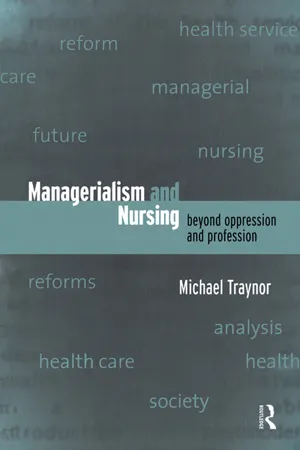
Managerialism and Nursing examines the effect of new management strategies on nurses, their morale and the profession as a whole. Using an innovative study of nurses conducted by the Royal College of Nursing, Michael Traynor analyses the relationship between nurses and their managers, looking at the contrasting ways in which each group argues its case and presents its identity.
Managerialism and Nursing will be stimulating reading for anyone interested in the future of the health service and also serves as a highly readably introduction to postmodern approaches to analysis.
- 208 pages
- English
- ePUB (mobile friendly)
- Available on iOS & Android
eBook - ePub
About this book
Information
1 Introduction:
enlightenment, rationality and colonisation
In a passage from a troubling novel, Leonard Cohen describes the French Jesuits’ attempts to convert the animist North American Iroquois to Christianity. The canny Indians cover their ears so as not to hear the discourse of sin and judgement. The Jesuits, however, take recourse to drawing lurid pictures of the torments of hell, the inhabitants of which are recognisable Iroquois.
‘Take your fingers out of your ears,’ said le P.Jean Pierron, first permanent missionary at Kahnawaké. ‘You won’t be able to hear me if you keep your fingers in your ears.’
‘Ha, ha,’ chuckled the ancient members of the village, who were too old to learn new tricks. ‘You can lead us to water but you can’t make us drink, us old dogs and horses.’
‘Remove those fingers immediately!’
The priest went back to his cabin and took out his paints, for he was a skilled artist. A few days later he emerged with his picture, a bright mandala of the torments of hell. All the damned had been portrayed as Mohawk Indians….
‘Now, my children, this is what awaits you. Oh, you can keep your fingers where they are….’
‘Arghhh!’
The colours of the picture were red, white, black, orange, green, yellow and blue….
‘Arghhh!’
‘That’s right, pull them right out,’ the priest invited them. ‘And don’t put them back. You must never put them back again….’
As those waxy digits were withdrawn a wall of silence was thrown up between the forest and the hearth, and the old people gathered at the priest’s hem shivered with a new kind of loneliness. They could not hear the raspberries breaking into domes, they could not smell the numberless pine needles combing out the wind, they could not remember the last moment of a trout as it lived between a flat white pebble on the streaked bed of a stream and the fast shadow of a bear claw. Like children who listen in vain to the sea in plastic sea shells they sat bewildered.
(Cohen 1993:81–82)
Cohen pictures, with the novel’s characteristic comic strip dialogue, the colonisation of the Iroquois as the moment when they allow themselves to hear the voices of the French. In that instant, echoing the fall of Adam and Eve in the Garden of Eden, they become isolated from the various magics of nature, lost to their ancient identity, bewildered.
This is a story of a similar colonisation, although the struggle is not over, and since post-structuralism, any notions of oppressor and oppressed as fixed and exclusive categories have become problematised. There may be less brutality in the story that I will develop, but there is pain and confusion alongside the evangelising activities of those who bring a new vision to sweep away fear and superstition. This is a story of an ascending rationality in UK health care and a response to it by a number of nurses. It is a rationality which I will argue finds its distant but vivid origins in the Enlightenment discovery of reason that took hold of European thought, imagination and aspiration in the eighteenth century. However, this account does not idealise any primitive state or alternative view. There is no championing of an oppressed group. What it does is make visible the contingencies behind a dominant rationality; it critiques the loss of space for difference in the wake of this powerful vision. Documenting the local exercise of power, the story places the discourses that have caught up health service managers into the contexts of economic rationalism and the modernism of Enlightenment thought. Countermovements in the story are to be found in the discourses taken up by nurses involved in care delivery and middle management. Their discourses are, in a sense, out of tune with both the rationality of management and the aspirations to power of their own professional leaders, many of whom have committed themselves to ‘speaking the manager’s language’ perhaps to preserve their own professional, and personal, position and influence.
When I say colonisation, I intend to ask how far managerialist language and the categories of thought that this has made available, and those that it has effaced, have succeeded in establishing themselves as the dominant language of nursing within the health care professions. Effectiveness, cost-effectiveness, division of labour, the measurement of outcome, productivity, customer satisfaction, rational(ised) evidence-based practice are all now ‘natural’ features of nursing discourse. Nursing may offer different conclusions to managers, for example over workforce profiling, but how far it has been successfully enrolled by these criteria is a matter for argument. The words of nurses quoted in this book may represent a rapidly marginalised or even by now virtually extinct position.
This story is also a deliberate subversion of other stories. It is an exploration of deconstruction’s discovery that a single text can be used to support seemingly irreconcilable positions. A deliberate subversion of the initial or face reading of a text informs the treatment of interviews and other utterances produced within this research. This involves an analysis of metaphor and its place in argument, an interrogation of a text’s dualisms and a radical approach to the question of intention and context. It is also a subversion of a research approach which is based upon a number of Enlightenment premises. The most influential has been the belief in the transparency of the individual who stands in a direct relationship to the objects that he or she observes. The aims of the original research project from which this work grew were the measurement of the morale of community nurses and the gathering of information from their managers. It was based on notions of the possibility of the objectivity of measurement and the transparency of language. Its intention was to trace lines of cause and effect between government policy, managerial activity and the morale of the nursing workforce and to enable the two groups, workers and management, to understand each other better and in that sense contribute to organisational and social progress. These beliefs and intentions are problematised in this work.
Why such deliberate awkwardness, such refusal to offer constructive help at a time when it is so badly needed? And why such reluctance to champion the cause of an oppressed group such as nurses? The answers, albeit uneasy ones, stem from an ambivalence toward an Enlightenment faith in processes of emancipation and, perhaps more importantly, from a belief in the inescapability of the projects of power. First, it is the tyranny implicit in the 1980s and 1990s managerialist project that is critiqued here (and already I cannot help but refer to humanistic notions of injustice and human dignity brought into focus by the Enlightenment), not the more-or-less usefulness of rational thought as a tool with which humans can meet some of their needs. It is the denial, the marginalising, the calling into service of other types of knowledge and being that is critiqued. Second, to bring out into the open delegitimised knowledges runs the risk of their recolonisation by an ascendant discourse. I view with unease the (albeit slim) possibility that this book might make nurses easier to manage for reasons quite apart from a regard for professional autonomy. After all, Barthes urges us to not fear annexation of our words by power and its culture but neither to be naive about this possibility (Barthes 1996). Third, and on the issue of motivation, this book is not, for the most part, a calling into question of the motivation or conscious intention of either managers or health workers, nor an attempt to discredit them. Nor will it be argued that they are ‘dupes’, passive before the structural forces of language and thought. It is rather an examination of how certain discourses give rise to subject positions that we might find each group standing within. Finally, if this work fails to take up the cause of nurses as an occupational group, it is through a reluctance to be colonised by yet another professionalising discourse. It is easy to speak of nurses as an oppressed group for any one of a number of reasons including those of economics, gender and culture. Professionalising forces within nursing have repeatedly called upon these discourses as well as upon discourses of empowerment and epistemology in their bids for political and professional power/survival. There is a problematic relationship between, for example, moves to increase the status of nursing as one particular occupational group (vis-à-vis other occupational groups) and those which might affect the status of all women.
Nurses have responded in a mixed way to analyses of power that insist on its ubiquity, such as those offered by Foucault (1980a). I will argue in Chapter 4 that many nurses and their leaders are more inclined to present themselves as seeking liberation from oppression than they are to understand themselves as implicated in maintaining the associations between profession and power. We could understand talk of holism, patient advocacy, professionalism or feminism as notions brought in, not necessarily consciously, to support such a project. Nevertheless, such attempts have only ever been partially successful. Nursing seems to have always struggled even for control over preparation for practice. For example, in early 1999 Health Secretary Frank Dobson dropped heavy hints that the profession’s elitist educational aspirations were at least partly to blame for a national nursing shortage and that nursing education may be moved, against the will of most nurses—certainly its leaders—out of the university sector back to hospitals.
Nevertheless, if this work has little to offer the professionaliser, I hope that it may be of use to some of those individuals who were involved in this research, and others like them, who found the changes affecting their work during the early and mid-1990s deeply troubling but who did not have the vocabulary to articulate their feelings. They felt, perhaps, that it would have been churlish to criticise a managerial project which was so well defined and rational and which had such good intentions. Some nurses in ‘middle-management’ positions come first to mind. It is for these individuals and groups, who are becoming increasingly marginalised within nursing itself, that an account is offered of how a particular discourse has become dominant and of some of the limitations of that discourse.
Horkheimer argued that the purpose of critical theory ‘is not, either in its conscious intention or in its objective significance, the better functioning of any element in the structure [of capitalist society]’ (Horkheimer 1972:207). It is, rather, a concern with the way that present social arrangements fail to meet, what he terms, human needs (ibid.).
In this chapter I will introduce:
• three of the basic notions which this book employs: Enlightenment, rationality and colonisation;
• the policy context of the study and its effects on nursing;
• the approach and aims of the research from which this work grew.
ENLIGHTENMENT
‘What is Enlightenment?’ asks Foucault (1984b), echoing and exploring Kant’s question posed two hundred years earlier in the German periodical, Berlinische Monatschrift. He suggests Kant argued that:
Enlightenment is a process that releases us from the status of ‘immaturity.’ And by ‘immaturity,’ he means a certain state of our will that makes us accept someone else’s authority to lead us in areas where the use of reason is called for.
(ibid.: 34)
Foucault maintained that Kant viewed the Enlightenment both as a phenomenon, an ongoing historical process, and as a task and an obligation faced by all humanity. It was seen as a new stage in the evolution of humankind, and enabled people to claim a new confidence, a new authority through the operation of reason and its principles. Enlightenment is thus both a teleological project, one that concerns itself with questions about the overarching development and purpose of human existence, and the quintessential emancipatory project, hence the difficulty experienced by anyone who wishes to reject the globalising pretensions of reason but preserve the desire for emancipation. Enlightenment promised emancipation from the primitive forces of unreason in its various forms, superstition, as well as unreasonable law and religion. Kant was obliged to present his views to Frederick II in a particularly careful form, suggesting that the obedience of subjects would be ensured if the ‘political principle that must be obeyed itself be in conformity with universal reason’ (Foucault 1984b:37).
The Enlightenment is also a project asserting the autonomy of the human subject rather than a relationship of dependence upon God or to abstract metaphysical principles. It is a project that still consumes a vast amount of energy and its heritage offers perhaps one reason for the persuasiveness of the ‘New Right’ vision of the freedom of the individual (Hayek 1967; Nozick 1974). Autonomy is also central to the claims of the modern professional and to the aspirations of the leader of the modern organisation. It is a notion mentioned a great many times by managers in this study and competing bids for this precious attribute provided a rich source of tension between them and other professionals.
RATIONALITY
The term ‘rationality’ as used in this book is related to the Enlightenment’s reason in a number of ways. First, I have considered managers to be invoking it when they have contrasted some, fearful, authority-following, self-interested or primitive way of being with a particular mode of (non)decision-making, understanding or motivation. Second, reason claims a certain freedom from context, a certain objectivity or universal applicability. Practical reason, according to Kant, ‘employs no criterion external to itself. It appeals to no content derived from experience…It is the essence of reason that it lays down principles which both can and ought to be held by all people, independent of circumstances and conditions’ (MacIntyre 1985:45). Kant based his moral philosophy on the principle that if the rules of morality were rational, they must be the same for all rational beings as are, for example, the rules of arithmetic. So reason is characterised by certain universalising claims, in this book, on the part of managers or nurses. Third, because such universalising claims are potentially tyrannical, its activity is noted whenever claims to a particular rationality or objectivity form the basis of the exercise of power by one group over another. Perhaps the present study could be located within the field of interest of:
a line of thinkers stretching from Max Weber to Martin Heidegger through Theodor Adorno and Max Horkheimer. Each of these men, in different ways recognised both a centrality and a danger in the process of increasing rationalisation and technological development in the world. Each also differentiated between types of reason or thinking—instrumental, substantive, formal, critical etc.—and attempted to separate out those dimensions and consequences of rational activity which were pernicious and those which in some form or other could serve as instruments of resisting or overcoming the destructive functioning of reason in Western culture.
(Rabinow 1984:13)
In this book I have tried to deal with rationality in four ways. First, with postmodernist writer Jean François Lyotard, this book ‘wages war’ (Lyotard 1979: 82) against the totalising aspect of some of the particular forms of rationality found in modern health care. Second, I contrast a certain ‘utilitarian’ rationality of the kind propounded by Jeremy Bentham (see Chapter 2, p. 38) with the more ‘deontological’ (Seedhouse 1993) values of the nurses involved in this study, although there are hazards in making such a clear distinction. The nurses, I will argue, can be understood as among the sort of groups which Richard Rorty has suggested have been excluded from an objectivity or rationality that has been conceived of in terms of ‘general agreement among sane and rational men’ (Rorty 1980:337). Third, with Foucault, this book undertakes an ‘ascending’ analysis of the local effects of rationality—power and knowledge— of ‘how things work at the level of on-going subjugation’ (Foucault 1980b). Fourth, in line with a literary deconstructive tendency, it analyses its material in the light of the argument that a text can be used to support apparently irreconcilable positions (Miller 1976).
COLONISATION
The third theme upon which this book draws is that of colonisation. Given the totalising ambitions of the rationality described above, this is unsurprising. Colonisation has been an image used by, for example, feminists to express the situation of being seen as an ‘Other’, an object for study, definition and redefinition by a dominant and dominating force (Hartsock 1990). An early example of this kind of theorising is Simone de Beauvoir’s observation that men understand and describe themselves as the norm or the ‘One’ from which they constitute woman as the ‘Other’, who is defined in relation to her deviation from the male norm (De Beauvoir 1953). Many in nursing have taken up these arguments for the compelling reason that nursing’s place in health care as a marginalised Other with regard to ‘mainstream’ medicine, acts as a vivid embodiment of societal relations between women and men. If women at large are the irrational, instinctual and dependent foil for men’s rationality of detachment, then nurses fulfil the same purpose by allowing medicine’s self-definition as scientific and autonomous all the more power. ‘No identity can ever exist by itself and without an array of opposites, negatives, oppositions: Greeks always require barbarians’ (Said 1993:60). Links can be formed between European voyages of discovery and settlement characteristic of the eighteenth and nineteenth centuries and that other European project of thought alluded to above. Edward Said argues that ‘European culture gained in strength and identity by setting itself off against the Orient as a sort of surrogate and even underground self (Said 1978:3). The coloniser is at once the Western historically located imperialist ‘implanting… settlements on distant territory’ (Said 1993:8) and the supposedly transcendental Enlightenment subject surveying the...
Table of contents
- Cover
- Title
- Copyright
- Contents
- List of tables
- Preface
- Acknowledgements
- 1. Introduction: Enlightenment, rationality and colonisation
- 2. Sawing off the branch and sitting: The context of the postmodern
- 3. Erasing the boundaries: Speech into text, comment into text
- 4. Locating nursing within the discourses of the Enlightenment*
- 5. The origins of the texts: Management interviews and nursing questionnaires
- 6. The interviews part I: Discourses of rationality
- 7. The interviews part II: Subjects and objects, autonomy and tradition
- 8. Morality and self-sacrifice: The nurses’ comments
- 9. Beyond oppression and profession
- References
- Index
Trusted by 375,005 students
Access to over 1.5 million titles for a fair monthly price.
Study more efficiently using our study tools.
Frequently asked questions
Yes, you can cancel anytime from the Subscription tab in your account settings on the Perlego website. Your subscription will stay active until the end of your current billing period. Learn how to cancel your subscription
No, books cannot be downloaded as external files, such as PDFs, for use outside of Perlego. However, you can download books within the Perlego app for offline reading on mobile or tablet. Learn how to download books offline
Perlego offers two plans: Essential and Complete
- Essential is ideal for learners and professionals who enjoy exploring a wide range of subjects. Access the Essential Library with 800,000+ trusted titles and best-sellers across business, personal growth, and the humanities. Includes unlimited reading time and Standard Read Aloud voice.
- Complete: Perfect for advanced learners and researchers needing full, unrestricted access. Unlock 1.5M+ books across hundreds of subjects, including academic and specialized titles. The Complete Plan also includes advanced features like Premium Read Aloud and Research Assistant.
We are an online textbook subscription service, where you can get access to an entire online library for less than the price of a single book per month. With over 1.5 million books across 990+ topics, we’ve got you covered! Learn about our mission
Look out for the read-aloud symbol on your next book to see if you can listen to it. The read-aloud tool reads text aloud for you, highlighting the text as it is being read. You can pause it, speed it up and slow it down. Learn more about Read Aloud
Yes! You can use the Perlego app on both iOS and Android devices to read anytime, anywhere — even offline. Perfect for commutes or when you’re on the go.
Please note we cannot support devices running on iOS 13 and Android 7 or earlier. Learn more about using the app
Please note we cannot support devices running on iOS 13 and Android 7 or earlier. Learn more about using the app
Yes, you can access Managerialism and Nursing by Michael Traynor in PDF and/or ePUB format, as well as other popular books in Medicine & Health Care Delivery. We have over 1.5 million books available in our catalogue for you to explore.