eBook - ePub
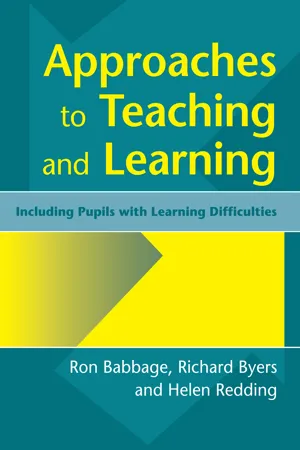
Approaches to Teaching and Learning
Including Pupils with Learnin Diffculties
- 116 pages
- English
- ePUB (mobile friendly)
- Available on iOS & Android
eBook - ePub
Approaches to Teaching and Learning
Including Pupils with Learnin Diffculties
About this book
First published in 1999. Increased levels of interest in inclusive education for pupils with learning difficulties are set to continue and while much progress has been made, challenges remain in promoting full and meaningful participation for these learners. This book focuses, therefore, on the teaching and learning and processes which will facilitate organisational and curricular inclusion for pupils with learning difficulties within day to day classroom practice. using their understanding of current theory, the authors provide practical approaches to the analysis of teaching methods used with pupils with learning difficulties and the learning preferences, strengths and areas of challenge of individual pupils. They also discuss the various factors which impinge upon the development of more inclusive provision. These approaches will provide practical help to all those working with pupils with learning difficulties in a variety of contexts. The book will also appeal to those responsible for staff and school development, including the changing roles of specialist teachers and special schools, and for developing policy and practice with regard to inclusion.
Information
1 | Introduction |
What is the Purpose of this Book and who is it for?
It is clear that increased levels of interest in the prospect of including pupils with learning difficulties in schools and classrooms alongside their mainstream peers will be sustained in years to come. Much has now been written about the structures and school improvement procedures which might support this process of inclusion (for example, Clark et al. 1997; Thomas et al. 1998) and there is also a growing literature devoted to the development of an inclusive curriculum (see, for example, the for All series inaugurated by the MEC Teacher Fellows (1990) or Carpenter et al. 1996). As this debate proceeds, and a number of questions are resolved, the key issue of how to include pupils with learning difficulties within day to day classroom practice remains. We know this to be the case because we have talked at length with colleagues whose work involves supporting pupils with learning difficulties in more inclusive settings. These practitioners will often say that access for these learners – to new learning environments, to a wider and more diverse peer group, or to a broad and balanced curriculum – has been secured. They will also say that challenges remain in promoting full and meaningful participation. This issue often turns, in our experience, on pedagogy and on the extent to which there is a match between the teaching methods selected by staff, and pupils’ innate or acquired learning preferences, skills and difficulties.
In the following pages we propose to focus, therefore, on the teaching and learning processes which will facilitate organisational and curricular inclusion for pupils with learning difficulties. Our purpose is to provide practical approaches, grounded in our understanding of theory, to the analysis of:
- the teaching methods used with pupils with learning difficulties;
- the learning preferences, strengths and areas of challenge of individual pupils with learning difficulties;
- the organisational, cultural and contextual factors which impinge upon the development of more inclusive educational provision.
This is not a book which is simply about relocation. We suggest that the issues we address will be relevant whether staff are seeking to include pupils with learning difficulties within mainstream classes or pupils with severe and complex or profound and multiple learning difficulties within teaching groups with their age peers in specialist contexts. We propose that all schools and all classrooms can be part of the project of making teaching and learning more inclusive. We would also argue, with Ainscow (1991), that what is needed to drive this project forward ‘is for each teacher to seek deeper understandings of the nature and outcomes of particular educational events and situations’. While the origins and potential outcomes of this project therefore lie in practice, improvements in the quality of teaching and learning for pupils with learning difficulties will mean improvements in teaching and learning for all and, ultimately, whole school improvement, as Ainscow makes clear.
We wrote this book with a clear sense of audience. We assume that it might be read and put to practical use by:
- anyone interested in the education of pupils with learning difficulties, including teachers, classroom co-educators, parents and carers and other professionals working with pupils with learning difficulties in a range of contexts;
- senior managers and those responsible for staff and school development or for developing policy and practice with regard to inclusion;
- students undertaking courses of further professional study in the field of special educational needs.
We hope that it will be read with interest as well as recognition and that it will have the effect of revitalising classroom processes for teachers and learners alike.
How has this Book been Written?
In this section we wish to give some thought to the ways in which we have approached the issue of exploring teaching and learning for pupils with learning difficulties and to set our work in the context of some of the literature on methods of enquiry. We should first make it clear that this project was initiated and supported by our receipt of the Fulton Fellowship for 1998/99. This provided both the impetus to proceed and the practical possibility of good quality non- contact time for writing, research and reflection. In gathering material for this book, we have worked individually and together in a number of different ways. We have, for example:
- provided an ongoing programme of professional development activities over time in one special school for pupils with severe and profound and multiple learning difficulties, St John’s School in Kempston;
- facilitated one-off professional development sessions for colleagues in inclusive and special school contexts;
- contributed to modules within programmes of higher education, working with participants from a range of backgrounds;
- taught, observed practice and acted as mentors to fellow practitioners;
- followed lines of enquiry into the literature;
- talked, debated and consulted with one another and with colleagues about the issues we have raised;
and used all these opportunities as ways of gathering evidence, developing and checking our ideas and furthering our enquiry. This development work, evidence gathering and professional discourse has provided much of the practical material which we have included in this book. In all cases, we have been explicit about our motives; clarified with colleagues our commitment to this project; and sought permission to use anonymised samples of worksheets, planning materials, pupil profiles or direct quotations drawn from informal discussions or the semi-structured interviews (Powney and Watts 1987) which we conducted with the four phase facilitators at St John’s School.
We have characterised this work, in our public descriptions of it, as a form of practice-based enquiry focused on fostering improvements in the quality of teaching and learning in particular schools and situations. We present the outcomes of our analysis of practice in these particular situations with the aspiration that they may contribute to a wider debate about the practice of promoting inclusion for pupils with learning difficulties.
The Reflective Practitioner
This is not a book written by people who are, in any formal sense, professional researchers. Schön (1991) characterises the traditional, hierarchical model of professional knowledge in the following way:
Researchers are supposed to provide the basic and applied science from which to derive techniques for diagnosing and solving the problems of practice. Practitioners are supposed to furnish researchers with problems for study and with tests of the utility of results, (p. 26)
As the authors of this book, we would certainly see ourselves, in Schön’s terms, as practitioners. We have certainly also furnished ourselves with a series of problems which we, along with colleagues at St John’s School and in a number of other settings and situations, have been keen to explore. We would therefore see ourselves as practitioner-enquirers grappling with the real problems that emerge from everyday experience in schools. As Schön (1991) says:
In real-world practice, problems do not present themselves to the practitioner as givens. They must be constructed from the materials of problematic situations which are puzzling, troubling, and uncertain... Problem-setting is a process in which, interactively, we name the things to which we will attend and frame the context in which we will attend to them. (p. 40)
We endorse many of the interesting words Schön uses here in order to characterise ‘real-world practice’. Our work has been ‘puzzling, troubling, and uncertain’, even when we have been engaged in the naming and framing processes that Schön identifies, much more often than it has been clear and unambiguous. We have learned to embrace and celebrate our uncertainty because we have come to see it as one of the marks of the authenticity of what we are doing. As Robinson (1993) notes, uncertainty and controversy are likely to be among the characteristics of what she calls a ‘problem-based methodology’. Robinson argues that the variables which are often ‘controlled out’ by the scientific researcher may be the very phenomena ‘that are most significant to practitioners’ decisions about how to act’. To remove these complexities and ambiguities may result in a Toss of meaning for the practitioner’. This is certainly something we want to avoid. Our work does not therefore provide a neatly packaged relationship between the problem, the experiment and the solution. Indeed, we have learned to become suspicious of any findings that seem to be too tidy and have found ourselves rejecting some of our early models, which offered intellectual and graphical symmetry but failed, in the end, to encompass the untidy complexity of the teaching and learning that we experience in the classroom. As Robinson (1993) notes, a problem-based methodology will be interested in the ongoing process of ‘resolving educational problems’, rather than simply in finding ‘a solution’, which can restrict the enquirer to a ‘single-loop search for a solution that fits the existing constraint structure of the problem’.
In embracing uncertainty in this way we have failed to generate easy answers, but we are sure that we have moved on. In describing the process of becoming a ‘reflective practitioner’, Schön (1991) suggests that this entails moving from ‘knowing-in-action’ (which he characterises as ‘the spontaneous behaviour of skilful practice’) towards ‘reflecting-in-practice’. As one of the phase facilitators at St John’s School said, ‘sometimes I do things but I don’t know what I do and then somebody gives them a name and I realise that’s what I’m doing and it confirms my practice ... I probably do know what I do because I think about it all the time’. Schön states that the reflective practitioner:
reflects on the phenomena before him, and on the prior understandings which have been implicit in his behaviour. He carries out an experiment which serves to generate both a new understanding of the phenomena and a change in the situation, (p. 68)
In undertaking the work for this book, we have encouraged ourselves, each other and a number of colleagues whom we have persuaded to join us in this endeavour, to behave in precisely the way that Schön describes. As reflective practitioners, we have perceived a problem and set ourselves the task of exploring it. This has entailed a critique of the ways in which such problems are usually framed. Robinson (1993) notes that enquirers using a problem-based methodology will deliberately explore, critique and evaluate ‘existing and . . . alternative constraint structures’. There are parallels here with Hart’s (1996) approach to practitioner research, which she calls ‘innovative thinking’. Hart encourages teachers to ‘probe’ their ‘existing knowledge, understandings and resources’ – to challenge and to call into question established ways of conceptualising practice and pupils – in order to ‘reach out for new understandings’. In our work we have attempted, along with our co-enquirers, to reframe and restructure the issues as we see them and to undertake exploratory action. In this sense, we have conducted an experiment – or more accurately a number of experiments on a number of different levels. Each of our actions has produced phenomena which Schön (1991) describes as ‘unexpected changes which give the situation new meanings’. Schön provides a compelling metaphor for this process when he describes the way in which the ‘situation talks back, the practitioner listens, and as he appreciates what he hears, he reframes the situation once again’. This idea of a ‘reflective conversation’, which ‘spirals through stages of appreciation, action, and reappreciation’, emerged as another strong theme in our work together. We found ourselves, then, engaged in a form of reflection on, and in, practice which was characterised by uncertainty as a key impetus to enquiry. We came to agree with Schön (1991) that by working in this way ‘the unique and uncertain situation comes to be understood through the attempt to change it, and changed through the attempt to understand it.’
Action Research and Naturalistic Enquiry
These notions of change and understanding would seem to mark our work, again in contrast to conventional scientific research, as a form of action research. Fullan (1991) links the action research model directly to the process of understanding and effecting change in educational settings. According to Robson (1993), action research seeks both to ‘understand’ a situation and to ‘promote change’ through the sorts of cycles of planning, action, observation and reflection that we undertook. Robson (1993) also notes that ideas about ‘improvement and involvement seem central’ to the action research process. Carr and Kemmis (1986) take this insight further. They suggest that action research entails:
firstly, the improvement of a practice of some kind; secondly, the improvement of the understanding of a practice by its practitioners; and thirdly, the improvement of a situation in which the practice takes place... Those involved in the practice being considered are to be involved in the action research process, (p. 165)
All of these were certainly characteristics of our work. As practitioners we were ourselves involved in the enquiry process and, as we shall note below, we also involved numbers of other participants. We set out with the intention of exploring the possibility of enhancing or improving practice and we rapidly found that one of the key elements in this process was the exploration of the understandings and constructs which practitioners bring to their work. We became interested then in the ways in which our enquiry could itself be seen as a means of promoting improvement in three dimensions:
- situational improvement – through changes in classroom practices for teachers and learners;
- contextual improvement – through changes in teachers’ understanding, awareness and capacity for reflection;
- institutional improvement – through whole school development.
An awareness of the everyday nature of these contexts or settings prompted us to see our enquiry as ‘naturalistic’ or, in Robson’s (1993) terms, as an example of ‘real world’ research. Lincoln and Guba (1985) identify a number of other characteristics of natural enquiry which again we would suggest are characteristics of our own work. For example, as enquirers we consistently:
- enlisted the support of other people in gathering data;
- negotiated meanings, understandings and interpretations with those respondents;
- tended to use qualitative methods in preference to quantitative because, as Lincoln and Guba (1985) note, they are more adaptable and sensitive to the complexities of natural settings;
- accepted the intuitive or felt knowledge of participants as making a legitimate contribution to the enquiry alongside other forms of evidence.
As the dialogue developed between us as co-enquirers and between us and other participants in classrooms and during the staff development activities which we undertook as an integral part of our project, we became increasingly focused on the importance of the perceptions and understandings of our co-enquirers. If there is to be change and improvement in an educational institution, then it must begin with the ideas that teachers and learners have about themselves; about one another; and about the processes entailed in teaching and learning.
Robinson (1993) argues that changes in theories of practice are necessary if change is to be non-coercive. She suggests that if practitioners begin to think about their work in different ways then their practice will change, as it were, from the inside. She argues that this kind of change is qualitatively different from the revised practices that are imposed upon practitioners from ‘above’ or from ‘the outside’. According to Robinson (1993), the purpose of a problem-based methodology (PBM) is:
to contribute to the understanding and improvement of problems of practice. In brief, PBM involves the reconstruction of theories of action which are operative in the problem situation, the evaluation of such theories, including the assessment of their possible causal role in the problem, and, where necessary, the development, implementation and evaluation of an alternative theory of action. Ideally, these stages of inquiry are embedded in a ‘critical dialogue’ between researcher and practitioner; that is a conversation that is simultaneously critical and collaborative, (p. 15)
We recognise that our work has many of the characteristics of this sort of iterative process, both in the ways in which our enquiry developed in direct response to changes in the practices in which we were interested, and in the sense that our work was shaped by our interactions with one another and with colleagues. Along with uncertainty and the notions of change and improvement, we came to view conversation, or interaction, or critical dialogue between the various participants in the enquiry process and the problem itself as a further key characteristic of our way of working.
Schools as Problem-solving Organisations
Skrtic (1991) argues that the form of school organisation which he refers to as ‘adhocracy’ ‘is premised on the principle of innovation rather than standardisation’. He also brings together, in ...
Table of contents
- Cover
- Title Page
- Copyright
- Contents
- Acknowledgements
- Foreword
- 1. Introduction
- 2. Definitions
- 3. Descriptions
- 4. Developments
- 5. Conclusions and implications
- References
- Index
Trusted by 375,005 students
Access to over 1.5 million titles for a fair monthly price.
Study more efficiently using our study tools.
Frequently asked questions
Yes, you can cancel anytime from the Subscription tab in your account settings on the Perlego website. Your subscription will stay active until the end of your current billing period. Learn how to cancel your subscription
No, books cannot be downloaded as external files, such as PDFs, for use outside of Perlego. However, you can download books within the Perlego app for offline reading on mobile or tablet. Learn how to download books offline
Perlego offers two plans: Essential and Complete
- Essential is ideal for learners and professionals who enjoy exploring a wide range of subjects. Access the Essential Library with 800,000+ trusted titles and best-sellers across business, personal growth, and the humanities. Includes unlimited reading time and Standard Read Aloud voice.
- Complete: Perfect for advanced learners and researchers needing full, unrestricted access. Unlock 1.5M+ books across hundreds of subjects, including academic and specialized titles. The Complete Plan also includes advanced features like Premium Read Aloud and Research Assistant.
We are an online textbook subscription service, where you can get access to an entire online library for less than the price of a single book per month. With over 1.5 million books across 990+ topics, we’ve got you covered! Learn about our mission
Look out for the read-aloud symbol on your next book to see if you can listen to it. The read-aloud tool reads text aloud for you, highlighting the text as it is being read. You can pause it, speed it up and slow it down. Learn more about Read Aloud
Yes! You can use the Perlego app on both iOS and Android devices to read anytime, anywhere — even offline. Perfect for commutes or when you’re on the go.
Please note we cannot support devices running on iOS 13 and Android 7 or earlier. Learn more about using the app
Please note we cannot support devices running on iOS 13 and Android 7 or earlier. Learn more about using the app
Yes, you can access Approaches to Teaching and Learning by Ron Babbage,Helen Redding,Richard Byers in PDF and/or ePUB format, as well as other popular books in Education & Education General. We have over 1.5 million books available in our catalogue for you to explore.