Rich with the voices and stories of participants, these touching, firsthand accounts examine how women of diverse racial, ethnic, class and religious backgrounds perceive prenatal testing, the most prevalent and routinized of the new reproducing technologies. Based on the author's decade of research and her own personal experiences with amniocentesis, Testing Women, Testing the Fetus explores the "geneticization" of family life in all its complexity and diversity.
eBook - ePub
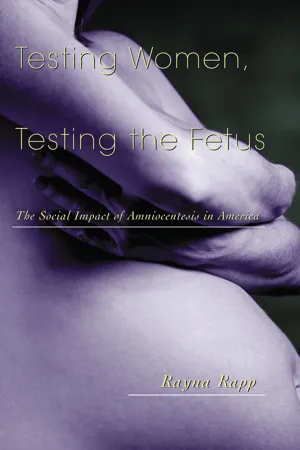
Testing Women, Testing the Fetus
The Social Impact of Amniocentesis in America
- 376 pages
- English
- ePUB (mobile friendly)
- Available on iOS & Android
eBook - ePub
About this book
Information
1
How Methodology Bleeds into Daily Life

Why am I having amniocentesis? I'm 42. I think at my age I'd be foolish, anyone would be foolish, not to have this test. (Brenda Kelly, white lawyer)
What is the purpose to this test? The purpose is to know what God has in store for you, so you can wonder at the marvels of his ways. (Lynthia Cato, 37, Trinidad-born factory worker)
You ask me why I am crying? I am crying because no one told me that I could have such a problem as sickle cell, that I carry this in my blood, and that it is now too late to test the baby. That is the reason I am crying. (Janis Winter, 32, African-American teacher's aide)
I don't smoke, I don't drink, I don't take drugs, I eat good food, I take good care of myself. What do I need this test for? (Dominique Laurent, 39, Haitian garment worker)
THIS BOOK EXPLORES the social impact and cultural meaning of prenatal diagnosis, one of the most routinized of the new reproductive technologies. In the United States, as in most late industrialized countries, amniocentesis and related prenatal diagnostic technologies are used to screen fetuses for chromosomal anomalies and neural tube problems during the second trimester of pregnancy, when women and their supporters may choose to continue or end the pregnancy should a positive diagnosis of a serious fetal problem be made. How and why has this reproductive technology developed? How has it become part of routine pregnancy care for some segments of the population? Who uses, refuses, and might desire to use it, and under what conditions is it offered? How do health care providers understand their own role, and how do they communicate the benefits and burdens of the test to their patients from diverse social backgrounds? How do women and their supporters describe and evaluate their experiences with this test? Is this test “revolutionizing pregnancy,” as is often claimed, and if so, for whom? How are we to discuss the simultaneously eugenic and liberating agendas of prenatal testing, and how are they enacted for and by different individuals and communities? How are popular understandings of genetics and inheritance shaped in contemporary America? What does scientific literacy mean in a culture as deeply stratified as our own?
I have worked on these problems as an anthropologist and as a feminist activist for more than a decade. In learning about the social impact and cultural meaning of prenatal diagnosis, I have used standard anthropological methods of participant observation. That professional umbrella is a catchall label for hands-on research that is open-ended, and locates the researcher as far into the experiences of the people whose lives are touched by the topic as she can figure out how to go. My methods have been as conventional as sitting through medical school lectures or interviewing candidates for prenatal diagnosis in English, Spanish, and sometimes French; as arcane as learning to recognize and cut up laboratory photographs of chromosomes so they could be assembled into karyotypes; as familial as taking my toddler to a charity performance of the circus to benefit the National Down Syndrome Society at which she appeared to be the only nondisabled child. The use of standardized interview topics has provided broad comparability across many constituencies with whom I have spoken. But the basic benefit of participant observation is its open-endedness: I set out with one set of research questions, and was forced to enlarge and transform them as people educated me on the complexity of the issues as they perceived them.
This book is divided into eleven chapters. These chapters are organized neither chronologically nor ecologically, the two dominant genres of classical anthropological presentation. Rather, I begin with a chapter discussing the history of prenatal diagnosis and its related technologies, sketching the complex social, legal, and political transformations that supported its development. I then follow the technology through its trajectory, as pregnant women encounter it. Each chapter takes up a communicative and practical problem posed by the development of this new technology: communication and miscommunication between providers and patients; pregnant women's anxiety and interpretation of what sonograms and chromosomes mean to them; the role of the fetal imaginary in thinking about disabling conditions; refusing the test; culturing chromosomes; getting bad news; living with children who have diagnosable conditions; and more. My goal in intersecting and juxtaposing many diverse perspectives on this topic is to create a Venn diagram, overlapping the social spaces in which amniocentesis and related technologies have developed. In making a map of both the obvious and the more interstitial places within which the simultaneously liberating and eugenic aspects of this technology develop, I attempt to describe and interpret the range of practices and problems associated with it. It is my contention that the construction and routinization of this technology is turning the women to whom it is offered into moral pioneers: Situated on a research frontier of the expanding capactity for prenatal genetic diagnosis, they are forced to judge the quality of their own fetuses, making concrete and embodied decisions about the standards for entry into the human community.
In overlapping many perspectives on amniocentesis, I hope to make a contribution to at least three discussions. The first concerns the technological transformation of pregnancy, a discussion which usually focuses on what have come to be called the new reproductive technologies: How “new” or “revolutionary” are the cluster of fertility-controlling practices like amniocentesis, when we examine their concrete social matrix, and not just their abstract potential as pieces of technology? The second examines the practical intersection of disability rights and reproductive rights, where issues of abortion on the one hand, and inclusion on the other, are now aspects of a national political discourse in the contemporary United States. The third examines the role of scientific literacy in late-twentieth-century American culture, with an emphasis on both practical knowledge and the very American nature of how we use it. The idea that science and technology provide positive resources for improving or even perfecting life is deep-seated in the history of the United States. So, too, is unequal access to those resources, and a consequent range of perceptions and responses to the burdens as well as the benefits that their stratified presence may impose. These concerns all take the diversity of gender, power, and culture as the starting point for analysis.
The Need for Women-Centered Analysis
When I began to study the impact and meaning of a new reproductive technology, my initial goal was to wrest understandings from the discourse of experts, and to relocate them in popular practices and perceptions. I came to this formulation the hard way: As a 36-year-old feminist health activist, I had chosen, with some ambivalence, to undergo prenatal diagnosis in my first pregnancy in 1983. When my fetus was diagnosed as having Down syndrome, the shock, grief, and confusion were enormous. Mike Hooper and I had ardently desired this pregnancy; together, we now chose to end it. In trying to recover from a devastating experience, I turned to the mundane tools of intellectuals: A medical library search quickly convinced me that the voices of experts (bioethicists, lawyers, doctors, and health economists, most of them male, all of them highly educated, and overwhelmingly white) dominated the discourse on prenatal diagnosis. Absent from the published literature were the concerns of the women of different class, racial, ethnic, and religious backgrounds who use, or might use, or might refuse to use the new technology. I also turned to the tools of feminism, constructing a network through other health activists to locate a few women who had sustained similar experiences. Together, we amassed huge phone bills, supporting one another as we tried to make sense of the painful decision to end the life of a fetus we had first desired and carried. Increasingly convinced that the complex topic of prenatal testing and abortion begged for a woman-centered analysis, I sought the help of sympathetic health care providers to gain access to other women, and began interviewing in late 1983. In 1984, I published an account of my own experiences in Ms. Magazine, hoping to provoke popular feminist discussion and awareness of this topic (Rapp 1984). I also gave birth to a healthy baby; the small, ordinary miracle of her existence served to increase my interest in what happened to other women whose pregnancies, like my own earlier one, did not lead to happy endings. By the mid-1980s, other feminist scholars and activists also began writing on what were loosely coming to be called the “new reproductive technologies.” I read their work with enormous appreciation and relief; surely, the ambiguous problems posed by technologies that offer more control over pregnancy outcomes while enforcing more medical surveillance deserved extensive feminist commentary. Those early works spoke with passion and courage about what women lost in having their pregnancies increasingly medicalized. But they also often spoke as if women's interests in reproductive technologies were both clear-cut and unified: Feminists usually described pregnancy as a natural process and its technologization as a male power play to contain Mother Nature. In many early analyses, male pharmacrats (to borrow Gena Corea's felicitous phrase) had controlling interests in the biotechnology companies, the experimental research, and the private medical practices within which women submitted to the new reproductive technologies. While enormously sympathetic to the critique of economic, social, and gendered power at the heart of such analyses, I was also skeptical on the basis of the complexity of my own experiences and those of the women I had begun to interview. We were both grateful for and critical of the technology, and we knew that “nature” was too simple a label for our pregnancy problems and possibilities. Who speaks for the diversity of women in such a circumstance? We will return to the problems of expert discourse—whether biomedical, feminist, or other—in chapters 2 and 3.
Recognition of the power of expert discourse reinforced my predilections to use anthropological tools in the service of telling another story: The discourses and practices of biomedicine and technology are played out on a complex cultural ground at the end of the twentieth century in the United States. Indeed, recent developments in science studies remind us that biomedical technology is itself a highly contested cultural object, porous in its diverse social constructions, uses, and exclusions. The transformations of pregnancy, experiences with disabling conditions, and family life on which prenatal diagnostic technology touches are deeply gendered; they are also powerfully influenced by class position, ethnic and cultural community background, and the resources and orientations provided by religions. Moreover, the institutional resources, constraints, and possibilities within which pregnancy is now monitored are highly contested in our current political-economic system: Access to comprehensive health care and abortion stands at the heart of contemporary political transformations and struggles. There can thus be no simple evaluation of this, or any other, new intervention into reproduction. I hope this book makes a case for the complexity, diversity, and contradictory nature of the impact of reproductive technology.
Attempting to set my own amniocentesis experiences against a larger social background, I set out to map the terrain of an emerging technology in 1983. My prior research projects had always engaged what I took to be social problems or circumstances requiring a structural understanding; now, the dilemmas I was confronting were simultaneously political-economic, epistemological, and ethical; I had become a guinea pig in my own research. Working through a sympathetic private physician, I began by interviewing twenty-five women who had chosen abortions after receiving what is so antiseptically labeled a positive diagnosis. In the face of a confusing and traumatic experience, they often described themselves as at a loss for words. These women were working in a communicative system whose vocabulary is exclusively medical, whose grammar is technological, and whose syntax has yet to be negotiated. It was not always easy for them to frame alternative descriptions with which to more accurately represent the impact of amniocentesis in their own lives.
Inventing a Methodology
In 1984, my proposal to undertake fieldwork was approved by the Medical and Health Research Association Inc., which oversees all Health Department research in New York City, and I was warmly welcomed by the staff of the Prenatal Diagnosis Laboratory (PDL) of New York City. The PDL stood as a model for what mass prenatal diagnostic services are, and might become, and it was the largest cytogenetics laboratory attached to a public health department in the United States. Its work informs much of this book, especially as presented in chapters 3, 4, and 5. Over the next four years, I spent from one to four days each week in the company of the genetic counselors who worked for PDL, following them on their rounds through city hospitals. I observed them and their PDL colleagues counseling more than 230 patients and often turned to them for help compiling historical and statistical information on PDL's services. Over the years, I was welcomed into sessions by the three full-time and two part-time genetic counselors who also worked at the PDL, and by the numerous graduate students who interned there. All consented to be observed and interviewed; all also provided much informal and valuable information for my study. The laboratory staff was more than tolerant during the two months that I imposed a maverick internship upon them, learning to spin and culture fluids, focus a microscope, and cut chromosomes into karyotypes. They must often have wondered why I thought science was exotic, when I could have gone to more traditional anthropological locations.
Through observations of PDL intake patient interviews, I also began to recruit a sample of women who were having amniocentesis and were willing to be interviewed at home (ideally, during the long weeks of waiting for test results).1 I initially attempted to conduct interviews with the partners and other close supporters of this patient population, but this proved a difficult task; I was able to interview only fifteen men (or FOFs, fathers of fetuses, as I came to think of them), compared to more than eighty women. I describe what I learned in all of these interviews in chapters 5 and 6, and I speculate on why men became an endangered species in this study in chapters 6 and 7. I have included whatever I know both from men directly, and about men less directly, from their partners, throughout the book, but the quality and quantity of my information concerning the exotic male sex and prenatal testing remains spotty.
PDL counselors and staff also helped me to recruit a sample of women who had received the news that a serious problem has been diagnosed in their fetus, and that a decision to continue or end the pregnancy had to be consciously made. These immeasurably enriched the understandings I had developed in the first pilot study. Later, I added interviews with ten more women with positive diagnoses through another medical center, bringing the total to forty-two.
Just as I began working through the PDL genetics team, my Ms. Magazine article appeared (Rapp 1984). It elicited more than one hundred letters in response, and I entered into correspondence with scores of women about their own amniocentesis stories. The outpouring was very moving. Often, their authors and I remained in correspondence through many rounds of missives, and in some cases I asked for and received permission to quote from the letters.
Through my observations at the PDL, I also began to interview women who chose not to take the test, to understand how a routinizing technology does not necessarily stay en route for everyone. Informally, I spoke with scores of women who opted during routine intake interviews not to use the test; eighteen women and two men granted me more formal interviews, sometimes through home visits, more often over the telephone. Their reasoning is discussed in chapter 7. Through my work with PDL counselors, I became interested in counseling as a new women's profession, and I set off to interview thirty-five counselors, at least one from each medical center in New York City where prenatal diagnostic services are offered. Later, with my colleague Diana Punales-Morejon, I conducted a survey of the (then) fifteen North American programs that offer master's degree programs in genetic counseling (Punales-Morejon and Rapp 1993; Rapp 1993a). While we focused on the problem of training counselors to understand ethno-cultural diversity among the urban populations they would soon serve, we also learned a great deal about how the profession has developed, and how curriculum and certification procedures change. Most recently, I interviewed ten geneticists to understand their perceptions of both the development of their field, and its social and ethical impact.
In 1984, right after the Ms. Magazine article was published, I also received a phone call that changed the course of my research dramatically. One of the founding members of a Down Syndrome Parents Support Group (Manhattan and the Bronx), the mother of a child with Down syndrome, challenged some of my descriptions of disabled children and the social services available to them. I quickly joined the support group, and with her philosophical and practical guidance began learning my way around the world of disability rights and educational services for children with special needs. I eventually interviewed thirty-eight families in which a child had Down syndrome, first through meeting activists in two parent support groups, later through the work I did on the education committee of one of those groups, and then through a family-court-funded early-intervention program for developmentally delayed children. On a more haphazard basis, I spoke with a dozen grown siblings of children with Down syndrome, and interviewed a handful of parents whose offspring had other chromosomal or genetic disabilities. Over the years of this study, I learned a great deal about two related and tension-fraught issues. The first is the need to champion the reproductive rights of women to carry or refuse to carry to term a pregnancy that would result in a baby with a serious disability The second is the need to support adequate, nonstigmatizing, integrative services for all the children, including disabled children, that women bear. The intersection of disability rights and reproductive rights as paradoxically linked feminist issues has emerged as central to my political and intellectual work.
In 1989, I added another piece to my research puzzle. Because the patient population served by the PDL was highly polarized, I was learning a lot about middle-class professional families (disproportionately white) and working-poor families (disproportionately African-American and Latino). In order to avoid conflating race and class in both my data collection and its interpretation, I sought and received permission to work in the Division of Medical Genetics, Beth Israel Medical Center, which held the contract to perform amniocentesis for several Hospital Insurance Plan (HIP) groups in the metropolitan area. As the oldest health maintenance organization in New York City, HIP has always served a solidly working-class, often unionized, and quite racially diverse population. More recently, HIP has added middle-class constituencies as the crisis in U.S. health insurance dictates cheaper employer-provided plans. Beth Israel provided what I hoped would be the “missing middle” to my data set. The Beth Israel genetics team had also developed an innovative outreach program in New York's Chinatown, whose hardworking and linguistically isolated population was not always easy to reach. And the genetics staff included several native Spanish speakers with professional commitments to serving new immigrant communities. For an anthropologist, it provided another excellent research site. Using protocols developed at the PDL, I observed one hundred intake interviews, conducted another twenty-five home interviews with women awaiting amniocentesis results, and met with ten women who had received positive diagnoses. I also visited the neonatal intensive care unit, observed weekly rounds, hung out in the laboratory, and learned about DNA diagnosis as the genetics team graciously incorporated me into their working life.
Decomposing Method
Through the PDL, Beth Israel, and the genetic counselors that I interviewed, I spent more than 130 days observing hospital-based counseling sessions. Initially, I intended to contrast observations and interviews with patients from white, Hispanic, and African-American backgrounds, distinguishing middle-class, working-class, and working-poor groups. With some effort, I managed to collect my comparative sample, primarily at Beth Israel, Harlem, Roosevelt, and Woodhull hospitals, with a few additional observational days and follow-up interviews at hospitals in Staten Island, the Bronx, and Queens. But the diversity I encountered quickly underlined how static such sociological classifications can become. Ethnic identity is, of course, far more complex than such census categories indicate; and while occupation and payment plan yield good approximations of socioeconomic status, they barely touch the experiential meanings of social class. Moreover, variation across New York's hospital catchment areas is profound: “Hispanic” on Manhattan's West Side virtually stands for Puerto Rican and Dominican. Many who use this label for themselves ...
Table of contents
- Front Cover
- Advance Praise for Testing Women, Testing the Fetus
- Title Page
- Copyright
- Dedication
- Contents
- Acknowledgments
- 1 How Methodology Bleeds into Daily Life
- 2 Accounting for Amniocentesis
- 3 The Communication of Risk
- 4 Contested Conceptions and Misconceptions
- 5 Waiting and Watching
- 6 The Disabled Fetal Imaginary
- 7 Refusing
- 8 Culturing Chromosomes, or What's in the Soup
- 9 An Error in Cell Division, or The Power of Positive Diagnosis
- 10 The Unexpected Baby
- 11 Endings Are Really Beginnings
- Notes
- References
- Permissions
- Index
Trusted by 375,005 students
Access to over 1.5 million titles for a fair monthly price.
Study more efficiently using our study tools.
Frequently asked questions
Yes, you can cancel anytime from the Subscription tab in your account settings on the Perlego website. Your subscription will stay active until the end of your current billing period. Learn how to cancel your subscription
No, books cannot be downloaded as external files, such as PDFs, for use outside of Perlego. However, you can download books within the Perlego app for offline reading on mobile or tablet. Learn how to download books offline
Perlego offers two plans: Essential and Complete
- Essential is ideal for learners and professionals who enjoy exploring a wide range of subjects. Access the Essential Library with 800,000+ trusted titles and best-sellers across business, personal growth, and the humanities. Includes unlimited reading time and Standard Read Aloud voice.
- Complete: Perfect for advanced learners and researchers needing full, unrestricted access. Unlock 1.5M+ books across hundreds of subjects, including academic and specialized titles. The Complete Plan also includes advanced features like Premium Read Aloud and Research Assistant.
We are an online textbook subscription service, where you can get access to an entire online library for less than the price of a single book per month. With over 1.5 million books across 990+ topics, we’ve got you covered! Learn about our mission
Look out for the read-aloud symbol on your next book to see if you can listen to it. The read-aloud tool reads text aloud for you, highlighting the text as it is being read. You can pause it, speed it up and slow it down. Learn more about Read Aloud
Yes! You can use the Perlego app on both iOS and Android devices to read anytime, anywhere — even offline. Perfect for commutes or when you’re on the go.
Please note we cannot support devices running on iOS 13 and Android 7 or earlier. Learn more about using the app
Please note we cannot support devices running on iOS 13 and Android 7 or earlier. Learn more about using the app
Yes, you can access Testing Women, Testing the Fetus by Rayna Rapp in PDF and/or ePUB format, as well as other popular books in Social Sciences & Anthropology. We have over 1.5 million books available in our catalogue for you to explore.