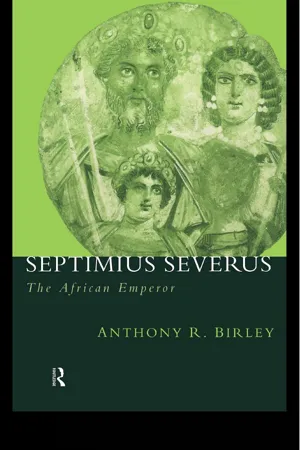
- 320 pages
- English
- ePUB (mobile friendly)
- Available on iOS & Android
eBook - ePub
About this book
In this, the only biography of Septimius Severus in English, Anthony R. Birley explors how 'Roman' or otherwise this man was and examines his remarkable background and career.
Severus was descended from Phoenician settlers in Tripolitania, and his reign, AD 193-211, represents a key point in Roman history. Birley explores what was African and what was Roman in Septimius' background, given that he came from an African city. He asks whether Septimius was a 'typical cosmopolitan bureaucrat', a 'new Hannibal on the throne of Caesar' or 'principle author of the decline of the Roman Empire'?
• 1 •
THE EMPORIA
SEPTIMIUS SEVERUS WAS BORN ON 11 April 145, at Lepcis Magna in Tripolitania, son of P.Septimius Geta and Fulvia Pia. Lepcis had had the status of a Roman colony for a generation and was one of the great cities of Roman Africa. Tripolitania, land of three cities, took its name from Lepcis and her two western neighbours, Oea (Tripoli) and Sabratha. The Roman empire was then at the height of its prosperity. Antoninus Pius, the emperor, give his name to an era synonymous with peace and affluence. In 145 he himself was consul with his adopted son as colleague. The year of Septimius’ birth was thus the year of ‘the emperor Antoninus for the fourth time and Aurelius Caesar for the second time’.1
The son born to Geta and Fulvia was given the names of his paternal grandfather: ‘Lucius Septimius Severus’. Fifty years later Septimius was to denote himself ‘son of the deified Marcus’ in place of ‘son of Publius’. Soon after this retrospective adoption into the Antonine dynasty a cynical senator congratulated Septimius on ‘finding a father’, implying that the real parent was a nobody. Geta was an obscure provincial, it is true (and long dead by 195). But men of his family in the same generation as himself were already senators when his son was born: P.Septimius Aper and C. Septimius Severus, both on the road to high office in 145. These men, probably Geta’s first cousins, were no doubt older than him. But Geta never held public office. Ill health may have been a bar, or lack of ambition, but hardly poverty. His sister Polla, who apparently died unmarried, was a very wealthy woman, and the family had property in Italy as well as estates at Lepcis. For whatever reason, Geta seems to have stayed in Africa with his wife and three children. There was another son, named after himself, hence probably the elder, and a daughter, Octavilla. However obscure his life, the biographer Marius Maximus discoursed ‘quite copiously’ about him and his character in his life of Septimius, according to the HA (which fails to reproduce any details).2
Even within so variegated an empire, Septimius’ home town, where he spent the first seventeen years of his life, was a very exceptional place, and the ‘three cities’ markedly different from the rest of what the Romans called ‘Africa’. A look at Lepcis’ origins is required to understand better who Septimius Severus was. ‘Civilisation’ came to North Africa with Canaanite traders from Tyre and Sidon, their language—Phoenician, later called Punic in the western Mediterranean—closely related to Hebrew. They began exploring the coasts of the west in the late second millennium BC. Phoenicia had acquired expertise in seamanship and trade over the preceding centuries, when Ugarit on the Syrian coast played no small part in the economy of Egypt. The great disturbances caused by the ‘Sea Peoples’ in about 1200 BC forced her to look further afield. North Africa’s few natural harbours became Phoenician staging-posts on the route to southern Spain. Not quite the earliest, but soon the most important, was Carthage, Qart-Hadasht, ‘new city’. During the first half of the first millennium BC these trading-stations began to take on the character of towns. The process was accelerated and stimulated by the march of events in Asia. Assyria crushed the mother-cities Tyre and Sidon in the eighth century. Further colonists, this time refugees, arrived. Carthage and her fellow Punic cities prospered. They faced rivalry, before long, from the Greeks, active in southern Italy and Sicily from the eighth century, and from the mid-seventh interested in Africa, ‘Libya’. Dorian Greeks from the island of Thera established themselves in eastern Libya, the ‘Green Mountain’, founding Cyrene in 531 BC. From there daughter-cities were sent out, extending Greek settlement from the borders of Egypt to the Syrtica. Carthage responded, it is clear, by planting a settlement at a site called Lpqy in Tripolitania, at first perhaps on a little island opposite the mouth of the wadi, but soon on the mainland. Later two more colonies followed, to the west, Wy‘t and Sbrt‘n. All three names are Libyan, not Punic. They were trading stations, and the Greeks subsequently still called them the emporia—and Lepcis was often known as Neapolis. Tripolitania lies hundreds of kilometres closer to black Africa than Carthage herself. It was clearly to control the shortest paths to the interior by the transsaharan routes that Carthage planted the emporia. But the hills to the south-west of Lepcis, the Gebel Msellata, Herodotus’ ‘Hill of the Graces’, cried out for exploitation, likewise the rich valley of the River Cinyps (Wadi el-Caam), which rises in the Gebel and flows into the sea twelve and a half miles (20 km) east of Lepcis. ‘It is equal to any country in the world for cereal crops and is nothing like the rest of Libya. The soil here is black and springs of water abound so that there is no fear of drought and heavy rains—for it rains in that part of Libya—do no harm when they soak the ground. The returns of the harvest come up to the Babylonian measures …the Cinyps region yields three hundred-fold’, Herodotus wrote. Further, ‘the Hill ofthe Graces is thickly wooded and is thus very unlike the rest of Libya, which is bare’.3
In about 514 BC a Spartan adventurer, Dorieus, guided by men of Thera, ‘came to Cinyps, where he colonised a place which has not its equal in all Libya, on the banks of a river’, Herodotus records. But ‘he was driven out in the third year by the Macae, the Libyans and the Carthaginians’. Greeks from Asia Minor had managed to found Massilia in about 600 BC and exploited much of southern Gaul. But Carthage was by then strong enough virtually to exclude them from Spain, expelled them from Corsica and dominated Sardinia and western Sicily. Northern and central Italy were controlled by the Etruscans, with whom Carthage allied herself, as she did with the infant Roman republic. Only in southern Italy, eastern Sicily and Cyrenaica could the Greeks secure a firm foothold. The western Mediterranean was virtually a Punic preserve until the third century BC.4
Tripolitania, the land between the two Syrtic Gulfs, is lost to history between the expulsion of Dorieus and the end of the third century. During these three hundred years the emporia clearly flourished, in spite of the obstacles. In its physical relief and climate Tripolitania stands apart from the rest of North Africa, a hybrid between Mediterranean and Sahara, with a fertile margin along and near the coast and a vast desert hinterland. A wide coastal plain, the Gefara, stretches from just west of Lepcis to the mainland opposite Meninx (Djerba), the ‘Isle of the Lotuseaters’, bounded on the south by the great rocky escarpment of the Gebel. This band of hills, some twelve and a half miles (20 km) wide for the most part, merges with the Saharan plateau, the Dahar, which in turn slopes away to the southwest into the Great Eastern Erg or sand sea, an almost impassable barrier, further to the east into the ‘red rock’, Hamada elHamra, which divides Tripolitania from the Fezzan. Much of the Gefara plain itself is arid scrub, apart from a band of oases along the coast. Rainfall in Tripolitania is far lower than in the Maghreb proper and the scorching wind from the Sahara, the ghibli, is an added hazard. Another might have been the presence of hostile Libyan tribes. Yet Herodotus knew that Carthage had combined with the largest of these, the Macae, to expel Dorieus. The Libyans were the ancestors of the modern Berbers, who have seemingly preserved their identity through three thousand years of domination by Phoenicians, Greeks, Romans, Vandals, Arabs, French and Italians. Neither they nor the Phoenicians practised cultural or social apartheid. There was considerable intermarriage, and the population of Carthage’s Tripolitanian colonies were to become known as ‘Libyphoenicians’. Further east, the Nasamones of the Syrtica were semi-nomadic, moving from the oasis of Augila to the coast, where they were feared by passing traders. To the south, in the oases of the Fezzan, lay the Garamantes, around whom legend accumulated. They were clearly important middlemen in the transsaharan trade, but from time to time were liable to raid their northern neighbours. Other indigenous peoples of the interior, between the coast and the Garamantes, are labelled ‘Gaetuli’, doubtless linked to the semi-nomads of Numidia and with the Numidae themselves, the most powerful people of the Maghreb. The Moors, Mauri, of the far west, were too distant to affect Lepcis.5
Until the third century only the Greeks had challenged Punic dominance. But the steady advance of Rome was to lead to Carthage’s downfall. Her mercenary armies lost the first long war (264–241 BC) to Rome’s citizen legions. She surrendered Sicily, and soon after Sardinia and Corsica. Hannibal came within an ace of destroying Rome during the second war (218–202 BC) and Carthaginian armies roamed Italy for thirteen years. But Carthage lost again, when Rome took the war first to Spain and then to Africa. She had invaded, to be sure, during the first war (the expedition of Regulus in 256 BC) but that venture had ended in disaster. This time there was no mistake.
Near the end of the Hannibalic war a Numidian chief who had served with Carthage, Massinissa, son of Gaia, defeated by a rival, took refuge in the region ‘between the Emporia and the Garamantes’. He did not forget what he saw there. Lepcis was still small, no doubt, clustered on the headland on the left bank of the Wadi Lebdah, but its control of the Gebel and the Cinyps valley made it rich from the cultivation of cereals and olives. It was paying Carthage tribute of one talent a day. The peace settlement between Rome and Carthage in 201 BC made Massinissa, who had switched sides opportunely, king of a united Numidia. For over half a century this remarkable man greatly enlarged his dominions, at the expense of Carthage. He repeatedly attempted to take over the emporia. In the 1905 Roman commissioners came to Lepcis, three eminent men, Cornelius Cethegus, Minucius Rufus and the great Scipio himself, Hannibal’s conqueror. No clear decision seems to have been made, but by the 160s Carthage’s rights were finally lost. However, Lepcis and her neighbours were left in relative independence from the distant Numidian king. Links with the eastern Mediterranean were developed, not least with Alexandria.
6
In 149 BC Roman fear and greed brought about her third and final war with Carthage. After three years the old enemy was destroyed by the younger Scipio, who formally cursed the levelled ruins. Her former territory in north-eastern Tunisia now became the Roman province Africa, with Utica as the governor’s residence. Little is heard of it until 122 when C.Gracchus attempted a refoundation. His embryonic colonia was abandoned on his death the next year although numbers of the settlers retained their land-allotments. Soon afterwards the Numidian kingdom entered a crisis. In 112 the most powerful claimant to the contested throne, Jugurtha, was at war with Rome. ‘As soon as war broke out the Lepcitani sent envoys to the consul Bestia, then to Rome, requesting friendship and alliance’, Sallust wrote. It was granted: Lepcis became a ‘treaty state’, civitas foederata, a friend and ally of the Roman people, and steadily provided assistance to successive consuls, Bestia, Albinus and Metellus. In 109 an internal conflict broke out: a noble called Hamilcar was plotting a coup, perhaps in Jugurtha’s interests. Metellus sent four Ligurian cohorts to Lepcis in response to an appeal. After numerous blunders the ‘new man’ C.Marius ended the war in 105 BC. The boundaries of the Roman province, defined by the ‘royal ditch’ (fossa regia) traced from the north-west to south-east by Scipio in 146, remained unchanged; but Marius settled some veterans in northern Numidia.
7
After the war Lepcis and the other emporia remained free states, allies of Rome. In due course they issued their own coinage, that of Lepcis depicting the city’s two guardian deities, Mlkqrt, the ‘king of the city’, the main god of Phoenician Tyre, worshipped at Lepcis under the name Mlk‘shtrt or Milk‘ashtart, underlining an association with Astarte, or ‘Ashtaroth the abomination of the Sidonians’, and Shdrp’, or Shadrapa. ‘Only the language of the city has been affected by intermarriage with the Numidians’, Sallust wrote in the late first century BC. ‘The laws and customs are Sidonian [i.e. Punic]: they were able to retain them because of their great distance from the king’s authority. There are considerable tracts of desert between them and the settled part of Numidia.’ As it happens, an inscription from the late second or early first century BC shows that the Punic language was not affected either. Only the script was debased, the so-called ‘Neo-Punic’ or cursive script being used rather than the lapidary forms found in Punic areas before the fall of Carthage. The stone honours ‘the Lord Shdrp’ and Mlks‘htrt, patrons of Lepcis’, to whom a statue was set up by ‘drb‘l (Adherbal), during the terms of office as šp?m—sufetes—of ‘rš (Arish) and Bdmlqrt (Bodmelqart or Bomilcar), in accordance with a decision of ‘the great of Lepcis and all the people of Lepcis’ (‘dr‘Lpqy wkl’m’Lpqy, in other words the council and assembly). The sufetes, as the title of these magistrates was written in Latin, were the twin annually elected magistrates at Carthage and all over the Punic world, equivalent to the ‘Judges’ of their Israelite cousins. Melqart, identified with the Greek Heracles and Roman Hercules, and Shadrapa, equated with Dionysus or Bacchus, and with the Roman Liber Pater, were to remain the guardian deities of Lepcis down to Septimius’ day. The Carthaginian Ba’al Hammon, whom the Romans called Saturn, and Tanit, the Roman Juno Caelestis, seem to have had a more restricted following than in the more westerly Punic cities.8
After the Jugurthine war Lepcis is lost to history for half a century, avoiding entanglement in the civil wars that wracked Rome in the 80s. But the tide of events was soon to sweep her firmly into the Roman orbit. The silence is broken only by Cicero’s mention, in 70 BC, of a Roman banker, T.Herennius, in business at Lepcis, and a victim of the notorious governor of Sicily, Verres. Neighbouring Cyrenaica, bequeathed to Rome by her last Ptolemaic king early in the century, was finally annexed in the 70s. An inscription from one of the Greek cities, Arsinoe, mentions the possibility of importing corn from Lepcis during a food shortage. Lepcis continued to prosper, although it was olive oil, for which the Gebel and even the pre-desert beyond could be exploited, which was her main source of wealth. It was probably before the end of the second century that a new city centre was laid out, with twin temples of the ancestral gods as its main focus.9
The last of the Numidian kings (as it turned out), Juba, resumed the practices of Massinissa at this time, seizing ‘property’ and perhaps land from Lepcis. The city complained to the Roman senate, which appointed arbitrators: her losses were restored. But in 49 BC, when Rome’s greatest civil war began, Juba was again in conflict with Lepcis, and was only recalled from Tripolitania by news that Caesar’s supporter Curio had landed with an army in Africa. Juba backed the Pompeians and Curio was crushed near Utica. After Pompey’s death in Egypt in 48, the Republican forces regrouped in Africa. The redoubtable Cato led a force right across the scorching Syrtica to join them, and wintered at Lepcis. Two years later retribution followed. Caesar arrived at the beginning of 46: the Pompeians were defeated, their vicious ally Juba committed suicide and the bulk of his kingdom was annexed as the province ‘Africa Nova’, ‘New Africa’. Lepcis paid dearly for its assistance to Caesar’s enemies. The dictator imposed a fine of three million pounds weight of olive oil, presumably as an annual payment. To be able to produce such a quantity as a surcharge—over one million litres—the Lepcitani must have possessed in the region of a million trees.10
Caesar took other, vital steps in Africa. Carthage was once again refounded as a Roman colony. This time it worked, and the new city was to become great again, second only to Rome in the western Mediterranean. Caesar sent veteran settlers to a number of other places in Africa. Augustus’ victory in the renewed civil wars that followed Caesar’s murder meant further changes. The two provinces were amalgamated and administered by a proconsul with a standing army, of which the main force was the legion III Augusta. The western part of North Africa became the kingdom of Mauretania, and was given to the younger Juba, who had married a daughter of Antony and Cleopatra. Both in Mauretania and in the enlarged province Augustus founded further colonies, mainly for veteran soldiers. A particular region around the old Numidian royal city of Cirta (Constantine) had been briefly seized, during the confused years when the Republic was collapsing, by the Campanian condottiere Publius Sittius, with a host of mercenary followers. He and his men at first retained Cirta as a private empire in northern Numidia, but Sittius was dead before Caesar Augustus gained sole power, and this area too, with its now strong Italian element, formed part of the province. Lepcis and the other emporia were probably left out; but not for long.11
• 2 •
LEPCIS MAGNA: FROM FREE STATE TO COLONIA
CAESAR’S MASSIVE FINE DOUBTLESS ACTED as a stimulus to Lepcis to develop its olive cultivation further in the Gebel and indeed in the valleys south and east. How long she had to go on paying is unknown, but the emporia clearly regained their status as free cities during the Triumviral period. Lepcis’ independent coinage continues, and before long the image of Caesar Augustus appears on it, as an additional and potent presiding deity. During the period from the mid-forties to the mid-twenties large numbers of Italians settled in Africa, not merely government-sponsored colonists but people dispossessed from their own land. ‘At nos sitientes ibimus Afros’, says an Italian farmer whose land was confiscated, in Virgil’s first Eclogue, ‘but we will go off to the thirsty Africans’. Not, however, to Tripolitania—more likely than not to Sittius’ ‘New Campania’ (with sitientes a punning allusion to the founder), in the Cirta region. Nor did Tripolitania receive any official settlers. A few Italians may be detected at Lepcis, probably traders or bankers (like Cicero’s Herennius). There is a man called Perperna, an Etruscan by his name; and a family of Fulvii: these were Septimius’ maternal ancesto...
Table of contents
- COVER PAGE
- TITLE PAGE
- COPYRIGHT PAGE
- LIST OF ILLUSTRATIONS
- PREFACE
- 1. THE EMPORIA
- 2. LEPCIS MAGNA: FROM FREE STATE TO COLONIA
- 3. LIFE IN ROMAN TRIPOLITANIA
- 4. THE BROAD STRIPE
- 5. INTO THE EMPEROR’S SERVICE
- 6. A CAESAR BORN TO THE PURPLE
- 7. THE GREAT MARSHAL
- 8. JULIA DOMNA
- 9. THE CONSPIRATORS
- 10. THE YEAR 193
- 11. THE WAR AGAINST NIGER
- 12. THE WAR AGAINST ALBINUS
- 13. PARTHIA AND EGYPT
- 14. RETURN TO AFRICA
- 15. THE YEARS IN ITALY
- 16. EXPEDITIO FELICISSIMA BRITTANNICA
- 17. AFTERMATH AND ASSESSMENT
- ABBREVIATIONS USED IN APPENDICES AND NOTES
- APPENDIX 1: ANCIENT EVIDENCE AND MODERN SCHOLARSHIP
- APPENDIX 2: THE SEPTIMII AND FULVII OF LEPCIS MAGNA, THE JULII OF EMESA AND THEIR CONNECTIONS
- REFERENCES AND NOTES
- BIBLIOGRAPHIES
Trusted by 375,005 students
Access to over 1.5 million titles for a fair monthly price.
Study more efficiently using our study tools.
Frequently asked questions
Yes, you can cancel anytime from the Subscription tab in your account settings on the Perlego website. Your subscription will stay active until the end of your current billing period. Learn how to cancel your subscription
No, books cannot be downloaded as external files, such as PDFs, for use outside of Perlego. However, you can download books within the Perlego app for offline reading on mobile or tablet. Learn how to download books offline
Perlego offers two plans: Essential and Complete
- Essential is ideal for learners and professionals who enjoy exploring a wide range of subjects. Access the Essential Library with 800,000+ trusted titles and best-sellers across business, personal growth, and the humanities. Includes unlimited reading time and Standard Read Aloud voice.
- Complete: Perfect for advanced learners and researchers needing full, unrestricted access. Unlock 1.5M+ books across hundreds of subjects, including academic and specialized titles. The Complete Plan also includes advanced features like Premium Read Aloud and Research Assistant.
We are an online textbook subscription service, where you can get access to an entire online library for less than the price of a single book per month. With over 1.5 million books across 990+ topics, we’ve got you covered! Learn about our mission
Look out for the read-aloud symbol on your next book to see if you can listen to it. The read-aloud tool reads text aloud for you, highlighting the text as it is being read. You can pause it, speed it up and slow it down. Learn more about Read Aloud
Yes! You can use the Perlego app on both iOS and Android devices to read anytime, anywhere — even offline. Perfect for commutes or when you’re on the go.
Please note we cannot support devices running on iOS 13 and Android 7 or earlier. Learn more about using the app
Please note we cannot support devices running on iOS 13 and Android 7 or earlier. Learn more about using the app
Yes, you can access Septimius Severus by Anthony R Birley in PDF and/or ePUB format, as well as other popular books in History & Ancient History. We have over 1.5 million books available in our catalogue for you to explore.