- 498 pages
- English
- ePUB (mobile friendly)
- Available on iOS & Android
eBook - ePub
About this book
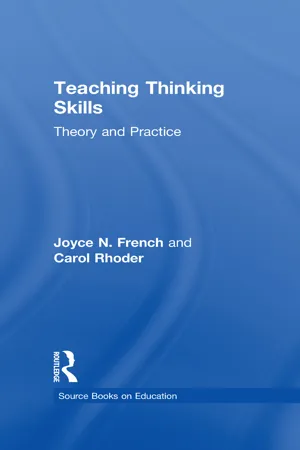
Bringing together theory and research on models of thinking, this work explores thinking skills, strategies, content, and results in depth, providing a framework for their application in the classroom. The authors highlight curriculum development, instructional procedures and assessment, professional roles and responsibilities, and teacher training. They also explore problem solving and critical and creative thinking, and current thinking skills programs. The bibliography includes works from 1980 to the present. Subject and author indexes are included.
Information
Annotated Bibliography
XIV
Bibliography
1. Adams, Marilyn Jager. “Thinking Skills Curricula: Their Promise and Progress.” Educational Psychologist 24 (Winter 1989): 25-77.
In this article, Adams reviews six thinking skills programs in terms of their transferability, accommodation of individual differences, and ease of use by teachers. She reviews three microlevel, generic programs: Feuerstein’s Instrumental Enrichment, Think, and Intuitive Math. She also reviews three macrolevel, content-tied programs: CoRT Thinking Materials, Philosophy for Children, and The Productive Thinking Program: A Course in Learning to Think.
Several important issues are discussed in the article: the organization of thinking skills programs, generic versus content-bound programs, and their benefits to low achievers. She reviews recent related research and theory and asserts that thinking skills should be taught generically, with practice in content to facilitate transfer. This is the only way, according to Adams, that a single, well integrated thinking schema can be developed, and only through such a schema can transfer take place. This is particularly important for low achieving students because teaching skills in content depends on amount of prior knowledge of the content and prior knowledge differs widely and is often deficient in low achievers.
Adams reviews the Odyssey program, which is a self-contained program teaching abstract generic skills, with practice in a variety of domains. Odyssey, according to Adams, is effective for a wide range of students, requires little teacher training and is inexpensive to implement. Assuming that thinking generates more thinking, she cites the need for longitudinal investigation of these programs.
2. Alexander, Patricia A., and Judith E. Judy. “The Interaction of Domain-Specific and Strategic Knowledge in Academic Performance.” Review of Educational Research 58 (Winter 1988): 375-404.
This article explores the relationship between domain knowledge and strategy use and the interactive effects of both on academic performance. The authors first present a comprehensive literature review with a discussion of their limitations. For example, young subjects (below 7th grade) are not usually studied; samples are especially small; criteria used to define experts versus novices are not consistent; baseline data on subjects are too general; content areas in which strategy use is investigated are not always clearly specified; and content used is not always directly related to classroom content. Additional concerns reflected by the authors include the lack of specificity and consistency within the strategies examined, conflicting interpretations and definitions of domain-specific and strategic knowledge, and methodological weaknesses such as poor design, invalid sampling procedures, and problems inherent in the use of verbal report data. In the last section of the article Alexander and Judy make several suggestions for future research on the domain knowledge-strategy use interaction.
3. Anderson, John R., James G. Greeno, Paul J. Kine, and David M. Neves. “Acquisition of Problem-Solving Skill.” Cognitive Skills and Their Acquisition. Edited by John R. Anderson. Hillsdale, New Jersey: Lawrence Erlbaum Associates, Pub., 1981, pp. 191-229.
The authors investigate general principles of learning and the specific nature of problem solving skill in geometry proofs. They include discussion of how a student plans and searches for a proof, how he learns from text by examples and definitions, how he uses what he knows to encode new information, transfers new knowledge into more useful, procedural form, and finally, uses new, procedural knowledge most efficiently. The authors provide a chart which gives a good overview of the learning processes involved in geometry problem solving.
4. Anderson, Thomas H., and Bonnie B. Armbruster. “Studying.” Handbook of Reading Research. Edited by P. David Pearson. New York: Longman, 1984, pp. 657-679.
The authors review the research on studying and relate it to other areas of educational and psychological theories and research. They discuss “state variables,” those aspects of studying related to the students and the materials such as knowledge of the criterion task and knowledge of the content itself. They also discuss processing variables or those aspects of studying related to the skills and strategies used to learn and remember the materials, such as focusing attention and encoding and retrieval strategies. They introduce the concept of “transfer appropriateness,” the ability to use the study strategy which requires the same or similar processing activities as those which are required in the criterion task.
5. Anderson, Valerie, and Suzanne Hidi. “Teaching Students to Summarize.” Educational Leadership 46 (December 1988/ January 1989): 26-28.
Anderson and Hidi review the different purposes for developing a summary, depending whether the summary is writer based or reader based. Both types require a selection and a reduction process. They provide specific suggestions for instruction beginning with the first purpose and moving to the second one. They stress the need to begin instruction in summarizing “from the earliest years of literacy” (p. 28).
6. Annis, Lind a Ferrill. “Student-Generated Paragraph Summaries and the Information-Processing Theory of Prose Learning.” Journal of Experimental Education 54 (Fall 1985): 4-10.
Annis reviews a study conducted to determine the effects of reading only, traditional notetaking, and paragraph summaries on Bloom’s six levels of cognitive learning. The three strategies produced the same results for the two lowest levels: knowledge and comprehension. The use of paragraph summaries was the most effective of the three at the application and analysis levels, perhaps because students had to stop frequently and put the text into their own words. The use of paragraph summaries was the least effective for the synthesis and evaluation levels. Annis suggests that because of the time constraint and because of the requirement that the students write an original response, they did not have the time or motivation to relate and evaluate information. She speculates that if the instructions given had emphasized the need to include these last two levels in the summaries, they might have been included. “This needs to be tested by further research” (p. 9).
7. Applebee, Arthur N. “Writing and Reasoning.” Review of Educational Research 54 (Winter 1984): 577-596.
Applebee argues that writing affects the ability to reason and think in general but that we have not yet developed a convincing research base to say so. He reviews recent literature on the process of writing and concludes that writing is a recursive process, that use of the process differs among individuals, and that the writing task affects the process itself. Applebee explores the relationship between writing and thinking and the ways in which current practice in writing instruction affects thinking. He concludes that we really know very little about the nature of the understanding that develops about a topic when we write about it. He suggests three areas for future research: the cultural effects of literacy, individual effects of writing on thinking and, finally, the interaction between classroom writing activities and instructional goals.
8. Arnold, Genevieve H., Alice Hart, and Karen Campbell. “Introducing the Wednesday Revolution.” Educational Leadership 45 (April 1988): 48.
Because of a need to develop children’s critical thinking skills, one school district initiated a program based on the ideas presented by Mortimer Adler in The Paideia Proposal Every child in the district participates in a Socratic seminar for two and a half hours each week, using quality literature as the basis for discussion. Parents are invited to participate.
9. Arrendondo, Daisy E., and Robert J. Marzano. “One District’s Approach to Implementing a Comprehensive K-12 Thinking Skills Program.” Educational Leadership 43 (May 1986): 28-30.
Arrendondo and Marzano describe the process of adapting Marzano’s thinking skills model to the needs and realities of one school district. The roll of local teachers and administrators is central in the process of decision-making, training and implementation. Learning-to-learn skills, content thinking skills, and reasoning skills are introduced in particular content areas and at particular grade levels but are “used, reviewed, and retaught as necessary throughout the curriculum” (p. 30).
10. Alter, Judith A., and Jennifer R. Salmon. Assessing Higher Order Thinking Skills. A Consumer’s Guide. Portland, Oregon: Northwest Regional Educational Laboratory, 1987.
Arter and Salmon review a number of tests designed to measure critical thinking, problem solving/decision making, creativity, achievement, and ability. In addition, they identify issues related to the assessment of higher order thinking and explore possibilities for assessment in the future. Finally, they provide detailed guidelines for choosing tests.
11. Baer, John. “Let’s Not Handicap Able Thinkers.” Educational Leadership 45 (April 1988): 66-72.
Baer strikes a note of caution concerning the rush to include thinking skills in the school curriculum since we still have unanswered questions in this field. Two such questions are addressed: Is thinking unconscious? Is thinking hardwired in our brains? According to Baer, thinking may be unconscious and occur without learning. He is particularly concerned with the possible negative effects of direct instruction in thinking skills and of self-reports of thinking processes on students who are already able thinkers. He suggests assessing students before instruction in a thinking skill and allowing for alternate thinking styles. In addition, he is concerned that we put too much emphasis on the thinking process with students who are effective thinkers even though they cannot articulate how they think. Baer proposes that thinking skill instruction take place in a separate course with skillful trained teachers with “infusion” by regular classroom teachers. (See entry 298.)
12. Baird, John R. and Richard T. White. “Improving Learning Through Enhanced Metacognition: A Classroom Study.” Paper presented at the Annual Meeting of the American Educational Research Association, New Orleans, April 23-27, 1984.40 pp. (ED 249 250)
This is a report of a metacognitive training study in 9th and 11th grade science classes which attempted to increase students’ knowledge of learning, awareness of their own learning, control over their learning through decision making, and improvement of attitudes toward learning. The training program demonstrated improvement in both learning and attitudes toward learning. Instructional implications are discussed.
13. Baker, John D. “Building Thinking Skills.” Developing Minds: A Resource Book for Teaching Thinking. Edited by Arthur L. Costa. Alexandria, Virginia: Association for Supervision and Curriculum Development, 1985, pp. 236-238.
Analytic and critical thinking skills are taught directly and sequentially in this program, using both words and graphics. The skills are presented with critical thinking building on the basic analytic skills of seeing similarities, sequencing, classifying and making analogies. The books in the series are intended to be used along with class discussion and verbalization of the thinking processes involved.
14. Baker, Paul J., and Louis E. Anderson. Teaching Social Problems Through Critical Reasoning. Washington, D. C.: American Sociological Association, 1983.
Baker and Anderson present a manual to be used in introductory courses in sociology and social problems. They identify three perspectives in social thinking: sociology, common sense and journalism. The course is designed to develop critical thinking that “transcends the three types of social knowledge” (p. ii). The application of critical reasoning to social problems includes: definition of the problem, assessment of evidence, determination of cause-effect relationships, clarification of value judgments, and assessment of logical consistency in stated solutions. Activities and materials are included which can be used to develop a course, which might be adapted to high school students.
15. Baldwin, Dorothy. “The Thinking Strand in Social Studies.” Educational Leadership 42 (September 1984): 79-80.
Using the taxonomies of Bloom and Sanders, teachers in a New Jersey school district are taught to incorporate all levels of thinking in their instruction. Through inservice programs, social studies teachers develop their own materials and approaches for including critical thinking, memorization and problem solving strategies in their courses. An example of the Thinking Strand from an eighth grade class is included.
16. Barbieri, Edmund L. “Talents Unlimited: One School’s Success Story.” Educational Leadership 45 (April 1988): 35.
Barbieri describes one lesson that illustrates the critical and creative thinking that is the focus of Talents Unlimited. The children are active agents in developing productive thinking, communication, forecasting, decision making, and planning. The lessons are developed by the teachers in this elementary school and are incorporated into the content areas.
17. Barbour, Nita H. “Can We Prepackage Thinking?” Childhood Education 65 (Winter 1988): 67-68.
Barbour expresses a number of concerns about using prepackaged programs to teach thinking. Teachers may not analyze the reasons for the lessons. Thus, in routinely following someone else’s plan, they will not provide a model of thinking themselves. The focus may be on steps and outcomes rather than on process. In order to teach thinking, teachers must view themselves as thinkers, and this may not happen with prepackaged programs. The author advocates open discussions, interesting experiences and play as ways to develop thinking in young children.
18. Barell, John, Rosemarie Liebmann, and Irving Sigel. “Fostering Thoughtful Self-Direction In Students.” Educational Leadership 45 (April 1988): 14-17.
Barell, Liebmann and Sigel highlight the importance of empowering students to become independent thinkers, able to set goals, identify their own problems, and find solutions, monitoring their progress as they go. The authors provide a number of practical suggestions drawn from classrooms on a variety of grade levels.
19. Baron, Joan Boykoff, and Bena Kallick. “What Are We Looking For and How Can We Find It?” Developing Minds: A Resource Book for Teaching Thinking. Edited by Arthur L. Costa. Alexandria, Virginia: Association for Supervision and Curriculum Development, 1985, pp. 281-287.
Baron and Kallick examine two approaches to assessing growth in thinking skills. The first is the use of standardized testing. They describe how the assessment of thinking skills has been incorporated into the Connecticut Assessment of Educational Progress and the Connecticut Mastery Test. In the second approach, classroom measures can provide much additional information. They suggest the use of student and teacher journals to record thinking, tape recordings of class sessions, interviews that focus on thinking, and the review of student work such as writings and drawings.
20. Baron, Jonathan. “What Kinds of Intelligence Components are Fundamental?” Thinking and Learning Skills. Research and Open Questions. Volume 2. Edited by Susan F. Chipman, Judith W. Segal, and Robert Glaser. Hillsdale, New Jersey: Lawrence Erlbaum Associates, Pub., 1985, pp. 365-390.
Baron uses the label “component” instead of “skill” because of its broader scope and includes processing components, strategies and styles in the discussion. He reviews the history of the research and development of each of these elements. He concludes that processing skills are probably not teachable. We need to examine both strategies and styles more closely, since these seem to hold the most potential.
21. Barton, Judy A. “Problem-Solving Strategies in Learning Disabled and Normal Boys: Developmental and Instructional Effects.” Journal of Educational Psychology 80 (1988): 184-191.
Barton’s study demonstrated differences between LDs and non LDs in the ability to use specific problem solving strategies. She studied older learning disabled and non-disabled students, (11 to 13 years old) and younge...
Table of contents
- Cover
- Title
- Copyright
- Dedication
- Contents
- Preface
- PART A: THEORIES OF THINKING
- PART B: THINKING IN SCHOOLS
- PART C: ANNOTATED BIBLIOGRAPHY
- AUTHOR INDEX
- SUBJECT INDEX
Trusted by 375,005 students
Access to over 1.5 million titles for a fair monthly price.
Study more efficiently using our study tools.
Frequently asked questions
Yes, you can cancel anytime from the Subscription tab in your account settings on the Perlego website. Your subscription will stay active until the end of your current billing period. Learn how to cancel your subscription
No, books cannot be downloaded as external files, such as PDFs, for use outside of Perlego. However, you can download books within the Perlego app for offline reading on mobile or tablet. Learn how to download books offline
Perlego offers two plans: Essential and Complete
- Essential is ideal for learners and professionals who enjoy exploring a wide range of subjects. Access the Essential Library with 800,000+ trusted titles and best-sellers across business, personal growth, and the humanities. Includes unlimited reading time and Standard Read Aloud voice.
- Complete: Perfect for advanced learners and researchers needing full, unrestricted access. Unlock 1.5M+ books across hundreds of subjects, including academic and specialized titles. The Complete Plan also includes advanced features like Premium Read Aloud and Research Assistant.
We are an online textbook subscription service, where you can get access to an entire online library for less than the price of a single book per month. With over 1.5 million books across 990+ topics, we’ve got you covered! Learn about our mission
Look out for the read-aloud symbol on your next book to see if you can listen to it. The read-aloud tool reads text aloud for you, highlighting the text as it is being read. You can pause it, speed it up and slow it down. Learn more about Read Aloud
Yes! You can use the Perlego app on both iOS and Android devices to read anytime, anywhere — even offline. Perfect for commutes or when you’re on the go.
Please note we cannot support devices running on iOS 13 and Android 7 or earlier. Learn more about using the app
Please note we cannot support devices running on iOS 13 and Android 7 or earlier. Learn more about using the app
Yes, you can access Teaching Thinking Skills by Carol Rhoder,Joyce N. French in PDF and/or ePUB format, as well as other popular books in Education & Education General. We have over 1.5 million books available in our catalogue for you to explore.