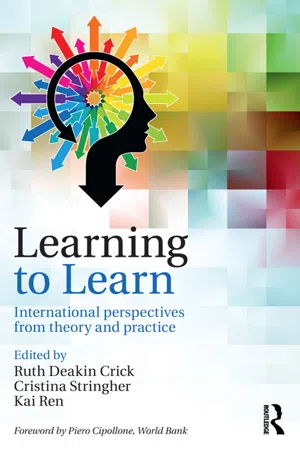
Learning to Learn provides a much needed overview and international guide to the field of learning to learn from a multidisciplinary lifelong and lifewide perspective. A wealth of research has been flourishing on this key educational goal in recent years. Internationally, it is considered to be one of the key competencies needed to compete in the global economy, but also a crucial factor for individual and social well-being. This book draws on leading international contributors to provide a cutting-edge overview of current thinking on learning to learn research, policy, and implementation in both formal and informal learning environments.
But what learning to learn is exactly, and what its constituting elements are, are much debated issues. These seem to be the crucial questions if assessment and development of this 'malleable side of intelligence' are to be accomplished. The approach of this volume is to consider a broad conception of learning to learn, not confined to only study strategies or metacognition, yet acknowledging the importance of such elements.
The book sets out to answer five main questions:
What is learning to learn?
What are its functions and how do we assess it?
What does it promise to the individual and society at large?
How is it conceived in national curricula internationally?
How can it be developed in a variety of contexts?
The text is organized into two parts: the first addresses the core question of the nature of learning to learn from a theoretical and policy viewpoint, and the second presents recent research carried out in several educational systems, with special attention to assessment and curriculum. It gives an account of pedagogical practices of learning to learn and its role in individual empowerment from childhood to adulthood.
Contributors also highlight the potential use of learning to learn as an organizing concept for lifelong learning, school improvement, and teacher training along with potential conflicts with existing incentive practices and policies.
This book is a vital starting point and guide for any advanced student or researcher looking to understand this important area of research.
Learning to learn has become a widely debated issue, both politically and among the international scientific community, yet confusion remains about the difference between learning and learning to learn. Furthermore, in the scientific literature there is little agreement concerning definitions of the latter concept. The aim of this chapter, therefore, is to describe learning to learn and identify its features through definitions taken from the literature. The ultimate goal is to provide a sound theoretical basis for the further study of learning to learn from an empirical perspective and for more precise use of this notion in diverse learning settings. The methodology is a literature review yielding 40 definitions from 90 studies examined. Other products of these analyses on learning to learn (including a concept map and a list of practical functions leading eventually to a meta-definition and a process and output model) are based upon subsequent elaboration of this material, and reference to international literature on learning to learn and to Maria Montessori’s works.
Key words: learning to learn conceptual definition, components, functions.
Introduction
The first chapter in any scientific endeavour is generally devoted to defining the topic sharply and describing it according to a chosen perspective. In our case, this is not an easy task. It could be argued that learning to learn is not strictly a scientific concept, but rather involves politics and this is the first difficulty when trying to develop a definition. Second, confusion remains about the difference between learning and learning to learn. From a practitioner’s and student’s perspective (experts, primary school children, graduate students, and teachers), it is clear that learning to learn cannot be easily disentangled from the concept of learning. Some individuals appear unable to conceive of the two different concepts: this is especially true for school children, but not only them, and this is no coincidence, as I will explore here.
One aim of the chapter, therefore, is to describe learning to learn through definitions taken from the literature and to identify those characteristics that contribute to a meta-definition,1 in an attempt to introduce the reader to concepts that will be analysed throughout this book. A more ambitious aim is to contribute some degree of order in learning to learn theory, avoiding reducing it to an umbrella term for all purposes: this reductionist position could take the scientific power away from a potentially powerful concept.2 However, the complexity of this task is evident not only for the wide disparity of definitions to be found in the literature, but also considering that any meaning associated with learning to learn derives from how learning is conceptualized.
The scale of the challenge is evident in Moseley and colleagues’ (2005) review, which incorporates 41 different frameworks or ways of understanding thinking and learning. However, learning to learn deserves an analysis of its own, since there seems to be little agreement about what it is and what it does. One way to achieve this discrete analysis is to present an account of learning to learn by identifying its features and providing a concept map, a list of its practical functions leading eventually to a definition and a conceptual model. The ultimate goal here is to provide a sound theoretical basis for the further study of learning to learn from an empirical perspective.
Let us start our journey with an overview of objectives attributed to learning to learn from different sources, some policy-led and others scientific. In 2010, the OECD published PISA 2009 Results: Learning to learn – Student engagement, strategies and practices (Vol. III). The opening line of its foreword states that ‘One of the ultimate goals of policy makers is to enable citizens to take advantage of a globalised world economy’ (OECD, 2010: 3). The authors maintain that
devising effective education policies will become ever more difficult as schools need to prepare students to deal with more rapid change than ever before, for jobs that have not yet been created, to use technologies that have not yet been invented and to solve economic and social challenges that we do not yet know will arise … Success will go to those individuals and countries that are swift to adapt, slow to complain and open to change.
(OECD, 2010: 5)
In the same volume, the authors focus on those policies that may enhance students’ reading competence and identify learning to learn as one of the keys to success. However, they do not define learning to learn and this phrase is used only in the title of the publication, with an attributed meaning ranging from learning ‘motivation’ and ‘engagement’, to ‘study strategies’ and ‘approaches to learning’.3
It is widely accepted that empowering young people by creating favourable conditions for them to develop their skills so that they can work and participate actively in society is essential for the sound economic and social development of any country. In a context of globalization, knowledge-based economies, and ageing societies, every young person must be given the opportunity to fulfil his or her potential (European Commission, 2007: 1). Therefore, it is clear why learning to learn has been included among the eight key competences by the European Parliament (2006).
Political interest at the European level matches and follows worldwide scientific interest in the concept of learning to learn: dozens of researchers have variably defined and explored it, sometimes from very different epistemological backgrounds, accounting for the diversity of approaches and the resulting interdisciplinarity (Bateson, 1977; Hounsell, 1979; Candy, 1990; Collett, 1990; Gibbons, 1990; Smith, 1990; Boekaerts, 1999; Hautamäki et al., 2002; Deakin Crick et al., 2004). Jules Henry (cited in Smith, 1990) states that learning to learn has been and still is humans’ essential evolutionary task. Similarly, Edgar Morin (2001) maintains that knowledge of one’s knowledge is a prerequisite for clarity of mind. Moreover, knowledge of one’s knowledge, which implies the integration of the knowers with their own knowledge, is a necessary principle for education. We need negotiation and reciprocal controls between our own mind and our own ideas in order to allow reflexivity and to avoid reasoning pitfalls (Morin, 2001: 11, 31–33).
According to Goleman (1999), the most basic knowledge of all is that of knowing how to learn. This opinion is shared by many scholars who refer to it as not only a concept, but an educational objective (Tuijnman & Van Der Kamp, 1992), the most secure foundation for lifelong learning (James et al., 2007: 29), a fundamental competence, just like numeracy or literacy (European Commission, 2003), the most urgent item on the agenda together with educational reform for the development of people (Candy, 1990), and even an ultimate life skill for the twenty-first century (Burgogne, 1998, cited in Carr & Claxton, 2002, 9). Candy (1990), however, warns the reader not to make learning to learn a slogan in danger of losing its power through overuse. Twelve years after Candy, Coffield adds to this warning, stating that for too long learning to learn remained an empty expression, a vacuum slogan especially when – notwithstanding its unanimous utility – there is no consensus on its definition (Coffield, 2002).
In this chapter, I present a detailed account of methodological choices guiding this research, the products of the analysis of learning to learn definitions and models, along with a meta-definition and a concept map of the components of learning to learn. Together, these contribute to the construction of a process and output model, also discussed here. Provisional conclusions point to the need to synthesize this knowledge in a coherent learning to learn theory, which, I will argue, is preliminary to any empirical study of this notion. This work on a definition of learning to learn and learning to learn modelling is the basis for improving the assessment of learning to learn and for more precise use of this notion in diverse learning settings.
Methodology
The Campaign for Learning initiative in the UK recently published a review on learning to learn (Amalathas, 2010). The author maintains that ‘some components of learning to learn may be found outside learning to learn models’ (Amalathas, 2010: 6), rendering the concept partial or flawed. This is not the view of this chapter: the search for definitions and components of learning to learn can be made within learning to learn research and models, provided one searches for studies dealing with a ‘wide concept’4 of learning to learn. The methodology used here is a qualitative review of worldwide literature with a comparative analysis of four major learning to learn models and 40 definitions from 90 contributions examined, accounting for a diachronic representation of learning to learn studies to date.
The literature review was based on the University of London’s EPPI Centre process for systematic reviews of evidence. Major sources include the EPPI Centre, the Eric Database, the British Educational Index and other Ebsco databanks, together with a number of university and research centre web sites, Italian resources, and international journals available electronically.5 The study was organized around one key question: How exactly is learning to learn defined? Sub-questions were concerned with how it is described in the literature: (a) What words/locutions can be considered synonyms for learning to learn? (b) What are its features, dimensions, components, and functions? (c) Is it possible to model them?
The literature search was carried out using the following key words: learning to learn, learning competence/competency, learning how to learn, learning power, learning about learning, independent learning, understanding learning, improving own learning, learning strategies, metacognitive learning strategies, learning-to-learn skills, study skills, ability to learn, and self-regulated learning. The initial search of these key words produced a total of 37,064 documents, which were screened with finer searches. This selection was performed by combining key words, the reading of titles, verification of the occurrence in the title of the words ‘learning to learn’ and not just ‘learning’, and availability of studies. In this way, 212 documents were identified for further scrutiny.
The schema shown in Fig. 1.1 provides an overview of the initial literature search: in the large oval, key words used to interrogate search engines have been grouped. Literature that was of policy versus academic origin was examined. Psycho-sociological fields contributing to learning to learn are highlighted in the smaller ovals, while in the background or at the core of each field lies evaluation and assessment studies in formal education.
Figure1.1 Schema for the initial literature search.
The 212 documents identified in the previous phase were further scrutinized through reading of abstracts. This resulted in 90 studies, mostly theoretical in nature, dealing specifically with the target topic. Of these, 40 were incorporated in...
Table of contents
Cover Page
Half Title Page
Title Page
Copyright Page
Table of Contents
List of figures, tables, and boxes
List of contributors
Foreword
Acknowledgements
Introduction
Part I Theory
Part II International research and practice
Index
Trusted by 375,005 students
Access to over 1.5 million titles for a fair monthly price.
Study more efficiently using our study tools.
Frequently asked questions
Yes, you can cancel anytime from the Subscription tab in your account settings on the Perlego website. Your subscription will stay active until the end of your current billing period. Learn how to cancel your subscription
No, books cannot be downloaded as external files, such as PDFs, for use outside of Perlego. However, you can download books within the Perlego app for offline reading on mobile or tablet. Learn how to download books offline
Perlego offers two plans: Essential and Complete
Essential is ideal for learners and professionals who enjoy exploring a wide range of subjects. Access the Essential Library with 800,000+ trusted titles and best-sellers across business, personal growth, and the humanities. Includes unlimited reading time and Standard Read Aloud voice.
Complete: Perfect for advanced learners and researchers needing full, unrestricted access. Unlock 1.5M+ books across hundreds of subjects, including academic and specialized titles. The Complete Plan also includes advanced features like Premium Read Aloud and Research Assistant.
Both plans are available with monthly, semester, or annual billing cycles.
We are an online textbook subscription service, where you can get access to an entire online library for less than the price of a single book per month. With over 1.5 million books across 990+ topics, we’ve got you covered! Learn about our mission
Look out for the read-aloud symbol on your next book to see if you can listen to it. The read-aloud tool reads text aloud for you, highlighting the text as it is being read. You can pause it, speed it up and slow it down. Learn more about Read Aloud
Yes! You can use the Perlego app on both iOS and Android devices to read anytime, anywhere — even offline. Perfect for commutes or when you’re on the go. Please note we cannot support devices running on iOS 13 and Android 7 or earlier. Learn more about using the app
Yes, you can access Learning to Learn by Ruth Deakin Crick, CRISTINA STRINGHER, Kai Ren, Ruth Deakin Crick,CRISTINA STRINGHER,Kai Ren in PDF and/or ePUB format, as well as other popular books in Education & Adult Education. We have over 1.5 million books available in our catalogue for you to explore.