This straightforward introduction to audio techniques guides the beginner through principles such as sound waves and basic acoustics and offers practical advice for using recording and reproduction equipment. Previously known as Audio Explained, this latest edition includes new material on: reverberation and its use in recording; principles of digital mixing; digital recording; including MiniDisc and MP3; digital artificial reverberation.
Designed with the student in mind, information is organised according to level of difficulty. An understanding of the basic principles is essential to anyone wishing to make successful recordings and so chapters are split into two parts: the first introducing the basic theories in a non-technical way; the second dealing with the subject in more depth. Key facts are clearly identified in separate boxes and further information for the more advanced reader is indicated in shaded boxes. In addition, questions are provided (with answers supplied at the end of the book) as a teaching and learning aid.
Sound Engineering Explained is ideal for both serious audio amateurs any student studying audio for the first time, in particular those preparing for Part One exams of the City & Guilds Sound Engineering (1820) course.
- 216 pages
- English
- ePUB (mobile friendly)
- Available on iOS & Android
eBook - ePub
Sound Engineering Explained
About this book
Information
Sound waves
DOI: 10.4324/9780080498171-1
Part 1
Some initial knowledge of sound waves is essential if later chapters are going to be fully meaningful. The following is a brief outline of their most important properties. Scientific facts and figures are set out in Part 2 at the end of this chapter for those who may find them useful or interesting.
What are sound waves?
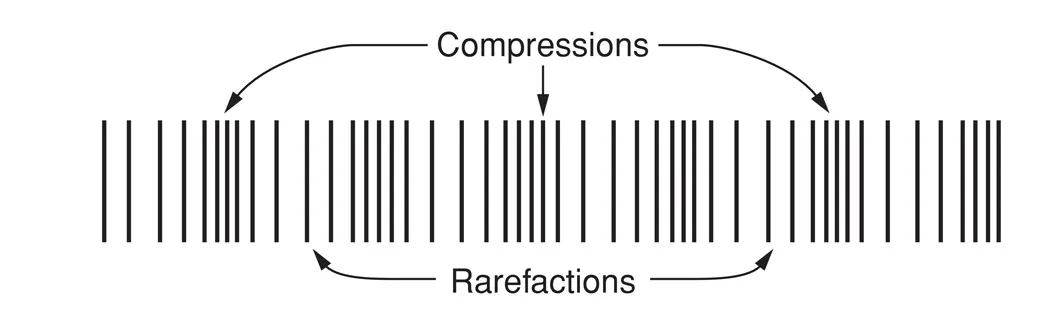
They are described as waves of compression and rarefaction in the air. This means that when sound waves travel past a fixed point the atmospheric pressure at that point goes slightly above and below the steady barometric pressure. But these fluctuations are far too small and far too rapid ever to be registered by a barometer. A microphone, on the other hand, can be thought of as a kind of extra-sensitive electrical barometer capable of detecting these rapid fluctuations in the air pressure, unlike a normal barometer, which can only indicate relatively slow pressure changes. Figure 1.1 shows what a sound wave would look like if we could see it.
Definitions
- Compression – a region where the air is compressed. In sound waves the compression is very small indeed.
- Rarefaction – the opposite of a compression. The air pressure is slightly lower than normal.
- ‘Steady barometric pressure’ – the normal air pressure of the atmosphere.
There is a compression where the lines are closest together and a rarefaction where they are widely spaced. Waves of this sort are called longitudinal waves. The waves we see in water, for instance, are called transverse waves because the individual bits (molecules) of the water move up and down when the wave goes horizontally. In longitudinal waves, like sound, the air molecules oscillate from side to side.
Despite the fact that sound waves are longitudinal, we always draw them like transverse waves – it's much easier!
Frequency
This is the number of waves emitted, or received, in one second. Up to the 1950s, frequency was expressed in English-speaking countries as so many cycles per second (c.p.s. or c/s), but this has been replaced by the hertz, to commemorate the name of the German physicist, Heinrich Hertz (1857–1894), who was associated with early work in radio waves. The abbreviation is ‘Hz’. This unit is commonly encountered in the home on mains-powered equipment, where the specified frequency of the supply in most of Europe is 50 Hz.
The normal human ear can detect sound wave frequencies in the range from approximately 16 Hz to about 16 kHz (kHz = kilohertz, or thousand hertz – 16 kHz is 16 000 Hz). The ear's response to sound will be dealt with more fully in Chapter 2.
Related to frequency is period – the time duration of one cycle. It is equal to 1/f.
Wavelength
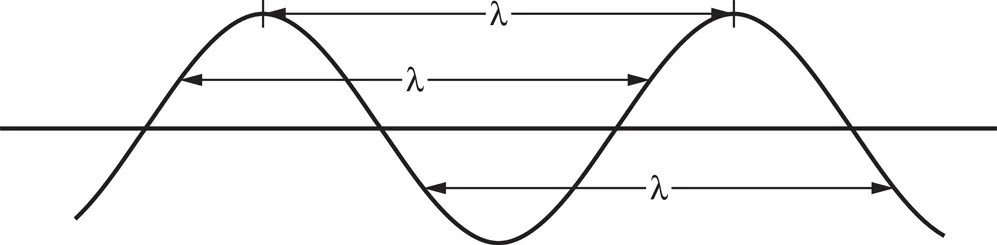
With any wave the distance between corresponding points on successive waves is termed the wavelength. The symbol used for wavelength is the Greek letter λ (pronounced ‘lambda’).
Amplitude
This is the ‘height’ of the wave in whatever units are most convenient – in electrical work, for example, the amplitude could be expressed in volts or amperes.
The velocity of sound waves
In the air, under normal conditions, sound waves travel at about 340 metres per second (m/s). This is close to 760 miles/hour, or about 1120 feet/second. The velocity varies slightly with air temperature, which is why players of wind instruments need, literally, to warm up their instruments, as the pitch depends on the speed with which sound waves oscillate within the instrument. For most practical purposes, apart from the instance just quoted, the variation in sound wave velocity with temperature is unimportant. Details are given in Part 2 of this chapter. The symbol for sound wave velocity is, in this book, v.
Sound waves travel in air at about 340 m/s, i.e. v = 340 m/s.
Velocity, frequency and wavelength
These three things are linked by an important, but fortunately simple, formula. A moment's thought will show that if, say, 1000 waves per second are being emitted from a source (i.e. the frequency is 1 kHz) and each has a wavelength of λ, then after one second the first waves emitted will be 1000 × λ away. Or, their velocity is 1000 × λ metres per second.
What we've done is to multiply the frequency by the wavelength to arrive at the velocity:
Important
Writing this another way:
Putting 340 m/s as the velocity and 1000 Hz as the frequency we have
It should be fairly obvious that if the frequency is doubled (to 2 kHz) then the wavelength is halved (to 17 cm) and so on. Simple calculations along these lines will show that the lowest frequency the normal ear can detect – 16 Hz – corresponds to a wavelength of about 21 m (70 feet), while at the highest frequency, around 16 kHz, the wavelength is about 2 cm, or rather less than one inch.
We shall see in the next two sections that this vast range of wavelengths presents problems in many sound recording situations, as the degree to which sound waves are reflected or bent round obstacles depends critically on the wavelength.
Sound waves and obstacles
Everyone is familiar with echoes – sounds being reflected from a large building or a cliff. What is perhaps not so obvious is that for this reflection to occur to any significant effect the sound wavelength must be smaller than the dimensions of the reflecting object. For example, the side of a building might be 10 m high and 20 m long. Sounds striking this building at right angles will be reflected if their wavelength is less than 10 m – that is, f...
Table of contents
- Cover Page
- Half Title Page
- Title Page
- Copyright Page
- Contents
- Preface
- Acknowledgements
- About this book
- 1 Sound waves
- 2 Hearing and the nature of sound
- 3 Basic acoustics
- 4 Microphones
- 5 Using microphones
- 6 Monitoring
- 7 Stereo
- 8 Sound mixers
- 9 Controlling levels
- 10 Digital audio
- 11 Recording
- 12 Public address
- 13 Music and sound effects
- 14 Safety
- Copyright
- Miscellaneous data
- Further reading
- Answers
- Index
Trusted by 375,005 students
Access to over 1.5 million titles for a fair monthly price.
Study more efficiently using our study tools.
Frequently asked questions
Yes, you can cancel anytime from the Subscription tab in your account settings on the Perlego website. Your subscription will stay active until the end of your current billing period. Learn how to cancel your subscription
No, books cannot be downloaded as external files, such as PDFs, for use outside of Perlego. However, you can download books within the Perlego app for offline reading on mobile or tablet. Learn how to download books offline
Perlego offers two plans: Essential and Complete
- Essential is ideal for learners and professionals who enjoy exploring a wide range of subjects. Access the Essential Library with 800,000+ trusted titles and best-sellers across business, personal growth, and the humanities. Includes unlimited reading time and Standard Read Aloud voice.
- Complete: Perfect for advanced learners and researchers needing full, unrestricted access. Unlock 1.5M+ books across hundreds of subjects, including academic and specialized titles. The Complete Plan also includes advanced features like Premium Read Aloud and Research Assistant.
We are an online textbook subscription service, where you can get access to an entire online library for less than the price of a single book per month. With over 1.5 million books across 990+ topics, we’ve got you covered! Learn about our mission
Look out for the read-aloud symbol on your next book to see if you can listen to it. The read-aloud tool reads text aloud for you, highlighting the text as it is being read. You can pause it, speed it up and slow it down. Learn more about Read Aloud
Yes! You can use the Perlego app on both iOS and Android devices to read anytime, anywhere — even offline. Perfect for commutes or when you’re on the go.
Please note we cannot support devices running on iOS 13 and Android 7 or earlier. Learn more about using the app
Please note we cannot support devices running on iOS 13 and Android 7 or earlier. Learn more about using the app
Yes, you can access Sound Engineering Explained by Michael Talbot-Smith in PDF and/or ePUB format, as well as other popular books in Technology & Engineering & Music Theory & Appreciation. We have over 1.5 million books available in our catalogue for you to explore.