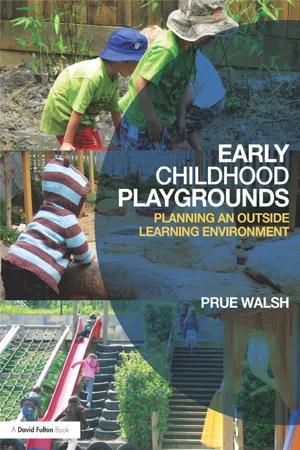
The outdoor play environment has an integral role to play in a child's learning across the pivotal early childhood years. An outside space that is well designed allows for enriching, stimulating and challenging play experiences that meet children's ongoing developmental needs. Early Childhood Playgrounds provides a step-by-step guide to planning, designing and creating an outdoor learning environment for young children.
Written by an experienced practitioner that has consulted on over 2000 early childhood settings and schools internationally, this book considers all aspects of the outdoor learning environment and provides practical support on:
planning procedures and ideas for designs;
a wide variety of play within a playground through the inclusion of quiet, open and active play areas;
stimulating and challenging play;
a natural environment that will provide interest and sustainability;
spaces for toddlers and babies;
playground needs for children with additional needs.
This book will be fascinating reading for those studying early childhood and practitioners looking into the ways and means of setting up, improving or expanding their outdoor play facilities. It is also geared towards other disciplines, making it an essential guide for architects and planning professionals wanting to gain a greater understanding of play and the vital role it takes in meeting children's needs and development.
The reduction in outside play is a feature of life for children living in developed countries in the twenty-first century, and there is deep concern about the consequences this change will have for child development (for example, see Moss 2012). This book acknowledges that there is a context of a general angst around the lack of outdoor play, and provision for outdoor play, but focuses solely on outdoor play spaces attached to children’s centres, nurseries and other early childhood facilities. As more and more children continue to live in urban areas, some children’s only real sensory experience of outdoor play will be at the playground attached to one of these facilities. Ensuring a high quality outdoor play experience across all centres is critical to providing a level playing field for children in their early years. These spaces need to be thought about and designed differently to a playground in a public park, which would normally cater for a much wider range of ages.
This idea is not new. In 1977 Sybil Kritchevsky and Elizabeth Prescott wrote that:
The higher the quality of space in a centre, the more likely were teachers to be sensitive and friendly in their manner toward children, to encourage children in their self-chosen activities, and to teach consideration for the rights and. feelings of self and others. Where spatial quality was low, children were less likely to be involved and interested, and teachers more likely to be neutral or insensitive in their manner, to use larger amounts of guidance and restriction, and to teach arbitrary rules of social living.
Despite the importance of these spaces, there are clear signs that they are failing to meet children’s needs and are the ‘forgotten spaces’ which are poorly understood when it comes to designing an early childhood centre.
There are a number of reasons to be concerned. First, as intimated above, children’s safety has become a prime consideration in the developed world. This anxiety has leached into playground design. The outcome in practice has been an over-zealous approach to safety that limits children’s play and is holding back their development.
Rather than seeking to eliminate risk in play – which is as impossible to achieve as devising a risk-free life – a better approach would be to seek a balance, where children’s developmental needs are put first. The British play experts David Ball, Tim Gill and Bernard Spiegal (2012) put it like this:
Risk management in play provision involves balancing risks and benefits in a strategic way. Since the reason for providing play opportunities is their benefit to children and young people, the starting point – the most important consideration – for risk assessment and decision-making should be an understanding of the benefit that the provision offers.
Nowhere is this approach needed more than the early childhood years when children are at their peak period of laying the foundations of their life skills and will extend, fine-tune and master all areas of their development. Injury data within Australia and elsewhere has shown that the peak period of injuries occur with newly mobile toddlers who have just mastered their upright position, are extending and developing their perceptions of space, have an overriding curiosity and discovery, and are seeking but not always knowing how to develop friendships.
Throughout early childhood, children use play to master overall body coordination, to learn to fit in with other children, and to pursue challenges and enjoy the satisfaction of achieving new skills. An element of risk taking is integral to all these aspects of development.
And yet, in Australia and other parts of the developed world, playground design has been increasingly driven by what appear to be commercial and litigation interests that have exploited underlying anxieties around risk and safety, and been counterproductive and harmful to meeting children’s needs through play.
Australia’s National Injury Surveillance system was set up in 1988. Early childhood playgrounds were found to have a low number of injuries and were therefore not prioritised for further analysis or in-depth research. Unfortunately, rather than being used as an enabling information source, the data gathered for all playgrounds has been used as a justification for imposing unnecessary restrictions on early childhood play spaces.
Regrettably, this has tended to be driven by a fear of litigation rather than a proper assessment of children’s play needs. The outcome has been restrictive playgrounds that inhibit play and a denial to children of the benefits of enriching – and, yes, risk-taking – outdoor play. As Tom Jambor writes: ‘We have technically done a fine job of setting national guidelines to make children’s playgrounds safer. But, in the process we have factored out the play value, especially with regard to challenge needs.’ (Jambor 1996).
An overemphasis on safety rather than a careful management of risk is not the only threat to children’s outside play spaces. The price of land, escalating building costs and poorly sited centres on non-standard sites has meant that the outdoor play space is too often treated as a poor afterthought. This is indicative of little understanding of children’s needs and what they actually require to thrive in outdoor spaces. The consequence is cramped, poorly designed spaces that fail to provide a suitable environment for young children to develop and thrive. Too often they end up with play pens rather than playgrounds!
The combination of safety concerns and increasing constraints on spatial provision has markedly constrained the diversity of play opportunities being provided in outdoor play spaces, with consequences including less focused and more antisocial play.
And yet, this is not the whole story. Since the publication of the first edition of Early Childhood Playgrounds in 1988 much has been learned about the value of play for children’s development, and the importance of outdoor spaces to help enable this. Concern about the lack of access of children to nature – expressed most cogently by Richard Louv (2005) with his notion of ‘nature deficit disorder’ – has tapped into deep-seated parental anxieties about over-exposing children to technology and sedentary activities at the expense of outdoor play.
There are also some outstanding examples of outside learning environments in children’s centres to counter the poor provision criticised above. The photos in this book highlight what is possible. These play spaces are designed to reflect the needs of the children who use them, as well as responding positively to the opportunities and constraints of the site where they are located. Crucially, they reflect a multidisciplinary approach that recognises the importance of putting children’s needs first and incorporating early childhood expertise from the start.
Creating generous outside play spaces that put children’s needs at their heart should be seen as an investment that will reap dividends. Play is critical to the overall rounded development of children, who will become the adults of the future. It is therefore essential that substantial, inspiring and well designed outdoor play spaces are provided to compensate for the lost fields, open pathways and large back gardens of past eras.
1.2 Why outdoor play is important
An effective early childhood centre playground is an area of constant daily use during the prime developmental years of a child’s life, and will be the setting for a high degree of focused, concentrated play. For many children it will be their main outdoor experience during the most formative years of their life.
However, too often playgrounds are designed by adults without the experience or real understanding of working with children and the evolving depth of knowledge of children’s play and developmental needs and the type of environment required. As Roger Hart puts it: ‘Most people who care about child development know nothing about design, and most people who know design know nothing about child development’. (Roger Hart quoted in Ruppel Shell, 1994.)
To meet the developmental needs of young children, it is essential that play spaces are flexible, adaptable and sensory rich spaces set in a framework of space that will allow for a degree of evolving change and the spatial provision to allow this to occur. These principles not only come from practice, but are endorsed by the work of the Russian developmental psychologist, Lev Vygotsky, who emphasised that each child has a ‘zone of proximal development’. In practice, this means providing spaces that act as a supportive framework for child development through play, that have a range of different play spaces within an adaptable setting, with a dominance of natural environments and adaptable settings will provide the flexibility needed to keep the ongoing process of stimulation and arousal of interest in play maintained.
Figure1.1 What not to do – poor site selection and planning: an example of a narrow site with insufficient outdoor space
For the provision of play spaces to be effective, the design must be based on an understanding of children’s play and developmental needs. If a designer truly uses this premise as her or his starting point, then the space will look different from most adult perceptions of outdoor play spaces, such as most public playgrounds.
Each chapter in this book summarises the specific play and developmental needs that the different play areas should aim to fulfil. Early childhood educators and designers should remind themselves constantly of why outdoor play is fundamental for children, apart from the simple right that they have to play because it is what they want and need to do. Play helps children improve their:
cognitive development (including language skills, problem solving and independent learning skills, self-efficacy, gaining perspective, representational skills, memory and creativity);
physical health and development (including physiological, cardiovascular and fine and gross motor skills development as well as increased physical activity);
mental health, happiness and emotional wellbeing (including building confidence, improved child–parent attachments, coping with stress, tackling anxieties and phobias, aiding recovery in therapeutic contexts, and alleviating the symptoms of ADHD for some children);
social development (including working with others, sharing, negotiating and appreciating others’ points of view);
risk management and resilience through experiencing and responding to unexpected, challenging situations.
(The Play Return by Tim Gill (2014) for the Children’s Play Policy Council)
1.3 Designing outdoor play spaces for children
The design characteristics that underpin an effective playground are listed below. They are geared specifically to running an early childhood programme and meeting the developmental needs of children. Incorporation of space combined with paying attention to these design characteristics will assist in sustaining children’s interest and empower them in their play-learning. A safe environment is crucial, but this does not need to be at the expense of providing a stimulating outdoor play space. It is also worth remembering that:
No playground is achieved by play apparatus alone, however well thought through it may be. This is often forgotten, and it may well be this very forgetfulness that is the cause of our failur...
Table of contents
Cover Page
Half Title Page
Title Page
Copyright Page
Table of Contents
Acknowledgements
Permissions
Preface
1 Setting the scene
2 Planning an outside learning environment
3 General planning and design considerations
4 Natural play areas
5 Quiet play areas
6 Open play areas
7 Active play areas
8 Loose parts
9 Playgrounds for toddlers and babies
10 Playgrounds for children with special needs
Bibliography
Index
Trusted by 375,005 students
Access to over 1.5 million titles for a fair monthly price.
Study more efficiently using our study tools.
Frequently asked questions
Yes, you can cancel anytime from the Subscription tab in your account settings on the Perlego website. Your subscription will stay active until the end of your current billing period. Learn how to cancel your subscription
No, books cannot be downloaded as external files, such as PDFs, for use outside of Perlego. However, you can download books within the Perlego app for offline reading on mobile or tablet. Learn how to download books offline
Perlego offers two plans: Essential and Complete
Essential is ideal for learners and professionals who enjoy exploring a wide range of subjects. Access the Essential Library with 800,000+ trusted titles and best-sellers across business, personal growth, and the humanities. Includes unlimited reading time and Standard Read Aloud voice.
Complete: Perfect for advanced learners and researchers needing full, unrestricted access. Unlock 1.5M+ books across hundreds of subjects, including academic and specialized titles. The Complete Plan also includes advanced features like Premium Read Aloud and Research Assistant.
Both plans are available with monthly, semester, or annual billing cycles.
We are an online textbook subscription service, where you can get access to an entire online library for less than the price of a single book per month. With over 1.5 million books across 990+ topics, we’ve got you covered! Learn about our mission
Look out for the read-aloud symbol on your next book to see if you can listen to it. The read-aloud tool reads text aloud for you, highlighting the text as it is being read. You can pause it, speed it up and slow it down. Learn more about Read Aloud
Yes! You can use the Perlego app on both iOS and Android devices to read anytime, anywhere — even offline. Perfect for commutes or when you’re on the go. Please note we cannot support devices running on iOS 13 and Android 7 or earlier. Learn more about using the app
Yes, you can access Early Childhood Playgrounds by Prue Walsh in PDF and/or ePUB format, as well as other popular books in Education & Urban Planning & Landscaping. We have over 1.5 million books available in our catalogue for you to explore.