The New Labour Government puts Education, Education, Education at the heart of its agenda but is it doing enough to combat educational disadvantage?
Combating Educational Disadvantage sets the discussion of educational disadvantage within the socio-political context of the 1980s and 1990s, with its market philosophy in education and brings together the contributions of leading writers and researchers of international standing.
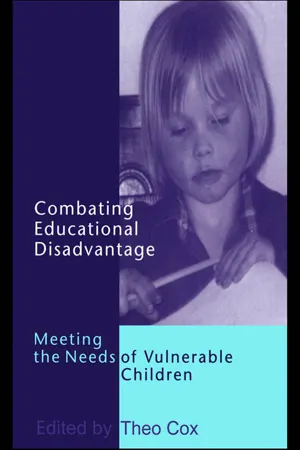
eBook - ePub
Combating Educational Disadvantage
Meeting the Needs of Vulnerable Children
- 304 pages
- English
- ePUB (mobile friendly)
- Available on iOS & Android
eBook - ePub
About this book
Information
1 Introduction
Theo Cox
Who Are the Disadvantaged?
There is now a vast literature on the causes, consequences and remedies for disadvantage, particularly in the USA but, increasingly in Britain, Europe and the various Organization for Economic Co-operation and Development (OECD) countries. There is a confusing variety of terms used as descriptors of disadvantage, such as deprivation (whether social, cultural or educational), inequality, at riskand, most recently, social exclusion. As Kellaghan et al. (1995) point out such terms are often used as if they were equivalent in meaning and this interchangeability may reflect the fact that educational disadvantage is a complex phenomenon resulting from the interaction of deep-seated economic, social and educational factors. This complexity is well represented in the present volume in which the contributing authors have chosen to discuss those aspects of disadvantage which are of particular concern to them.
A helpfully clear discussion of various definitions of disadvantage is provided by Natriello et al. (1990). After discussing the earlier use of terms such as ‘culturally deprived’ which aroused much controversy, they refer to the recent emergence of the term ‘at risk’, commenting that (perhaps like previous terms) it appears to mean different things to different observers. Despite this a general theme running through uses of this term is a future orientation, referring to students who may be more likely to experience problems at some point in the future, but with an emphasis on early identification before these problems become manifest. They further assert that, by defining the disadvantaged population as having characteristics that make it susceptible to certain environmental conditions, we can avoid the conflict over whether the problem is located in the students’ families, community circumstances or their schools. On the negative side there is the risk that, while early identification can lead to appropriate educational or other provision being made for the students concerned, it also carries the danger of derogatory labelling and the creation of self-fulfilling prophecies resulting from lowered expectations of pupil performance. In another useful discussion of the concept of ‘at risk’ Evans (OECD, 1995) argues that it becomes an optimistic one if it moves the debate forward by recognizing the transactional nature of much learning. In the educational context this means that the right educational experiences over time can help to compensate for disadvantage and optimize the chances for success for all pupils.
Natriello et al. (op cit.) go on to offer a definition of educational disadvantage which borrows from earlier definitions but places it within an emerging understanding of education as a process that takes place both inside and outside of schools, i.e. within the family and the community as well as in formal education. Their definition is as follows:
Students who are educationally disadvantaged have been exposed to insufficient educational experiences in at least one of these three domains. While the first awareness of the consequences of such experiences may surface in the schools where student performance is formally assessed, the source of the problem may rest with the school and/or with the family and the community in which the student is reared.
(Natriello et al., 1990, see page)
The term ‘at risk’ was defined by the OECD in a recent review of research, policy and practice in the area of disadvantage as follows:
The term ‘at risk’ refers to children and youth who are in danger of failing at school, or in making a successful transition to work. Educational, social and vocational failure are predicted by a range of factors, including: poverty, ethnic status, family circumstances, language, type of school, geography and community.
Thus the term ‘at risk’ refers in a general sense to children and youth from disadvantaged backgrounds.
(Day et al., 1997, see page)
This definition overlaps with that of Natriello et al. but is more comprehensive in scope and, as such, was communicated to all of the contributing authors of the present volume, although without any intention on the Editor’s part of constraining their individual perspectives on disadvantage.
Although the term ‘at risk’, historically, has been used much more in the medical than an educational context in Britain it did actually feature strongly in the work of one of the units of the Schools Council Research and Development Project at University College Swansea (now the University of Wales Swansea). This unit developed a screening procedure for identifying those entrants to infant schools/departments who were at risk of educational handicap (Evans, 1978). Also, as Evans (1995) points out, when used in an educational context, the term ‘at risk’ is normally distinguished from the concept of special educational needs (SEN), although it is certainly true that some children with handicapping physical, sensory, cognitive or emotional disabilities may also experience educational disadvantages in addition. Regarding the estimated prevalence of educational risk in OECD countries Evans states that this ranges between 15 and 30 per cent of school age populations but he concludes that there is too much variability in the definition to enable a meaningful estimate to be made.
Risk Factors
As the definition of ‘at risk’ indicates there is a wide range of factors which can be implicated in this concept, particularly under the headings of family/community and school factors.
Family and Community Factors
Schorr (1988) describes some of the major non-school risk factors as follows:
growing up in persistent or concentrated poverty and in a family of low social class;
being born unwanted or into a family with too many children born too close together;
growing up with a parent who is unemployed, a teenager, a school dropout, an illiterate, a parent who is impaired (as a result of alcoholism, drug addiction, or mental illness), and/or who is without social supports;
growing up in a family or neighbourhood with such high levels of social disorganisation as to leave a young child unprotected from abuse and violence, and with little exposure to healthy role models;
growing up outside one’s family, especially in multiple foster care or institutional placements; and
growing up with the sense that one has bleak prospects for good employment or a stable family life and little power to affect one’s own destiny and that one is not valued by the outside world.
being born unwanted or into a family with too many children born too close together;
growing up with a parent who is unemployed, a teenager, a school dropout, an illiterate, a parent who is impaired (as a result of alcoholism, drug addiction, or mental illness), and/or who is without social supports;
growing up in a family or neighbourhood with such high levels of social disorganisation as to leave a young child unprotected from abuse and violence, and with little exposure to healthy role models;
growing up outside one’s family, especially in multiple foster care or institutional placements; and
growing up with the sense that one has bleak prospects for good employment or a stable family life and little power to affect one’s own destiny and that one is not valued by the outside world.
Schorr goes on to identify poverty as the greatest risk factor of all, relentlessly correlated with high rates of school age child bearing, school failure and violent crime, stating that:
Virtually all of the other risk factors that make rotten outcomes more likely are found disproportionately among poor children: bad health in infancy and childhood, being abused or neglected, not having a decent place to live, and lacking access to services that protect against the effects of these conditions.
(Schorr, 1988, p. xxiii)
While, like educational disadvantage, the concept of poverty is both relative and complex, there is good evidence that it is a persistent and world-wide problem, both in developing and in industrialized countries. A recent report published for the United Nations Development Programme (UNDP, 1998) states that over 100 million people are ‘income poor’ in OECD countries (i.e. having less than 50 per cent of the median disposable income), at least 37 million are without jobs and unemployment among youth (age 15–24 years) has reached unprecedented heights. Among 17 industrial countries in the OECD for which data are presented, the UK, Ireland and the USA are revealed as having the highest poverty index, a composite measure taking account of life expectancy, literacy, poverty and long-term unemployment. Mortimore and Whitty, in the present volume (Chapter 10), point to the increase in the proportion of children living in poverty in Britain and Carl Grant and LaVonne Williams (Chapter 14) describe the continuing substantial prevalence of poverty across the USA.
As with poverty, however defined, low social class (or low socio-economic status) has been consistently linked with poor educational achievement and prospects (see Silver and Silver, 1991; Halsey et al., 1980, and also Chapter 10 in this volume). A recent striking example of this association appeared in a report of research carried out by MacCallum into social class and national curriculum Key Stage 2 performance in English, maths and science in all 32 of the LEAs in Greater London (TES, 1997). His analysis of these results showed a clear trend for schools serving areas with higher proportions of low socio-economic status households to perform less well than schools serving more socially advantaged catchment areas. He claimed that almost 80 per cent of the differences (variance) in pupil performance in the London LEAs could be attributed to social class (i.e. the occupational status of the head of household), and only 20 per cent could be attributed to other variables, including school differences, which were independent of social class.1 A parallel study by the same author, analysing the GCSE results of pupils in the same boroughs yielded a similar, though slightly less pronounced pattern of findings (MacCallum, 1996). Both of these sets of findings are in line with other strong evidence that family circumstances, including social class, parental interest in and attitudes to education, account for significantly more of the variation in children’s measured school achievement than school factors (see Chapter 10). Recent evidence has also emerged about the importance of peer group pressure on pupil performance (see Chapter 9).
Although such analyses of the association between poverty and social class and educational performance have produced highly consistent and compelling results, they do not tell us how these factors actually operate within the family context of adult–child interaction. On this question Evans (OECD, 1995) quotes Stodolsky and Lesser (1967) who argued that we need to go beyond definitions of ‘at risk’, based upon such factors as social class, ethnicity and poverty, towards definitions which incorporate environmental circumstances which bear upon developmental process and which vary within and across social class and ethnic lines. As Evans puts it, the search is on for explanatory factors which have a direct bearing upon learning and which, in turn, can be manipulated to good effect. In the present volume Lucey and Walkerdine (Chapter 3), and Gregory (Chapter 7) throw some light on how parental attitudes and values towards education inform their home literacy practices and their expectations of their children’s academic performance, which, in turn, affect the patterns of their children’s learning. Elsewhere Wells (1986) and Tizard and Hughes (1984) have identified patterns of adult–child language interaction which appear to be most conducive to the educational development of young children in the home (and school) setting.
School Factors
In MacCallum’s analysis of the Key Stage 2 performance of children in the London LEAs described earlier (TES, 1997) it was found that the 11-year-old children in about half of the LEAs were performing better in the tests than would have been expected, given their predominant social complexion, and the children in the remaining half were, with one exception, doing worse than expected. It is this variability in pupil performance across schools with similar social intakes which has underlain the drive by the present British Government and its predecessors to find reliable ‘value-added’ measures of school performance which will allow a fair comparison of the academic results across schools, allowing for differences in pupil intake.
The range of educational disadvantages experienced by pupils in poorer performing schools is well described in OFSTED’s (1993) report on access and achievement in urban education. This was based on a survey of schools and institutions in seven highly disadvantaged urban areas in England, covering the range of pre-school provision to adult education/training. It showed that, overall, the pupils in these areas were poorly served by the educational system. In many cases under-achievement in the basic skills of these pupils which had been apparent in their early primary school years had not been reversed subsequently. Curriculum planning in the schools lacked challenge and pupil participation, there were poor standards in the planning of teaching and the assessment monitoring and evaluation of pupils’ learning was weak in many schools. Pupils not doing well in GCSE examinations had few opportunities for post-16 study and there was a lack of co-ordination between post-16 providers, with little priority given to low attainers at 16. The report concluded that the quality and standards of much of the work in the schools were inadequate and disturbing, although there was some good quality work in each sector.
As discussed in Ch...
Table of contents
- Cover Page
- Title Page
- Copyright Page
- List of Tables and Figures
- Foreword
- 1 Introduction
- Part I Vulnerable Groups
- Part II Meeting the Needs of the Disadvantaged
- Notes on Contributors
Trusted by 375,005 students
Access to over 1.5 million titles for a fair monthly price.
Study more efficiently using our study tools.
Frequently asked questions
Yes, you can cancel anytime from the Subscription tab in your account settings on the Perlego website. Your subscription will stay active until the end of your current billing period. Learn how to cancel your subscription
No, books cannot be downloaded as external files, such as PDFs, for use outside of Perlego. However, you can download books within the Perlego app for offline reading on mobile or tablet. Learn how to download books offline
Perlego offers two plans: Essential and Complete
- Essential is ideal for learners and professionals who enjoy exploring a wide range of subjects. Access the Essential Library with 800,000+ trusted titles and best-sellers across business, personal growth, and the humanities. Includes unlimited reading time and Standard Read Aloud voice.
- Complete: Perfect for advanced learners and researchers needing full, unrestricted access. Unlock 1.5M+ books across hundreds of subjects, including academic and specialized titles. The Complete Plan also includes advanced features like Premium Read Aloud and Research Assistant.
We are an online textbook subscription service, where you can get access to an entire online library for less than the price of a single book per month. With over 1.5 million books across 990+ topics, we’ve got you covered! Learn about our mission
Look out for the read-aloud symbol on your next book to see if you can listen to it. The read-aloud tool reads text aloud for you, highlighting the text as it is being read. You can pause it, speed it up and slow it down. Learn more about Read Aloud
Yes! You can use the Perlego app on both iOS and Android devices to read anytime, anywhere — even offline. Perfect for commutes or when you’re on the go.
Please note we cannot support devices running on iOS 13 and Android 7 or earlier. Learn more about using the app
Please note we cannot support devices running on iOS 13 and Android 7 or earlier. Learn more about using the app
Yes, you can access Combating Educational Disadvantage by Dr Theo Cox,Theo Cox in PDF and/or ePUB format, as well as other popular books in Education & Education General. We have over 1.5 million books available in our catalogue for you to explore.