Code Switching, the alternating use of two or more languages ation, has become an increasingly topical and important field of research.
Now available in paperback, Code-Switching in Conversation brings together contributions from a wide variety of sociolinguistics settings in which the phenomenon is observed. It addresses not only the structure and the function, but also the ideological values of such bilingual behaviour. The contributors question many views of code switching on the empirical basis of many European and non European contexts. By bringing together linguistics, anthropological and socio-psychological research, they move towards a more realistic conception of bilingual conversation action.
- 368 pages
- English
- ePUB (mobile friendly)
- Available on iOS & Android
eBook - ePub
About this book
Information
1
Introduction
Bilingual Conversation revisited
1 What this book is about
During the last twenty years, we have experienced a sharp rise of scientific interest in phenomena of bilingual speech, and in particular, in code-switching. Code-switching used to be a matter for a few specialists in the 1950s and 1960s, of peripheral importance for linguistics as a whole. A number of pioneering and now classical publications of the 1970s, both on the syntactic (Poplack 1979 [1981]) and the sociolinguistic (Blom and Gumperz 1972) aspects of bilingual speech, have moved it into the focus of interest of a great number of researchers in syntax, sociolinguists and psycholinguists. The 1980s and particularly the 1990s have witnessed the publication of numerous monographs and articles on the subject, and, in Europe, the establishment of an ESF (European Science Foundation) Network on Code-Switching and Language Contact (cf. Milroy and Muysken 1995). Thus, code-switching has developed from what used to be looked upon as ‘possibly a somewhat peculiar…act’ (Luckmann 1983:97) into a subject matter which is recognised to be able to shed light on fundamental linguistic issues, from Universal Grammar to the formation of group identities and ethnic boundaries through verbal behaviour.
Within this now vast field, the present volume is devoted to the study of code-switching as (part of a) verbal action; as such, code-switching has and creates communicative and social meaning, and is in need of an interpretation by co-participants as well as analysts. The contributors to this volume are united by their conviction that in order to explicate the meaning of code-switching as (part of a) verbal action, the ‘alternating use of two or more “codes” within one conversational episode’ (thus the usual definition) needs to be taken seriously as such, i.e. as a conversational event. Whatever cultural or social knowledge may be necessary to arrive at a full understanding of code-switching practices in a given community, its analysis first and foremost requires close attention to be paid to the details of its local production in the emerging conversational context which it both shapes and responds to (cf. Li Wei, this volume).
The traditions of research in which the articles in this volume are embedded seek to understand verbal actions not by subsuming (‘coding’) them under pre-established external categories, but by explicating the systematic resources that members of a community, as participants in a conversation, have at their disposal in order to arrive at interpretations of ‘what is meant’ by a particular utterance in its context. With respect to code-switching, as we shall outline below, this methodological postulate has far-reaching consequences, since what linguists tend to take for granted as ‘codes’ (and hence classify as ‘code-switching’) may not be looked upon as ‘codes’ by members/participants (see Alvarez-Cáccamo, this volume and below, section 3).
Both the insistence on the conversational dimension of code-switching and the insistence on reconstructing participants’ categories instead of imposing external linguistic or sociolinguistic ones on them, are relatively recent developments in research on bilingualism and are certainly not shared by all present-day theories of code-switching. They are, in addition to various other interactional/interpretive approaches, indebted to ethnomethodological and conversation analytic thinking about human interaction, even though most contributions in this volume do not subscribe to an orthodox conversation analytic framework. They also provide the two most important theoretical issues running through the chapters of this book: (a) what are the ‘codes’ in ‘code-switching’? and (b) how does conversational code-switching relate to its wider ethnographically reconstructed (social and cultural) context?
In this Introduction, these central themes of the volume will be treated in the following way. Section 2 will outline what the conversational dimension of code-switching looks like; in particular, the relationship between conversational structure and ethnographically gathered knowledge in the interpretation of code-switching will be discussed, which is the topic of the chapters in the second part of the book. Section 3 contains some thoughts on the notion of a ‘code’ and sketches a possible continuum from ‘code-switching’ to ‘mixed codes’, corresponding to the topic of the first part of the volume.
Frequently, the background of the discussion will be Bilingual Conversation (Auer 1984a), in which an attempt was made to apply a CA (conversation analysis)-type approach to data in which two or more languages are used alternately and in which this alternation between codes is employed as a resource for the construction of interactional meaning. Since then, a number of highly competent studies using the same or a similar methodology have appeared (to mention just a few: Alfonzetti 1992, Khamis 1994, Li Wei 1994, Sebba 1994). They have broadened our understanding about the organisation of bilingual conversation by investigating in detail the structures of code alternation in a variety of speech communities.
2 The conversational structure of code-switching and its social and cultural embeddedness
From earlier and more recent research we know (a) that code-switching is related to and indicative of group membership in particular types of bilingual speech communities, such that the regularities of the alternating use of two or more languages within one conversation may vary to a considerable degree between speech communities, and (b) that intrasentential code-switching, where it occurs, is constrained by syntactic and morphosyntactic considerations which may or may not be of a universal kind. Accordingly, the dominant perspectives on code-switching taken in research have been either sociolinguistic (in the narrow sense of the term, i.e. as referring to relationships between social and linguistic structure), or grammatical (referring to constraints on intrasentential code-switching). The central research question of the first type of research is how language choice reflects power and inequality, or is an index of the ‘rights and obligations’ attributed to incumbents of certain social categories. The second tradition usually addresses the question of syntactic constraints from within the framework of a particular grammatical theory.
Yet these two traditions leave a gap which is well known to every linguist working on natural data from bilingual settings. The gap is due to the fact that, on the one hand, macro-sociolinguistic aspects of the speech situation never determine completely language choice, including code-switching and the absence of it. Often, and in many ways, the verbal interaction between bilingual speakers is open to local processes of language negotiation and code selection. Many macro-sociolinguistic investigations of code-switching restrict themselves to analysing the social meaning of the occurrence or non-occurrence of code-switching in an interaction at large, by reference to its participants, topic or setting, but they fail to account for these local processes, and therefore the place within the interactional episode in which languages alternate, either because they dismiss the question itself as uninteresting, or because they do not believe that such an account is possible.
On the other hand, the gap is also due to the fact that code-switching is never restricted to the intrasentential case which may be amenable to a strictly syntactic analysis; on the contrary, whenever intrasentential code-switching occurs, intersentential switching is a matter of course, but not all code-switching situations/communities which allow intersentential switching also allow intrasentential switching. This means that neither the sociolinguistic approach (sensu stricto) nor the grammatical approach explores the whole range of observed regularities in bilingual speech. The lacuna is precisely in those patterns of code-switching which go beyond the sentence, i.e. code-switching between conversational ‘moves’ or ‘intonation units’ each representing full ‘constructional units’ in terms of their syntactic make-up.
In order to fill this gap, it has been claimed in Bilingual Conversation that there is a level of conversational structure in bilingual speech which is sufficiently autonomous both from grammar (syntax) and from the larger societal and ideological structures to which the languages in question and their choice for a given interactional episode are related. The partial autonomy of conversational structure in code-switching is shown, for example, by the fact that switching is more likely in certain sequential positions than in others (for example, responsive turns or components are less suited for switching than initiative ones), or that certain sequential patterns of alternating language choice direct participants’ interpretation (Auer 1995). It is also shown by the many ways in which code-switching can contextualise conversational activities, for example on the level of participant constellation, topic management, the structure of narratives, etc. (cf. Gumperz 1982, 1994; Auer 1984a; Li Wei and Milroy 1995; Sebba and Wootton, this volume; Alfonzetti, this volume; Meeuwis and Blommaert, this volume; as well as many others).
But the ‘partial autonomy’ of the conversational level does not imply that ‘macro’ dimensions are irrelevant for the interpretation of code-switching. Quite on the contrary, the indexicality of patterns such as the ones proposed in Auer (1984a) and schematised in Auer (1995:125–6) provides a built-in sensibility for these dimensions: conversational regularities (such as the ones found to hold in turn-taking) are both context-independent and contextsensitive. The model’s indebtedness to CA, as well as to Goffman’s notion of the ‘Interaction Order’, is particularly visible here (see in particular Goffman 1982). While Bilingual Conversation attempts to ‘flex the muscles of conversation analysis as much as possible’ (1984a:6), the indexical aspect is still clearly visible. In the following, I want to give some examples of the ways in which the wider social and cultural context of an interactional episode links up with conversational structure.
The first is discourse-related code-switching (in the terminology of Auer 1984a), i.e. the use of code-switching to organise the conversation by contributing to the interactional meaning of a particular utterance. Let us consider as an example a very simple conversational pattern of this type in which code-switching is frequent and has been reported in many bilingual communities all over the world: the repetition in the other language of a first pair part which was not responded to (‘second attempts’, Auer 1984b), as in the following extract:
EXAMPLE 1
Informal conversation among young Spanish-German bilingual speakers of South American origin in Hamburg; W, female; M, male; Spanish in italics.1
Informal conversation among young Spanish-German bilingual speakers of South American origin in Hamburg; W, female; M, male; Spanish in italics.1

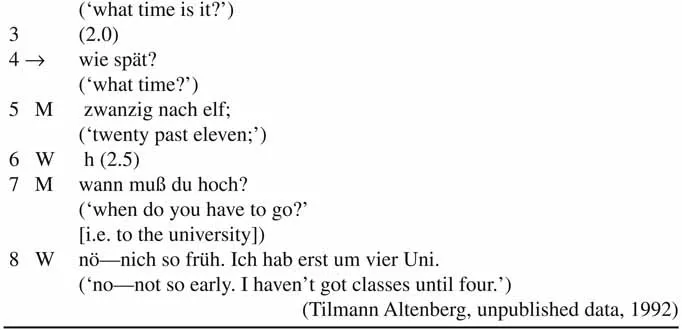
The non-response in line 3 by the second participant (in this case, after an initial question which reopens this focused interaction after a 25-second silence) is interpreted by the first participant as repair-initiating. Code-switching on the ‘second attempt’ (line 4) offers a first speaker’s account of this ‘notable absence’ as being due to the ‘wrong’ language choice, i.e. one not coinciding with that recipient’s preferred language. Code-switching in this sequential position, i.e. in order to contextualise it as a ‘non-first first’, certainly is discourse-related, following
Pattern Ib:…A1//B1 B2 B1 B2…
of Auer (1995) (where letters stand for languages, and numbers for speakers).2
Among the younger children investigated in our study of Italian immigrant workers’ children in Germany, the same structure was observed. But in addition, switching on such repairs was found to have a constant direction: overwhelmingly from Italian (dialect) into German (dialect) but rarely the other way round (Auer 1984b). This direction indexes the larger context of the children’s life-world in Germany, for it evokes the status of German as what one might call the ‘in-group’ language of peer interaction (the ‘out-group’ language of the parents and other adults being Italian (dialect); cf. Jørgensen, this volume, for a similar reversal of the ‘we-code’/‘they-code’ distinction of adult migrants in their children): for the second, the ‘repaired’ version of the activity, the ‘right’ language is chosen, which concords with the dominant language choice of the children among themselves—German. Code-switching serves a conversational function, but at the same time it links up with ‘larger’ (ethnographically recoverable) facts about the children’s life-world; yet reference to these facts in our analysis is indexed by conversational structure.
Discourse-related code-switching is particularly likely to index elements of the wider context in cases lik...
Table of contents
- Cover Page
- Half Title Page
- Title Page
- Copyright Page
- Contents
- List of Contributors
- Acknowledgements
- Introduction Bilingual Conversation revisited
- The ‘Codes' of Code-Switching
- Conversation and Beyond
- Index
Trusted by 375,005 students
Access to over 1.5 million titles for a fair monthly price.
Study more efficiently using our study tools.
Frequently asked questions
Yes, you can cancel anytime from the Subscription tab in your account settings on the Perlego website. Your subscription will stay active until the end of your current billing period. Learn how to cancel your subscription
No, books cannot be downloaded as external files, such as PDFs, for use outside of Perlego. However, you can download books within the Perlego app for offline reading on mobile or tablet. Learn how to download books offline
Perlego offers two plans: Essential and Complete
- Essential is ideal for learners and professionals who enjoy exploring a wide range of subjects. Access the Essential Library with 800,000+ trusted titles and best-sellers across business, personal growth, and the humanities. Includes unlimited reading time and Standard Read Aloud voice.
- Complete: Perfect for advanced learners and researchers needing full, unrestricted access. Unlock 1.5M+ books across hundreds of subjects, including academic and specialized titles. The Complete Plan also includes advanced features like Premium Read Aloud and Research Assistant.
We are an online textbook subscription service, where you can get access to an entire online library for less than the price of a single book per month. With over 1.5 million books across 990+ topics, we’ve got you covered! Learn about our mission
Look out for the read-aloud symbol on your next book to see if you can listen to it. The read-aloud tool reads text aloud for you, highlighting the text as it is being read. You can pause it, speed it up and slow it down. Learn more about Read Aloud
Yes! You can use the Perlego app on both iOS and Android devices to read anytime, anywhere — even offline. Perfect for commutes or when you’re on the go.
Please note we cannot support devices running on iOS 13 and Android 7 or earlier. Learn more about using the app
Please note we cannot support devices running on iOS 13 and Android 7 or earlier. Learn more about using the app
Yes, you can access Code-Switching in Conversation by Peter Auer in PDF and/or ePUB format, as well as other popular books in Languages & Linguistics & Linguistics. We have over 1.5 million books available in our catalogue for you to explore.