- 352 pages
- English
- ePUB (mobile friendly)
- Available on iOS & Android
eBook - ePub
Mathematics for Engineering
About this book
Mathematics for Engineering has been carefully designed to provide a maths course for a wide ability range, and does not go beyond the requirements of Advanced GNVQ. It is an ideal text for any pre-degree engineering course where students require revision of the basics and plenty of practice work.
Bill Bolton introduces the key concepts through examples set firmly in engineering contexts, which students will find relevant and motivating.
The second edition has been carefully matched to the Curriculum 2000 Advanced GNVQ units:
Applied Mathematics in Engineering (compulsory unit 5)
Further Mathematics for Engineering (Edexcel option unit 13)
Further Applied Mathematics for Engineering (AQA / City & Guilds option unit 25)
A new introductory section on number and mensuration has been added, as well as a new section on series and some further material on applications of differentiation and definite integration.
Bill Bolton is a leading author of college texts in engineering and other technical subjects. As well as being a lecturer for many years, he has also been Head of Research, Development and Monitoring at BTEC and acted as a consultant for the Further Education Unit.
Information
Section E
Graphs
13 Graphs
14 Straight-line motion
15 Linear graphs
16 Polar coordinates
17 Alternating waveforms
The aims of this section are to enable the reader to:
- Plot graphs, choosing suitable scales and clearly marking data points.
- Plot graphs of equations: in particular, linear, exponential and sinusoidal.
- Determine gradients, intercepts and areas from graphs.
- Intepret graphs.
- Recognise the relationship between polar and Cartesian representations of points on a graph; plot polar graphs.
- Reduce non-linear laws to linear form.
- Use and interpret graphs in an engineering context.
This section is about the construction and interpretation of the types of graphs that are commonly encountered in engineering. Particular attention is directed towards linear, exponential and sinusoidal graphs; also, the linearisation of functions in order to obtain linear graphs.
Chapter 13 parallels the development of the mathematics in Section B. This section assumes dexterity with basic algebraic manipulation of equations. Chapter 14 shows the applications of Chapter 13 in a consideration of stright-line motion. Chapter 15 assumes that Chapter 12 and much of the algebra in Section B has ben covered. Chapter 16 assumes a basic knowledge of trigonometry and that the basics of Chapter 13 have been covered. Chapter 17 is an application of graphs in a study of alternating waveforms and their modelling by phasors.
13 Graphs
13.1 Introduction
Graphs are an indispensable element in engineering. They enable trends in experimental data to be more easily seen, and determined, than is possible by just looking at the numbers. Also, equations can be pictorially displayed by means of graphs and the relationships described by the equations more easily comprehended. This chapter is a review of the basic techniques of Cartesian graph drawing and the interpretation of such graphs. Functions which give linear and non-linear graphs are considered.
Chapter 14 looks at the application of graphs to at the engineering context of straight-line motion. Chapter 15 is consideration how relationships can be organised to give linear relationships.
13.2 Cartesian graphs
It is possible to specify the position of a point along a line from some zero point on that line by specifying its distance from the point. In order to specify which side of the zero point the distance is, distances measured to the right of the zero point are given as positive and distances to the left negative (Figure 13.1). Thus, with such a line, a distance specified as +2 is located 2 units to the right of the zero point.

Figure 13.1 Number line
If we want to specify the position of a point on a plane then we can use two such number lines at right angles to each other and intersecting at their zero points. The two lines are then called coordinate axes and their point of intersection the origin. The horizontal axis is called the x-axis and the vertical axis the y-axis (Figure 13.2). The positive half of the x-axis is to the right of the origin and the negative half to the left. The positive half of the y-axis is upwards from the origin and the negative half downwards.
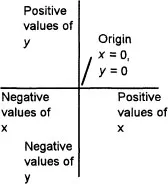
Figure 13.2 Cartesian coordinates
To specify a point on the plane then we can specify its horizontal displacement and its vertical displacement from the origin, i.e. the intersection of the vertical and horizontal lines through the point with the x- and y-axes. If these intersections are xA and yA for some point A then the point is said to have the coordinates of (xA, yA). Such coordinates of points are called the Cartesian coordinates. The first number in such a pair of numbers is always the x-coordinate (or abscissa) and the second the y-coordinate (or ordinate)....
Table of contents
- Front Cover
- Half Title
- Title Page
- Copyright
- Contents
- preface
- Section A: Number and mensuration
- Section B: Algebra
- Section C: Further algebra
- Section D: Trigonometry
- Section E: Graphs
- Section F: Calculus
- Answers
- Index
Trusted by 375,005 students
Access to over 1.5 million titles for a fair monthly price.
Study more efficiently using our study tools.
Frequently asked questions
Yes, you can cancel anytime from the Subscription tab in your account settings on the Perlego website. Your subscription will stay active until the end of your current billing period. Learn how to cancel your subscription
No, books cannot be downloaded as external files, such as PDFs, for use outside of Perlego. However, you can download books within the Perlego app for offline reading on mobile or tablet. Learn how to download books offline
Perlego offers two plans: Essential and Complete
- Essential is ideal for learners and professionals who enjoy exploring a wide range of subjects. Access the Essential Library with 800,000+ trusted titles and best-sellers across business, personal growth, and the humanities. Includes unlimited reading time and Standard Read Aloud voice.
- Complete: Perfect for advanced learners and researchers needing full, unrestricted access. Unlock 1.5M+ books across hundreds of subjects, including academic and specialized titles. The Complete Plan also includes advanced features like Premium Read Aloud and Research Assistant.
We are an online textbook subscription service, where you can get access to an entire online library for less than the price of a single book per month. With over 1.5 million books across 990+ topics, we’ve got you covered! Learn about our mission
Look out for the read-aloud symbol on your next book to see if you can listen to it. The read-aloud tool reads text aloud for you, highlighting the text as it is being read. You can pause it, speed it up and slow it down. Learn more about Read Aloud
Yes! You can use the Perlego app on both iOS and Android devices to read anytime, anywhere — even offline. Perfect for commutes or when you’re on the go.
Please note we cannot support devices running on iOS 13 and Android 7 or earlier. Learn more about using the app
Please note we cannot support devices running on iOS 13 and Android 7 or earlier. Learn more about using the app
Yes, you can access Mathematics for Engineering by W Bolton,W. Bolton,William Bolton in PDF and/or ePUB format, as well as other popular books in Mathematics & Applied Mathematics. We have over 1.5 million books available in our catalogue for you to explore.