- 152 pages
- English
- ePUB (mobile friendly)
- Available on iOS & Android
eBook - ePub
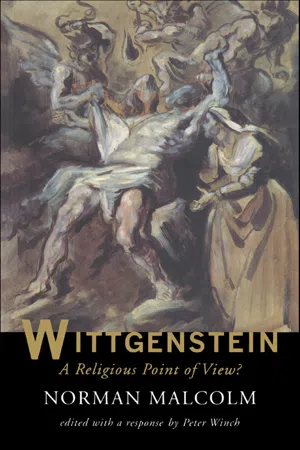
Wittgenstein: A Religious Point Of View?
About this book
Ludwig Wittgenstein once said: 'I am not a religious man, but I cannot help seeing every problem from a religious point of view.' This study, the last work of the distinguished philosopher Norman Malcolm, is a discussion of what Wittgenstein may have meant by this and its significance for philosophy. The book concludes with a critical discussion of Malcolm's essay by Peter Winch.
Information
1
A RELIGIOUS MAN?
As a child Ludwig Wittgenstein received formal instruction in Roman Catholicism. Later on, conversations with his sister Gretl destroyed his childish faith. He became indifferent to, perhaps even contemptuous of, religious belief. When he was about 21 years of age, however, something occurred that had a lasting impact on him. He saw a play in Vienna which was mediocre drama: but there was a scene in which a person whose life had been desperately miserable, and who thought himself about to die, suddenly felt himself to be spoken to in the words, ‘Nothing can happen to you!’ No matter what occurred in the world, no harm could come to him! Wittgenstein was greatly struck by this thought (as he told me approximately forty years later): for the first time he perceived the possibility of religious belief (NM, p. 58).
In a ‘Lecture on ethics’ that Wittgenstein gave in Cambridge in 1929 (he was 40 years old), he spoke of an experience of his which he described as ‘feeling absolutely safe. I mean the state of mind in which one is inclined to say, “I am safe, nothing can injure me whatever happens”’ (LE, p. 8), The words, ‘I am safe; nothing can injure me’, could strike one as an echo of Psalm 23: ‘Yea, though I walk through the valley of the shadow of death, I will fear no evil: for thou art with me; thy rod and thy staff, they will comfort me.’ In the same ‘Lecture on ethics’, Wittgenstein spoke of another experience he sometimes had, which could be described by the words, ‘I wonder at the existence of the world.’ He thought that this experience lay behind the idea that God created the world; that it was the experience of ‘seeing the world as a miracle’. He also thought that ‘the experience of absolute safety’ was connected with the idea of ‘feeling safe in the hands of God’ (LE, p. 10).
Let us move to the First World War. Upon the declaration of war, Wittgenstein immediately volunteered for service as a private in the Austrian army, even though he could have been exempted because of a rupture. In September 1914 he discovered Tolstoy’s The Gospel in Brief in a bookstore. Thereafter, ‘He read and reread it, and had it always with him, under fire and at all times’, and was known by the other soldiers as ‘the one with the Gospels’ (McG, p. 220). Near the end of the war, when Wittgenstein was in a prison camp at Monte Cassino, he and a fellow prisoner read Dostoevsky together. According to Parak, it was this writer’s ‘deeply religious attitude’ that commended him to Wittgenstein. Parak believed that Wittgenstein had gone through a religious conversion in the war, and that this played a part in his subsequently giving away all of his inherited wealth (McG,(p. 273).
Probably Wittgenstein’s motivation for giving away his fortune was complex. (He once said to me that he had given away his wealth so that he would not have friends for the sake of his money.) But I think it is likely that Parak was right. Since Wittgenstein knew the Gospels thoroughly, he could hardly have failed to be struck by these words of Jesus:
Truly I say to you, it will be hard for a rich man to enter the kingdom of heaven. Again I tell you, it is easier for a camel to go through the eye of a needle than for a rich man to enter the kingdom of God.
(Matthew 19:23–4)
Whoever of you does not renounce all that he has cannot be my disciple.(Luke 14:13)
The diaries that Wittgenstein kept during the war reveal that he often prayed, not that he should be spared from death, but that he should meet it without cowardice and without losing control of himself.
How will I behave when it comes to shooting? I am not afraid of being shot but of not doing my duty properly. God give me strength! Amen!
If it is all over with me now, may I die a good death, mindful of myself. May I never lose myself! Now I might have the opportunity to be a decent human being, because I am face to face with death. May the spirit enlighten me.
(McG, p. 221)
Brian McGuinness, biographer of Wittgenstein, says: ‘Generally before action he prays like this: God be with me! The spirit be with me!’ (ibid.). Wittgenstein volunteered for the extremely dangerous post of artillery observer in an advanced position. He wrote: ‘Perhaps nearness to death will bring light into my life’ (ibid., p. 240).
While he was in prison camp Wittgenstein had to think ahead to what his vocation would be when he was released. Probably he had already decided to renounce his fortune—which he insisted on, once he was back in Vienna, despite the amazed protests of his family. He could not return to philosophy because he felt that he had nothing more to say. The choice was between the priesthood and the life of a schoolmaster. The four years of theological studies required for the priesthood ruled out that option for him. He decided to become a school teacher. To his friend Parak he said: ‘I’d most like to be a priest, but when I’m a teacher I can read the Gospel with the children’ (ibid., p. 274).
During the war Wittgenstein and Paul Engelmann, the architect, had become friends. In his Memoir of Wittgenstein, Engelmann raises the question, ‘Was Wittgenstein religious?’ His answer is that the idea of God as creator of the world scarcely engaged Wittgenstein’s attention, but ‘the notion of a last judgment was of profound concern to him’ (Engel, p. 77). When I knew Wittgenstein, many years later, I had the same impression. To quote from my Memoir:
Wittgenstein did once say that he thought he could understand the conception of God, in so far as it is involved in one’s awareness of one’s own sin and guilt. He added that he could not understand the conception of a Creator. I think the ideas of Divine judgment, forgiveness, and redemption had some intel-ligibility for him, as being related in his mind to feelings of disgust with himself, an intense desire for purity, and a sense of the helplessness of human beings to make themselves better.
Wittgenstein once suggested that a way in which the notion ofimmortality can acquire a meaning is through one’s feeling that one has duties from which one cannot be released, even by death. Wittgenstein himself possessed a stern sense of duty.
I believe that Wittgenstein was prepared by his own character and experience to comprehend the idea of a judging and redeeming God. But any cosmological conception of a Deity, derived from the notions of cause or of infinity, would be repugnant to him.
(NM, p. 59)
The influence of the notion of a Last Judgment is reflected in some of his remarks. The first occurs in a letter to me in 1940: ‘May I not prove too much of a skunk when I shall be tried’ (ibid, Letter 3, p. 88). The second was in a conversation between Drury and Wittgenstein in 1949. Drury had mentioned a doctrine of Origen, according to which ‘at the end of time there would be a final restitution of all things. That even Satan and the fallen angels would be restored to their former glory.’ Drury then added that this conception ‘was at once condemned as heretical’. Wittgenstein replied: ‘Of course it was rejected. It would make nonsense of everything else. If what we do now is to make no difference in the end, then all the seriousness of life is done away with’ (R, pp. 174–5). The third remark was written in 1951 in the final months of his life: ‘God can say to me: “I am judging you out of your own mouth. Your own actions have made you shud-der with disgust when you have seen them in others”’ (VB, p. 87). The Tractatus Notebooks and the Tractatus itself were written while Wittgenstein was serving in the Great War. Both works contain thoughts of a religious nature. In the Notebooks of 1916 he puts the question, ‘What do I know about God and the purpose of life?’ (NB, p. 73). He goes on to say that ‘something about the world is problematic, which we call its meaning’; that ‘to pray is to think about the meaning of life’; and that ‘to believe in God means to see that life has a meaning’ (NB, p. 74). In the Tractatus he says: ‘God does not reveal himself in the world’ (T, 6.432). ‘The mystical is not how the world is, but that it is’ (T, 6.44). The second of these statements is connected with ‘the experience of wondering at the existence of the world’, and the experience of ‘seeing the world as a miracle’, to which he referred in the ‘Lecture on ethics’ of 1929.
M.O’C.Drury and Wittgenstein first met in 1929. Their friendship continued throughout Wittgenstein’s life. Drury was in his first year as an undergraduate at Cambridge, and had begun to attend the lectures of G.E.Moore. In his first lecture Moore said that among the subjects on which he was required to lecture was the philosophy of religion, but that he would not be talking about this because he had nothing to say. Drury was indignant that a Professor of Philosophy should be silent on so important a subject, and said so to Wittgenstein. Wittgenstein’s reply was to quote from Augustine’s Confessions, ‘And woe to those who say nothing concerning thee, just because the chatterboxes talk a lot of nonsense.’ He added, ‘I won’t refuse to talk to you about God or about religion’ (R, p. 104).
Drury once remarked how impressed he was by the ancient liturgical prayers of the Latin rite and their translation in the Anglican prayer book. Wittgenstein replied: ‘Yes, those prayers read as if they had been soaked in centuries of worship. When I was a prisoner of war in Italy we were compelled to attend Mass on Sundays. I was very glad of that compulsion’ (R, p. 109). Wittgenstein and Drury had a talk about Drury’s intention to be ordained as a priest. Wittgenstein said:
Just think, Drury, what it would mean to have to preach a sermon every week; you couldn’t do it. I would be afraid that you would try and give some sort of philosophical justification for Christian beliefs, as if some sort of proof was needed>. The symbolisms of Catholicism are wonderful beyond words. But any attempt to make it into a philosophical system is offensive. All religions are wonderful, even those of the most primitive tribes. The ways in which people express their religious feelings differ enormously.
(R, p. 123)
In another conversation Wittgenstein made these remarks:
But remember that Christianity is not a matter of saying a lot of prayers; in fact we are told not to do that. If you and I are to live religious lives, it mustn’t be that we talk a lot about religion, but that our manner of life is different. It is my belief that only if you try to be helpful to other people will you in the end find your way to God.
(R, p. 129)
As Drury was leaving Wittgenstein suddenly said: ‘There is a sense in which you and I are both Christians’ (R, p. 130).
I do not know what Wittgenstein specifically had in mind when he said that ‘we are told’ not to say a ‘lot of prayers’. There are, however, many biblical admonishments of those who cry out in words of prayer and praise, but do not alter the manner of their lives. Jeremiah said:
Thus says the Lord of hosts, the God of Israel, Amend your ways and your doings, and I will let you dwell in this place. Do not trust in these deceptive words: ‘This is the temple of the Lord, the temple of the Lord, the temple of the Lord.’
For if you truly amend your ways and your doings, if you truly execute justice one with another, if you do not oppress the alien, the fatherless or the widow, or shed innocent blood in this place, and if you do not go after other gods to your own hurt, then I will let you dwell in this place, in the land that I gave of old to your fathers for ever.
(Jeremiah 7:3–7).
And there are these words of Jesus:
Not every one who says to me, ‘Lord, Lord’, shall enter the kingdom of heaven, but he who does the will of my Father who is in heaven. On that day many will say to me, ‘Lord, Lord, did we not prophesy in your name, and cast out demons in your name, and do many mighty works in your name?’ And then I will declare to them, ‘I never knew you; depart from me, you evildoers’.
(Matthew 7:21–3)
Why do you call me ‘Lord, Lord’, and not do what I tell you? (Luke 6:46)
What is being said is not, of course, that worship and praise have no place in a religious life, but rather that they are worthless if there is no amending one’s ways and one’s doings.
In 1931 Wittgenstein lived for a while in his hut in Norway. On his return to Cambridge he told Drury that he had done no philosophical writing, but had spent the time in prayer. He had written a confession of those things in his past life of which he was most ashamed. He insisted that Drury read it. He asked Moore to do the same. Several years later he made what was possibly the same confession, to Fania Pascal, but that time orally, face to face. We will come to that episode later.
By 1933 Drury had decided against training for the priesthood. Instead, with Wittgenstein’s encouragement and financial help, he undertook medical training. One day in 1936 he told Wittgenstein that he had been asked to be a godfather at the christening of his nephew. Drury went on to say:
The godparents have to promise in the child’s name ‘To renounce the devil and all his works, the pomps and vanities of this wicked world, and all the sinful lusts of the flesh’. I feel it would be hypocrisy for me to speak those words. It is something that I haven’t done myself.
Wittgenstein replied: To renounce the pomps and vanities of this wicked world. Just think what that would really involve. Who of us today even thinks of such a thing? We all want to be admired (R, p. 153). In 1944 Drury was serving in a military hospital in Wales. When Wittgenstein came to Wales they were able to spend some time together. Wittgenstein told Drury that one of his students had written to him to tell him that he had become a Roman Catholic. Wittgenstein went on to say: ‘I seem to be surrounded now by Roman Catholic converts. I don’t know whether they pray for me. I hope they do’ (R, p. 163). In the invasion of France, Drury was to be a medical officer on a landing craft When they said goodbye,...
Table of contents
- COVER PAGE
- TITLE PAGE
- COPYRIGHT PAGE
- PREFACE
- LIST OF ABBREVIATIONS
- INTRODUCTION
- 1: A RELIGIOUS MAN?
- 2: THE SEARCH FOR EXPLANATION
- 3: THE ESSENCE OF LANGUAGE
- 4: UNDERLYING MECHANISMS
- 5: FAILED EXPLANATIONS
- 6: THE LIMIT OF EXPLANATION
- 7: FOUR ANALOGIES
- BIBLIOGRAPHY
- DISCUSSION OF MALCOLM’S ESSAY
Trusted by 375,005 students
Access to over 1.5 million titles for a fair monthly price.
Study more efficiently using our study tools.
Frequently asked questions
Yes, you can cancel anytime from the Subscription tab in your account settings on the Perlego website. Your subscription will stay active until the end of your current billing period. Learn how to cancel your subscription
No, books cannot be downloaded as external files, such as PDFs, for use outside of Perlego. However, you can download books within the Perlego app for offline reading on mobile or tablet. Learn how to download books offline
Perlego offers two plans: Essential and Complete
- Essential is ideal for learners and professionals who enjoy exploring a wide range of subjects. Access the Essential Library with 800,000+ trusted titles and best-sellers across business, personal growth, and the humanities. Includes unlimited reading time and Standard Read Aloud voice.
- Complete: Perfect for advanced learners and researchers needing full, unrestricted access. Unlock 1.5M+ books across hundreds of subjects, including academic and specialized titles. The Complete Plan also includes advanced features like Premium Read Aloud and Research Assistant.
We are an online textbook subscription service, where you can get access to an entire online library for less than the price of a single book per month. With over 1.5 million books across 990+ topics, we’ve got you covered! Learn about our mission
Look out for the read-aloud symbol on your next book to see if you can listen to it. The read-aloud tool reads text aloud for you, highlighting the text as it is being read. You can pause it, speed it up and slow it down. Learn more about Read Aloud
Yes! You can use the Perlego app on both iOS and Android devices to read anytime, anywhere — even offline. Perfect for commutes or when you’re on the go.
Please note we cannot support devices running on iOS 13 and Android 7 or earlier. Learn more about using the app
Please note we cannot support devices running on iOS 13 and Android 7 or earlier. Learn more about using the app
Yes, you can access Wittgenstein: A Religious Point Of View? by Norman Malcolm, Peter Winch in PDF and/or ePUB format, as well as other popular books in Philosophy & Philosophy History & Theory. We have over 1.5 million books available in our catalogue for you to explore.