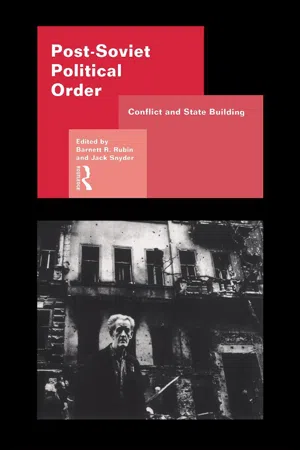
Post-Soviet Political Order asks what is shaping the institutional pattern of the post-Soviet political order, what the new order will be like, what patterns of conflict are emerging, and what can be done about stabilising the region. In considering these questions the contributors converge on four common themes:
* the institutional legacy of empire
* the social processes unleashed by imperial collapse
* patterns of bargaining within and between states to resolve conflicts arising out of the imperial collapse
* the impact of the wider international setting on the pattern of post-imperial politics
Focusing on the former Soviet Union and Eastern European countries, the contributors show how strong state institutions are essential if conflict and political instability are to be avoided.
- 224 pages
- English
- ePUB (mobile friendly)
- Available on iOS & Android
eBook - ePub
Post-Soviet Political Order
About this book
Information
1
INTRODUCTION
Reconstructing politics amidst the wreckage of empire*
When empires come crashing down, they leave hunks of institutional wreckage scattered across the landscape: pieces of bureaucracies, military units, economic networks, administrative districts, as well as demographic and cultural patterns that bear the marks of the imperial past.1 This detritus of empire constitutes the building blocks of the new political arrangements that are constructed out of the rubble. From these are formed not only new states and nations, but also a whole new system of international and transnational relations among these remnants.
How the rubble of the Soviet empire gets recombined has momentous consequences for the peace and security of the whole world, not to mention the lives of people who inhabit the former empire. The broader international community has consequently shown great interest in shaping the formation of political, economic, and social institutions in the successor states to the Soviet Union. Western governments, international organizations, and non-governmental organizations have all propounded schemes for building democratic institutions, strengthening civil society, establishing markets, and embedding the rule of law in these new states. To a modest degree, they have even deployed resources to these ends.2
Building the underpinnings of democracy is a valuable objective. However, this is only one of the dimensions of the reconstitution of political order in the former Soviet empire. In those portions of the former Soviet Union where conflict has been most acute, such as Tajikistan and the Transcaucasus, the more pressing problem is the creation of coherent state institutions, without which the exercise of the democratic franchise has no meaning. Indeed, where effective state institutions are lacking, increased popular participation in politics is likely to be a cause of civil and international strife, rather than an antidote to it.3
In this book, we take a step back from the question of how to build democracy in order to ask the prior question of what is shaping the institutional pattern of the post-Soviet political order, both within and among the Soviet successor states. Focusing on Russia, Ukraine, and Central Asia, we ask what the new order will be like, what patterns of conflict are emerging in that order, and what can be done about it. Our analyses of this contemporary problem are set in the historical context of the collapse of other great empires and earlier instances of the formation of national states.
Public discussion of possible futures of the post-Soviet space focuses on three themes: competitive ethno-nationalism, the re-establishment of empire, and the creation of a liberal, democratic zone of peace and co-operation.4 Many Americans, schooled in a Wilsonian view of world politics, have tended to see the Soviet Union as a “prison house of nations,” each naturally wanting to exercise self-determination in the wake of imperial collapse.5 If so, given the ethnic intermingling in the former Soviet space, each nation’s demand for self-determination would necessarily conflict with that of others. From this perspective, the supplanting of an archaic empire by ethnically-based nation-states is bound to be a bloody process. A second view, stressing Russia’s geopolitical weight and the continuing power of military-imperial interests at the core of the old empire, anticipates the re-emergence of a Moscow-centered informal empire.6 In this view, the ease of playing the game of dividing, penetrating, and dominating weak states in the former Soviet periphery makes this outcome likely, at least along Russia’s southern frontier. The third outcome, perhaps more a hope than a prediction, is the notion that a region of liberal co-operation can be institutionalized by creating democratic structures within many of the successor states, and by uniting them in regional and global international organizations to facilitate economic and security co-operation.7
These three visions do have some value in organizing our thinking about post-imperial patterns, but reality in this case is more complicated than the pure ideal types. One of the striking features of the post-Soviet order is the incompleteness of the emergence of any of these three patterns. Elements of each pattern are apparent in some corners of the former empire or on some issues. Ethno-national rivalries over sovereignty and self-determination are prevalent in the Caucasus and at lesser intensity in the Baltics, but local clan identities or civic-territorial concepts have often trumped ethnicity elsewhere. Neo-imperial intervention, if not quite domination, has shaped political outcomes in Tajikistan, Georgia, and elsewhere in the South. Normal diplomatic bargaining between more or less democratically elected politicians, sometimes shored up by timely mediation from the broader international community, has led to progress toward settling Russian-Baltic and Russian-Ukrainian differences over the stationing of military forces, sovereignty and citizenship issues, and economic relations.
It is not surprising that the former Soviet space remains indecisively suspended among these different potential outcomes. The circumstances of imperial collapse typically create barriers to the easy emergence of stable patterns of any of these types. The quick emergence of coherent nation-states is hindered by the weakness of governmental institutions in the colonial periphery of the empire and by the arbitrariness of many colonial boundaries imposed by the imperial administration. As was shown in Rupert Emerson’s classic work, From Empire to Nation, post-colonial nation-building is typically a task of artifice and mobilization carried out by a thin stratum of nationalist elites rather than an inevitable political expression of cultural yearning.8 Only in the Baltic states and Armenia were pre-formed nations waiting in the wings to occupy the stage after the Soviet collapse. Even at the center of collapsed empires, national identity is problematic, since authoritarian empires, including the Soviet one, typically promote a transnational self-conception to legitimize their domination over other peoples, not a national one. Thus ethno-national rivalries are an uneven and often muted theme in post-Soviet politics.
Democratic outcomes are hindered for many of the same reasons. Among the great empires, only Britain put in place a colonial legacy of democratic institutions, including political parties and a free press, that facilitated the transition to stable democracy in the wake of decolonization.9 Where administrative institutions are weak, and where the notion of national self-rule is weakly rooted, the preconditions for any statehood, let alone democratic statehood, are shaky.
Yet there are also barriers to the re-establishment of empire. Empires collapse because they become less efficient than their competitors, because their reach exceeds their strength, or because their formula for co-opting or suppressing internal opponents stops working.10 Unless the imperial center can generate some new source of efficiency or appeal, opponents in the post-colonial periphery and among the great powers will be able to thwart a reassertion, and weary citizens of the post-imperial core may shun its burdens. Bolshevism rather quickly provided a formula for reasserting Russian domination of the “near abroad” in the 1920s. In contrast, as Alexander Motyl’s chapter in this volume shows, it took some time until the Nazis could establish an ideological and geopolitical basis for reasserting control over the detritus of the Germanic Austrian and Prussian empires of Central and Eastern Europe. In the Ottoman case, this reassertion never happened, because of geopolitical weakness and the success of a more insular alternative identity based on the Turkish nation-state.
The indecisive evolution of the post-Soviet case reflects the mutually blocking nature of many of the institutional remnants of the Soviet system. On one hand, the legacy of Soviet ethno-federalism loaded the dice towards ethno-national outcomes when the USSR collapsed.11 With power imploding at the center, people turned if only by default to the administrative structures of the ethnicallytitled Soviet republics as the jumping-off points for re-establishing a political order. Since the personnel and symbols of these republican units were ethnically freighted already in the Soviet period, it was natural for many of the post-Soviet state-building elites, whether former Communist or oppositional, to mobilize support based on populist ethnic appeals. On the other hand, any form of mass political participation, whether based on ethnicity or civic democracy, threatened the interests of incumbents in other institutional remnants of empire. For them, transnational elite networks looked like a more attractive alternative to popular support. Former Communist political elites in some republics, for example, had strong incentives to re-establish patronage ties with the imperial center in order to maintain the flow of economic subsidies and military protection against domestic opponents.12 Likewise, for the Soviet Army, acquiescence to a system of hermetic nation-states would have made borders harder to secure, exacerbated the military housing crisis, and foreclosed illicit business opportunities. Thus the institutional legacy of the Soviet period has helped to create a stalemate, perhaps unstable and temporary, among cross-cutting incentives to adopt ethno-national, democratic, and imperial political forms.
In the short run, this stalemate has mixed consequences for armed conflict in the former Soviet space. On the positive side, transnational connections among neo-imperial elites can provide a basis for political support without relying on the populist enthusiasms of ethno-nationalist movements. They can also provide order in institutional vacuums, like Tajikistan. At the same time, regimes that are nationally-based, yet not highly nationalistic, prevent the need for a reimposition of direct imperial control, which, as in Chechnya, would risk bloodshed and resistance. On the negative side, neo-imperialist circles inject a tone of anti-democratic belligerency into Russian politics, and they have sometimes promoted tension in order to exploit it in the “near abroad.”13
Thus many post-Soviet relationships of a partly national, partly imperial character have two-edged implications for conflict. In Ukraine, for example, Russian reluctance to part with the Black Sea fleet and other trappings of imperial domination was an irritant to the relationship, yet a commonality of outlook and background between local former Communist politicians in Russia and Eastern Ukraine helps to underwrite political coalitions in both countries that are turning away from the demagogic confrontations of the immediate post-independence period. In Georgia, Russian machinations promoted Abkhazian separatism, which helped to spur a lapse into anarchy that only an invited Russian intervention could reverse. Though Russian policy spurred conflict at the outset, the result, at least temporarily, has been the breaking of militant Georgian nationalism and the stabilization of a moderate, incipiently democratic Shevardnadze regime. In Kazakstan, President Nazarbaev’s imposition of sharp limits on democratic parliamentary politics and free speech, though deplored in the West, have arguably helped to contain incipient conflict between local Russians and Kazaks, which could have triggered a larger conflict involving Russia itself.14 Apart from the Baltic states, where cohesive and moderate national states are well-established, indirect Russian influence through post-Communist elites with interests complementary to Moscow’s helps to explain why armed conflict has been so limited in the wake of imperial collapse. The two largest conflicts were in Tajikistan, during the interlude when the transnational nomenklatura’s control collapsed, and in Armenian-backed Nagorno-Karabakh, where a mass nationalist movement replaced the Communist-era elites entirely.15
This pattern, with its mixed costs or benefits for armed conflict, may not be durable. Only the Baltic states have established a stable equilibrium, based on a moderate ethno-national formula with some guarantees to ethnic minorities, shored up by oversight and backing from the broader international community. Elsewhere, the stalemate among imperial remnants, truncated democracy, and limited nationalism may have some stabilizing features, but it remains uncertain whether they will be lasting. Social processes unleashed by the collapse of empire and of Communism—increased mass political participation, marketization of the economy, the creation of new bureaucratic state structures, and the competition of elites to mobilize mass support under the banner of nationalism—may gradually erode the institutions left over from the Soviet era. This could be good news, in so far as liberal democratic structures replace those institutions. It could, however, be bad news, in so far as the replacements are more virulent forms of populist nationalism or imperial assertion. Those legacies of empire that are serving to contain conflict may simply be putting post-imperial conflicts on a long fuse.16
The contributors to this book offer a variety of perspectives on the emergence of post-imperial and post-Soviet political institutions, but as a group they converge on four common themes that inform the analysis of post-imperial politics in most of the essays: the institutional legacy of empire; the social processes unleashed by imperial collapse; patterns of bargaining within and between states to resolve conflicts arising out of the imperial collapse; and the impact of the wider international setting on the pattern of post-imperial politics.17 These essays, while developing their distinctive insights, jointly demonstrate what can be gained by analyzing the reconstitution of political order through these perspectives.
The institutional legacy of empire
When a child’s edifice assembled from rods and connectors crashes down, the overall structure is destroyed, but tightly interconnected segments of it may retain their shape, though scattered across the floor. When an empire collapses, the stillconnected sections may be of several types.
Some of the pieces may be territorial. Administrative units of the old empire may take on political significance because of their state-like bureaucratic structures. All of the Soviet republics, for example, became successor states in the wake of the imperial collapse. In most cases, this was due more to their organizational features than their authenticity as expressions of ethno-national identity. It may be true that ethnic labeling of the republ...
Table of contents
- Cover Page
- Title Page
- Copyright Page
- Illustrations
- Contributors
- Preface
- 1. Introduction: Reconstructing Politics Amidst the Wreckage of Empire
- 2. After Empire: Competing Discourses and Inter-State Conflict In Post-Imperial Eastern Europe
- 3. The Great War and the Mobilization of Ethnicity In the Russian Empire
- 4. Will Russia Survive?: Center and Periphery In the Russian Federation
- 5. Ethno-Linguistic and Religious Pluralism and Democratic Construction In Ukraine
- 6. Possibilities for Conflict and Conflict Resolution In Post-Soviet Central Asia
- 7. Russian Hegemony and State Breakdown In the Periphery: Causes and Consequences of the Civil War In Tajikistan
- 8. Conclusion: Managing Normal Instability
- References
Trusted by 375,005 students
Access to over 1.5 million titles for a fair monthly price.
Study more efficiently using our study tools.
Frequently asked questions
Yes, you can cancel anytime from the Subscription tab in your account settings on the Perlego website. Your subscription will stay active until the end of your current billing period. Learn how to cancel your subscription
No, books cannot be downloaded as external files, such as PDFs, for use outside of Perlego. However, you can download books within the Perlego app for offline reading on mobile or tablet. Learn how to download books offline
Perlego offers two plans: Essential and Complete
- Essential is ideal for learners and professionals who enjoy exploring a wide range of subjects. Access the Essential Library with 800,000+ trusted titles and best-sellers across business, personal growth, and the humanities. Includes unlimited reading time and Standard Read Aloud voice.
- Complete: Perfect for advanced learners and researchers needing full, unrestricted access. Unlock 1.5M+ books across hundreds of subjects, including academic and specialized titles. The Complete Plan also includes advanced features like Premium Read Aloud and Research Assistant.
We are an online textbook subscription service, where you can get access to an entire online library for less than the price of a single book per month. With over 1.5 million books across 990+ topics, we’ve got you covered! Learn about our mission
Look out for the read-aloud symbol on your next book to see if you can listen to it. The read-aloud tool reads text aloud for you, highlighting the text as it is being read. You can pause it, speed it up and slow it down. Learn more about Read Aloud
Yes! You can use the Perlego app on both iOS and Android devices to read anytime, anywhere — even offline. Perfect for commutes or when you’re on the go.
Please note we cannot support devices running on iOS 13 and Android 7 or earlier. Learn more about using the app
Please note we cannot support devices running on iOS 13 and Android 7 or earlier. Learn more about using the app
Yes, you can access Post-Soviet Political Order by Barnett Rubin, Jack Snyder, Barnett Rubin,Jack Snyder in PDF and/or ePUB format, as well as other popular books in Politics & International Relations & Comparative Politics. We have over 1.5 million books available in our catalogue for you to explore.