- 208 pages
- English
- ePUB (mobile friendly)
- Available on iOS & Android
eBook - ePub
Product Marketing for Technology Companies
About this book
The author compresses his twenty years of experience to take a step-by-step approach to the product life-cycle, and covers areas such as:
* selecting target markets
* creating a positioning statement
* writing a financial paragraph
* motivating others
thereby demonstrating how to act as a bridge between sales, development and finance.
Successfully marketing products for technology companies requires the application of precision marketing techniques, and in this book the author teaches how to focus on the whole product and create real solutions that match the market needs.
C H A P T E R 1
Product Marketing for Technology Companies
Why Product Marketing is the most Key Position in any Technology Company
Objectives
This chapter sets the stage and the framework for the rest of the book. It describes:
- The essence of product marketing.
- Introduction to the product life cycle.
- The product life cycle seen as a process.
- The compound product life cycle.
- Why a technology company is different from companies in other industries.
Marketing: Getting and keeping the right customers
Most people in business have an understanding of what marketing is all about – getting and keeping the right customers. Although you will find many definitions on marketing when you search for it, I like this definition best for its simplicity and usability. Marketing can be direct marketing, viral marketing, branding, customer relationship management, promotion and advertising, public relations and so forth. Product marketing is marketing that is focused on the product (or service) the company is bringing to market.
Product managers can be found in all kinds of companies, from pharmaceutical makers to furniture manufacturers and from fast-food chains to computer vendors. Regardless of the industry, product managers have one thing in common; they are responsible for the marketing of their product.
The responsibilities of the product manager vary from sector to sector and company to company – but all products have a life cycle. Understanding how to manage that product life cycle through each stage determines the success or failure of a product.
Descriptions of the product life cycle can be found in many marketing books and is graphically represented in Figure 1.1. After the introduction of a product, sales will first slowly pick up, before entering the growth phase of the product life cycle. Popularity increases, market share increases, and also competition will increase. The growth of sales will diminish and sales will flatten during the maturity phase. With the introduction of competitive products and/or more competitors, the decline in sales is inevitable; and finally the product will become obsolete and will be withdrawn from the market.
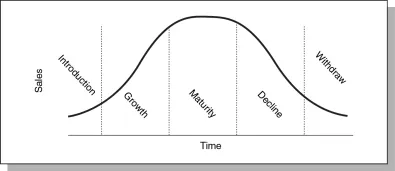
Figure 1.1 The product life cycle
The higher the amplitude and the broader the curve, the more successful the product is. The first line of this chapter stated that marketing is about getting and keeping the right customers. Getting the right customers will result in high sales and keeping the right customers will postpone the decline phase. Product marketing is all about optimizing sales results, in other words, optimizing the product life cycle.
Optimizing and controlling the product life cycle is easier said than done and starts way before the introduction of the product. It requires careful strategizing, planning, execution and control. Above all, it requires a process and methodology for all phases of the process.
The Product Life Cycle Process
Figure 1.2 is a high-level representation of the product life cycle process.
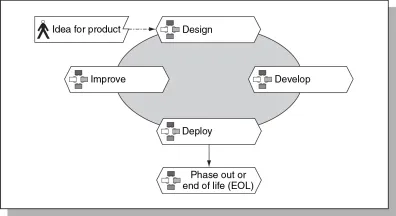
Figure 1.2 The product life cycle process
The stages of the product life cycle process are:
- Idea: This is the trigger of the process.
- Design: The attempt to get the right customers starts with a careful and methodical design and product definition, which includes a lot more than just the technical design.
- Development of the product: The realization, testing and, where needed, improvements of the design.
- Deployment: The deployment starts with the introduction of the product and starts the real product life cycle. Careful monitoring and continuous adjustments are needed in order to get and keep the right customers. We can recognize three sub-categories in the deployment phase:
1 Production
2 Selling
3 Maintenance.
- Improvement: To extend the product life or increase the profitability, regular improvements to the design of the product will be needed. Reasons for improvements can have its origin in either one of the above-mentioned sub-categories. After describing the improvement needed, the process goes back into the design phase.
- Phase out or end of life (EOL): At some point, it is no longer possible or wise to extend the product life.
This product life cycle is valid for any type of product. This process is also true for technology companies, those operating in the IT and Telecom sectors, generally referred to as IT companies. But the market characteristics for the IT industry are unique and so is the methodology required to make a product successful.
The Product Life Cycle is Like a Fractal
Although the product life cycle as drawn in Figure 1.1 looks quite simple, it is actually the resultant of multiple product life cycles and at the same time a part of a bigger product life cycle. The product life cycle and its process are applicable to the technology, a product family, a product, a product version and so on. No matter how much you zoom in on it or out of it, it always behaves as a product life cycle again. In that way, it acts like fractal.
Example: The facsimile, better known as fax machine, was invented already in 1843 by a Scottish mechanic Alexander Bain. It was a very rudimentary machine consisting of a metallic contact resting on a moving paper slip saturated with an electrolytic solution. In 1865 the first working trials for a commercially viable fax machine was set up in France by an Italian, Caselli. Despite many improvements to the machine, such as the use of a photo-electric cell in 1902 and the use of coupling devices for the telephony network (PSTN) around 1930, the fax remained a cumbersome, expensive and difficult-to-operate machine.
In terms of product life cycle, the ‘growth’ phase only started after the Group 1 standard was agreed by the International Telegraph and Telephone Consultative Committee (CCITT) in 1968, followed by Group 2, Group 3 and Group 4 fax standards. Between 1973 and 1983, the number of fax machines in the United States increased from 30 000 to 300 000. By 1989 the number had jumped to four million and the compact fax machines available in the late 1980s revolutionized everyday communications around the world. So, before the fax really took off and became popular, both improvements to the technology itself as a multitude of products came and went. After the growth phase in the 1980s, products and technology did not stop improving themselves: from thermo-paper to plain paper; improvements in speed and ease-of-use; integration with printers and copiers; and so on and so forth.
By now, the trend is to move away from the fax. Email took a predominant role in communications and the combination of scanning, emailing and printing makes the fax machine in many situations redundant. Many subsequent technologies and products kept the fax at a high level of sales, but the fax seems to have reached the phase of decline in its product life cycle (Figure 1.3).
Fax technology itself is part of a bigger product life cycle. Call it 2D image transfer or (even bigger) communications technology, which is still just in its early maturity.
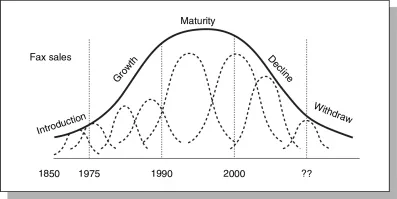
Figure 1.3 The compound product life cycle
What Makes the IT Company Different?
The Market Changes Extremely Fast
The information and communication technology (ICT) market changes faster than any other market sector. Although Nike would like you to believe otherwise, a shoe is a shoe and the idea for a new design and its product life cycle is, for the most part, based on fashion, not technology. The short product life cycles of Nike shoes and other fashionable products are created artificially. Products in the ICT industry are based on technology advances – fashion is secondary. And the pace at which new products are cranked out and then become out of date by newer technology is faster than in any other industry.
In 1965, just four years after the discovery of the integrated circuit (IC), Dr Gordon E. Moore observed an exponential growth in the density of transistors in ICs, while costs per component were falling rapidly. Moore predicted that this trend would continue. The Press called it Moore’s Law. For almost 40 years now, the famous Moore’s law is still valid: ‘The amount of components storable on a given amount of silicon has roughly doubled every 18 months since the technology was invented, and will continue to do so.’
The implication of Moore’s law is that every year and a half the processor power doubles at the same or lower cost.
This is why new technology products are coming out at such a rapid pace. For example, with the introduction of a new computer, the vendor will have its successor already in development and the design for a replacement computer underway.
Moore’s law can be applied to disk space, storage density, memory, transmission speed or other technologies.
Another, more general law says: ‘Data expands to fill the space available for storage’ (Parkinson’s Law of Data). Or, whatever capacity is available will be used. This also applies to our daily lives. Look at your briefcase: No matter how big it is, it will always be full. The same is true for computer capacity. When DOS, the operating system for the 8088 personal computer (PC), was introduced by IBM in August 1981, it had a maximum addressable memory of 640 KB. At that time, no one imagined application taking up that much memory. Today, 256 MB of memory is the minimum of RAM needed to run a modern operating system on a PC. This increase beats Moore’s law by five years. And the same rapid developments are true for other technologies. When we look at that first PC with DOS, we see a computer system with no hard drive and two floppy disks of 360 KB each. The first IBM PC (the XT) with a hard disk was introduced in March 1983. It had 10 MB of storage capacity. As hard disk storage also doubled every 18 months, 80 GB drives were available in 2003.
Higher capacity, better performance and new technologies are ever creating new opportunities for software developers. Software developers are always pushing the limits of computer capability, urging computer makers to increase performance, thus creating a vicious circle. The consequences of these short product life cycles are obvious. With the constant renewal of technology, the IT market is everchanging. The real innovators in the IT sector are often just slightly ahead of the early adaptors and majority.
This fast moving market is just one of the many fascinating aspects of product management in IT sector. It also presents many challenges. The product manager must juggle with upcoming and current products and is forced to think ahead in a market that renews itself every one and a half years.
Vendors in the IT Sector tend to be Technology-Driven, not Solution-Oriented
Because of the rapid development of technology, with IT companies, there is of course a strong focus on the technology itself. But technology should not be the goal. Just a small part of the market buys technology for technology’s sake. Most of us buy solutions made possible by that technology. What matters is how technology is applied to solve a certain problem or need.
With strong focus on technology and the necessity for ICT companies to continually renew their products and develop new so...
Table of contents
- Cover
- Half Title
- Title Page
- Copyright
- Contents
- List of Figures
- About the Author
- Preface
- Acknowledgements
- 1. Product Marketing for Technology Companies
- 2. The Spider in the Web
- 3. The Product Life Cycle Process
- 4. Mission Statement for your Product
- 5. Product Positioning
- 6. The Product Adoption Life Cycle
- 7. The Product Launch
- 8. Cost Price Calculations
- 9. Finance for Non-Financials
- 10. You and the Sales Force
- 11. You and the Engineers
- 12. If your Product is a Service
- 13. Managing the Product Portfolio
- Appendix I: The Product Plan
- Appendix II: Product Marketing Industry Benchmark 2003
- Index
Trusted by 375,005 students
Access to over 1.5 million titles for a fair monthly price.
Study more efficiently using our study tools.
Frequently asked questions
Yes, you can cancel anytime from the Subscription tab in your account settings on the Perlego website. Your subscription will stay active until the end of your current billing period. Learn how to cancel your subscription
No, books cannot be downloaded as external files, such as PDFs, for use outside of Perlego. However, you can download books within the Perlego app for offline reading on mobile or tablet. Learn how to download books offline
Perlego offers two plans: Essential and Complete
- Essential is ideal for learners and professionals who enjoy exploring a wide range of subjects. Access the Essential Library with 800,000+ trusted titles and best-sellers across business, personal growth, and the humanities. Includes unlimited reading time and Standard Read Aloud voice.
- Complete: Perfect for advanced learners and researchers needing full, unrestricted access. Unlock 1.5M+ books across hundreds of subjects, including academic and specialized titles. The Complete Plan also includes advanced features like Premium Read Aloud and Research Assistant.
We are an online textbook subscription service, where you can get access to an entire online library for less than the price of a single book per month. With over 1.5 million books across 990+ topics, we’ve got you covered! Learn about our mission
Look out for the read-aloud symbol on your next book to see if you can listen to it. The read-aloud tool reads text aloud for you, highlighting the text as it is being read. You can pause it, speed it up and slow it down. Learn more about Read Aloud
Yes! You can use the Perlego app on both iOS and Android devices to read anytime, anywhere — even offline. Perfect for commutes or when you’re on the go.
Please note we cannot support devices running on iOS 13 and Android 7 or earlier. Learn more about using the app
Please note we cannot support devices running on iOS 13 and Android 7 or earlier. Learn more about using the app
Yes, you can access Product Marketing for Technology Companies by Mark Butje in PDF and/or ePUB format, as well as other popular books in Business & Business General. We have over 1.5 million books available in our catalogue for you to explore.