- 192 pages
- English
- ePUB (mobile friendly)
- Available on iOS & Android
eBook - ePub
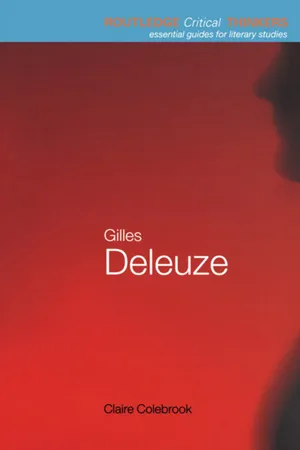
Gilles Deleuze
About this book
Why think? Not, according to Gilles Deleuze, in order to be clever, but because thinking transforms life. Why read literature? Not for pure entertainment, Deleuze tells us, but because literature can recreate the boundaries of life. With his emphasis on creation, the future and the enhancement of life, along with his crusade against 'common sense', Deleuze offers some of the most liberating, exhilarating ideas in twentieth-century thought. This book offers a way in to Deleuzean thought through such topics as:
* 'becoming'
* time and the flow of life
* the ethics of thinking
* 'major' and 'minor' literature
* difference and repetition
* desire, the image and ideology.
Written with literature students in mind, this is the ideal guide for students wishing to think differently about life and literature and in this way to create their own new readings of literary texts.
Information
1 Powers of Thinking
Philosophy, Art and Science
DOI: 10.4324/9780203029923-1
This chapter looks at how Deleuze defines philosophy in relation to art and science. For Deleuze it remains important to look at the specificity and difference of philosophy. This ties into his whole project of provoking and mobilising thinking. We should not see philosophy or art as disciplines or conventions – something that already is and that we can know and define; we need to see philosophy (or anything) in terms of its possibility or what it might be able to do. So we need to distinguish philosophy from art, for example, in order to avoid the homogenisation of thinking. We have a tendency today to assume that there is a common sense or agreed upon way of thinking, or that we should aim at such a common sense through communication and consensus. Against this, Deleuze wanted to open life up to diverse modes of thinking. Literature, for example, would not be based on representing or expressing some common world-view or shared experience; literature should shock, shatter and provoke experience. But there are different ways in which thought can be disrupted. To demonstrate this difference Deleuze made a distinction between philosophy, art and science.
The title of one of Deleuze's final works, co-authored with his long-time colleague the French psychoanalyst Félix Guattari, took the form of a question: What is Philosophy? (1994; published in French in 1991). It is in this late work that Deleuze and Guattari distinguish philosophy from art and science. But from the earliest point in his work Deleuze looked at philosophy as a power; not as a collection of texts, but as a permanent challenge to think differently by creating problems. While philosophy is a unique power it is also enabled by its encounter with other powers; events in science and art will require and provoke new problems in philosophy. Deleuze insisted that neither philosophy, nor art, nor science were ‘academic’ pursuits in search of disinterested knowledge. Rather, all thinking is an art and event of life and Deleuze regarded the three main modes of thinking – art, science and philosophy – as powers to transform life. According to Deleuze, we can define the distinction between literature, art and philosophy not by cataloguing literary and philosophical texts and finding some shared feature, but by looking at what they do, and what they do when they are extended and stretched to their utmost. Philosophy, art and science need to be seen as distinct moments of the explosive force of life, a life that is in a process of constant ‘becoming’. It is not that we have a world or life that philosophers or writers then describe or interpret. Each act of art, science or philosophy is itself an event and transfiguration of life. And each transformation changes life in its own specific or singular way.
Reading a work as art or as philosophy requires that we see its specific force, or its capacity for rupturing life. We may never encounter a pure work of art or philosophy, but we can strive to distinguish and maximise artistic, philosophical and scientific tendencies within any text. We can distinguish these tendencies not by looking at what a work is but at what it achieves or does. Plato may have used literary metaphors but he did so in order to establish a philosophical truth above and beyond this world; scientists may use fictions or narratives, such as the ‘big bang’ but they do so in order to make the world we live in functional and manageable. Literature is the power of fiction itself: not making a claim about what the world is, but about the imagination of a possible world. Art is not about representation, concepts or judgement; art is the power to think in terms that are not so much cognitive and intellectual as affective (to do with feeling and sensible experience). We are not reading a work as artistic or literary if we read it for its representation of the world or its presentation of theories. Deleuze insisted that we should understand these distinctions, in order to push thought to each of its limits and to avoid bland notions of common sense. If we accept that thought takes one homogeneous form we fall into unquestioning opinion, reducing all science to ‘stories’ or all philosophy to fact-finding. We never really see what our thinking can do. If we can create philosophies, art and science then this tells us that thought is productive. If we understand the power that drives this production then we will be able to maximise our creativity, our life and our future.
Deleuze was a philosopher but he also wrote in a highly literary manner – using voices, characters and scenes worthy of science fiction. In A Thousand Plateaus (1987; published in French in 1980) Deleuze and Guattari construct a drama among competing theorists of natural science, drawn from different moments in history and overseen by a fictional character. Deleuze also wrote on literary authors and argued for the specific power of literature. If we want to understand what Deleuze has to offer as a philosopher we first have to understand the reason for philosophy in relation to literature and to science. Deleuze drew upon science and art, and presented some of his most challenging ideas in relation to cinema. His project, though, is ultimately philosophical, for he allowed the creations of literature and observations of science to make a repeated philosophical claim_ a claim about the very force of life in general. Philosophy is just this power to create a general concept of life, giving form to the chaos of life. Any truly philosophical thought, therefore, will strive to think the whole of life: so it must encounter art and science but then go on to think the world beyond art and science. Science may give consistent descriptions of the actual world, such as the things we observe as ‘facts’ or ‘states of affairs’, but philosophy has the power to understand the virtual world. This is not the world as it is, but the world beyond any specific observation or experience: the very possibility of life. For Deleuze, the concept that best answers this power to think the whole of life is difference. Life is difference, the power to think differently, to become different and to create differences. The philosophical ability to think this concept will help us to live our lives in a more joyful and affirmative manner. Because philosophy allows the transformation of life, it is a power, not an academic discipline. Similarly, but in its own different way, art also encounters difference: not by producing a concept of difference but by presenting and creating differences (such as all the different characters in a novel or different sounds in a symphony). If we want to know what something (such as art, science or philosophy) is, then we can ask how it serves life. The problem, today, is that when we ask what art or philosophy are for we tend to feel they should serve some everyday function: making us better managers or communicators. We fail to see that the purpose or force of art and philosophy goes beyond what life is to what it might become. Today, no one really seems to ask what science is for, and this is probably because science is manifestly functional. Much of Deleuze's project was spent in showing a force of life beyond everyday function, such as the force and value of change and becoming: not a becoming for some preconceived end, but a becoming for the sake of change itself. Deleuze drew from science in all its forms, but he did so in order to extend the powers of literature and philosophy, all the while arguing for the necessity of literature and philosophy for life.
Deleuze's books on literary authors and his own uses of literature were then acts of philosophy, but for Deleuze philosophy and literature both required each other. Philosophy is not just something philosophers do, nor is it confined to those times when we are ‘doing philosophy’. Philosophy is a tendency of all thinking. Common sense and everyday banal generalisations are just bad philosophy, for in appealing to common sense we have already formed a general concept of what it means to think. Deleuze begins by showing that we already work with an image of thought or some abstract notion of life: such as the image of common sense or the concept of life as matter. From this already given tendency for thinking of life in homogenising general terms, Deleuze asks that we do philosophy more explicitly and more adventurously. If we were to ask the question, ‘Why Philosophy?, Deleuze would not say that it will make us clever, or solve problems or tidy up logical errors in our arguments. We do philosophy, not because it will clean up other areas of our lives, but because it is a dimension of life in its own right. We do philosophy because we can, and if we can do philosophy – if we can ask ‘big’ and possibly unsolvable questions – then we ought to. Why? For Deleuze life in general proceeds by creatively maximising its potential; philosophy is one of the directions by which a certain line of life (thinking) increases its power. For Deleuze there is a direct link between philosophy, literature and ethics. If we limit thought to simple acts of representation and cognition – ‘this is a chair’, ‘this is a table’ – then we impose all sorts of dogmas and rules upon thinking (Deleuze 1994: 135). We fail to extend life to its maximum. We use a creation of thought – logic and grammar – to imprison thought. The fact is that there are all sorts of texts and styles of thinking that go well beyond representation or simple pictures of the world. Not only philosophy but literature, art, cinema, stupidity, madness and malevolence all testify to a thinking that is not that of representation so much as production, mutation and creation. We do philosophy, then, not to conform to or correct some dogma of common sense; we do philosophy to expand thought to its infinite potential. In general, Deleuze insisted on the universal power of philosophy. This is not a power of generalisation or looking at some common feature that all beings share. Thinking universally demands that we go beyond all the beings that we perceive and think how any being might be possible. In What is Philosophy? Deleuze, with Guattari, defines this universalising power of philosophy more specifically as the power to create concepts. Deleuze had always intertwined references to science, art and philosophy, but in What is Philosophy? he and Guattari offer explicit accounts of philosophy as the creation of concepts, art as the creation of percepts and affects and science as the creation of functions.
Concepts
Both literature and philosophy carry thought beyond common sense and representation in different but connected ways. Philosophy, according to Deleuze, creates concepts. Concepts are not labels or names that we attach to things; they produce an orientation or a direction for thinking. A concept in this philosophical sense is quite different from an everyday concept. At a day-to-day level, for example, we might use the concept of happiness. ‘Happy Birthday’, ‘Andrew and Elizabeth are a happy couple’, ‘Do whatever makes you happy’, ‘Seven steps to happiness’. Day-to-day usage of concepts works like short-hand or habit; we use concepts so that we do not have to think. We say, ‘Happy Birthday’, not because we want to say or mean something, but because that is just what we do. Everyday concepts, then, allow life to carry on in an orderly or functional manner. But here, as else-where, Deleuze refuses to see the everyday or common form of something as the essence of something. Our day-to-day concepts do not capture what a concept is because they do not allow the full force of what a concept can do. Indeed, for Deleuze, if we want to understand what thinking is we should not gather examples from everyday life and draw conclusions; we should look at thinking in its most extreme forms (such as art, philosophy, stupidity, madness or ill will). The philosophical concept bears little relation to the concepts of everyday language, just as Deleuze's definitions of art and cinema will seem to be at odds with our common viewing experiences. One overwhelming reason for reading Deleuze lies in this rather unfashionable ‘high-culture’ affirmation of art and philosophy as distinct from ordinary life and popular culture. For Deleuze, our daily use of concepts follows the model of representation and opinion, where we assume that there's a present world that we then re-present in concepts, and that we all aim for agreement, communication and information. A philosophical use of concepts does not follow opinion and everyday usage. It is creative rather than representational and this has a direct bearing on life and literature.
Opinion, for Deleuze, is the very inertia or failure of thinking. Opinion is a laziness directly opposed to the expansiveness of the philosophical concept. Deleuze and Guattari cite the example of a man who moves from his dislike for a certain type of cheese to a general claim that the cheese just is offensive (Deleuze and Guattari 1994: 146). It is this tendency of opinion to reduce the difference of the world to being ‘just like me’ that both weakens the active character of thought and reinforces the modern capitalist prejudice that we are ‘all the same’ and capable of interacting in one global market:
In every conversation the fate of philosophy is always at stake, and many philosophical discussions do not as such go beyond discussions of cheese, including the insults and the confrontation of worldviews. The philosophy of communication is exhausted in the search for a universal liberal opinion as consensus, in which we find again the cynical perceptions and affections of the capitalist himself.(Deleuze and Guattari 1994: 146)
In opinion, then, we move from a particular experience and use it to form some whole that reduces difference and complexity. Everyday opinions are bland and reductive generalisations. I am annoyed by the asylum seeker who lives next door, therefore all asylum seekers are lazy. I am not turned on by meaningless same-sex encounters, therefore all extra-marital relations are evil. Opinion moves from my specific likes and desires and homogenises desire, producing a general ‘subject’. A philosophical concept work against this reductive and generalising tendency by expanding difference. It creates new ways of thinking. Take the concept of love. Opinion will reduce love to its already known forms – bourgeois marriage – and then dismiss all other forms: ‘That's not love; it's perversion!’ A concept in its philosophical sense moves beyond any example or model to think the very power or possibility: so ‘love’ would not be reducible to any given form, whether that be familial, homosexual or heterosexual. We might form a concept of love, as Deleuze did, that was as open as possible (Deleuze 1973: 140). Love is the encounter with another person that opens us up to a possible world. This concept does not take a form of love – the couple – and then say that this is what love is. The concept of love as ‘a possible encounter with an other as a whole new world’ allows us to think of forms of love that are not yet given, that are not actual but virtual. A concept, for Deleuze, is just this power to move beyond what we know and experience to think how experience might be extended.
A concept does not just add another word to a language; it transforms the whole shape of a language. We can get a sense of this by going back to the concept of ‘happiness’. One of the philosophers most frequently cited by Deleuze, Friedrich Nietzsche (1844–1900), created a number of concepts that were crucial for Deleuze's project. The first thing to note about a philosophical concept is that it cannot be looked at in isolation. If I ask you for a definition of ‘happiness’ you might say, ‘what makes you feel good’, or ‘what we're all aiming for’. But philosophical concepts cannot have these succinct definitions because they create a whole new path for thinking: the concept of happiness would not refer to this or that instance of happiness; it would have to enact or create a new possibility or thought of happiness. Philosophical concepts are not amenable to dictionary style definitions, for their power lies in being open and expansive. For this reason we have to understand them through the new connections that they make. Nietzsche, for example, used a number of interrelated concepts to challenge the idea that thinking was a picture of representation of the world. Thinking and concepts, he argued, take the flux of reality and cut it up into manageable units. All thinking for Nietzsche was a type of metaphor – substituting a fixed image for a fluid reality – and we can never be literal or say exactly what we see. Take the word ‘leaf’. We might think that it originally refers to the green growths on a tree, and that we then use the word metaphorically to refer to a ‘leaf’ of paper. The problem is, of course, that the word ‘leaf’ is just as arbitrary whether it is used to refer to trees or books. In both cases we have to take the infinitely different – each different and varying leaf – and fix some word that will apply to all leaves. This gives us the illusion that there is some general type – say, ‘leafness’ – to which language refers. We imagine that there are fixed forms which our language labels or which can be pointed to, literally and concretely, in language. Against this, Nietzsche insists that language creates concepts; all language, not just literary language, is metaphorical. It takes the concrete and sensible world and refers to it through something else, such as the sign or the concept. All language, then, by virtue of the fact that it is language, is creative. We have, however, developed the illusion that there is some truth behind language, and we imagine that there are some ways of speaking or writing (such as science) that will get us out of metaphor and give us the ‘true’ world. But there is no ‘true’ world behind appearances, only further appearances. There is no essential ‘truth’ above a...
Table of contents
- Cover
- Half Title
- Series Page
- Title Page
- Copyright Page
- Table of Contents
- Series Editor's preface
- Acknowledgements
- WHY DELEUZE?
- KEY IDEAS
- 1 Powers of thinking: philosophy, art and science
- 2 Cinema: perception, time and becoming
- 3 Machines, the untimely and deterritorialisation
- 4 Transcendental empiricism
- 5 Desire, ideology and simulacra
- 6 Minor literature: the power of eternal return
- 7 Becoming
- AFTER DELEUZE
- FURTHER READING
- Works cited
- Index
Trusted by 375,005 students
Access to over 1.5 million titles for a fair monthly price.
Study more efficiently using our study tools.
Frequently asked questions
Yes, you can cancel anytime from the Subscription tab in your account settings on the Perlego website. Your subscription will stay active until the end of your current billing period. Learn how to cancel your subscription
No, books cannot be downloaded as external files, such as PDFs, for use outside of Perlego. However, you can download books within the Perlego app for offline reading on mobile or tablet. Learn how to download books offline
Perlego offers two plans: Essential and Complete
- Essential is ideal for learners and professionals who enjoy exploring a wide range of subjects. Access the Essential Library with 800,000+ trusted titles and best-sellers across business, personal growth, and the humanities. Includes unlimited reading time and Standard Read Aloud voice.
- Complete: Perfect for advanced learners and researchers needing full, unrestricted access. Unlock 1.5M+ books across hundreds of subjects, including academic and specialized titles. The Complete Plan also includes advanced features like Premium Read Aloud and Research Assistant.
We are an online textbook subscription service, where you can get access to an entire online library for less than the price of a single book per month. With over 1.5 million books across 990+ topics, we’ve got you covered! Learn about our mission
Look out for the read-aloud symbol on your next book to see if you can listen to it. The read-aloud tool reads text aloud for you, highlighting the text as it is being read. You can pause it, speed it up and slow it down. Learn more about Read Aloud
Yes! You can use the Perlego app on both iOS and Android devices to read anytime, anywhere — even offline. Perfect for commutes or when you’re on the go.
Please note we cannot support devices running on iOS 13 and Android 7 or earlier. Learn more about using the app
Please note we cannot support devices running on iOS 13 and Android 7 or earlier. Learn more about using the app
Yes, you can access Gilles Deleuze by Claire Colebrook in PDF and/or ePUB format, as well as other popular books in Philosophy & Literary Criticism. We have over 1.5 million books available in our catalogue for you to explore.