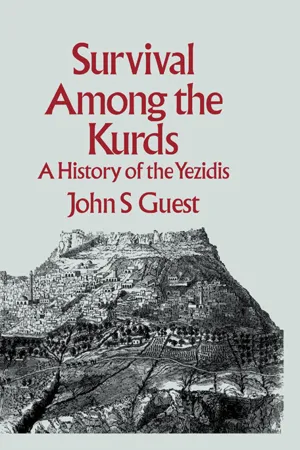
First published in 1993. The Yezidis are a community of around 200, 000 Kurds who possess their own religion, quite distinct from Islam, which most other Kurds profess, and from the Christian and Jewish faiths. The Yezidis live in the northern parts of Iraq and Syria, in eastern Turkey, in Germany and in the ex-Soviet republics of Armenia and Georgia. (In Armenia the Yezidis, long classified as Kurds, are now recognized as a separate minority group and the term 'Kurd' is applied only to Moslem Kurds.) This book stems from a conversation with the Yezidi priest of the village who remarked that now the children were learning to read and write they were asking him questions about the Yezidi scriptures and the history of the community. Lacking any written material, he could only repeat to them the oral traditions he had himself learned as a child.
- 386 pages
- English
- ePUB (mobile friendly)
- Available on iOS & Android
eBook - ePub
Survival Among The Kurds
About this book
Information
Chapter One
Antecedents
The people and events described in this book belong to a world, once known as the Near East, visited by few people nowadays. The cities are crowded, but the highways and rail lines carry only intermittent traffic and the rivers flow silently toward the sea. Most of the frontiers are closed.1
In the countryside life goes on as it has for thousands of years in these ancient lands. Shepherds tend flocks of sheep and goats, farmers raise crops from the fertile soil and camels aid man to subsist in the deserts to the south. But one element is missing – the immemorial movement of people and their animals – the traders, migrants, pilgrims and preachers who once frequented the traditional routes connecting the Mediterranean basin with the world east of Aleppo.
Before modern technology created air lines and motor highways across the desert, travellers were obliged to follow routes where they could find water and pasture for their livestock and could expect a reasonable degree of security from robber tribes. In those days three historic routes connected the trading cities of the Levant with Mesopotamia – the mellifluous name given by the Greeks to Iraq.2
The ‘Great Desert Route’, most direct of all, followed a series of water holes south of the Euphrates to Basra; but it was often endangered by tribal wars. The ‘Little Desert Route’ followed the Euphrates to a point level with Baghdad, making the final stages overland; the river itself was navigable most of the year.
But the preferred route was the one from Aleppo to Mosul and thence down the Tigris valley. At Mosul travellers could elect to transfer their families and goods to keleks – rafts supported by inflated sheepskins – for a swifter, less arduous passage downstream to Baghdad. Others crossed over the pontoon bridge at Mosul to follow the old ‘Royal Road’ by way of Erbil and Kirkuk to Baghdad.
Caravans, resembling modern convoys, were organized by important merchants at regular intervals, except during the hottest summer months. Other merchants, livestock dealers and ordinary travellers were welcome to join, thereby spreading the cost of the armed escort and the payments to the tribes whose pastures were crossed. A typical caravan of loaded camels accompanied by thousands of horses, sheep and goats, would cover the 400 miles between Aleppo and Mosul in thirty to forty days.
Leaving Aleppo by the el-Hadid gate, the route crosses fifty miles of rolling country, dotted with beehive-shaped dwellings, to reach the great bend of the Euphrates, which flows from its sources in the Anatolian mountains south-westward to a point only 120 miles from the Mediterranean sea. The river, torrential in the Anatolian canyons, can be crossed at Birecik (the present Route E90 bridge), at Jerablus (the Baghdad railway bridge) and at other points downstream to Meskene (now submerged by the lake behind the Tabqa dam).3 From this point the river turns to the southeast and runs through desert country until it reaches the lowlands of Iraq. Here, lined by date groves and tapped along its left bank by canals cut by Nebuchadnezzar and later kings, the Euphrates flows gently past the ruins of Babylon, Erech and Ur to join the Tigris at Qurna, the traditional site of the Garden of Eden. The united rivers flow past Basra to discharge into the gulf at Fao.
After crossing the Euphrates the caravan route runs along the foothills of the Anatolian plateau to Urfa – once known as Edessa or Callirhoe, the ‘city of beautiful springs’ and recently renamed Şanliurfa (Urfa the Glorious). From Urfa the Balikh (Fish) river, much favoured by carp, flows south to the Euphrates past Harran, where the patriarch Abraham camped for several years with his flocks on the long journey from Ur to Palestine and to remoter destinations in Egypt and Arabia. (In July 1911 the British archaeologist T. E. Lawrence walked from Harran to Jerablus in thirteen days.)4
At Urfa there was a choice between two routes. Camel caravans continued across the Khabur river basin to stage in the plain below Mardin. Hoofed animals generally followed another old trade route striking north-east from Urfa over the volcanic Karaca Dag mountains to the walled city of Diyarbakir on the right bank of the Tigris. An extension of this route crossed the Tigris below Diyarbakir and two of its tributaries farther east, finally heading north up a third valley to the strategically located hill town of Bitlis. Once past Bitlis, this route followed the southern shore of Lake Van to the city of Van and thence eastward to Persia and Turkestan.
Below Diyarbakir the Tigris (traditionally known as ‘the arrow’) gathers speed, swollen by water from its northern tributaries and confined by rocky sides as it thrusts its way through the mountains to the Mesopotamian plain. Travellers who chose to travel by kelek from Diyarbakir never forgot the fearsome stretches where the river twisted and hurtled between sheer rock walls while passengers cast coins into the water to appease the dreaded whirlpools. The river flowed calmer as it approached Jezira b. Omar (now Cizre). But most merchants preferred to take the easy route south from Diyarbakir to the old fortress city of Mardin that overlooks the rich bottom-lands of Mesopotamia.
On a clear day one can see from Mardin a range of hills stretching across the horizon to the south. The Jebel Sinjar, 60 miles long and 4914 ft high at its summit (snow-capped in winter), looms over the desert like an isolated plateau, recalling to a German observer the sheer cliffs of Heligoland in the North Sea.5
The northern slope of the Jebel Sinjar is a steep escarpment, indented by ravines, with manna-bearing oak forests and terraced gardens where grapes, figs and pomegranates grow. On the southern side clear mountain streams flow across a tableland past Beled Sinjar, capital of the district, down to the flat lands below. Sinjar water, channelled through underground conduits, once irrigated groves of date palms, orange and lemon trees and flowed into the Tharthar – the lost river of Mesopotamia – but for many centuries the plain south of the Jebel Sinjar has been a hot, thirsty desert where the streams of water evaporate or are lost. The Thar-thar is now an arroyo that trickles past the deserted city of Hatra to vanish in a sink west of Baghdad (recently converted into a man-made lake fed by Tigris overflow).
Leaving the shelter of Mardin, the caravan route passes the ruined fortresses of Dara and Nisibin to cross the barren, salty watershed between the Euphrates and Tigris basins. Pinched between the Anatolian mountains and the Jebel Sinjar, this last most difficult stage of the long trail from Aleppo is plagued by dust devils and a scorching south wind that can single out a dehydrated man or beast for instant death.
The city of Mosul lies 80 miles east of Beled Sinjar on the right bank of the Tigris. Across the river lie the ruins of Nineveh and the foothills of the mountains of Kurdistan. The highest of these peaks, visible from Mosul and sometimes even from the Sinjar, is Jebel Judi, 6854 ft above sea level, where local tradition claims Noah brought his ark to rest.
Below Mosul three tributaries from the Zagros range bring fresh impetus to the current – the Great Zab, thrusting down from the Hakkari mountains; the Lesser Zab, with sources east and south of Rowanduz; and the broad valley of the Diyala, along which ran the old trade route from Baghdad to Hamadan, Kermanshah and the markets of the east.
The movement of travellers and merchandise between Syria and Mesopotamia has often been interrupted by war. The hieroglyphs of Egypt and the cuneiforms of Nineveh and Babylon record incessant struggles between the empires at each end of the trail, sometimes involving resettlement of entire peoples to provide labour to build pyramids, canals and other infra-structure.
In the eighth century BC the Assyrians removed ten Jewish tribes to Mesopotamia. But 100 years later the prophecies of Jonah, Nahum and other prophets were fulfilled. The city of Nineveh was destroyed by a Babylonian army allied with the Medes (a people believed by some to be the ancestors of the Kurdish race). A few years later Nebuchadnezzar took Jerusalem and carried the two remaining Jewish tribes back with him.
Babylon, too, was doomed to be conquered after a few decades by a coalition of Medes and Persians. Their leader Cyrus, styled ‘great king’ by the Greeks but known as ‘shah’ or shahanshah (king of kings) to his own people, permitted the Jews to return to Palestine. But many stayed in Mesopotamia, including Esther, wife of one of Cyrus’ successors, the biblical Ahasuerus.
The Persians conquered the Anatolian plateau, but along the Mediterranean and Black Sea coasts the Greek people maintained their identity and their commercial skills. A new dimension was added in 401 BC, when another Cyrus, a grandson of Ahasuerus, enlisted an army of Greek mercenaries in a bold move to seize the Persian throne. Striking unopposed through Anatolia and down the Euphrates valley, the Greeks defeated the shah’s army near Falluja, but in the battle the pretender was slain.
The Greek writer Xenophon has described the retreat up the Tigris to the point where there were no more banks and the mercenaries had to fight their way through the mountains, harried by ‘Karduchoi’ – resembling the Kurds in name and behaviour – to reach the Black Sea at Trebizond.
Seventy years later another Greek army led by Alexander of Macedon, who had already conquered Anatolia, Syria and Egypt, marched eastward along the old caravan route to the Tigris and defeated the shah’ s last army near Erbil (Arbela). After Alexander died, his conquests were divided among his generals. Syria and Mesopotamia were awarded to Seleucus; the first new year’s day of his reign fell on 1 October 312 BC – a date that commenced an era used by some communities to this day. Seleucus established a new capital, Seleucia, on the right bank of the Tigris and another new city, Antioch, west of Aleppo.
Over the next 1,000 years the Greeks – initially under Seleucus’ dynasty and later as part of the Roman empire – expanded, maintained and gradually lost their dominion over the world east of Aleppo. Halfway through this millennium the contest between the two cultures was embittered by the rise of two new religions, each an offshoot of an older faith.
In Persia revival began in 226 AD. Ardeshir, a general who claimed descent from the old shahs, seized the throne and established Zoroastrianism as the state religion. A major element of this faith, founded 1,000 years earlier by Zoroaster and still practiced in some parts of Asia, is the battle for man’s soul between his creator Ahura Mazda (also called Hormizd) and Ahriman, the spirit of evil.
Ardeshir’s son Shahpur stamped the seal of victory on the new regime. At one point his army managed to trap the Roman emperor Valerian and his legions in the citadel of Urfa. Adamant in parleys, the shah forced the emperor to surrender with his entire army. Valerian, whose abject moment is carved in rock near the tombs of the ancient Persian shahs, died in captivity.
Three hundred and twelve years after the birth of Jesus, the emperor Constantine announced his conversion to Christianity, a religion that had survived years of persecution and inner conflict to emerge as a dedicated, disciplined church. The emperor established a new capital on the Bosporus at Byzantium, renamed Constantinople. His mother Helena made a pilgrimage to Jerusalem and unearthed a relic identified as the True Cross. (Manicheism, a third religion that combined Christian and Zoroastrian doctrines, especially the struggle between the powers of good and evil, gained many followers, including for a while Shahpur himself. But its prophet Mani was finally burned alive by the Persians and his followers were persecuted on both sides of the border.)
Constantine’s pagan nephew Julian attempted to revive the glory of ancient Rome. The Christian church was disestablished, the administration of the empire reformed and legions were gathered from the western provinces for a decisive war against Persia, now ruled by Shahpur’s great-grandson, Shahpur II.
In the spring of 363, escorted by a fleet of supply ships, the emperor and his army marched down the Euphrates valley, crossed Mesopotamia along Nebuchadnezzar’s canal and challenged the shah outside the walls of his twin capitals of Seleucia and Ctesiphon. Shahpur shrewdly waited while the days grew longer and the weather hotter. Finally the emperor made the fateful decision to go back. The army crossed the Tigris, burning its boats and retreated northward along Xenophon’s route toward the Kurdish hills.
The summer months in Mesopotamia are cruel. Harassed day and night by elusive Persian horsemen, the famished invaders plodded past fields of scorched crops until a stray javelin (perhaps thrown by a Roman auxiliary from the Tai tribe of Arabs) killed the emperor. His Christian successor Jovian negotiated a treaty with Shahpur, whereby the Jebel Sinjar and other territories were ceded to Persia as the price of an armistice that enabled the legions to re-cross the Tigris and limp back to the west.
Saturday, 1 October 589 opened the tenth century of the era of Seleucus. The events of the next 100 years are summarized in the following pages; many of them are engraved forever in the traditions of the communities who live today in Near Eastern lands.
For over 200 years Jovian’s treaty, often breached but consistently renewed, had defined the frontier between the two empires. This strange coexistence, formalized by ambassadors bearing correspondence between the two monarchs, reflected a common fear of the Huns, a race of fierce, stirrupped horsemen from Central Asia who thrust incessantly against Persia’s northern flank.
Blocked in Turkestan and by the Caucasus range, the Huns had moved west-ward, propelling an avalanche of other tribes who overran the old Roman provinces in the Balkans, West Germany, France, Britain, Italy and Spain.
The Roman empire, now governed from Constantinople, was reduced to the lands around the capital, the Anatolian glacis and a fringe along the Mediterranean coast that included the half-deserted cities of Athens, Antioch and Alexandria, Carthage and Cartagena, Genoa, Naples and Rome.
Amidst these catastrophes, Christianity – blamed by Gibbon as their cause but perceived by contemporaries as the best refuge – had become the established faith of the empire. From his palace beside the recently completed Santa Sophia cathedral, the emperor headed a hierarchy of patriarchs, metropolitans, bishops and lesser clergy. In the west the bishop of Rome (henceforth called ‘the Pope’) conducted missionary work in the conquered territories and over time converted their rulers to the faith.
There were many Christians in Mesopotamia. After years of persecution by the shahs, they finally organized a separate church, independent from the empire, with a patriarch who resided at Seleucia and became an important functionary at the Persian court. But despite official toleration of the new church – commonly called Nestorian because some of its tenets stemmed from the doctrines of Nestorius, a fifth-century patriarch of Constantinople – the state religio...
Table of contents
- Cover
- Half Title
- Title Page
- Copyright
- Dedication
- Contents
- List of Illustrations
- Preface to the Revised Edition
- Chapter 1: Antecedents
- Chapter 2: Sheikh Adi and His Order
- Chapter 3: The Yezidi Religion
- Chapter 4: Early Encounters with the Outside World
- Chapter 5: Prisoners on a Sinking Ship
- Chapter 6: English-speaking Missionaries and Explorers
- Chapter 7: Rassam and Layard
- Chapter 8: The Tribulations of Mir Hussein Beg
- Chapter 9: Abdul Hamid and the Yezidis
- Chapter 10: The Publication of the Sacred Books
- Chapter 11: Brother and Sister
- Chapter 12: The Epoch of Mayan Khatun
- Chapter 13: The Yezidis in Transcaucasia
- Epilogue
- Appendix I: The Yezidi Sacred Books and Sheikh Adi’s Hymn
- Appendix II: Texts of the Yezidi Letters to the Grand Vizier and Sir Stratford Canning
- Appendix III: An Interview with Yezidi Religious Leaders
- Abbreviations
- Chapter Notes
- Bibliography
- Chol Family Genealogy
- Index
Trusted by 375,005 students
Access to over 1.5 million titles for a fair monthly price.
Study more efficiently using our study tools.
Frequently asked questions
Yes, you can cancel anytime from the Subscription tab in your account settings on the Perlego website. Your subscription will stay active until the end of your current billing period. Learn how to cancel your subscription
No, books cannot be downloaded as external files, such as PDFs, for use outside of Perlego. However, you can download books within the Perlego app for offline reading on mobile or tablet. Learn how to download books offline
Perlego offers two plans: Essential and Complete
- Essential is ideal for learners and professionals who enjoy exploring a wide range of subjects. Access the Essential Library with 800,000+ trusted titles and best-sellers across business, personal growth, and the humanities. Includes unlimited reading time and Standard Read Aloud voice.
- Complete: Perfect for advanced learners and researchers needing full, unrestricted access. Unlock 1.5M+ books across hundreds of subjects, including academic and specialized titles. The Complete Plan also includes advanced features like Premium Read Aloud and Research Assistant.
We are an online textbook subscription service, where you can get access to an entire online library for less than the price of a single book per month. With over 1.5 million books across 990+ topics, we’ve got you covered! Learn about our mission
Look out for the read-aloud symbol on your next book to see if you can listen to it. The read-aloud tool reads text aloud for you, highlighting the text as it is being read. You can pause it, speed it up and slow it down. Learn more about Read Aloud
Yes! You can use the Perlego app on both iOS and Android devices to read anytime, anywhere — even offline. Perfect for commutes or when you’re on the go.
Please note we cannot support devices running on iOS 13 and Android 7 or earlier. Learn more about using the app
Please note we cannot support devices running on iOS 13 and Android 7 or earlier. Learn more about using the app
Yes, you can access Survival Among The Kurds by John S. Guest,Guest in PDF and/or ePUB format, as well as other popular books in Social Sciences & Anthropology. We have over 1.5 million books available in our catalogue for you to explore.