eBook - ePub
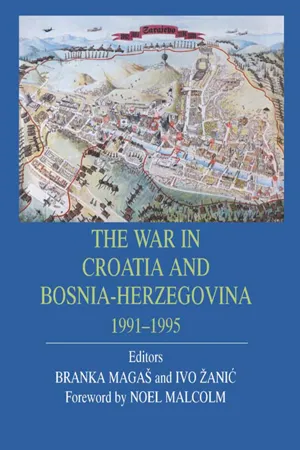
The War in Croatia and Bosnia-Herzegovina 1991-1995
- 432 pages
- English
- ePUB (mobile friendly)
- Available on iOS & Android
eBook - ePub
The War in Croatia and Bosnia-Herzegovina 1991-1995
About this book
This work provides an understanding of the wars in Croatia and Bosnia-Herzegovina. These two interdependent wars were the greatest armed conflicts in Europe in the second half of the 20th century. This work provides an analysis of their successes and failures.
Trusted by 375,005 students
Access to over 1.5 million titles for a fair monthly price.
Study more efficiently using our study tools.
Part II
The War in Bosnia-Herzegovina
6
___________________________________
The Road to War
Rusmir Mahmutćehajić
The war against Bosnia-Herzegovina is part of events that took place in the wider region, and cannot be understood outside that context, whether as to its causes or its long-term consequences, not only in Bosnia-Herzegovina but also in the neighbouring countries and significantly further afield. As far as I know, no consistent, credible model for interpreting that process has been offered so far, either in Bosnia-Herzegovina or elsewhere. So I shall begin by emphasizing the wording of my original title ‘The war against Bosnia-Herzegovina’, since this is very important for understanding the propositions that follow. The war against Bosnia-Herzegovina also explains what occurred in Croatia, both politically and militarily, and what happened in Serbia, all within the context of the repercussions and influences of European and global processes. The break-up of SFRY involved the question of Bosnia-Herzegovina, which remains the central issue after that break-up, as it also was of what we have called the war in Croatia. Events in Croatia and Serbia were crucially important for the war against Bosnia-Herzegovina; they are neither independent nor parallel phenomena, but hierarchically subordinate to that war.
In all partial approaches to the issue thus far, two interpretations of Bosnia-Herzegovina have been offered as basic premises. To construct a consistent and credible model for understanding the issues we are discussing here, it is necessary first to consider these two premises and adopt one of them. One sees Bosnia-Herzegovina as an indivisible organic unity, the other as an artificial creation of separable parts. The first viewpoint is held by those who have been steadfast in the defence of Bosnia-Herzegovina as a whole, whether they were conscious of it or not; while the second is characteristic of those who repudiate it and seek its destruction. The would-be destroyers of Bosnia-Herzegovina in the immediate neighbourhood have always claimed that it is unnatural and divisible. Standing against them have been various actors, in B-H itself and in a wider environment, who assert that it is an organic whole which can be decomposed only by the application of massive external force along with protracted internal destructive action.
The matrix, model or paradigm of the destruction of Bosnia-Herzegovina is formed of three essential elements, three ethno-national blueprints: the Greater Serbian, the Greater Croatian, and the Muslim or Bosniak.1 They are not equal either in magnitude or in power, nor as regards their time of origin, nor in their sequence in that matrix, nor as to degree of guilt; but they are equal in principle. They are also rational, albeit deeply permeated with irrational rhetoric, religious content and an emotional reading of history.
THE SERBIAN ETHNO-NATIONAL BLUEPRINT
The first, original or active, stimulative or impellent blueprint is the Greater Serbian. Understanding it requires insight into the convergence of four factors that can make an ethno-national blueprint operative to the point where it produces destruction along with the energy it generates. The four essential dimensions of the Greater Serbia blueprint are:
1.its ethno-national elite, publicly personified by Milošević as manager of the activity directed towards the ethno-national goal; he is not the most important intellectual expression of the blueprint, but merely the administrator of what the writer and ideologue Dobrica Ćosić propounded and disseminated;
2.its ethno-national ideology of Greater Serbdom, similar to other ethnonational ideologies which characterized Europe in the eighteenth and nineteenth centuries, but which has not undergone the metamorphosis that has affected phenomena of the same kind all over Europe;
3.its organization: essentially the state of Serbia, with such trans-Serbian instruments as can be mobilized or subordinated to this Greater Serbia blueprint; in other words, the state potential and capacity of Serbia, which in a region like ours are rather powerful; and
4.its executors, i.e. that wide circle of people who, within the hierarchy of the ethno-national elite/ethno-national ideology/ethno-national organization, are prepared to submit themselves, absolutely or almost absolutely, to that system and to carry out orders from above regardlessrights of their scale and nature, including genocide as organized destruction of a people and all that belongs to it.
This blueprint is known to the majority of observers, even to those with limited knowledge of the Balkans. Its goal is the establishment of an ethnonational state over a wide region which, with inconsistent logic, is postulated as Serb, sometimes on the basis of the ethnicity of the population, sometimes on the basis of a common language, sometimes on the basis of geostrategic interests, sometimes on the basis of historic right, etc. In the whole collection of diverse arguments it is possible to recognize in the final instance an extreme arrogance which justifies right by might: whatever can be achieved by the force at our disposal or the capacity of our organizations is permissible. In this concept, Yugoslavia was seen as an instrument for achieving the ethno-national goal. To that extent Yugoslavia was indeed ‘a basic Serb interest’, as frequently asserted by the historian Milorad Ekmeičić, one of the key proponents of the shift within the Greater Serbia project from the idea of Greater Serbia to the idea of Yugoslavia, i.e. of identifying Yugoslavia with Greater Serbia. Anything opposed to the interest thus defined is seen as anti-Serb.
However, since we are dealing with a rationally established ethnonational blueprint, in real life, like any other such blueprint, it soon came up against significant resistance, as also happens in physics, where things are much more precise and founded on pure premises.
For Yugoslavia to be a state within which all Serbs could live and achieve political dominance on the basis of numerical advantage, it had to have a centralized administrative system. The de-Serbianization of the Yugoslav state, the emancipation of non-Serb nations and the relative decentralization of the mid 1970s, prompted the Greater Serbian strategists and theoreticians to view communist Yugoslavia as incompatible with their fundamental objective: a state that would realize Greater Serbian interests. Viewing the presence of non-Serb ethnic and historical identities in the Yugoslavia created in 1918 as a historical excess or incomplete historical process, they were convinced that demographic development would lead to the definitive inclusion of a significant number of Croats, Bosniaks, Montenegrins and others within the Serb demographic corpus. But, in post-war conditions of stability, the normal demographic development of the entire region demonstrated that Serb ethno-national homogeneity (an essential premise of the ethno-national blueprint) rather than becoming stronger was actually growing weaker.
Systematic analysis of the understanding of these circumstances by the intellectual leadership of Greater Serbia (operating, of course, under the mantle of the communist idea) would reveal a kind of mental disturbance, often manifested in public as panic in the face of a situation in which Serbs, it was said, were losing what they had gained in war. Claiming that Serbs are ‘losers in peace’ shows an essential lack of readiness to face up to the real facts of the situation, except through an ideological image postulated as a new religion.2
A deeper interpretation of the SANU Memorandum shows that it does not repudiate Yugoslavia, though many see this as its main theme. It postulates Yugoslavia as essential to Serbia, but calls for its reform, asserting that its existing structure is anti-Serb, so that not only is the Serb national issue not resolved, but its solution is becoming more and more difficult and the Serbs more and more endangered. Defining Yugoslavia’s problem as fundamentally a Serb problem opened the door to transforming all Federal institutions and organizational components into Serb components. The idea of Yugoslavia, in which communism was supposed to be the homogenizing or cohesive factor, would simply be transformed (as many of yesterday’s contributions showed in relation to the JNA) into something which, for a large number of people raised within that ideology, would be identical with Serb interests, since Serb interests were regularly identified with Yugoslav interests and vice versa.
Raising the question of the need to reorganize Yugoslavia changed the Yugoslav question into the Serb question, a process that lasted until its culmination in the war. But it was not fully concluded with the end of the war; it would continue to develop for a long time in the same direction, albeit in different forms.
THE CROATIAN ETHNO-NATIONAL BLUEPRINT
The reorganization of Yugoslavia according to the Serbian ethno-national blueprint involves confrontation with factors opposed to it. Crucial among these is the Croat question, or the existence of the Republic of Croatia, or the existence of legitimate Croat interests. These legitimate Croat interests will offer resistance to the Greater Serbia blueprint, provided they do not take a purely reactive form. Thus from the very start of the moves to reorganize (or destroy) Yugoslavia, the Croatian ethno-national response displays the same ingredients as the Serbian, defining Yugoslavia as also a Croat problem and seeing the resolution of that problem only in the two blueprints which, with natural and logical justification, we can call the Greater Serbian and the Greater Croatian. This blueprint is identical in nature and principle to the Greater Serbian. True, in the hierarchy of causes and consequences, it comes second to the Greater Serbian, but it adopts the latter’s essential elements, and has all its four dimensions. It too has an ethno-national elite personified by Franjo Tuđman, except that the Ćosić-Milošević duo is not paralleled in the Croatian case, since Tuđman is at one and the same time the spokesman, the intellectual shaper of the blueprint, and its executive leadership. It too has an ethno-national ideology, which can be explained in all its elements by reference to the elements of the Greater Serbian ideology. Since the goal of the Greater Serbian blueprint is the familiar mantra ‘All Serbs in a single state’, which disregards the demographic, ethno-national, cultural, religious and every other profile of the region, the response comes in a word-for-word identical formula: ‘if Serbia’s demand for all Serbs to live in a single state is met, then no one can deny the same right to Croats’. Which is precisely the stance that Tuđman adopted.3
Thus for both blueprints the fundamental question becomes that of new borders between what is defined as the attainment of Serbian and Croatian national interests as a whole, a paraphrase of the formula in the public statement made after the Tuđman—Milošević meeting at Karadordevo: representatives of Croatia and Serbia had agreed to respect ‘the interests of the Serbian and Croatian nations as a whole’.4 The phrase ‘as a whole’ meant, in essence, that the existing borders within Yugoslavia were to be abolished and new borders established which would realize the funda mentally identical goal of both parties — the creation of two new states on the ruins of Yugoslavia with a simple, sustainable border between them.
But the existence of Bosnia-Herzegovina was a key obstacle to the attainment of this goal. The new border, if it was to conform to their ‘interests as a whole’, would have to cross Bosnia-Herzegovina, as would be explicitly repeated on many occasions in public: clearly by Tuđman, with considerable restraint by Milošević; but when Milošević is silent one should listen to what Ćosić says, or said.
Both sides, of course, agreed that Bosnia-Herzegovina was an artificial creation, an unnatural construction, which had emerged as a result of unfortunate historical circumstances, for which the presence of Muslims in it was the crucial argument. Since the execution of the plan implied a gradual process, as soon as Tuđman began to demand, understandably and legitimately, the independent statehood of Croatia, he would come up against the fact that the same publicly stated criteria on which he based his demand would also require recognition of the statehood of Bosnia-Herzegovina. The grounds on which Croatia established its right to international recognition after the collapse of Yugoslavia established this right for Bosnia-Herzegovina too. This is a paradox which has remained unexplained: Tuđman publicly recognizes Bosnia-Herzegovina, while tenaciously working to destroy its statehood.
Thus Bosnia-Herzegovina, whose statehood is based on the same legal grounds as Serbia and Croatia, represented a fundamental obstacle to both the Greater Serbian and the Greater Croatian ethno-national blueprints. From the very start of the Yugoslav crisis Bosnia-Herzegovina became directly or indirectly a fundamental question for both Tuđman and Milošević, so that they had to agree at the outset that without its destruction it would be impossible to achieve the objectives in their ethnopolitical blueprints. Hence, the most important topic at their meetings in Karađorđevo on 25 March and Tikveš on 15 April 1991 was the Muslim issue, with most of the discussion being devoted to the question of how to reduce Bosnia-Herzegovina from an organic whole to three separate parts.
THE REDUCTION OF BOSNIA-HERZEGOVINA AND THE...
Table of contents
- Cover
- Half Title
- Full Title
- Copyright
- Contents
- List of Tables
- List of Maps
- Notes on Contributors
- List of Abbreviations
- Foreword
- Introduction
- I: THE WAR IN CROATIA
- II: THE WAR IN BOSNIA-HERZEGOVINA
- III: INTERNATIONAL RESPONSE - LESSONS FOR THE FUTURE
- IV: ADDENDUM
- V: APPENDIX Chronology 1985-1995
- Index
Frequently asked questions
Yes, you can cancel anytime from the Subscription tab in your account settings on the Perlego website. Your subscription will stay active until the end of your current billing period. Learn how to cancel your subscription
No, books cannot be downloaded as external files, such as PDFs, for use outside of Perlego. However, you can download books within the Perlego app for offline reading on mobile or tablet. Learn how to download books offline
Perlego offers two plans: Essential and Complete
- Essential is ideal for learners and professionals who enjoy exploring a wide range of subjects. Access the Essential Library with 800,000+ trusted titles and best-sellers across business, personal growth, and the humanities. Includes unlimited reading time and Standard Read Aloud voice.
- Complete: Perfect for advanced learners and researchers needing full, unrestricted access. Unlock 1.5M+ books across hundreds of subjects, including academic and specialized titles. The Complete Plan also includes advanced features like Premium Read Aloud and Research Assistant.
We are an online textbook subscription service, where you can get access to an entire online library for less than the price of a single book per month. With over 1.5 million books across 990+ topics, we’ve got you covered! Learn about our mission
Look out for the read-aloud symbol on your next book to see if you can listen to it. The read-aloud tool reads text aloud for you, highlighting the text as it is being read. You can pause it, speed it up and slow it down. Learn more about Read Aloud
Yes! You can use the Perlego app on both iOS and Android devices to read anytime, anywhere — even offline. Perfect for commutes or when you’re on the go.
Please note we cannot support devices running on iOS 13 and Android 7 or earlier. Learn more about using the app
Please note we cannot support devices running on iOS 13 and Android 7 or earlier. Learn more about using the app
Yes, you can access The War in Croatia and Bosnia-Herzegovina 1991-1995 by Branka Magas,Ivo Zanic, Branka Magas,Ivo Zanic,Branka Magaš,Ivo Žanic, Branka Magas, Ivo Zanic in PDF and/or ePUB format, as well as other popular books in History & Eastern European History. We have over 1.5 million books available in our catalogue for you to explore.