Super series are a set of workbooks to accompany the flexible learning programme specifically designed and developed by the Institute of Leadership & Management (ILM) to support their Level 3 Certificate in First Line Management. The learning content is also closely aligned to the Level 3 S/NVQ in Management. The series consists of 35 workbooks. Each book will map on to a course unit (35 books/units).
Now that you have read through Session A you should be aware that there are many ways of learning something new. This session concentrates on one of the more structured of them – training.
2 Training – a definition
First of all, let’s start with a definition. What exactly is ‘training’?
Activity 9
Write down your own brief definition of training. Think in general terms about what people learn during a typical work training session.
______________________________
______________________________
You may have said that people learn ‘how to do a job’, or ‘how to carry out a task better’, or ‘the skills required for a trade’. Any similar phrase would be accurate.
One way to summarize what people learn during training is to say that they acquire knowledge and/or skills that they can then use at work. A more formal definition of training is as follows:
Training is a planned procedure designed to improve the effectiveness of people at work.
Good training can be expensive, difficult to organize and time-consuming. Yet its benefits easily outweigh its disadvantages.
Good training requires that real training needs have been correctly identified. This ensures that you don’t waste money training people in skills they already have or simply don’t need.
Good training also requires thorough and detailed planning and preparation. This ensures that training is delivered in the right way, at the right time, to the right people.
EXTENSION 1
You will find Everything You Ever Needed to Know About Training, Kay Thorne and David Mackey’s step-by-step guide to training helpful in planning your training delivery.
Both training needs analysis and planning training are covered in detail in Developing Yourself and Others in this series. This session considers later stages in the training process:
■ delivering the training;
■ giving feedback and evaluating the results.
3 Your role in the training process
Some organizations employ full-time trainers to carry out training internally. Others employ external training providers as and when they need them. Many more organizations recognize that, in addition to other resources, first line managers form a very valuable source of expertise, which can be used to replace or supplement the more traditional trainer. Whatever your organization does, there will be times when you, as a first line manager, are required to deliver training. It is important, therefore, that you be aware of the different methods of delivering training and be able to choose the most appropriate one. It is also important that you develop and practise your delivery skills.
One occasion when most first line managers are required to train their work team members is when these members first arrive. Typically, during an induction training programme, you would need to draw on a number of training methods in order to ensure that the new starters have absorbed all the new knowledge and are able to take on their new roles quickly and efficiently.
4 Structure of a training session
Let us now review the essential elements of a successful training session. As you read through the following description, you may like to make a note of the relevance of the points being made at each stage to the kind of training sessions you have to manage or deliver.
Different components make up a successful training session.
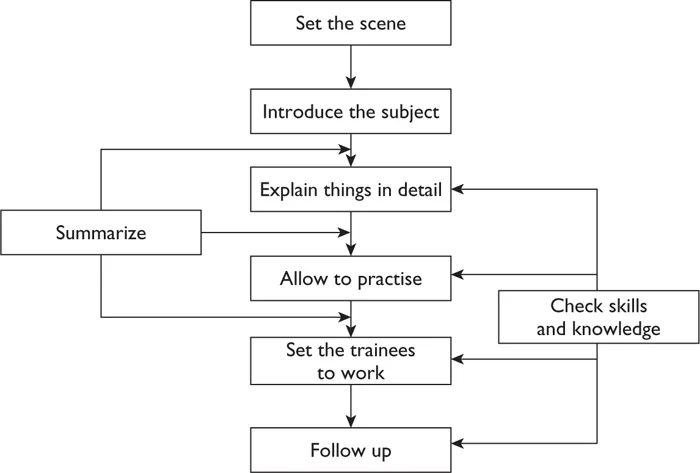
A number of components go towards making a successful training session. They are:
■ setting the scene;
■ introducing the subject;
■ explaining things in detail;
■ summarizing;
■ practising;
■ checking skills and knowledge;
■ setting the trainees to work;
■ following up.
The following diagram shows how these components relate to each other.
EXTENSION 2
Another useful publication to help you design your training strategy is Designing and Delivering Training for Groups.
4.1 Setting the scene
Before any training begins, trainees need to understand what the training is intended to achieve and where it will lead them. They will also need to establish a relationship with you as the trainer. At the beginning of a training session, people tend to be self-conscious and apprehensive. Some of the things you can do are to:
■ state the objectives clearly;
■ establish a personal, friendly relationship with the trainees;
■ ask them about their previous experience;
■ explain what they can expect to be able to do after completing the training;
■ explain how it will affect their work;
■ arouse their interest;
■ show how the newly learned skills and knowledge will be of value and benefit to them and to the organization.
Activity 10
Answer the following questions about setting the scene. You only need to write a sentence or two for each reply.
How is a personal friendly relationship between you and the trainees likely to help?
______________________________
______________________________
______________________________
______________________________
Why is it so important to make the objectives of the training clear at the outset?
______________________________
______________________________
______________________________
______________________________
Why should you go into explanations of how the new skills and knowledge will be of benefit?
______________________________
______________________________
______________________________
______________________________
■ A personal friendly relationship between you and the trainees will help them to relax and feel less nervous. It will help you to draw out the best from them as people usually give of their best in a relaxed atmosphere.
■ Making training objectives clear at the outset helps because people like to know what they are supposed to be aiming at. As with any project, in order to achieve something you have to know what you are trying to achieve.
■ By explaining the skills and knowledge to be learned, you are answering implied questions such as: ‘Why am I here?’ or ‘Is this going to be a waste of time?’ That person is then reassured and encouraged, and will feel positive about the training.
4.2 Introducing the subject
Once the overall purpose of the training has been established and the participants have got to know each other, the members of your work team need to...
Table of contents
Cover
Title
Copyright
Contents
Series preface
Unit specification
Workbook introduction
A. How people learn
B. Training
C. Coaching
Performance checks
Reflect and review
Trusted by 375,005 students
Access to over 1.5 million titles for a fair monthly price.
Study more efficiently using our study tools.
Frequently asked questions
Yes, you can cancel anytime from the Subscription tab in your account settings on the Perlego website. Your subscription will stay active until the end of your current billing period. Learn how to cancel your subscription
No, books cannot be downloaded as external files, such as PDFs, for use outside of Perlego. However, you can download books within the Perlego app for offline reading on mobile or tablet. Learn how to download books offline
Perlego offers two plans: Essential and Complete
Essential is ideal for learners and professionals who enjoy exploring a wide range of subjects. Access the Essential Library with 800,000+ trusted titles and best-sellers across business, personal growth, and the humanities. Includes unlimited reading time and Standard Read Aloud voice.
Complete: Perfect for advanced learners and researchers needing full, unrestricted access. Unlock 1.5M+ books across hundreds of subjects, including academic and specialized titles. The Complete Plan also includes advanced features like Premium Read Aloud and Research Assistant.
Both plans are available with monthly, semester, or annual billing cycles.
We are an online textbook subscription service, where you can get access to an entire online library for less than the price of a single book per month. With over 1.5 million books across 990+ topics, we’ve got you covered! Learn about our mission
Look out for the read-aloud symbol on your next book to see if you can listen to it. The read-aloud tool reads text aloud for you, highlighting the text as it is being read. You can pause it, speed it up and slow it down. Learn more about Read Aloud
Yes! You can use the Perlego app on both iOS and Android devices to read anytime, anywhere — even offline. Perfect for commutes or when you’re on the go. Please note we cannot support devices running on iOS 13 and Android 7 or earlier. Learn more about using the app
Yes, you can access Coaching and Training your Work Team by Institute of Leadership & Management in PDF and/or ePUB format, as well as other popular books in Business & Business General. We have over 1.5 million books available in our catalogue for you to explore.